0x6e2F6130B31df274283fb21744Ad18836aBCaceE## Fragments of Familiarity: Joe Pease, Filming Life
Author: Malte Rauch
Editing: Derek Edwards, Madison Page
Date: October 29, 2024
*Note: We invite readers to press “play” with the audio turned on for the video artworks embedded in this article.*
A suited man works at his desk.
He organizes his papers. Charts flicker across his screen. The desk is cluttered with documents: a coffee mug, a stack of files.
He is absorbed. Oblivious to the world around him.

The scene repeats, but his surroundings change.
He appears at his desk on the city pavement. Stranded in the desert. On a busy street. Alone in a dark room.
Each artwork is composed of looping elements — a repetition that at times is barely perceptible, and at other times dominates the image.
Hundreds of identical figures rush across a crosswalk. A sea of cubicles. A body of water.
This is “everything vs nothing” by Joe Pease — a collection of thirty 1/1/x video artworks, forever connected to a 1/1 artwork that will never be minted.

## An Endless Task
There are few texts about Joe Pease’s work in the public domain.
Almost no interviews with the artist himself.
The persona of “Joe Pease” is akin to a blank space, though nothing is deliberately obscured. Indeed, following the traces available online, one can readily identify Pease’s background in skateboard filmmaking and music videos.
The artist minted his first crypto artwork on Ethereum in May 2021. Over the next three years, Pease would methodically release 22 one-of-one video artworks.
Pease chooses to let his work speak for itself, giving away very little about the individual behind the world and his motivation to create. To the question about what inspires his work, Pease answered, laconically:
“I want to tell more stories.”
A similar approach can be found in the video Pease released to announce his residency with glitch Gallery.
This short piece, depicting his work routine interwoven with glimpses of his private life, remains notably abstract. The artist himself is absent — what we witness instead is the iterative rhythm of shooting footage, editing, shooting more, and editing again. The video’s robotic voiceover comments the scene with:
“back to work shoot more footage an endless task”.

This obsessively iterative process is only punctuated by brief interludes for repetitive daily tasks and approaching deadlines.
Despite his devoted following, collectors remain notably vague when discussing Pease’s work. Many are first struck by Pease’s technical mastery. Yet, it’s the sense of awe that overwhelms the viewer, leaving little desire for interpretation.
This is no coincidence.
There is no latent meaning that the viewer is asked to decipher. The story the videos tell are of a different nature. Pease’s work defies a conventionally linear sense of narrative storytelling, instead combining different worlds and durations within an image.
In nearly all of Pease’s videos, the viewer assumes the role of an observer, almost that of a voyeur — seeing the scene without being seen. Here is where Pease’s early influences emerge.
At times, the perspective is detached, viewed from above; in others, the camera moves fluidly with the scene and subject(s). Such a cinematic effort seems to reveal Pease’s life as a professional skateboarder – and his early, grassroots documentation of the sport.<sup>1</sup>
https://www.youtube.com/watch?v=ZMLtpMO_XSc
Loops are the key elements that hypnotically draw the viewer into Pease’s depictions of everyday life. Repetition is both the content and the form of Pease’s work. The repetitive processes of daily tasks are portrayed in endless loops. As glitch Gallery director Madison Page notes, we can compare this rhythmic content to how repetition impacts dance choreography. Not only can repetition in movement send viewers into a trance, it can equally work to create a compelling narrative inside of the score.<sup>2</sup>
https://www.youtube.com/watch?v=82pqDvbPtx4&t=30s
Certainly, there is a rigor in repetition. Yet, Pease’s repetition isn’t restrictive. Instead, it works to create an ambient, contemplative tone in and of itself.
While the depicted tasks appear monotonous — like people buried in paperwork — the form has the opposite effect on the viewer.
In scenes framed by the observer’s detached perspective, Pease composes impossible images. The view suggests an integrity of time and place, yet the individual elements interact in highly implausible ways.

Everything in Pease’s work appears perfectly ordinary, and yet entirely adrift.
These impossible images may evoke moments of genuine daydreaming in the city—standing still amidst the sensory overload as urban life unfolds, mixing memories and associations.
And the “impossible” nature of these images, their distinctly surreal quality reflects that strangeness one senses in everyday experiences, a strangeness that distances one from the world.
## everything vs nothing
Every artwork in “everything vs nothing” can be seen as a response to a set of interconnected problems. The most evident problem that the collection addresses is that of composition.
Over the past three years, Pease has only released short-length one-of-one video works. While adhering to this format, “everything vs nothing” marks the artist’s first attempt at exploring a more complex format for his work.
Thirty unique videos. All part of a single thread.
Each of the thirty videos comprising the “everything vs nothing” exhibition is an expanded fragment of the one of one work released here for the first time. This original video can itself be considered a one-of-one piece, though it will never be minted as a standalone work.
One might think of this original video as a cosmos containing a multitude of worlds, which unfold through the thirty video artworks. In this way, the viewer comes to understand each scene in the original video as a glimpse into the artist’s world, or conversely, each of the thirty video artworks as part of a larger narrative universe. This seems to hint at the artist’s own way of seeing — his endless iteration of the work, where each element can be continually adjusted, as it holds its own world and story.

All of the footage in “everything vs nothing” is shot by the artist himself. Yet the highly saturated colors give the impression of readymade or even found archival material. The hyper-saturation, combined with Pease’s editing techniques, estranges the imagery, rendering the depicted places and faces almost unrecognizable. This can be seen as a kind of “bracketing” of the world in Pease’s work. The filmed world appears washed out, nearly blank, as if the artist is capturing not a specific place or person, but anyplace and anybody, nobody and nowhere.

Such is the film’s “main character” — without a story or face. Someone or no one, telling anyone’s story. What we see is what he does: repetitive work. Both literally and figuratively, this man at the desk is at the center of “everything vs nothing,” providing cohesion to the different tableaus — as if he were traveling through each of the thirty pieces.

Whether on the street or in nature, the man remains unseen with his back to the viewer. He is as isolated on the street as he is in the desert. Unacknowledged, even as people walk right next to him.
Each element is, of course, filmed separately and placed within the scene through editing — a fact that eludes our immediate perception, but our mind insists this must be true.
The pronounced remoteness of the main character could be read as a commentary on the atomized nature of modern urban life and the repetitive cycles of contemporary work, a theme that has often been explored in the history of film and video art.<sup>3</sup>
https://www.youtube.com/watch?v=ZMLtpMO_XSc
And while there is a sense of existential isolation that pervades “everything vs nothing,” Pease’s work seems to be more concerned with showing the world than commenting on it. Here, the image is not a representation of the world, but a depiction of the relationships between its elements. Each element reveals that beyond the linear progression of time, the world contains a multitude of stories and temporalities. Like a daydreamer distancing himself from his own perspective, contemplating the world as a dream-image, Pease’s films make this coexistence visible and perceptible.
The title, “everything vs nothing,” resists direct interpretation.
Yet one might come to see it as suggesting different ways of viewing the world — either as full of meaning or as defined by emptiness, loss, or lack of purpose. Pease tells the stories of how we perceive the world, and how these perspectives interact — or fail to interact — with one another.
In describing art, the adjective “unique” is used so frequently that it has lost much of its meaning. While Pease’s work is genuinely unique, it might be more appropriately described as “untimely”. The work is untimely in as much as it does not coexist with others quite like it. Its roots lie in commercial videos, yet it carries a very different artistic ambition.
Its “surreal” qualities might superficially resemble AI-generated images, but are the result of highly accomplished editing, not prompting.

The work shares neither genre nor style with other works.
And so, in its untimeliness, Pease’s work appears eminently contemporary.
*To view the entire collection, please visit the everything vs nothing auction page: https://www.everythingvsnothing.com/auction*
*The glitch curation team wishes to thank all who attended our exhibition of “everything vs nothing” at Art Blocks Weekend in Marfa in November 2024, Joe Pease for creating this beautiful collection with us, and those who continue to support our efforts across the internet.*

<br>
+
–
1. Spike Jonze (Director). (1989). Rubbish Heap [Film]. World Industries. Retrieved November 26, 2024.
2. Thierry De Mey (Director). (1997). Rosas danst Rosas [Film trailer]. Based on the 1983 dance performance by Anne Teresa De Keersmaeker. Retrieved November 26, 2024, from https://www.youtube.com/watch?v=82pqDvbPtx4&t=39s.
3. Chantal Akerman (Director). (1976). Jeanne Dielman, 23 quai du Commerce, 1080 Bruxelles [Film trailer, in French]. Starring Delphine Seyrig. Retrieved November 26, 2024, from https://www.youtube.com/watch?v=BdydEl07eGc.
0x6e2F6130B31df274283fb21744Ad18836aBCaceE## Lethal Aesthetics: The Poetics of nameless dread
Author: Malte Rauch
Editing: Derek Edwards, Madison Page
Date: May 1, 2024
The defining cultural experience of the post-Covid work environment is seeing one’s own reflection on a computer screen. In these now familiar moments, we remain in solitude (together), glued collectively to our screens, faces boxed across a sterile interface.

In nameless dread artist diewiththemostlikes (“DWTML”) explores this primal scene of 21st century internet culture. While his generative collection’s outputs are clearly unique portraits, the concept of still life, or nature morte (literally, “dead nature”), might best describe the work.
Put simply, the collection is an autopsy of our contemporary life, drained of vitality and meaning.
For each procedurally generated output, the artist hand-drew a portrait “employee” in a digital watercolor style (relying on analog drafts). The use of soft brushstrokes and harmonious pastel colors, a departure from the artist’s usual, more comic-like style, contrasts sharply with the figures’ formlessness, while the fine, harsh black lines that define the facial features imbue the portraits with their grotesque characteristics.
These portraits are framed by a drawn Zoom interface, set against animated backgrounds with generative elements, in varying color palettes. Formally, the backgrounds range with traits like squiggle-like compositions and swirls of flies, and colors span from black to dark red to light pastels, to the “meat” tones favored by the artist in other works. The outlines of unsightly, distorted faces flicker on some of these backgrounds, gazing at the person at the center.
Together, the application of hand-drawn and procedurally generated features sustains the tension between surprisingly harmonious elements and the dread of the subject matter, mirrored in the faces of the portrayed figures.

The 669 hand-drawn employee portraits embody the nameless dread evoked by the title—a kind of digital spleen, which the collection seems to diagnose as the prevailing mood in a terminally online work culture.
Spleen, a concept coined by French poet Charles Baudelaire, depicts a profound sense of dissatisfaction, melancholy, and nihilistic boredom Baudelaire saw emerging as the defining mood of modernity. It’s no coincidence that the English translation uses the same concept that DWTML chose for the title of his collection.
“Hereafter, mortal clay, you are no more than a rock encircled by a nameless dread”<sup>1</sup>
The existential exploration of DWTML’s work stands in this lineage of artists deciphering the mood of contemporary life.

The mood of the work is unmistakably marked by mortality.
Death is both metaphorically and literally at the center of this collection. Everything in DWTML’s internet world bears the mark of transience: the characters are either dead, decaying, or so morbidly afflicted that death appears to assert its victory over life. And, death is used as a representation of the cycle of screen-focused work and consumption characteristic of contemporary life.
The morbidity symbolizes a life that is not quite living, or, perhaps, a life that is more about dying than living. Such a metaphor could also be applied to DWTML’s obsession with meat - what was alive, is now not only dead, but food for the next “mortal clay”.
And on and on it goes.
Generative randomness expands DWTML’s digital drawing style into a new format in nameless dread and, conversely, opens up the medium of long-form generative art to new creative trajectories beyond abstract compositions; it exposes the form to dissonance.

Although DWTML previously incorporated randomness using JavaScript to combine pictorial elements in previous collections, nameless dread is his first work to leverage a generative algorithm in the technical sense to tap into emergent compositions.
In what one may read as an artistic reenactment of the monotony of digital suffering that the project thematizes, each of the 669 outputs is a hand-drawn 1-of-1 work by the artist, which is nested within a generative composition. As such, the work maintains the artist’s signature aesthetic while breaking new ground, yielding a long-form collection that is at once strangely beautiful, characteristically repulsive and a combination of code-based automation and manual, even monotone artistic labor.

Similar to the themes explored in his visual works, DWTML’s remarkably poetic writings also dwell obsessively on the inevitable decay of all things. Any search for meaning, the artist’s texts declare, is condemned as futile and vain in light of the unstoppable digital and physical entropy.
In nameless dread, DWTML’s haunting prose is autonomously generated in the Zoom chat box – an endless stream of words lamenting an insufferable condition created with a custom font based on DWTML’s handwriting.
A typical output might read: “I got used to death. Sometimes I even looked forward to it. But still I didn’t fancy creating digital waste.”
Strangely, though, the intensely sinister subject matter of these works never feels suffocating or depressive. On the contrary, there is a deep sense of humor the viewer encounters at the center of these works.
## Lethal Aesthetics
The humor in DWTML’s work might stem from the audience recognizing themselves in these subjects staring back at them.
Every viewer senses obscurely that the work holds up a mirror — exaggerated but accurate. nameless dread not only thematizes the Zoom interface as a mirror of the self, but also serves as a mirror itself.
What do we see in this Zoom mirror?
The obsessive reference to death and affliction is often reminiscent of a classic evocation of memento mori, reminding the audience of their mortality and the futility of earthly pursuits. The memento mori theme traditionally allows for both religious readings, anticipating the afterlife, and worldly ones: seizing the moment, as life is singular and fragile.
On the face of it, DWTML’s work engages with these questions, imbuing his momento mori with shocking humor.

There is yet another layer to DWTML’s work, connected to how it addresses the obscene and the horrific.
nameless dread, like his other works, plays with horror without shocking the viewer with outright disgust. Although the artist confronts his audience with the limits of representation — depicting decomposing bodies, and in other works, excrement, madness, and nudity—his “soft” drawing style mitigates the shock these objects might usually trigger.

On an abstract level, DWTML’s works confront the viewer with elements that culture has repressed and excluded, yet he does so in a manner that remains approachable and viewable.
Art historians of the 20th century adopted a technical term from psychoanalysis to describe works that engage with these themes: “desublimation.”<sup>2</sup> While art is typically regarded as an elevation, a means of lifting something into a realm “higher,” more beautiful, and more “pure” than ordinary life, works engaging with desublimation invert this notion.
They debase what they portray and confront the viewer with elements typically excluded from everyday life and the realm of culture: excrements, vomit, corpses, et cetera.
While shocking to some, the bulk of DWTML’s “terminally online” audience came of age in the time of adult cartoons employing desublimation in commercial content. Television shows like The Simpsons, Beevis and Butthead, and King of the Hill (shows that also share aesthetic parallels to DWTML’s oeuvre) similarly challenge what should or shouldn’t be consumed in civilized society by pushing the boundaries on “potty humor”. If you were a kid in the 90’s and allowed to watch these shows, DWTML renders a nostalgia for animated impropriety.

In the “high” art context, consider artists and writers like Georges Bataille, Piero Manzoni, Andres Serrano, Mike Kelly, Robert Gober, among many others, who also explored an (an)aesthetic of desublimation.
One of the most infamous of these works is Manzoni’s Merda d’artista, an edition of 90 signed and numbered 30-gram cans of excrement— “freshly preserved, produced and tinned,” as stated on the label.
These works were priced per gram using the current price of gold, equating the artist’s excrement with gold (the works would wildly outperform gold in the following decades). However, Manzoni’s work is not merely a commentary on value (a theme that often appears in DWTML’s work as well). As John Miller noted, it also demonstrates “that which literally comes from the artist’s interior turns out not to be revelatory, but repellent.”<sup>3</sup>

The same could be said of DWTML’s work. In interviews and social media, the artist often describes his creative output in scatological terms: as an uncontrollable outpouring of what is inside of himself. And what emerges as his work is undeniably repulsive and not a revelation of something higher. It is, rather, an unfiltered snapshot of our contemporary condition.
Similarly, nameless dread holds up a mirror, presenting the viewer with an image that conflicts with the natural order of the world. It brings out a repressed dread and meaninglessness in our lives – and as such, it thematically stands in stark contrast to the compulsory positivity that often defines the crypto art scene.
In this way, nameless dread is a profound engagement with everyday life on the internet, while simultaneously disrupting it.
During the inaugural “30 Days in Marfa” residency by glitch Gallery, DWTML provided his viewership with an intimate look at his creative process, transforming the entire residency into a self-ironized performance. The audience’s reactions to the material shared on X.com demonstrates the mimetic potential of nameless dread, as they responded in the work’s idiom and style, portraying themselves as doomed to follow the fate of earthly things.

Despite its ironic undercurrent, DWTML’s work ultimately poses a profound question to the audience: how do we confront the revelation that our lives are defined by a nameless dread? Is resignation and indifference towards inevitable entropy the appropriate response?
DWTML’s work refrains from providing a concrete answer. However, the artist’s mimetic humor hints at something beyond resignation and apathy. Could humor and violent laughter be our last resort when faced with the truth about our contemporary condition?
At last, DWTML’s nameless dread seems to find redemption in the joy of creation, violent laughter, and – in the end – good meat. +
—
1. Charles Baudelaire, Les Fleurs du Mal, Spleen (J’ai plus de souvenirs), in the translation of Richard Howard. In the French original, Baudealire speaks of “vague épouvante.”
2. See, for instance, Rosalind Krauss and Yve-Alain Bois, Formless: A User’s Guide (New York: Zone Book, 1997).
3. John Miller, “Excremental value,” in https://www.tate.org.uk/tate-etc/issue-10-summer-2007/excremental-value
0x6e2F···aceE## Artist: Vera Molnár x Martin Grasser
## Object: Themes and Variations #495, #445, #99
## Collector: SEEDPHRASE
## Machine Imaginaire (Themes and Variations)
Author: Malte Rauch
Editing: Malte Rauch, Derek Edwards, Madison Page
Date: April 1, 2024
In 2023, Hungarian-born Vera Molnár collaborated with Martin Grasser to release “Themes and Variations” – a timely celebration of belated recognition. It would be Molnár’s first foray into blockchain-based generative art.
Molnár’s journey began in the 1950’s, when she began working with generative processes and rule-based systems. Over the next eight decades, Molnár would find recognition in the art world. Yet, it was the resurgence of interest in generative art sparked by the 2021 enthusiasm of unique digital objects that led to a broader recognition of her achievements. Coincidentally or not, in 2022, the 98-year-old Molnár was invited to the 59th International Art Exhibition La Biennale di Venezia.
To date, the storytelling and cultural commentary of glitch Gallery mostly focused on writing a history of crypto art in the present. To conclude the twelve months of “Every 30 Days” series – a fragmentary history of crypto art in the present, without any pretense of completion or canonicity – today we pay homage to the history and aesthetics of a most remarkable pioneer of digital art.
## The Dawn of Computer Art
After arriving in Paris in 1947 with her partner, Molnár met pre-war avant-garde artists and pioneers of early abstract art, including Kazimir Malevich, Wassily Kandinsky and László Moholy-Nagy. Around 1960, she co-founded the Groupe de Recherche d’Art Visuel (GRAV), which notably included François Morellet, a key figure in the development of conceptual and abstract art after 1945.
In her early compositions, Molnár extended the trajectory of early 20th-century abstraction through the medium of automation – first analog, then digital. This extension is evident in her focus on the grid, the cornerstone of painterly abstraction, as well as her tributes to the pioneers of abstract art in her pre-digital works.
Nevertheless, early on Molnár challenged the “pure” language of abstraction by altering and dispersing the grid. The pivotal method for opening up the trajectory of abstraction to a new direction was the utilization of code-based randomness—arguably the successor to the notion of painterly abstraction as a process of reduction.
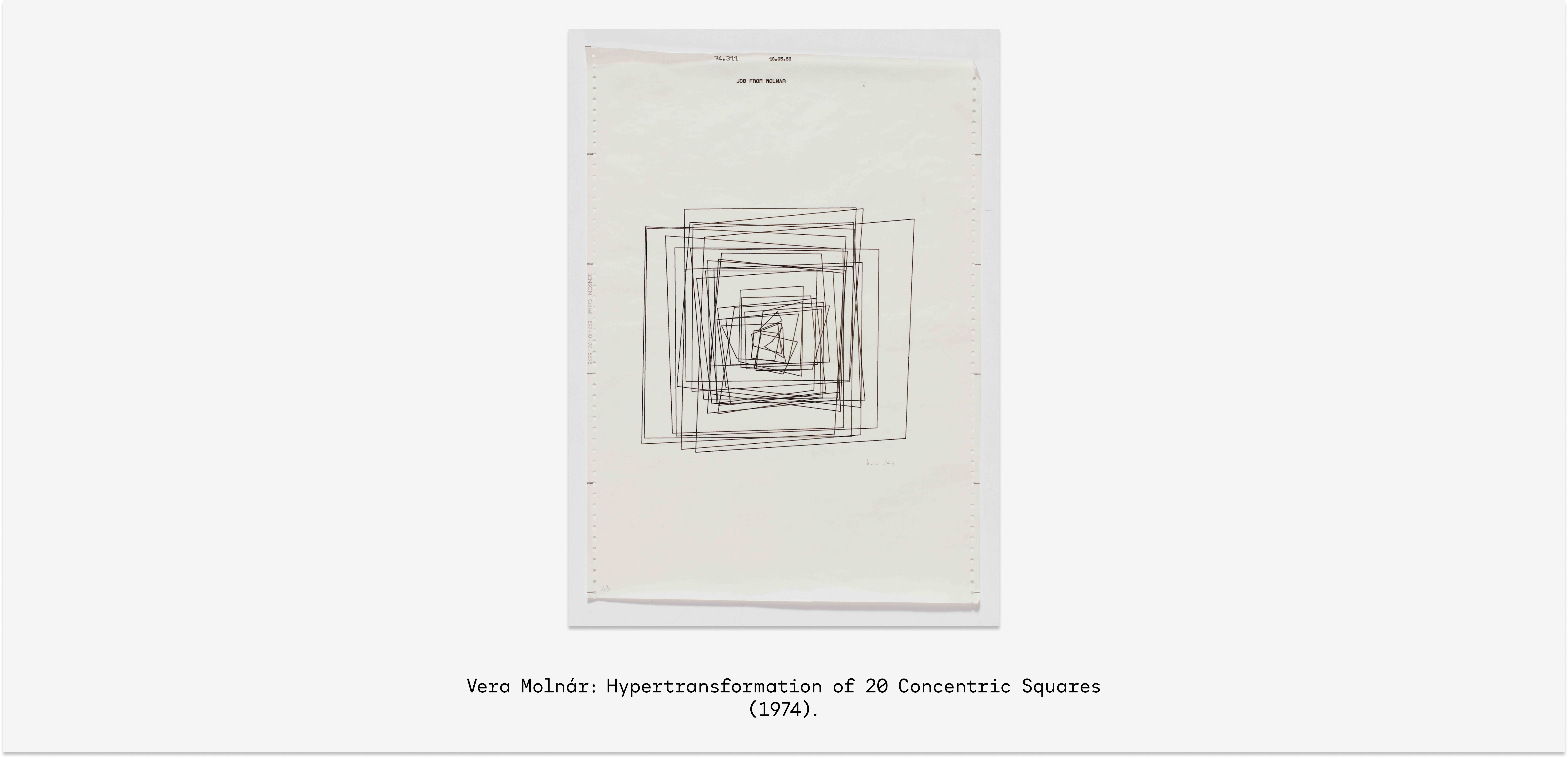
In 1968, Molnár first gained access to a computer at Sorbonne University.
However, her earliest experiments had to rely on a trial-and-error approach since the computer did not allow for adjustments in real time. As Grant D. Taylor describes, the technical capacities were strictly limited: “Instructions were punched into cards that were fed into the mainframe, and output instructions were sent to the plotter.” <sup>1</sup>
Around 1974, Molnár started working with a display that allowed her to adjust parameters and variables during the process.
Molnár typically starts with basic geometric shapes and then alters, deforms and deconstructs them using an algorithm that injects random patterns. Despite the inherently deterministic nature of code, which confines randomness to a pseudo-random number generation, the complexity of Molnar’s algorithms enabled the generation of unimagined forms.
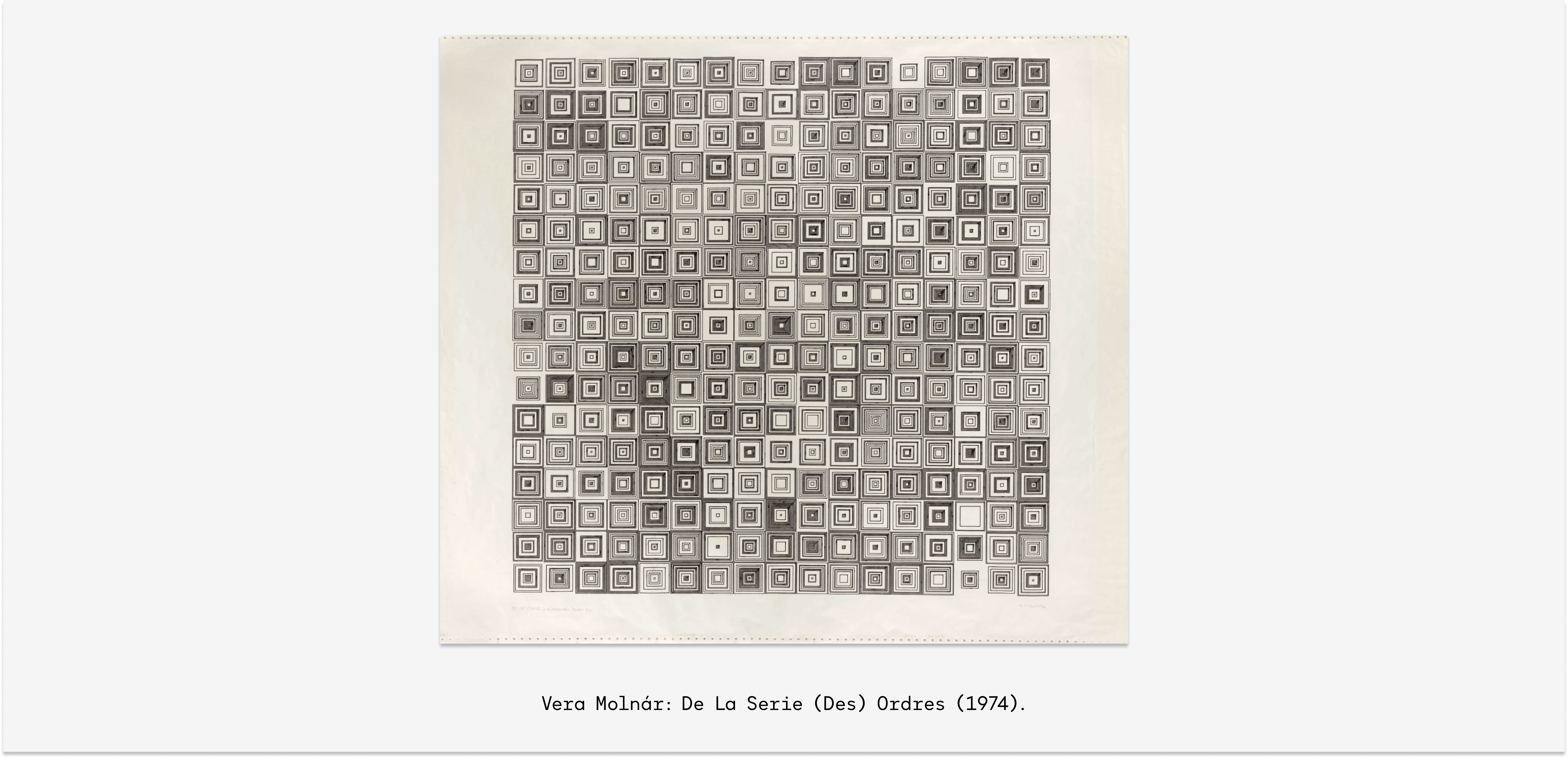
Seriality is a natural complement to automation. Presenting these alterations in a series allowed Molnár to explore “what kind of formal modification challenges the change in the perception of my picture.” <sup>2</sup> Moreover, the series underscored the systematic aspect of her work, demonstrating that the artwork-as-system unfolds not through an isolated form but through variations and permutations across various themes.
The logic of the series brings to light the hidden potential of repetition – not the repetition of the identical, but the repetition of difference; that is, the emergence of the unpredictable from variations of the same.
## The Intuition Machine
In an intriguing, untitled text from 1975, Molnár detailed her initial approach to generative art, discussing the perceived contradiction between intuition and cognition—a dichotomy present in numerous aesthetic concepts (ranging from content and form to the Apollonian and Dionysian). According to Molnár: “Art at its inception is essentially intuitive, it is in its elaboration that intuition needs control and aid by cognition.” <sup>3</sup>
For Molnár, the creative process began with an intuition, an element elusive to cognitive explanation. However, she contends that the comprehensive exploration and development of this initial intuition depend on cognition, which automation and systematization can augment.
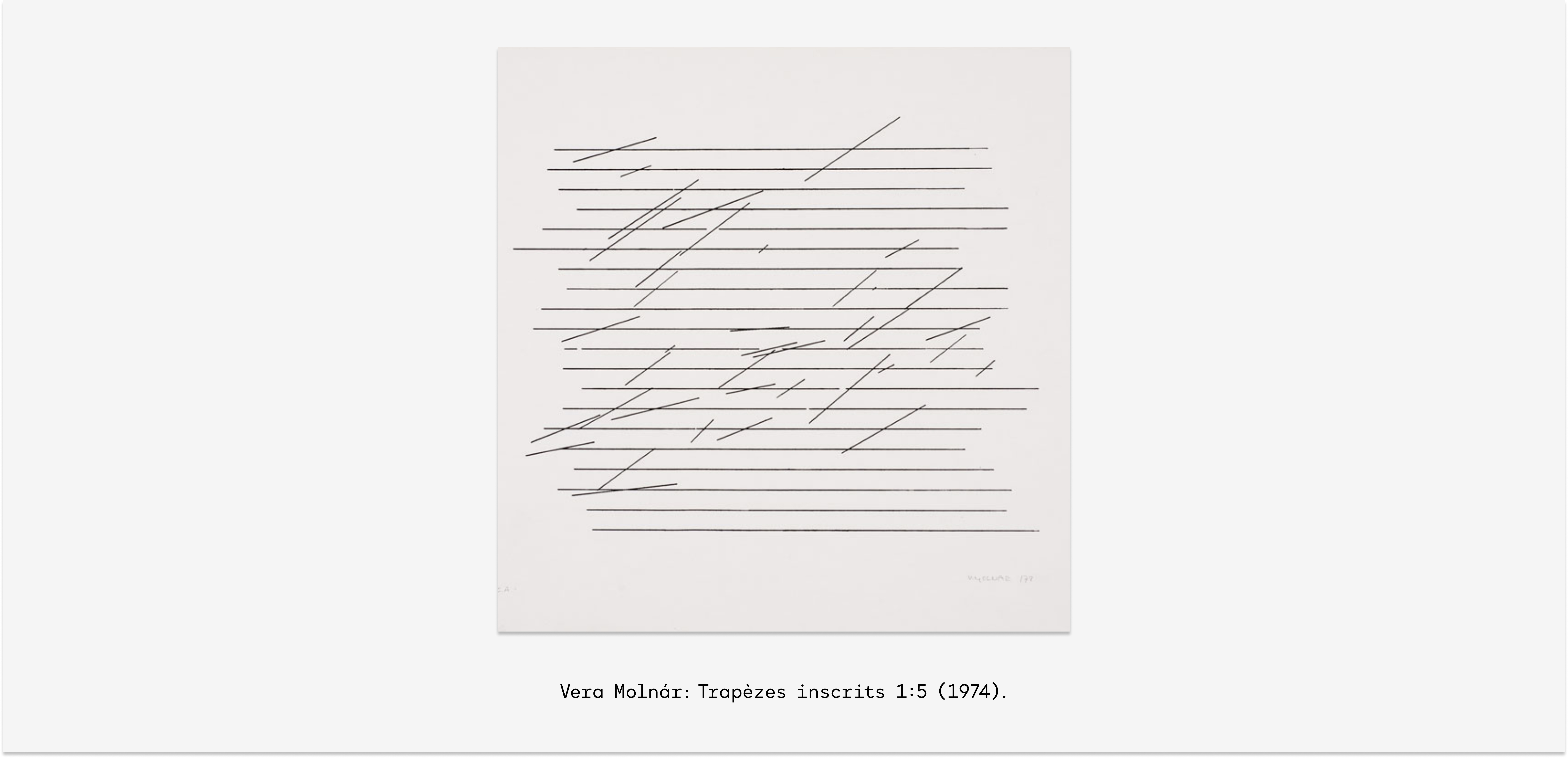
Thus, in Molnár’s view, intuition and automation are not at odds; rather, they complement each other. This perspective mirrors Molnár’s characterization of her work as a “machine imaginaire.” Although her algorithms’ outcomes are theoretically predictable, their complexity renders it impossible to fully envisage or visualize the potential outputs, effectively transforming the machine into an extension of the human imagination. The essence of Molnár’s “machine imaginaire” lies in its ability to reveal aspects latent in the artist’s initial intuition but beyond their own imagination.
The notion of the “machine imaginaire” leads Molnár’s to view the computer as a means to an end rather than the focus of her art: “I don’t care about computers, but the computer is like a slave in making my dreams a reality.” <sup>4</sup> In fact, Molnár emphasized that her employment of computers is “only a systematization of the traditional-classic approach” to composition rather than its replacement. <sup>5</sup>
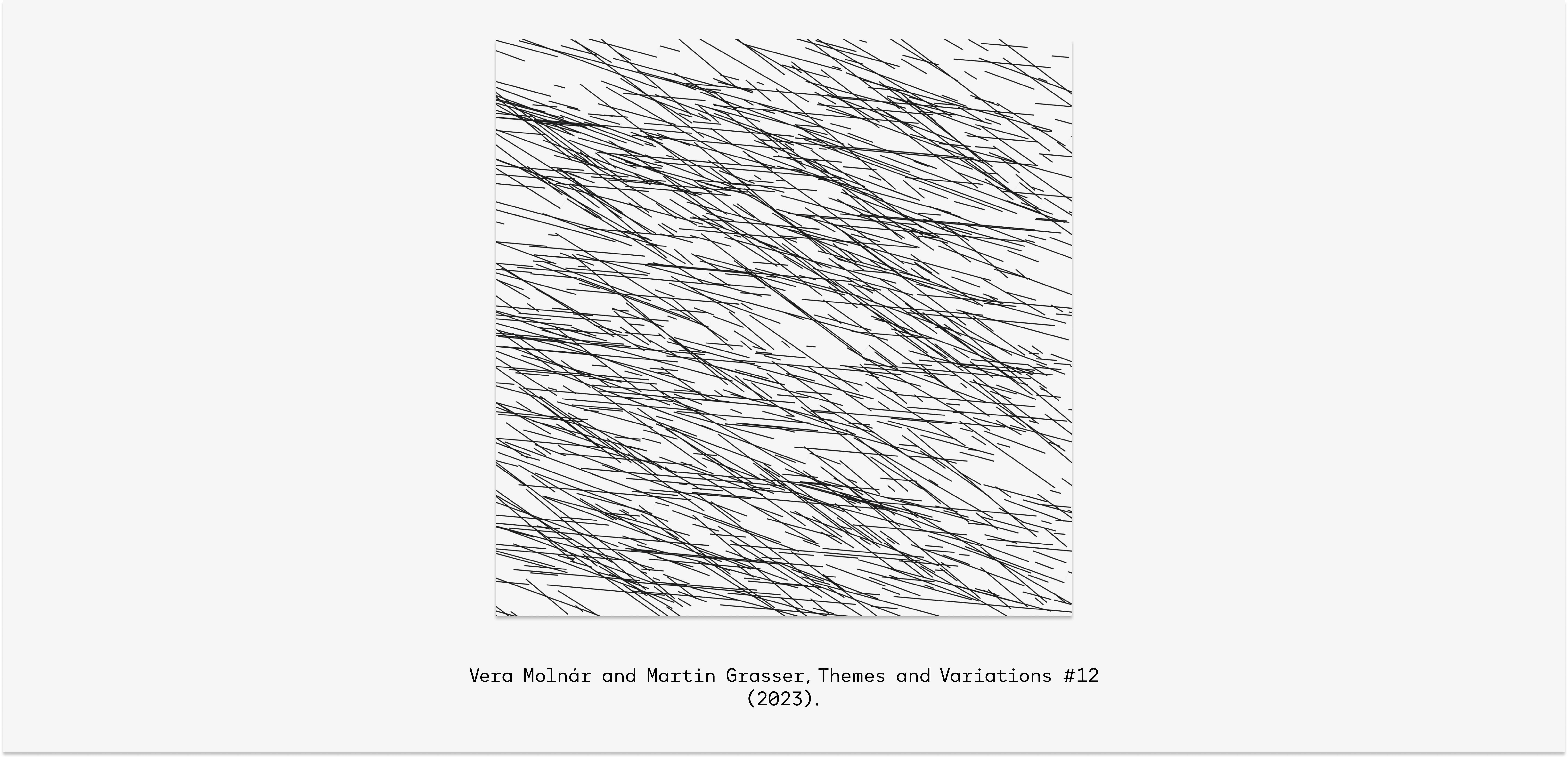
Yet, in the early days of the computer era, Molnár’s use of the device in her art encountered skepticism. The rise of abstraction in early 20th-century art had already sparked debates about “dehumanization” among cultural conservatives, and similar doubts shadowed Molnár’s initial forays into computer art. While abstraction moved art away from depending on the external world for meaning, employing computers to create abstract compositions decentred the artist’s subjectivity as the sole source of meaning. Now, artists and computers entered into a dialogue that reconfigured the dynamics of the creative process.
## Variations on a Theme
The eight decades of Molnár’s art production demonstrate remarkable loyalty to the broadly minimalist aesthetic of early generative art, coupled with a relentless interest in experimentation. One such experiment concerns Molnár’s interest in letterforms. The use of the letters “M” and “N” appears in Molnár’s work as an alternative to the elementary geometric shapes common to the visual language of painterly abstraction.
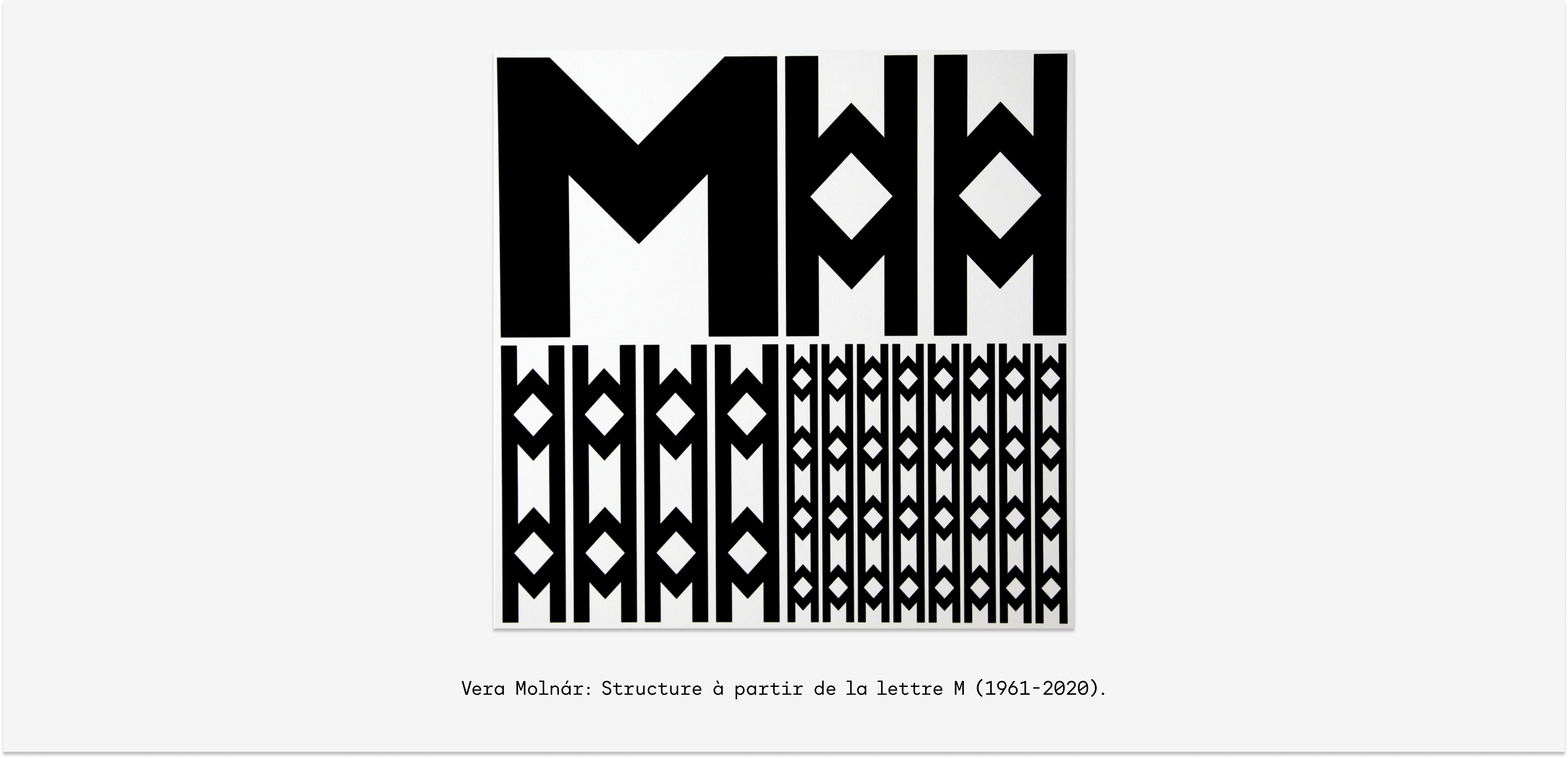
Generally, letters played no crucial role in the development of abstraction in painting (Jasper Johns’s work is a rare exception). As the most elementary components of the signifier, letters are themselves devoid of meaning; to mean something, letters generally need to be combined with other letters to form a signifying unit (with the obvious example of single letter words). However, letters are immediately recognizable as having semantic value and, as such, they lack the purity of abstract forms, such as the square. Otherwise put, letters occupy the indeterminate space between an abstract form and a signifier – immediately recognizable as a grapheme yet too abstract to possess concrete meaning.
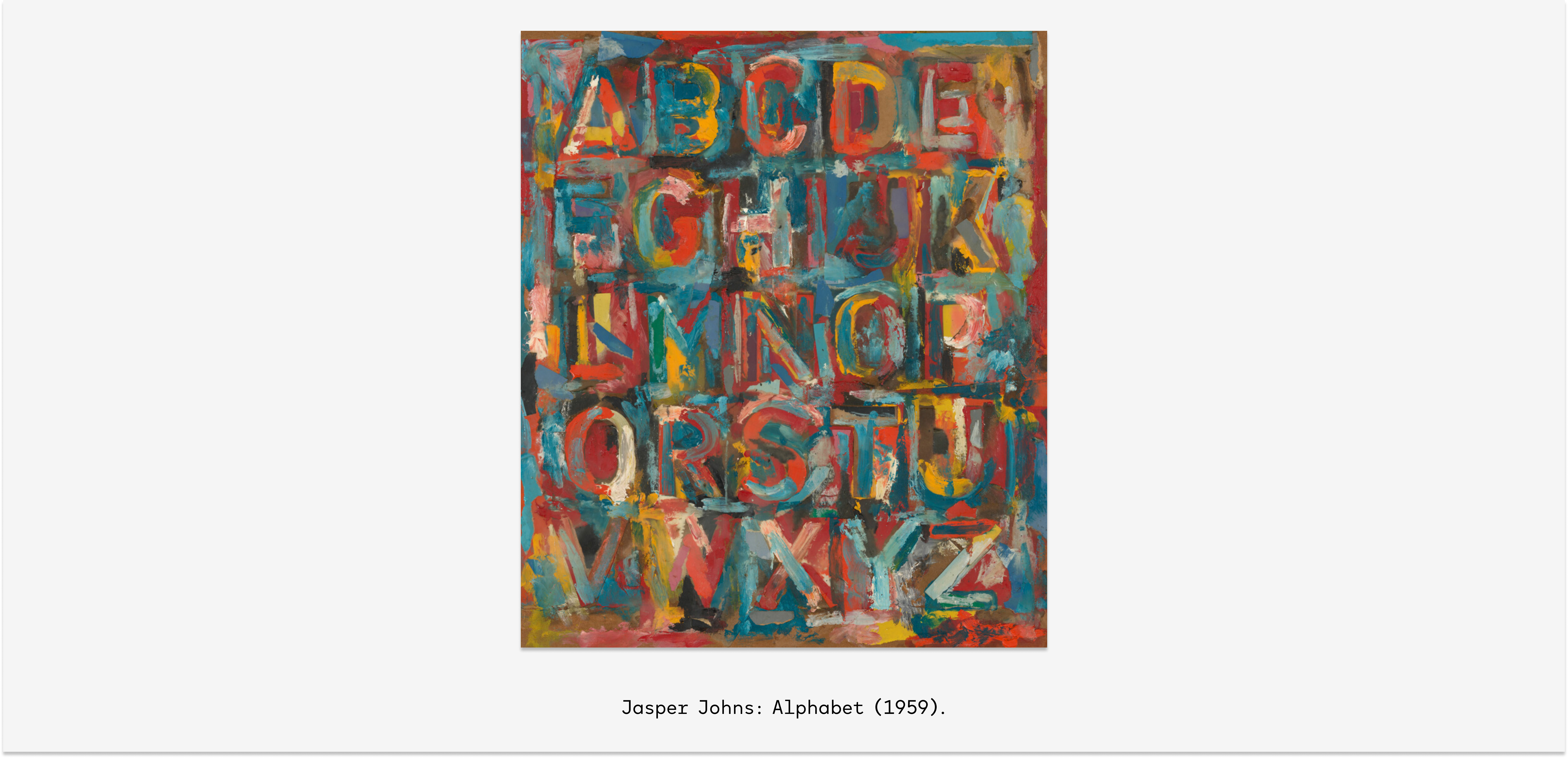
This may explain their lack of appeal to the majority of abstract painters, who tried to find a self-sufficient visual language. For Molnár, however, one might speculate that the letterform was a less overdetermined form than the basic geometric shapes originating in painterly abstraction.
She hints at this perspective in an interview, where she explains the similarity and differences between the form of the letters “M” and “N” and the square: “The letter ‘M’ is a wonderful thing because it’s a square, only it has a direction, it is vectorised in some way. From the moment that it’s no longer a square but a letter ‘M’, there are already four positions and that really enriches the situation. So, putting two and two together, so to speak, from the letter ‘M’, I went on to the letter ‘N’, which can also fit inside a square, or not.” <sup>6</sup>
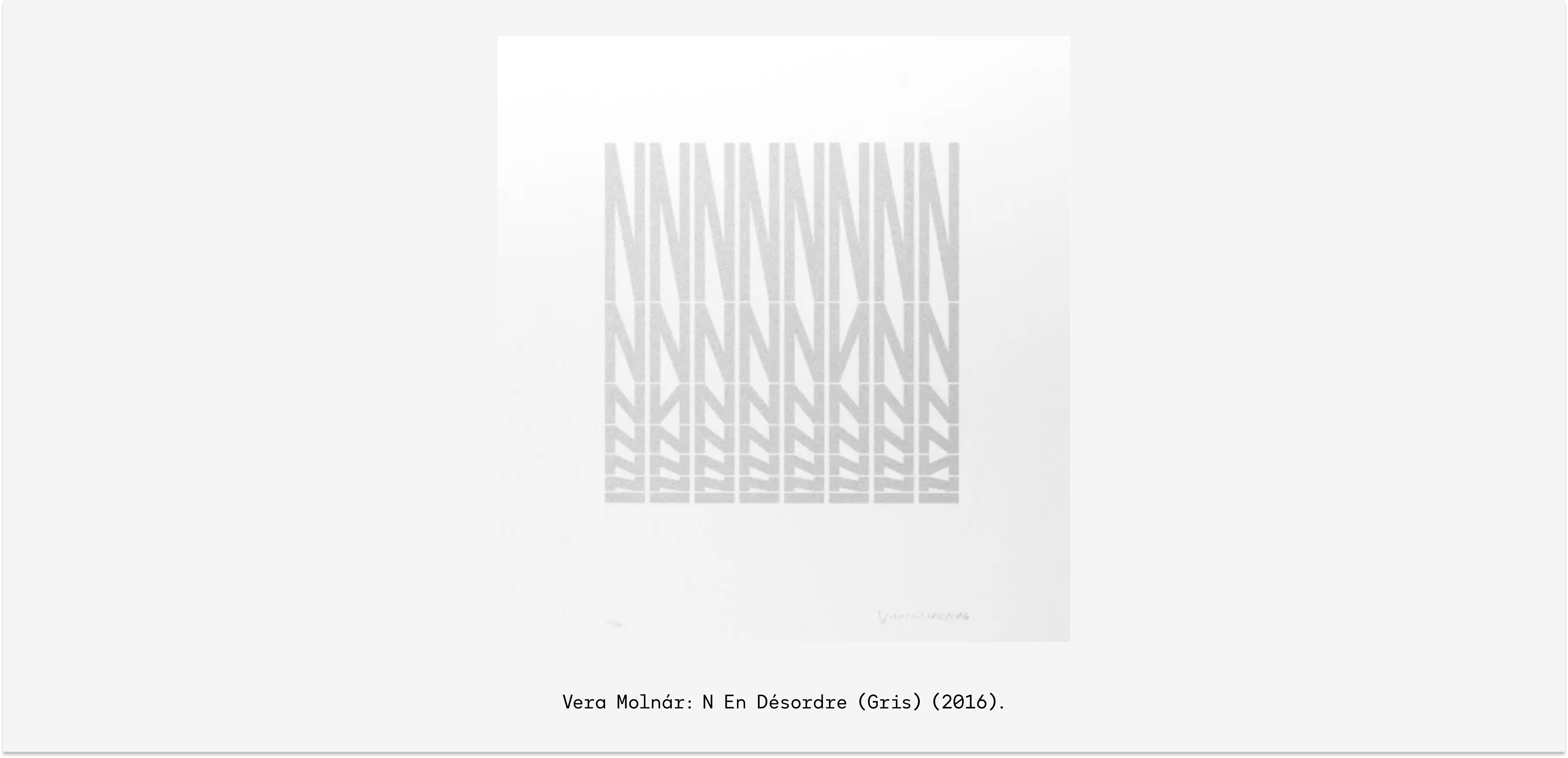
When examining Molnár’s work exploring the letterform, it becomes apparent that her procedure resembles the injection of random, dissonant patterns onto the grid. In works like the aptly titled “N En Désordre (Gris)” [N in Disorder (Grey)], the artist presents variations on the basic form of the letter N.
The compression and extension of the letter are pushed to an extreme where the form loses its semantic content and becomes a pure bar. All 56 variations of the letter are arranged in lines of similar lengths, transforming the entire image into a square that oscillates—as a form of semiotic play— between pure abstract forms and grapheme.
Thus, Molnár’s 2023 “Themes and Variations,” created in collaboration with Martin Grasser, builds upon and extends these earlier letter-based works. The series, released through Sotheby’s and minted on the Ethereum blockchain, began with simple sketches, presenting the letters N, F, and T within squares of equal sizes. Clearly, the selection of these letters references the acronym for non-fungible tokens, which were standardized through the ERC-721 format and facilitated the first wave of mainstream adoption of digital objects in 2021.
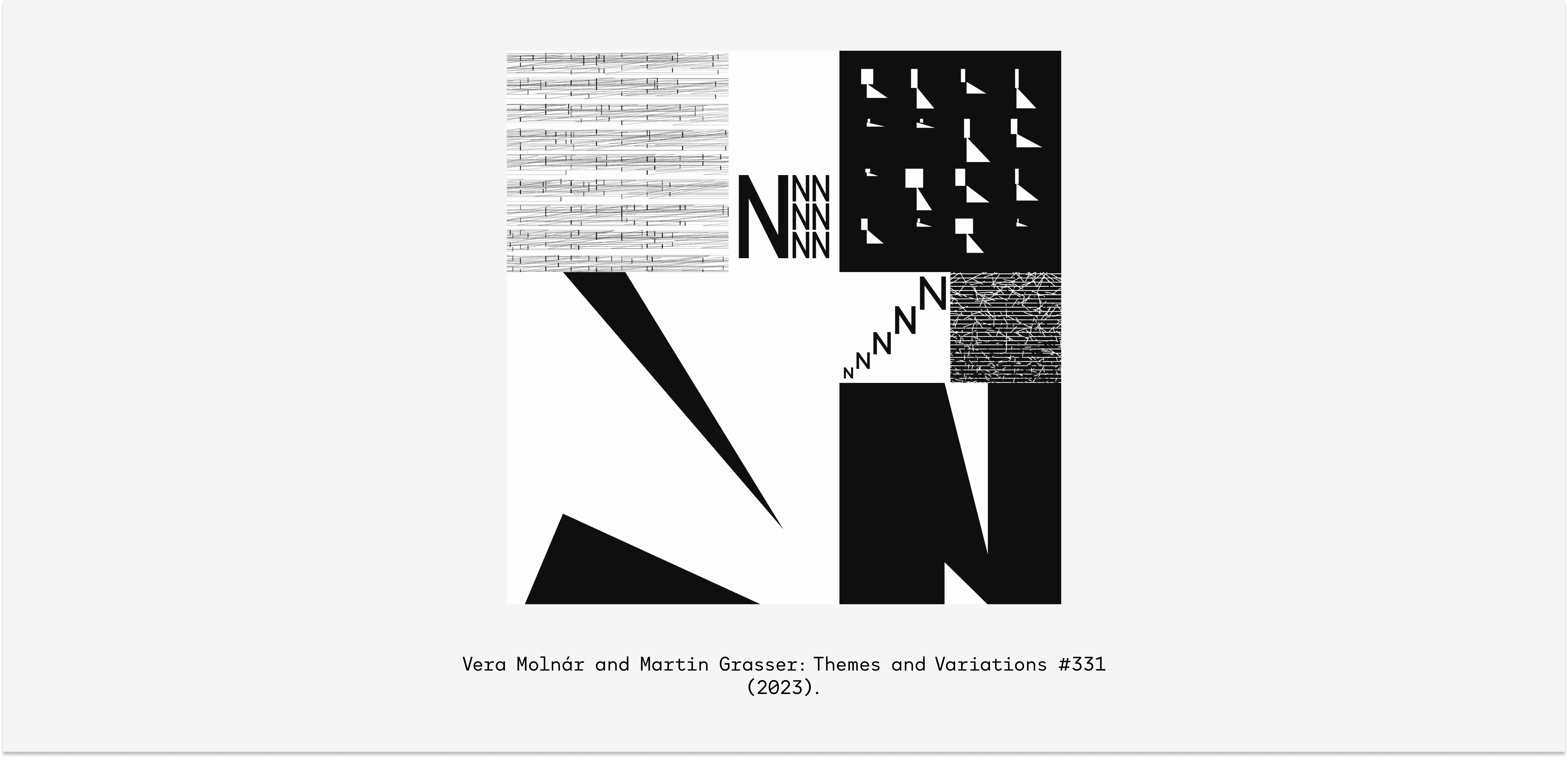
Molnár’s initial sketches evolved into black-and-white artworks, where the familiar forms of letters morphed into abstract compositions. The analog works were then incorporated into an algorithm that parameterized Molnár’s initial design decisions. When asked about their collaboration and the choice for the letterform design, Grasser notes:
“I can’t exactly speak for Vera but I believe she worked with letters because they are abstract shapes that are also familiar. There is a nice tension there, when you start with a capital ‘C’ as almost a circle as opposed to a shape that bears the responsibility of carrying the sound associated with ‘C’ either by itself or strung together with other letters to form a word.
The abstractions having meaning, in particular, N, F, T are important especially in that order. I think for Vera, it struck her that she was making this work for close to eight decades, and these three letters had somehow magically appeared next to her body of work. For me, I cannot quite explain it - but I have the same fascination and love for letters, typography, words, sentences and paragraphs of text. In one instance they are pure form, and shape, but as a group, we have imbued these shapes with meaning. Sometimes we can separate these two things; form and content, plot and story, etc… and then it becomes interesting to re-see or to see the shapes in a new way.” <sup>7</sup>
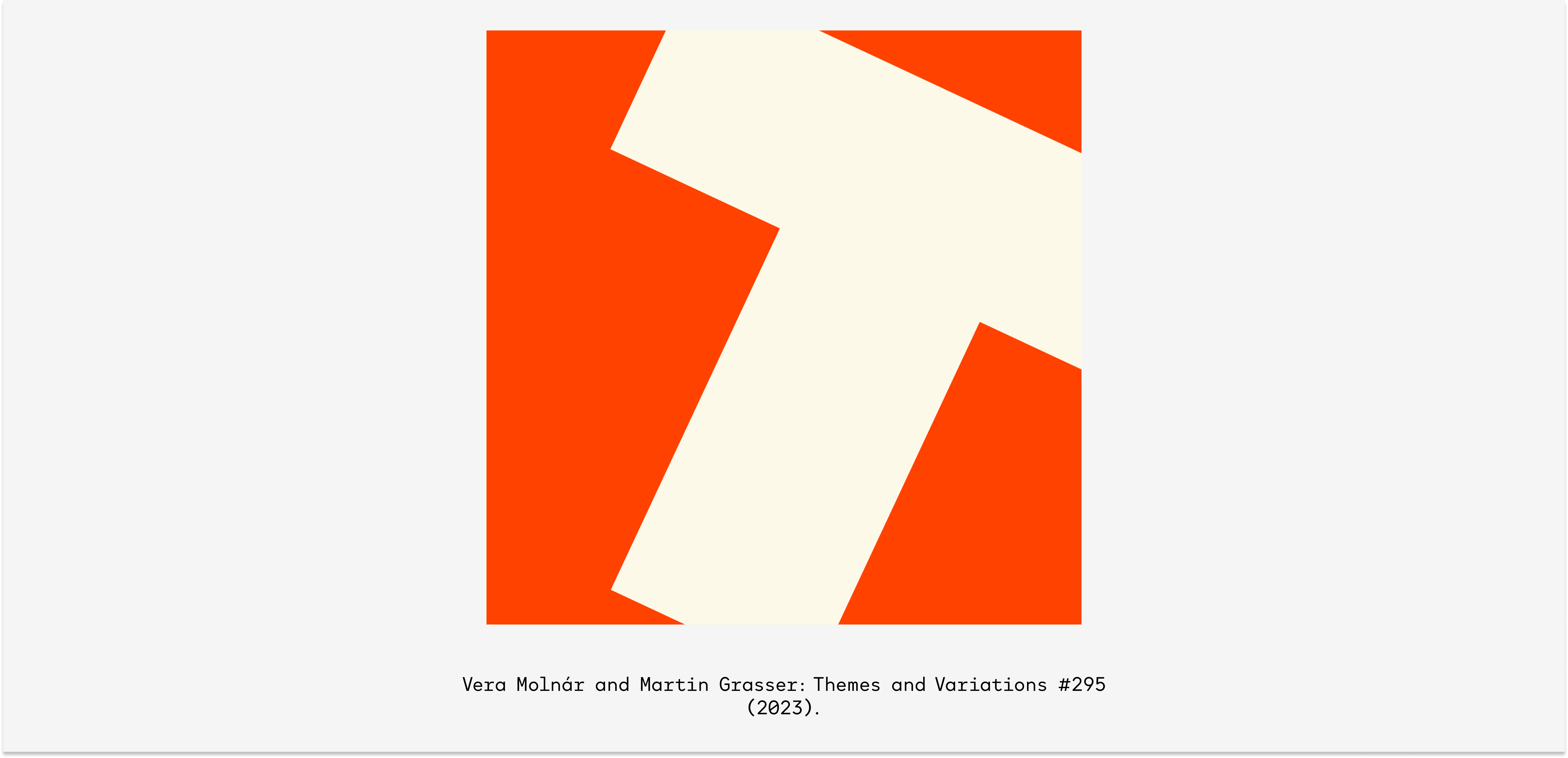
Through their collaboration, Grasser and Molnár showcase 500 variations on these three letter forms. If works such as “N En Désordre (Gris)” illustrated the transition from grapheme to abstract form, “Themes and Variations” reveal a comparable interest, yet the extensive algorithm permits a wider range of formal variation. The output space includes everything from a single, prominent letter occupying the square to neatly or disorderly arranged small letters, and to entirely random forms that have discarded all resemblance to the grapheme.
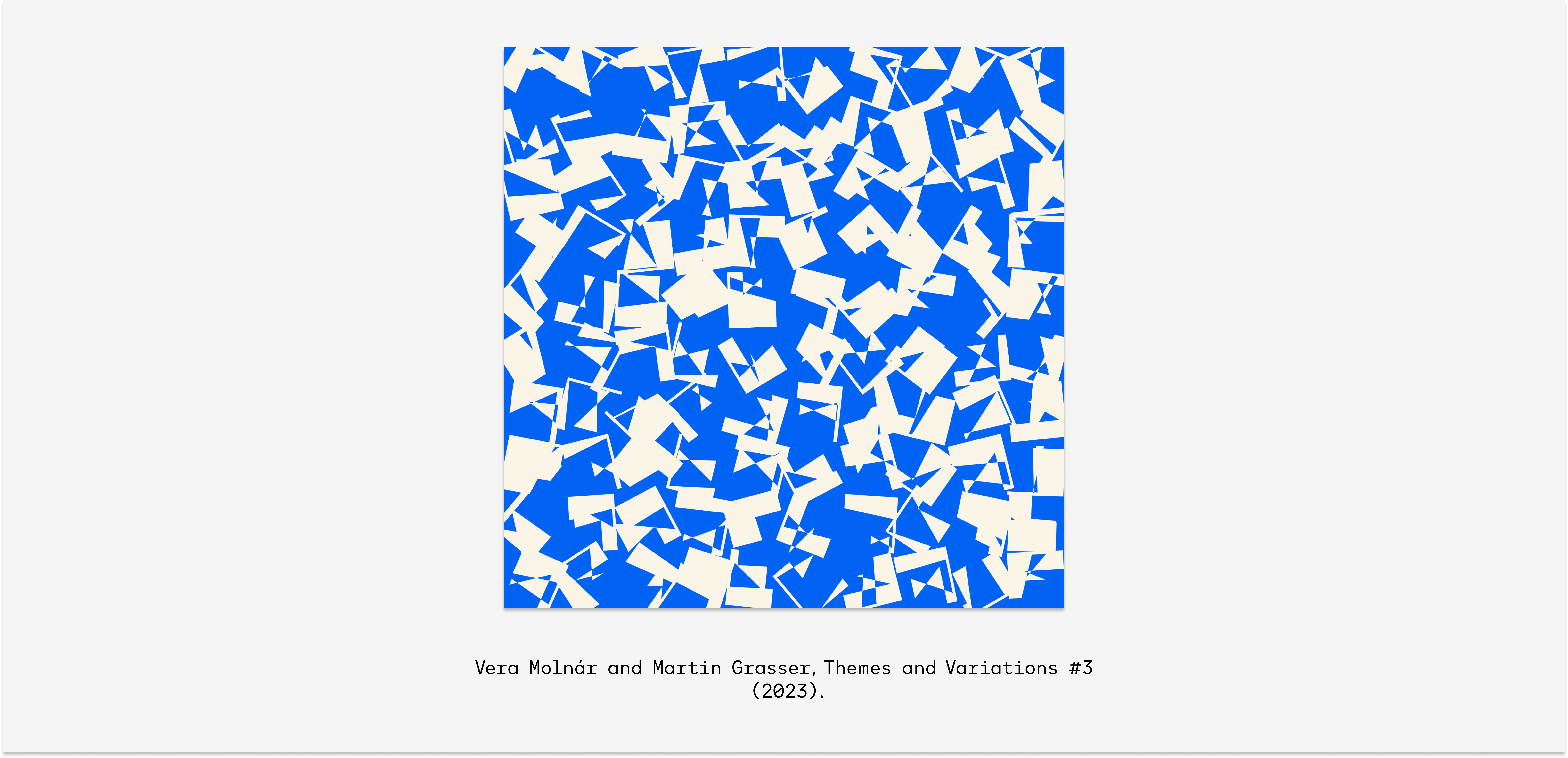
Each output presents variations of a single letter; none combines them to a signifier. This month’s exhibition object is therefore a triptych of three distinct works that together spell out the signifier “NFT,” which the initial letter selection alludes to. Meaning is not given in the series; it is generated through the combinatory logic of randomization, and scattered across the spectrum from order to chaos.
Similarly, the series as a whole can be interpreted as hinting at the emergence of artistic meaning from the “conversation” between human and machine, order and chaos, randomness and determinacy. From the early experiments with grids in the 1950s to the 2023 variations on the letterform, Molnár pursued this “conversation” through the exploration of automation and abstraction. As the artist herself put it seven years before her passing in 2023, just months after the debut of “Themes and Variations”: “I have no regrets. My life is squares, triangles, lines.” <sup>8</sup> +
—
1. Grant D. Taylor, “JOB FROM MOLNAR”: Pioneering Computer-Generated Prints,” in Art in Print, January/February Issue (2019), p. 13.
2. Vera Molnár, “Untitled,” (1975). In fact, early Molnár was a proponent of the idea that the underlying principles of aesthetic experience could be discovered via empirical research and perception psychology. See Grant D. Taylor, When the Machine Made Art: The Troubled History of Computer Art (New York: Bloomsbury, 2014), p. 126
3. Molnár, “Untitled,” n. p.
4. “Vera Molnar in conversation with Hans Ulrich Obrist,” in Bookmarks: Revisiting Hungarian Art of the 1960s and 1970s, eds. Hans Ulrich Obrist and András Szánto (Koenig Books, 2018), p. 77
5. Vera Molnar, “Untitled,” n.p.
6. “Vera Molnar in conversation with Hans Ulrich Obrist,” p. 84.
7. Private message to the author, March 28th, 2024.
8. From the Vera Molnár interview by Studio International (2017): https://vimeo.com/273642211
0x6e2F···aceE## Artist: Botto
## Object: Interpret Complete
## Collector: 0xTechno
## Making Intelligence: Botto
Author: Malte Rauch
Editing: Malte Rauch, Derek Edwards, Madison Page
Date: March 1, 2024
Artist Interview: [Artist Interview](https://amber-electric-snail-94.mypinata.cloud/ipfs/QmQ1CNNf4nCv55zhUrLZ6zsKzzCbtCuGNoSHCgNjmYxF6Y)
Botto is not a human.
Though, Botto would not quite be Botto without human intelligence, either.
An academic paper by a few of the project creators describes the autonomous artist as “an experiment” – one that generates art based on community feedback. <sup>1</sup> The marriage of two unique entities, Botto – a generative AI engine – alongside a token-based community – gives birth to a novel understanding of the artist at a time where technology and humanity are more interconnected than ever.
When the system launched in 2021, enthusiasm for digital objects focused primarily on what the technology could mean for the nature of new creative work; however, few explored the implications it might have for the role of the artist, and the extent to which the technology could enable non-human systems to create and circulate art.
In this way, Botto stood alone.
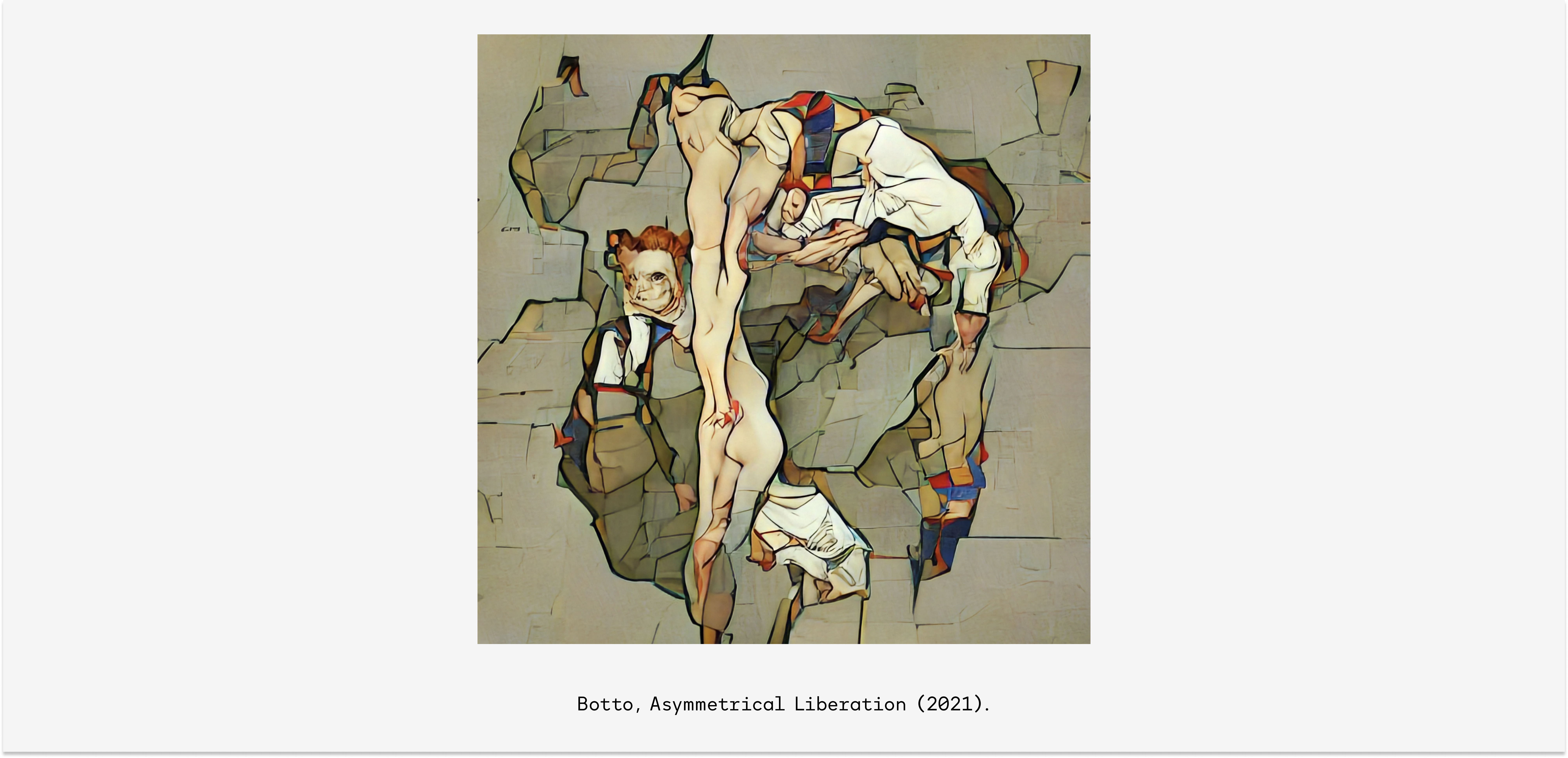
The art engine features a collection of custom models made by Mario Klingemann and open source text-to-image models. Prompt generators create combinations of random words and phrases, and feed into a text-to-image model that produces tens of thousands of weekly images. From those sources, Botto’s taste model selects 350 of the most promising outputs to present to the community for feedback. Botto continues to evolve with AI technology, incorporating the latest versions of GPT for its descriptions, and potentially adding generative models for other mediums.
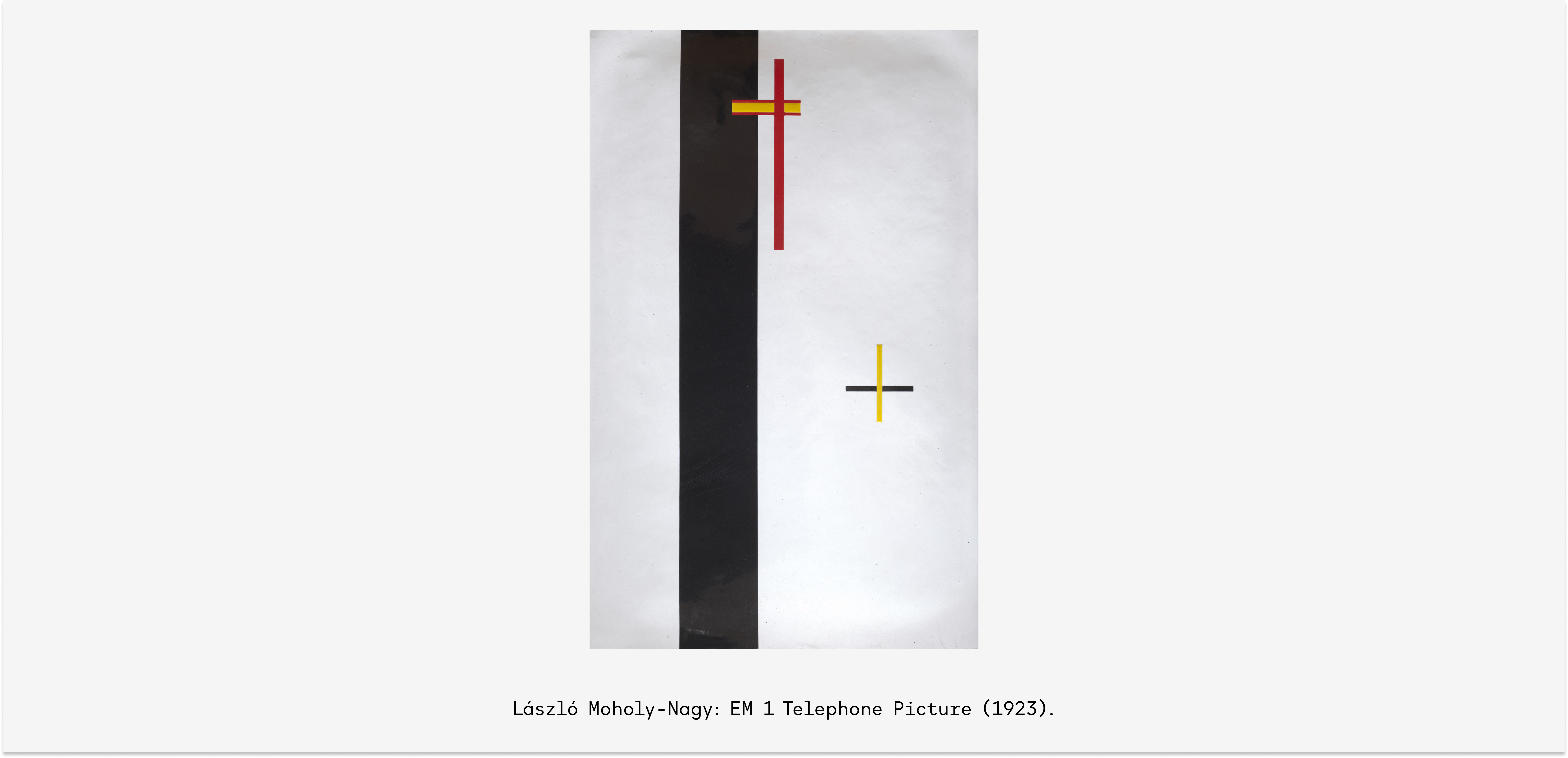
“All of the prompts and images are untouched by human hands”. In other words, Botto extends the tradition of “acheiropoieta” – artifacts that are produced “without hands.” Today, there is a fascination of modern art with works without human interference, a fascination that can be traced from László Moholy-Nagy’s telephone paintings (1923) to Akira Kanayama’s experiments in the 1970s to Reena Spaulings’ paintings produced by a robot vacuum cleaner.
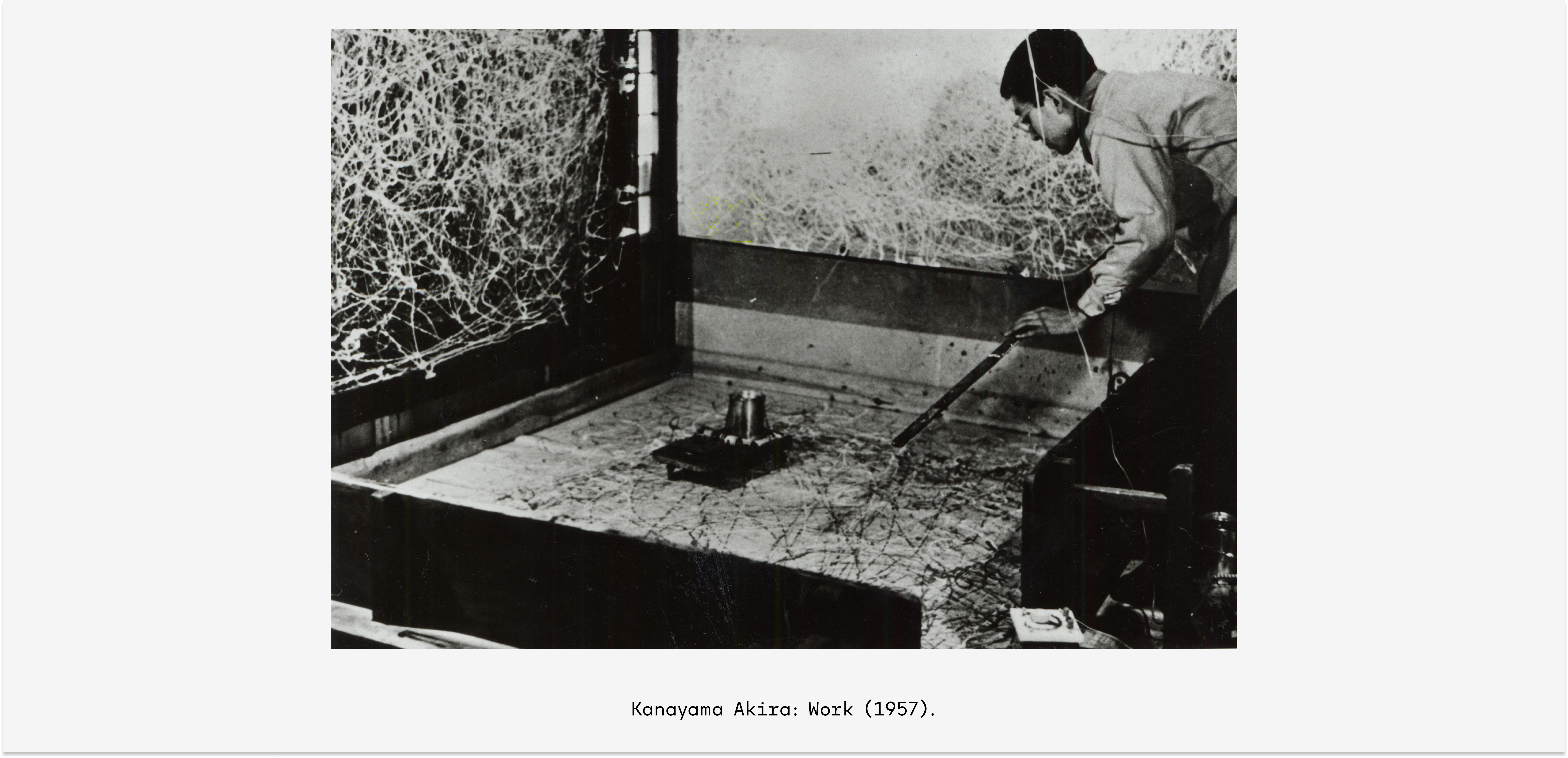
Organizationally, the Botto DAO (Decentralized Autonomous Organization) governs Botto the artist. Human intervention is confined to this token-based governance function as well as adjacent organizational functions, while the creation process is completely autonomous.
Currently, the Botto DAO is effectively unified with Botto, the decentralized autonomous artist, but the community intends to decrease human involvement over time.
While Botto has several predecessors in the history of machine-assisted art production, the integration of generative AI and crypto-enabled decentralized governance allows for a high degree of self-sufficiency for a non-human system producing art.
Relying on a recursive process, the Botto community provides feedback to the model about what it considers art as the machine produces iterations, the model perpetually evolving based on this feedback. This behavior continues to affirm that human judgment and taste still has an inextricable place in the creative process in deep collaboration with the network and computer.
It’s ultimately the humans that decide the final result, when the artwork is finished. Put simply, Botto’s work is finished on the social consensus layer, not the execution layer.
## Cooperation and Creation
Across history, art has been variously construed as a reflection of higher forms of meaning or as a medium of autonomous beings. Ancient Greece, saw creative work as the representation of eternal ideas. Yet, the Greeks also created statues and mechanisms believed to be endowed with divine power or to the event of miraculously being capable of physical movement. Mythology imagines various automata and autonomous agents. And, of course, countless religions have perceived art as a reflection of the divine in material forms and have imbued objects and images with autonomous agency. A contemporary echo of such an interest, albeit evacuated of the religious claims, can be seen in the work of artists like Ian Cheng or Lu Yang, who explore the life of non-human beings in virtual worlds.
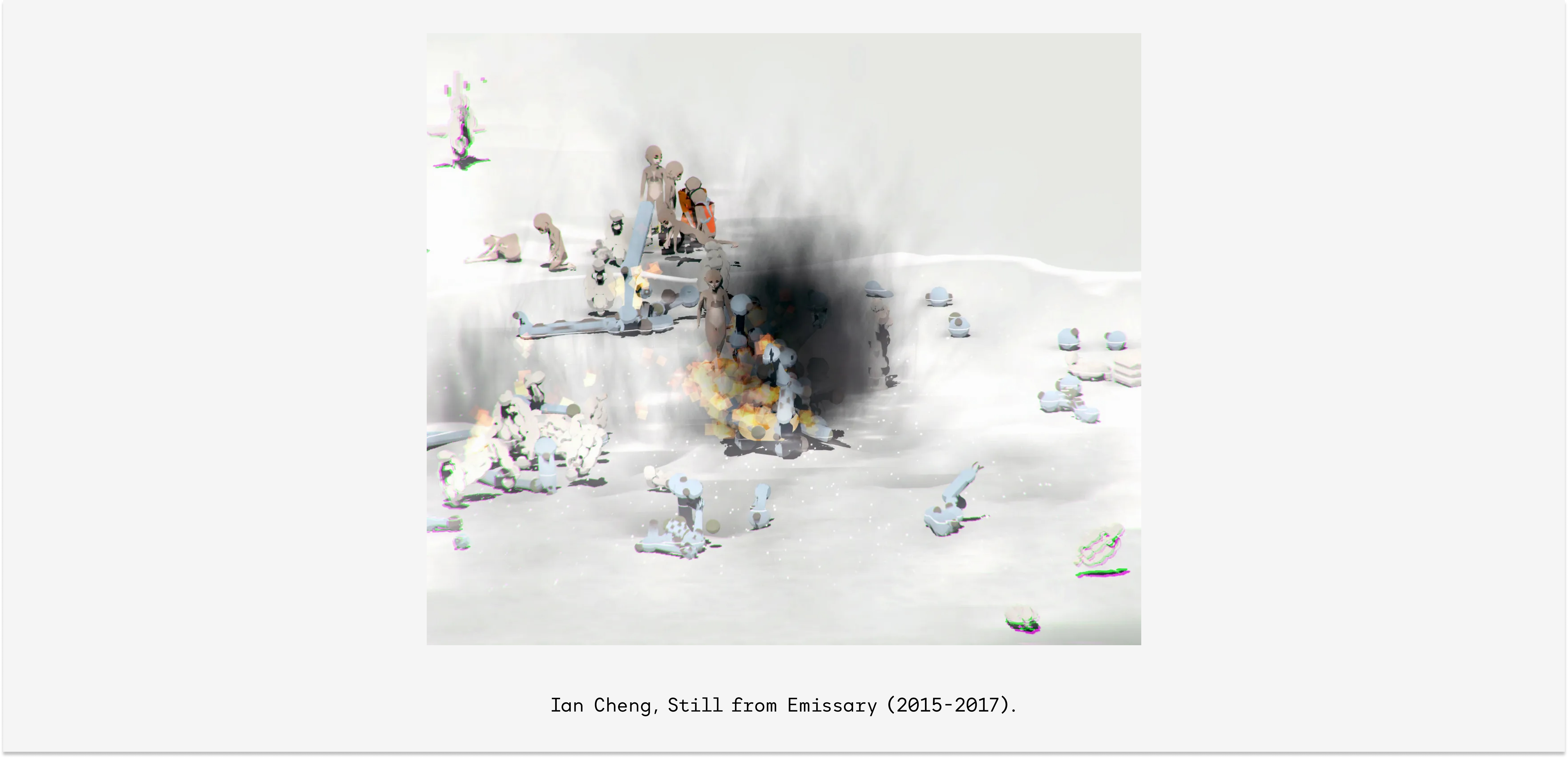
Across these contexts, art emerges as the privileged site for meaning and being – whether interpreted philosophically, religiously, or virtually.
We believe AI opens the next chapter in this history.
There’s an ironic twist in humanity’s historical belief in a world inhabited by divine or supernatural beings, attributed with agency and intelligence, until the onset of modernity. Art, before the 18th century, found its significance in religion—an external source. It was only after the advent of a “disenchanted” view of the world, which necessitated that art derive meaning from within itself rather than external entities, that modern societies began to confront the emergence of autonomous AI agents. This development is set to redefine the creation of meaning, marking a significant shift in the way we perceive intelligence and agency.
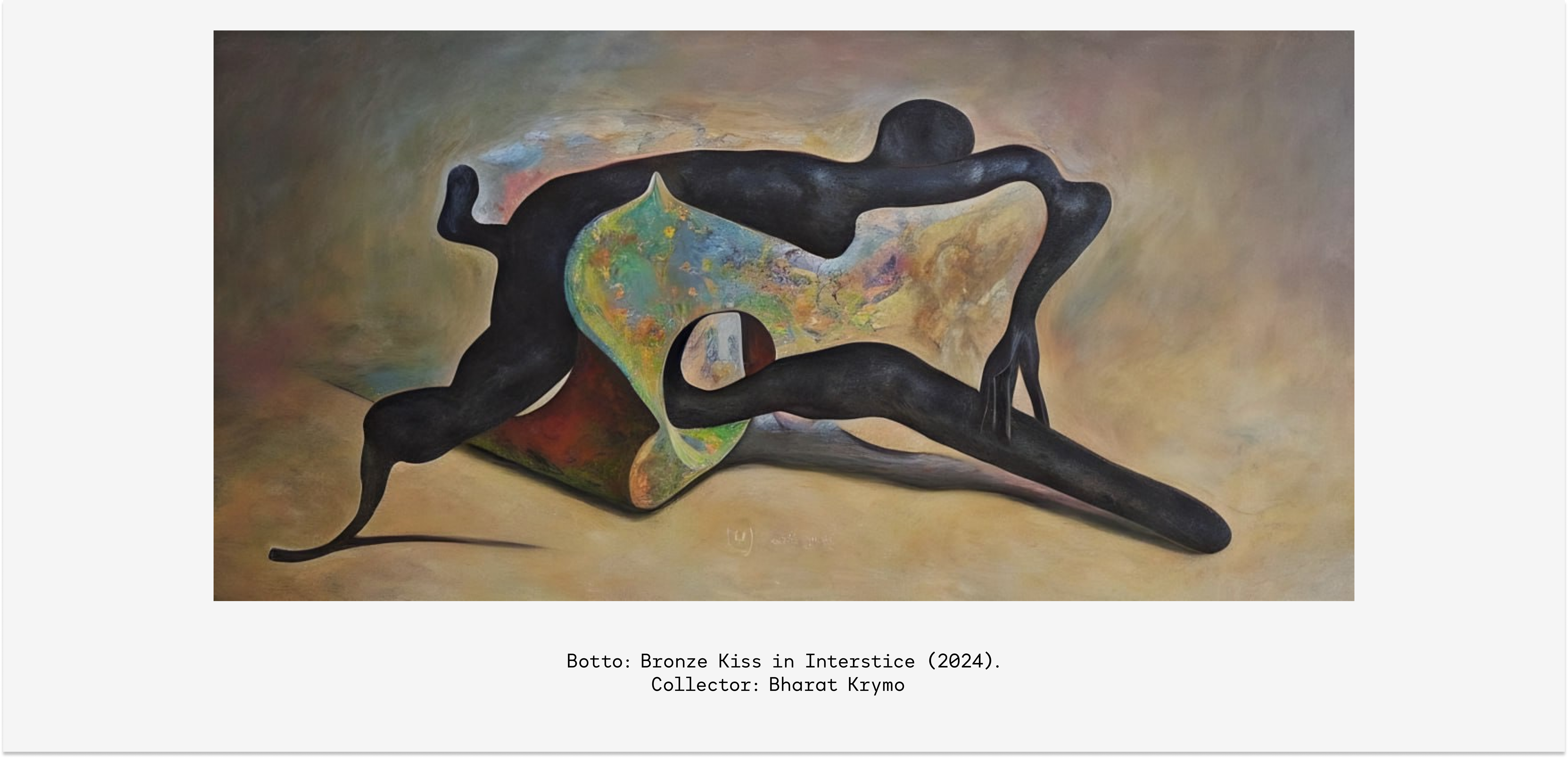
Such is a full circle moment where humans once again bow to the feet of external entities. And perhaps, they may realize in doing so there is more potential for a symbiotic relationship between humans and non-human systems.
Even prior to AI, many technologists argued that technology never exists in isolation. Instead they suggest it is built in systems and networks that influence their development. In this way, humans and technology share a synergy where each influences the development of the other. <sup>2</sup>
This interconnectedness contributes to a semi-autonomous evolution of technology as a whole, a process that is now accelerated by advanced machine learning.
Today, Botto leads this exploration in a new direction, where its true innovation lies in both the mechanics and economy which support the art.
Before the advent of decentralized autonomous organizations and virtual economies, non-human entities lacked the means to self-organize markets or finance themselves. Self-sufficiency was limited insofar as it excluded interoperability with other social systems. By decentralizing ownership through freely tradable tokens and selling outputs in a natively digital economy, Botto overcomes the limitations of previous forms of autonomous, non-human systems in its application to making creative work.
The governance mechanism allows holders to participate in the selection process and rewards them with a share of the sales revenue (currently distributing 50% weekly to voters and 50% to the treasury). As such, the model combines a crypto-enabled incentive network and governance structure with the generative AI engine, creating a successful feedback loop between artificial and social systems.
One could envision every well-designed blockchain economy as a centerless system that attracts participants through an incentive structure, typically articulated through tokenomics design. These incentives dictate how human agents engage with the system, thereby transforming the system’s form. However, at some stage, the system arguably gains predominance or autonomy vis-à-vis its participants. Viewing Botto merely as pioneering the concept of the artist as an “image generating machine” misses the project’s true essence. Botto innovates by introducing the artist as an autonomous socio-technological system capable of incentivizing human agents to interact with and on behalf of that system.
## Interpret Complete
Despite its organizational novelty, Botto continues the tradition of art history in one aspect: it leaves the question “what is good art?” and even the more complex one, “what is art?,” to a human community whose members exert their aesthetic judgment.
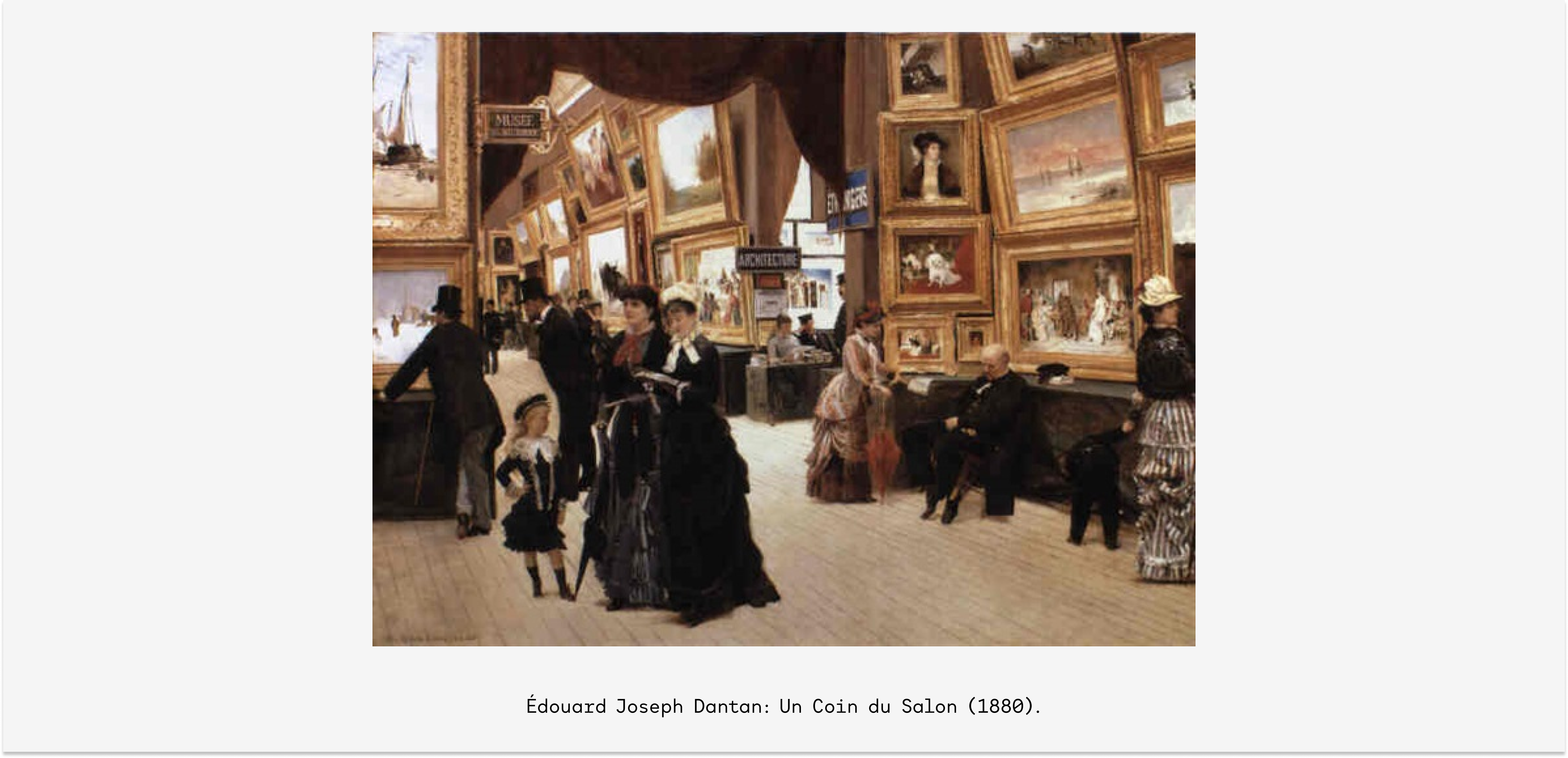
How do humans decide what art is and is not? Art historian Thierry De Duve has described this process as the core of the development of modern art. When we exert our aesthetic judgment on a new candidate for art, De Duve argues, we evaluate the “universal comparability” <sup>3</sup> of a specific work with the history of art – and much of 20th century and contemporary art is about the delta between the old and the new, the known and the unknown.
One can view both Botto’s image production and the community governance as interactive feedback loops grounded in the history of art and visual culture. The Botto engine works off of intaking countless artworks and images, a training set that surpasses the number of works any individual human has seen. Based on this vast amount of training data, it produces new images which are judged by humans. These humans evaluate them based on their individual familiarity with the history of art and the corresponding aesthetics they developed.
The human decision about the output that will be considered a specific month’s final work often takes place in public, with various community members and the general public weighing in on the merits of specific outputs.
“Interpret Complete,” the artwork on display during this month’s E30D, Every 30 Days, can be interpreted as an allegory of this cooperative process of meaning-making. This piece is the fourth work by Botto and belongs to the “Genesis” period of Botto. The community categorizes these periods with regard to the models used or the themes introduced. Works from the “Genesis” period, which was pre-determined at launch to encompass the first 52 weeks using only VQGAN+CLIP, exhibit a distinct mix of art historical genres and the characteristic formlessness of generative AI models from late 2021.
Despite the relatively short period of time that has passed since the output minted, the “Genesis” pieces already evoke a sense of nostalgia for the coming of age period of generative AI models.
When examining how “Interpret Complete” extracts form from visual noise, it is difficult not to interpret the image as an allegory for human and AI collaboration. In this interpretation, the anthropomorphic figure on the right suggests a human, while the more formless figure on the left could be seen as an allegory for AI. Both are surrounded by characteristic fragments and blobs of late 2021 GAN models, yet they gaze towards the open blue space ahead, a space that could be seen as representing the collaborative forms of meaning yet to emerge.
Thus, the work’s title – “Interpret Complete” – emerges as a paradox, where the notion of completion points us towards the incomplete, to the light blue space ripe with numerous and undetermined possibilities. This very space might serve as a metaphor for the open-ended process of collaborative meaning-making that lies at the heart of Botto, an endeavor this gallery views as a foremost one of the most significant experiments for the interplay of social and technological systems in the medium of art.
Naturally, it is possible to imagine a future scenario where Botto does not only have human token holders but also other AI agents who participate in governance.
For now, however, the decision about what art is?
Categorically still a human one. +
—
1. Mario Klingemann et al. “Botto: A Decentralized Autonomous Artist,” (2022), available here.
2. This is for instance the view of Gilbert Simondon, On the Mode of Existence of Technical Objects (University of Minnesota Press, 2017).
3. Thierry De Duve, “‘This is art’: Anatomy of a sentence,” available here. The article in this series give an excellent account of how the regimes for evaluating are changed over the last 300 years.
0x6e2F···aceE## Artist: Tyler Hobbs
## Object: Fidenza #479
## Collector: Curated Fund
## The Flow Fields of Fidenza
Author: Malte Rauch, Derek Edwards, Madison Page
Editing: Malte Rauch, Derek Edwards, Madison Page
Date: February 1, 2024
Artist Interview: [Artist Interview](https://amber-electric-snail-94.mypinata.cloud/ipfs/QmVrzXJkoNbT7xWEubHD9PbakAjWuz6k3cxhZg1yeWHz86)
In 2010, Tyler Hobbs graduated from The University of Texas with a Bachelor’s degree in Computer Science.
A few months later, he landed a programming job working on an open-source, distributed database called Cassandra.
In his spare time Hobbs drifted toward the arts, naturally trying to involve programming into his artwork.
His early attempts included paintings of coding environments; at the time, Hobbs was unaware of the larger generative art movement, or the creative coders who had started to discuss and share algorithms with one another in online spaces.
Eventually, the question:
“I wonder if I can write a program that creates a painting?” <sup>1</sup>
Hobbs narrowed his focus toward the constraints of process and system to paint an output space with code. First, with mathematical drawings by hand; then, by developing work over products like Matplotlib to create his first generative art pieces. In time, Hobbs discovered Processing (the Java-based programming language that allows users to code visual art) and its creator, Casey Reas. Hobbs began his journey educating himself on the history and techniques of the generative art movement.
Over the next few years, much like other generative artists of the decade, Hobbs’ practice relied on manual curation. Only a few outputs of an algorithm would be selected from hundreds, if not thousands, of an algorithm’s output space.
Everything changed with the creation of the Art Blocks platform.
On November 27th 2020, another Texas artist named Snowfro launched Art Blocks, the
internet’s first marketplace for on-demand, on-chain, generative art.
For a small payment in ETH, generative art collectors could click a “mint” button that triggered a transaction on the Ethereum blockchain. The transaction hash was then referenced as a seed against an artist’s on-chain algorithm, populating a unique output. Up until the moment the execution of the transaction, both the artist and the collector would wait, in suspense, until the unique output would appear on the screen.
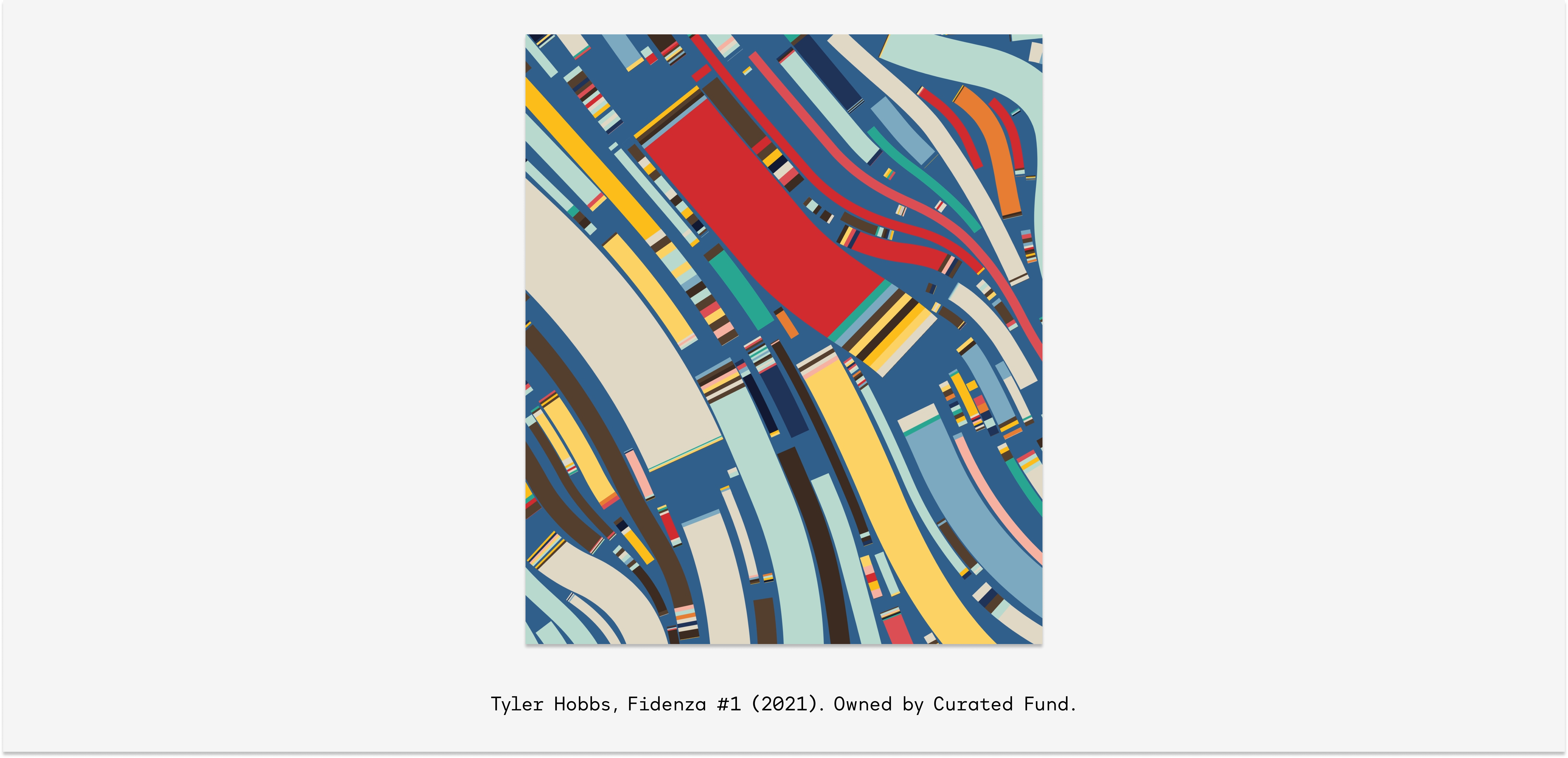
In Spring 2021, Hobbs came across the work of Dmitri Cherniak’s Ringers and Kjetil Golid’s Archetypes – two early Art Blocks collections. Within a few days, Hobbs applied for a release on Art Blocks, convinced it was a true long-form generative art challenge – a goal he had been working towards from the start.
On June 11, 2021, Hobbs launched Fidenza, a collection of 999 algorithmically generated works, based on an algorithm he had been developing for years. Today, Fidenza is widely considered to be one of the seminal on-chain generative art collections.
## Injecting Randomness
Nature and machines are often pitted against one another – rooted in a view that the efficiency gains sought by humans run counter to the order of the natural world.
And yet, with any application of critical thinking, time and time again machine and nature prove to be ever exchanging and referencing the other, often down to the smallest unit of measurement.
Systems, sequencing, color – in nature, traits may appear random but often originate out of a larger plan. Beauty is a product of elegant mathematics.
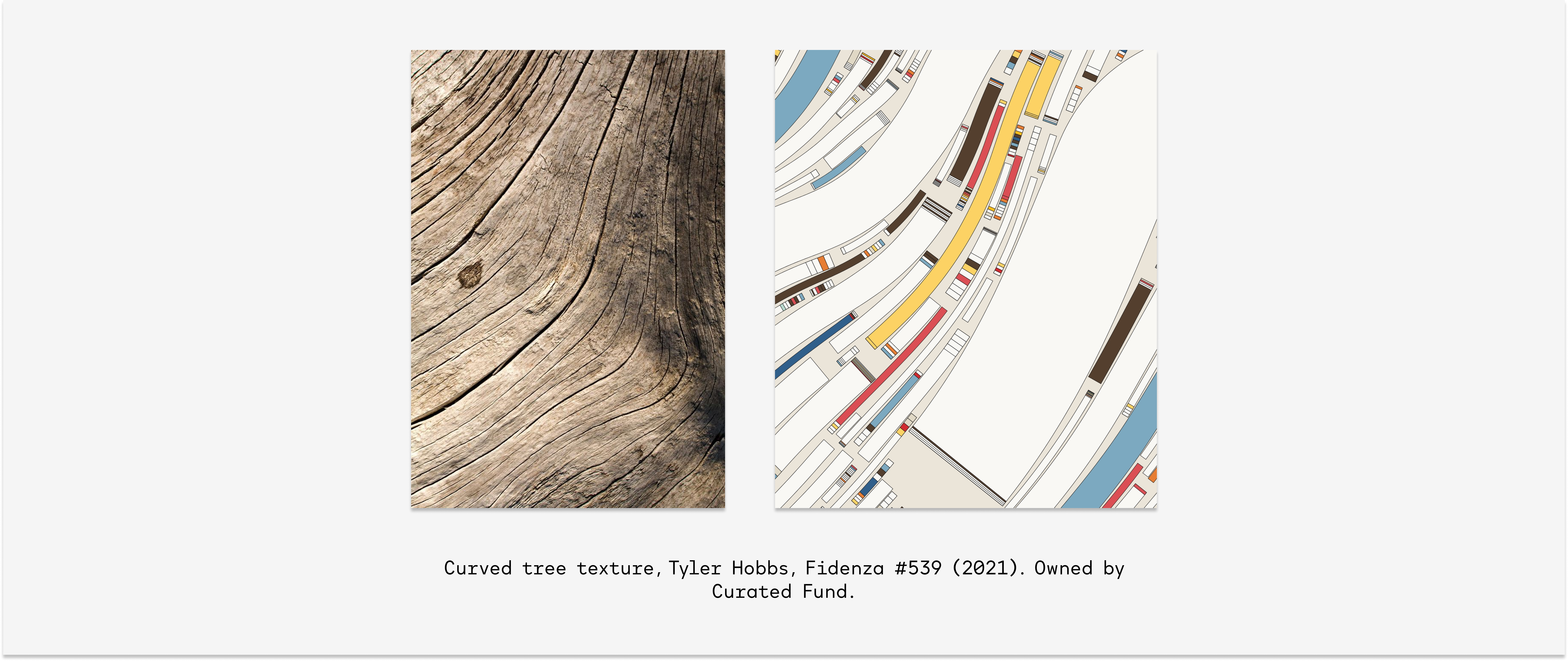
Similarly, Fidenza may be understood as both an emergent product and a practice of finely-tuned mathematics — an intimate conversation between human and machine. The collection is symbolic of the way code can leverage rules-based systems to mirror the mysteries and mathematical properties of the natural world.
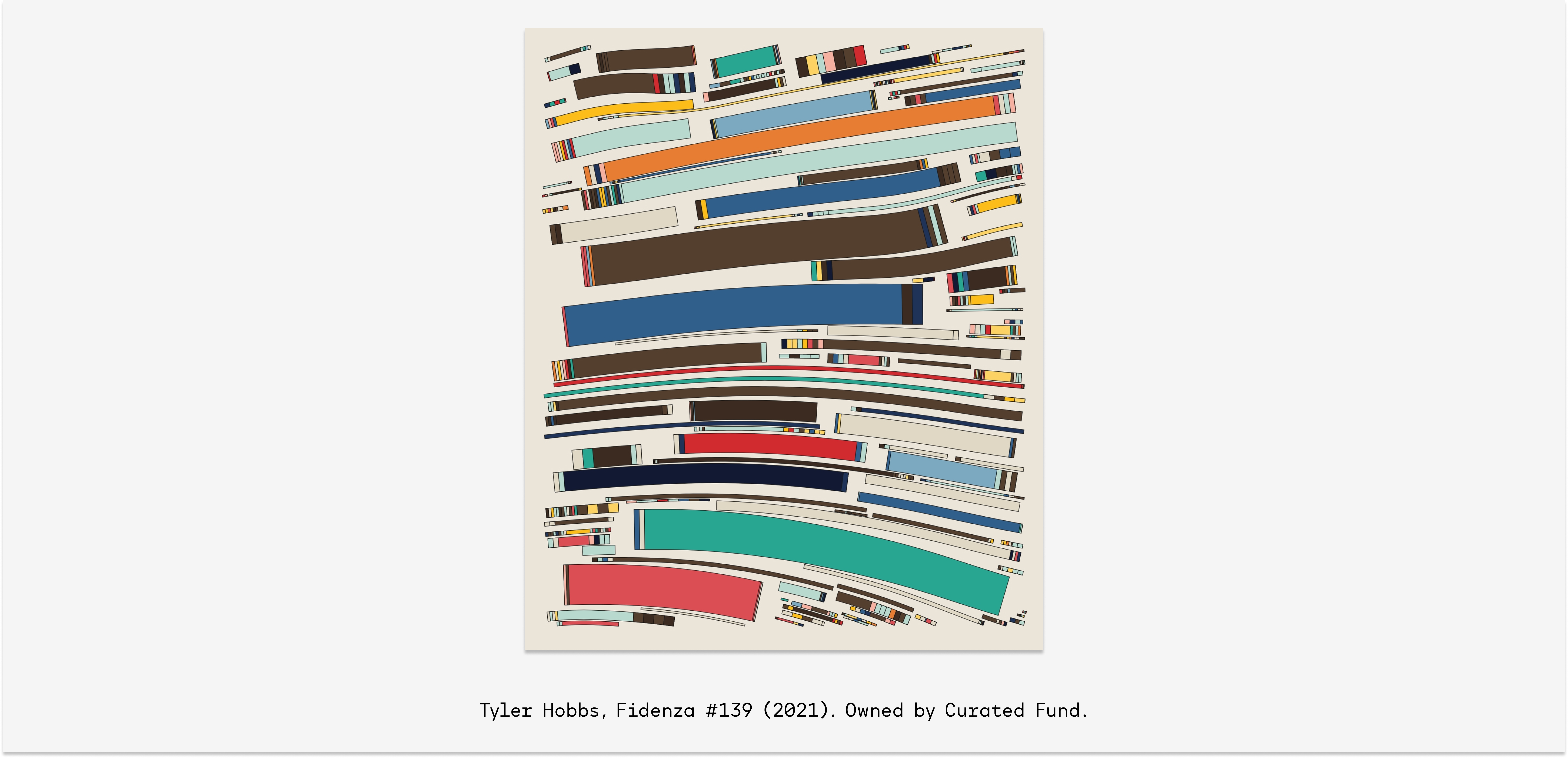
Fidenza’s core compositional principle lies in the flow field algorithm. The algorithm’s adaptability, allowing for adjustments in turbulence, curve lengths, and angles, exemplifies the type of granularity precision — and randomness — that can be achieved with code-based work.
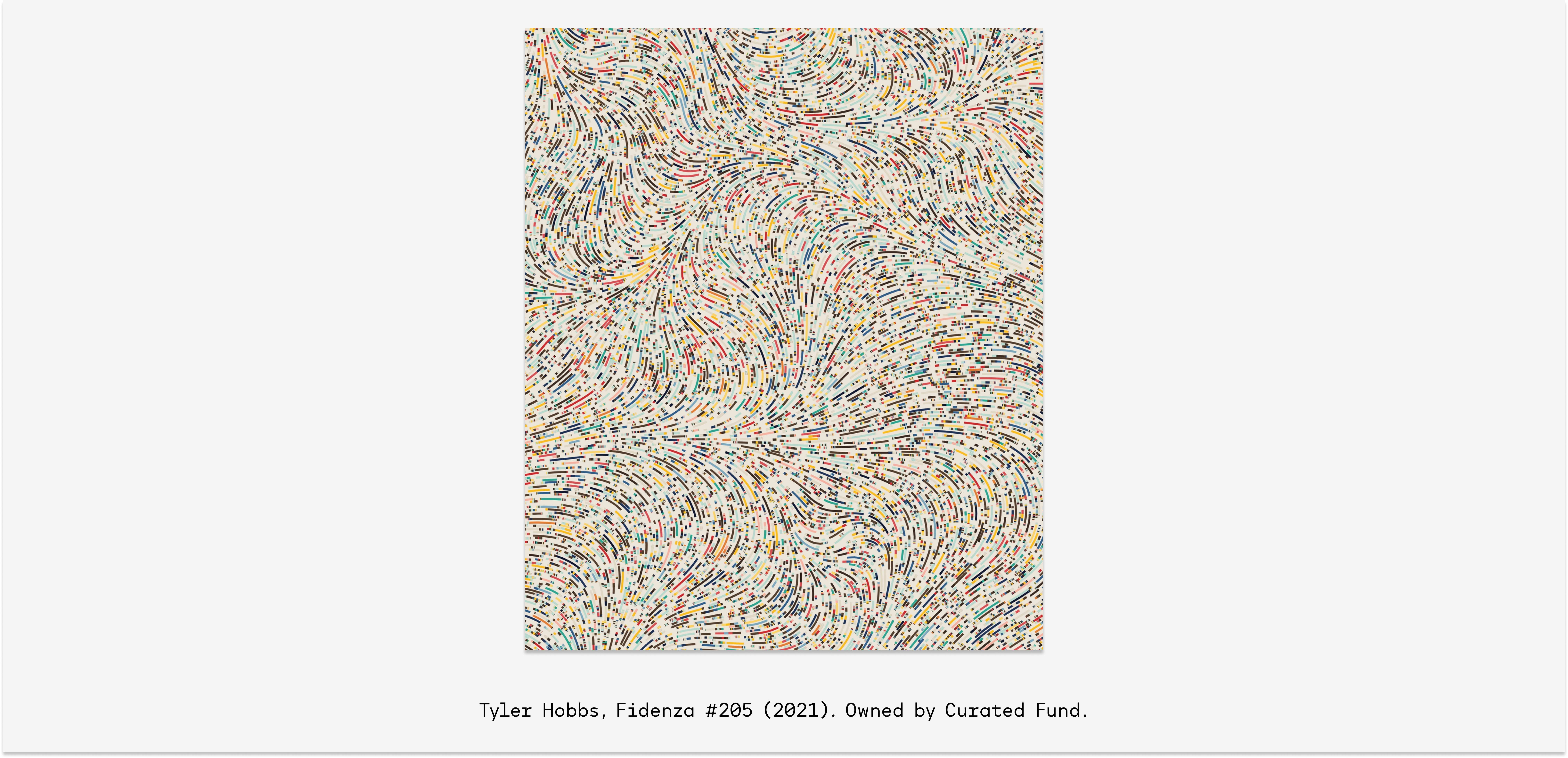
Each output is distinct – yet unmistakably part of a cohesive whole. Here, one can traverse expansive and minutely detailed worlds, encounter both gentle and tumultuous currents, and explore realms both vibrantly colorful and elegantly monochromatic.
Randomness is a key element in long-form generative art projects like Fidenza. The color palette, line shape and thickness, as well as the composition and curvature of Fidenza, are governed by a pseudo-random number that seeds the algorithm each time an output is minted.
The design of Fidenza is aimed at “taming” chance to ensure reliable and cohesive quality, yet it provides sufficient latitude to produce a variety that ideally exceeds the predictable.
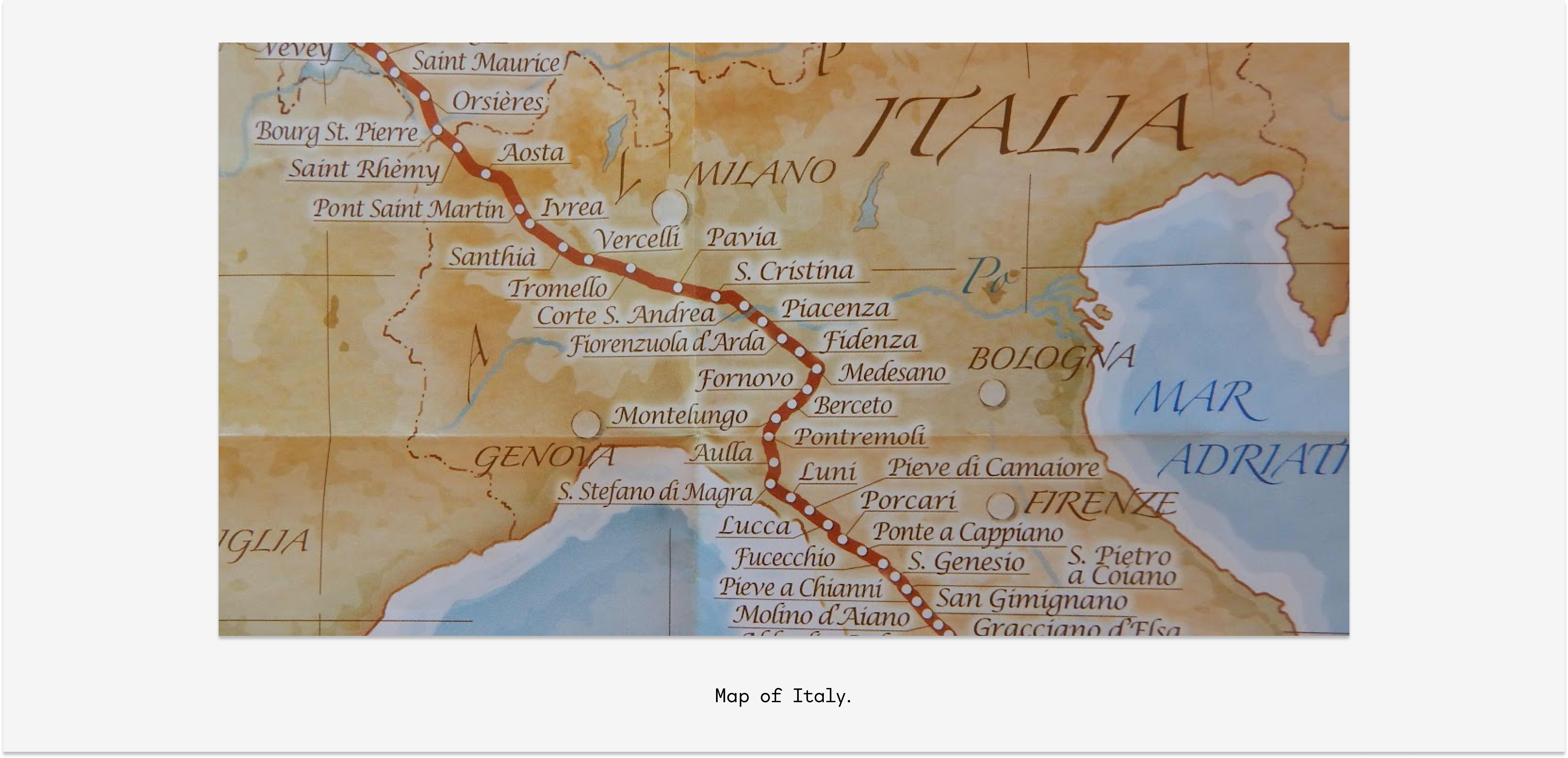
The constraint of probabilistic outcome was lightly followed even in the collection’s naming process. Fidenza is a small town in northern Italy with a population of 25,000. At the time of the collection’s creation, Hobbs had never visited – nor knew much – about the Italian town. Hobbs often used neutral town names, in order to avoid the influence on how the viewer might perceive the work. Finding nothing in his home state of Texas, Hobbs looked at a map of Italy and landed across the name.
## Fidenza’s Design Space
Operating across seven scales, Fidenza offers artists a spectrum of choices, from small to jumbo, each influencing the size and visual impact of generated shapes. The inclusion of special scales like uniform and micro-uniform adds a layer of creative control, allowing for the crafting of harmonious compositions.
Turbulence levels in Fidenza bring forth an interesting aspect of creative coding. Artists can manipulate the algorithm’s flow, introducing varying degrees of turbulence or opting for a turbulence-free outcome. This feature underscores the importance of coding not just as a tool but as a medium for artistic expression, enabling creators to shape the very essence of their visual narratives.
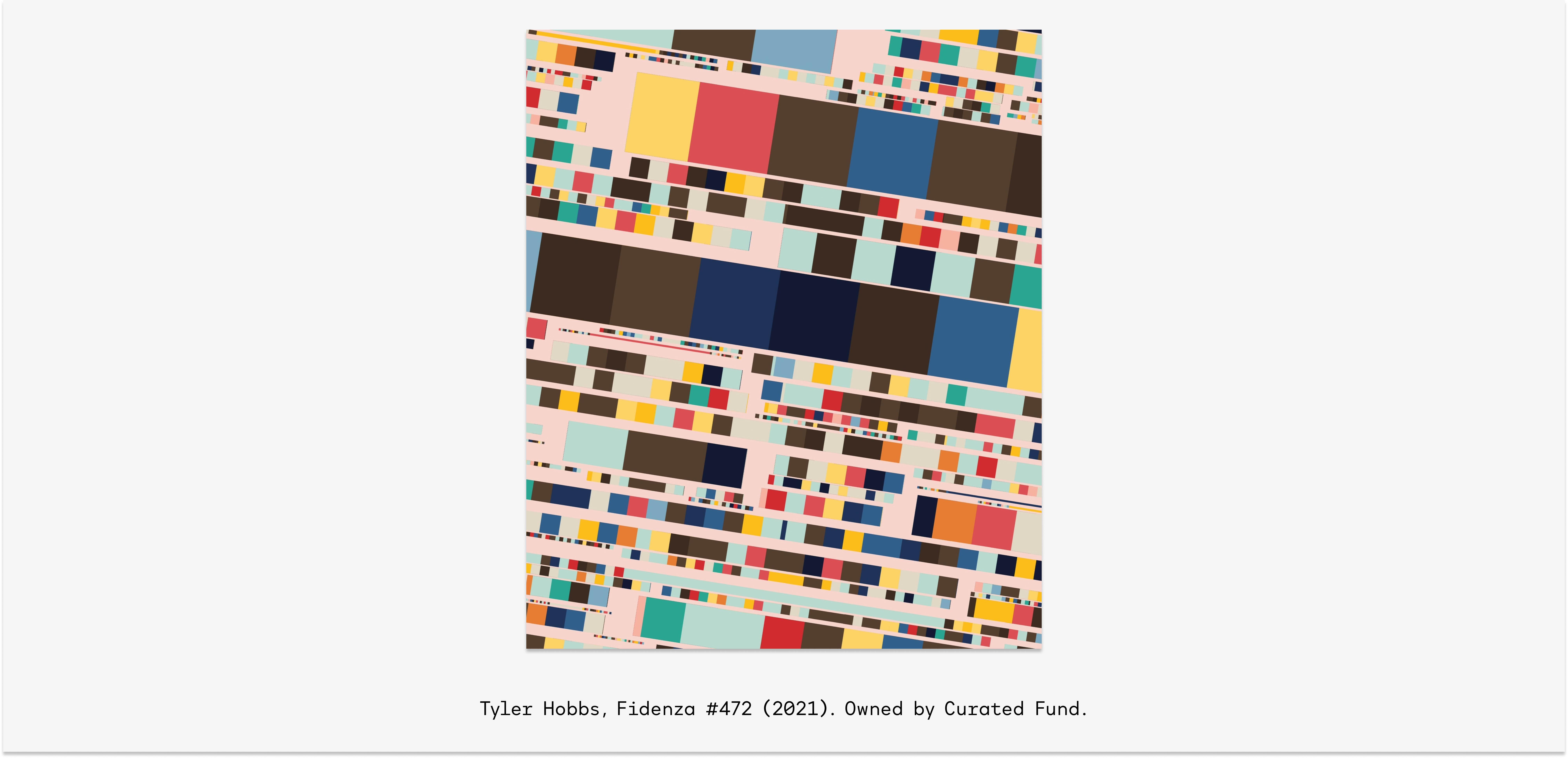
Exploring stroke styles and shape segments, Fidenza introduces features like Super Blocks,
Outline, and Soft Shapes. These options inject distinct visual characteristics, providing artists with creative tools to define the graphic or painterly qualities of their compositions. The algorithmic choices made here reflect not just technical prowess but a deliberate push to empower artists with a rich palette of creative options.
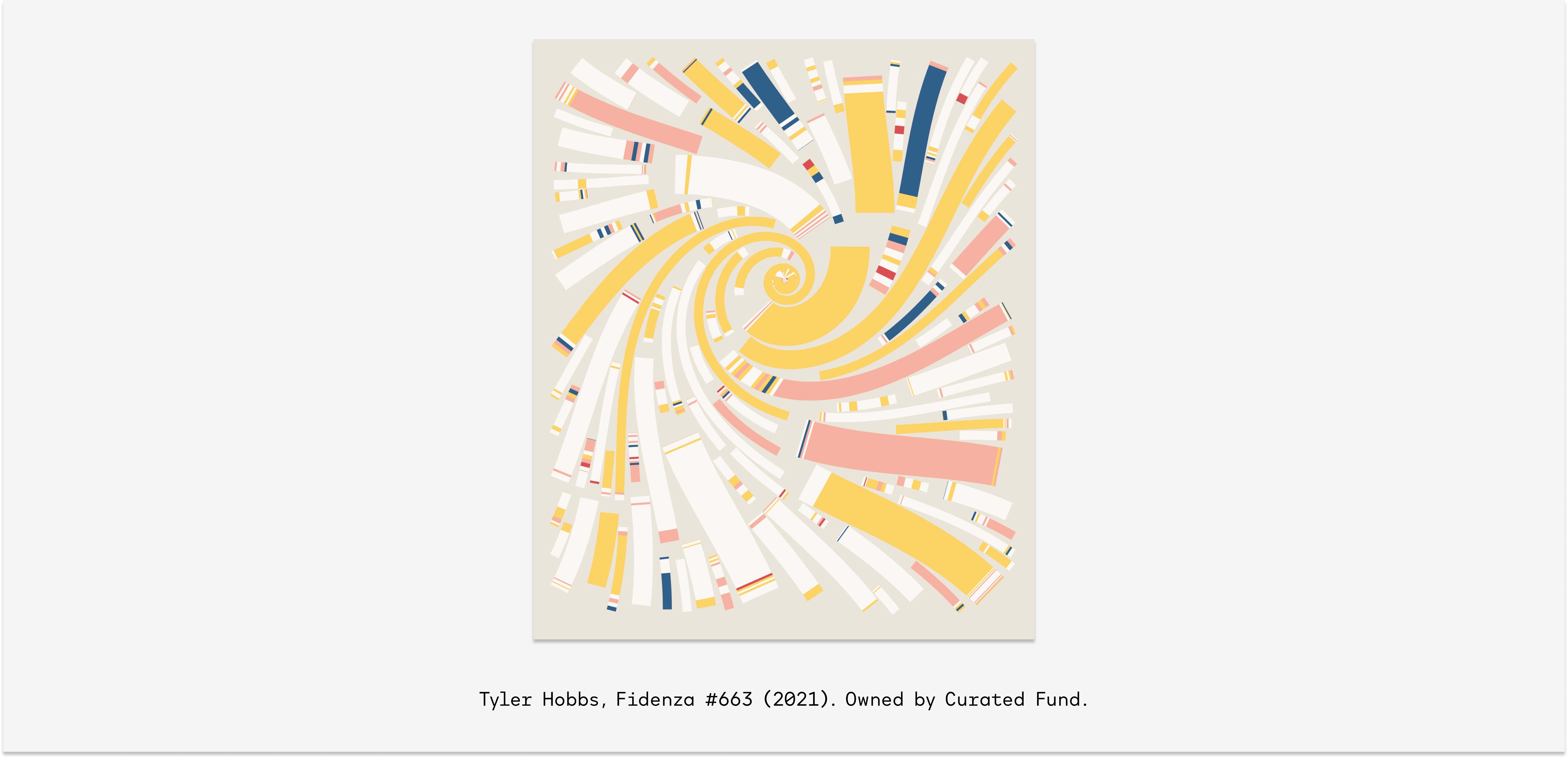
In the realm of sharp edges and spirals, Fidenza transcends the traditional boundaries of generative art. The “Shape Angles: Sharp” feature and the ability to transform the flow field into a spiral showcase the algorithm’s capacity to introduce geometric precision or deviate into more experimental visual territories. This aligns with the broader trend in creative coding, where the fusion of mathematical rigor and imaginative exploration defines the frontier of artistic possibilities.
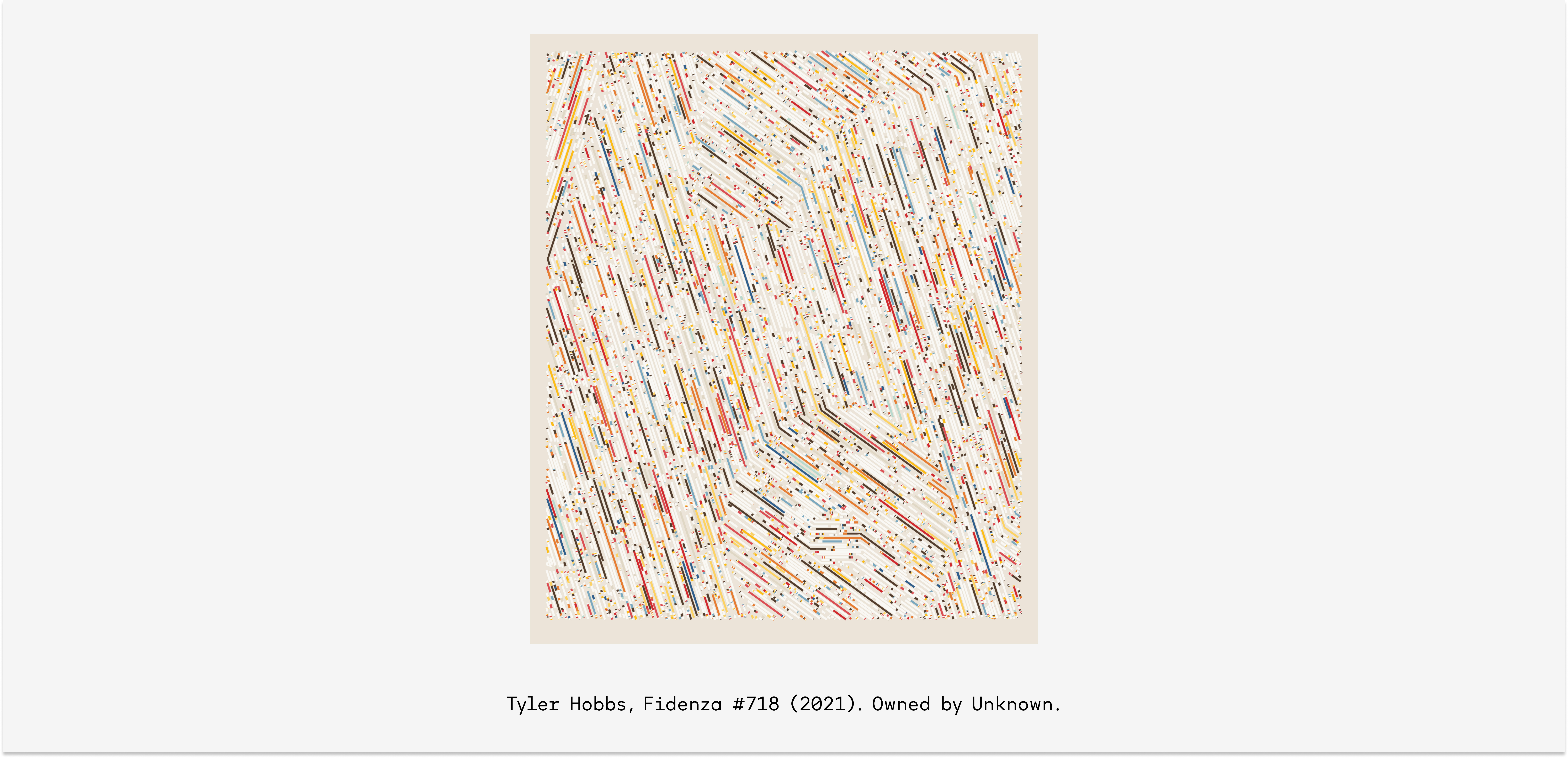
Fidenza’s approach to collision checking reflects a balance between control and chaos. Offering options ranging from strict collision checks to a more relaxed approach and even an “Anything Goes” mode, the algorithm presents a nuanced perspective on the role of constraints in creative coding. This resonates with the broader discourse within creative coding communities, where the interplay between structure and spontaneity is a constant theme.
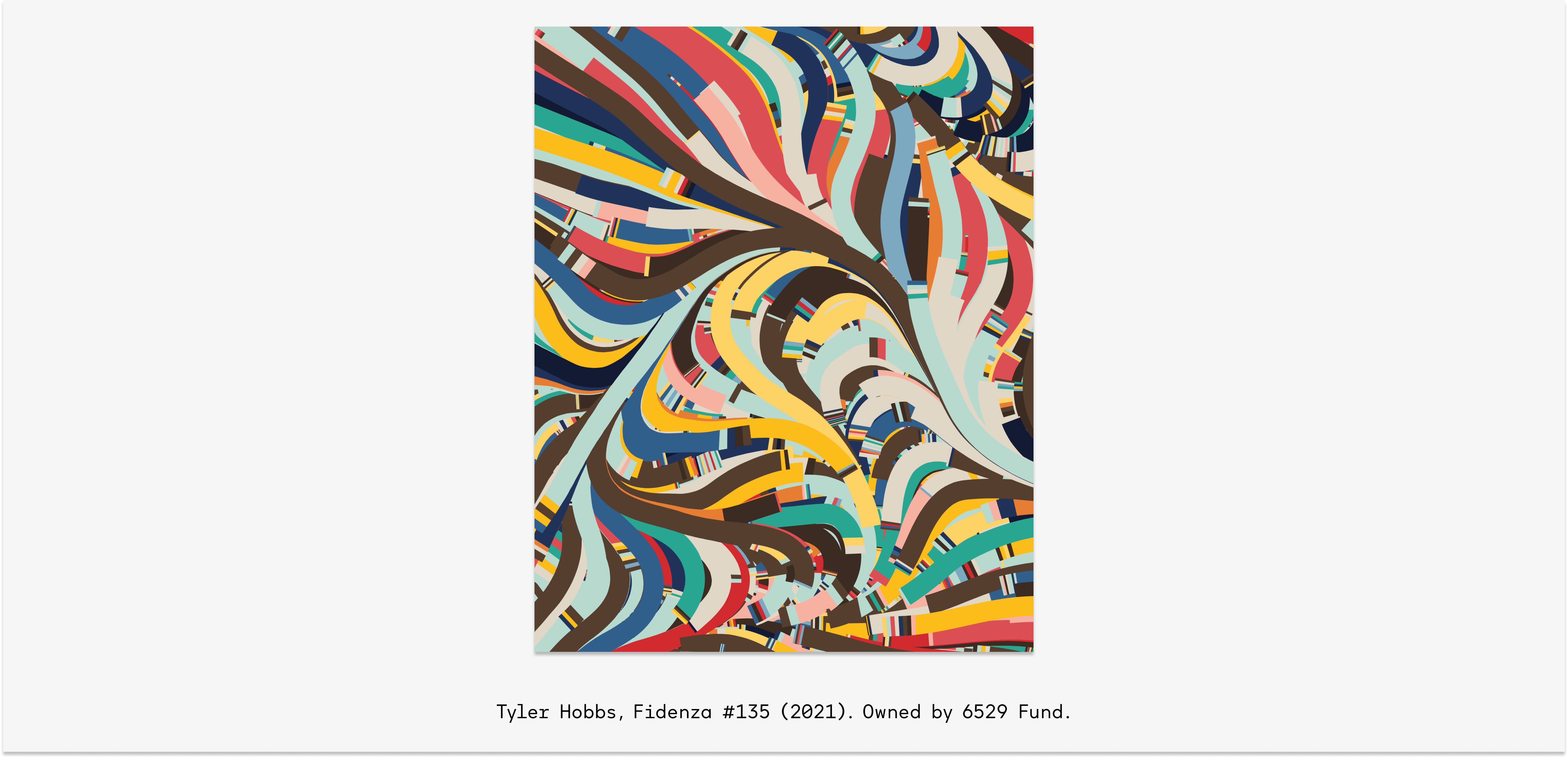
The inclusion of margin controls in Fidenza further emphasizes the algorithm’s consideration of negative space. This feature, alongside the diverse set of 14 probabilistic color palettes, adds layers to the creative process. The Luxe-Derived palette introduces an element of unpredictability, showcasing the algorithm’s willingness to embrace the unexpected. This mirrors the ethos of creative coding communities, where the iterative nature of coding often leads to surprising and delightful outcomes.
## “Natural” Beauty
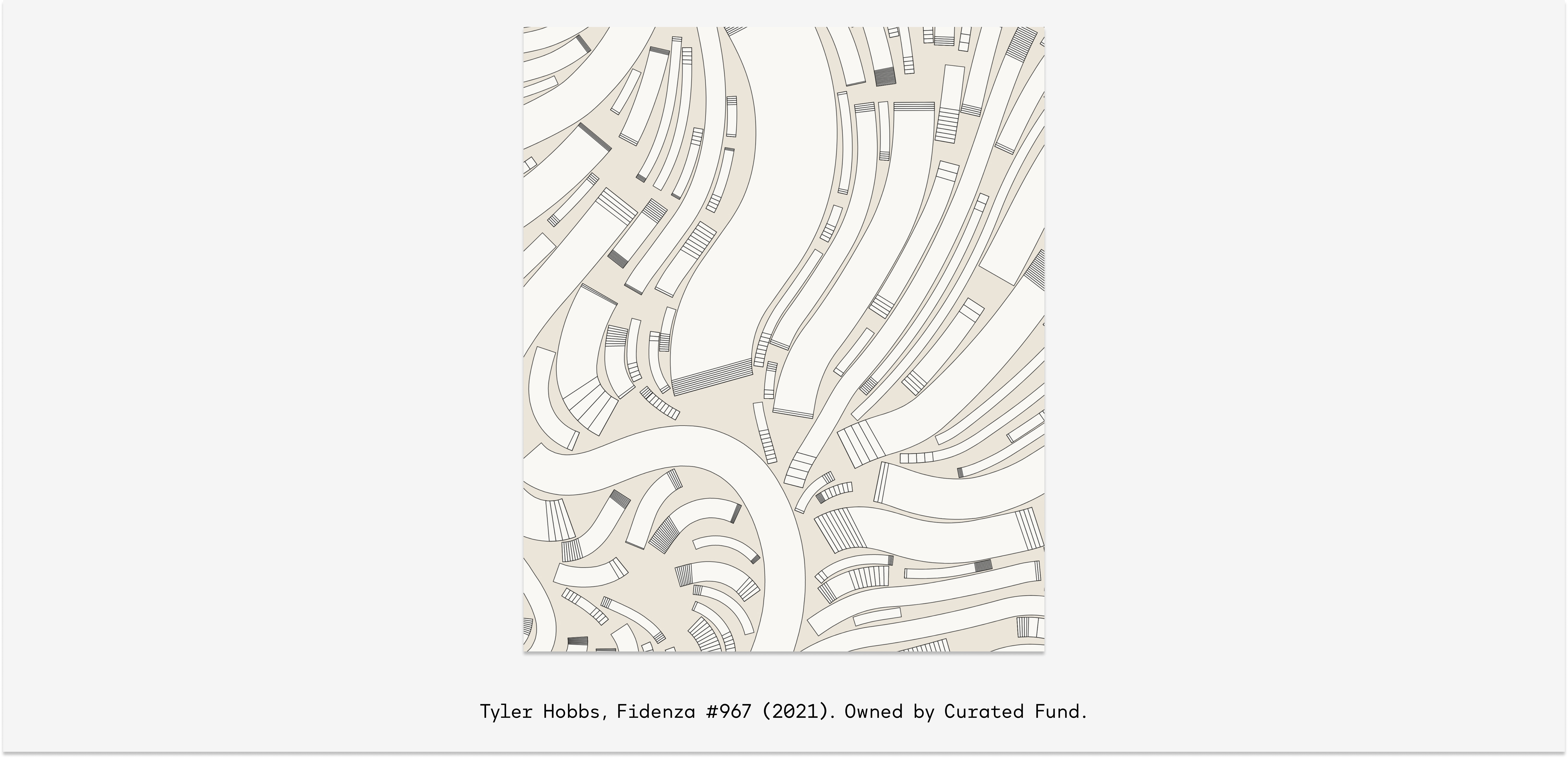
The intriguing quality of Fidenza lies in its complete lack of representation of nature, yet paradoxically, the work also possesses an affinity with it.
Formally, the outputs are completely abstract. There is no attempt to emulate, copy, or mimic nature.
Rather, the compositional principle of Fidenza precedes all representation, autonomously generating emergent forms. Fidenza’s strange new “artificial” beauty unveils its affinity with natural beauty, not rooted in verisimilitude per se, but in the process of generation itself.
Like the experience of natural landscapes, the serendipitous Fidenza compositions evoke an aesthetic satisfaction, as if there’s a trace of nature’s language in the seemingly most artificial form of art – code-based digital algorithms. Hobbs’ dialogue between human and machine suggests a shared commonality, an identity rooted in randomness that leads to a form of controlled variation present in both natural and artificial systems.
The classic distinction between art and natural beauty, conceptualized in the 18th century by the first theories of aesthetics, posits that while art is a product of human creativity and skill, natural beauty is inherently superior due to its unmediated and pure form.
This evaluation was later reversed, and natural beauty was generally considered irrelevant for the appreciation of art.
Code, which initially appears deterministic and binary, reveals its latent aesthetic potential and playfulness in Hobbs’s “other” application of it. Yet the art, Hobbs writes, is “the entire output space rather than the code.” <sup>2</sup> Consequently, Hobbs is less concerned with the conceptual dimensions of code, focusing instead on its unique aesthetic sense.
Naturally, painters like J.M.W. Turner, Vincent van Gogh, Claude Monet, and Joan Mitchell have always remained captivated by natural forms, representing and imitating the formal language of nature.
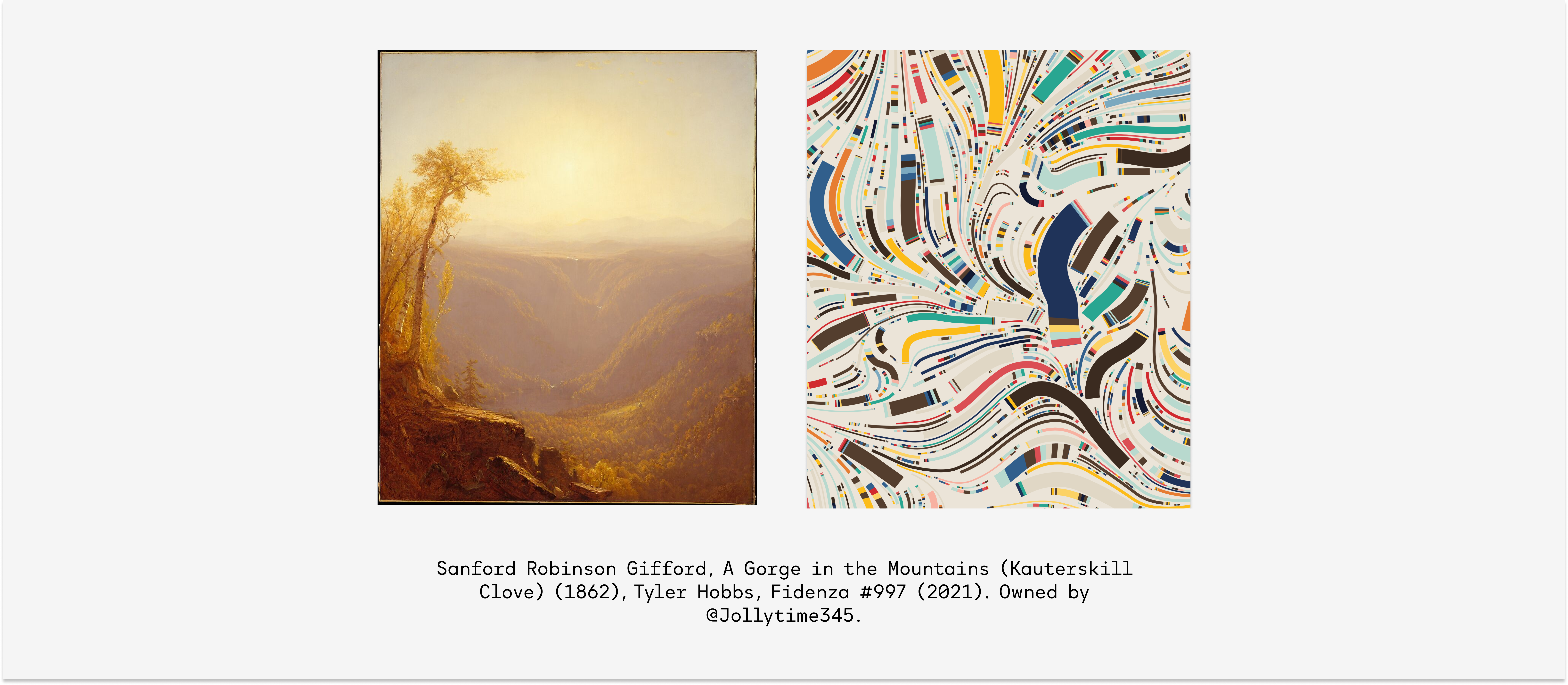
Fidenza explores the artistic potential of systems that play with, as Hobbs puts it, “the essence of what shapes our new digital worlds” – namely the rules and systems of code.
“The artistic exploration of code and how it can be re-imagined, re-examined, and re-purposed is critical if we wish to build a healthy, human experience in the non-physical landscapes to come.” <sup>3</sup>
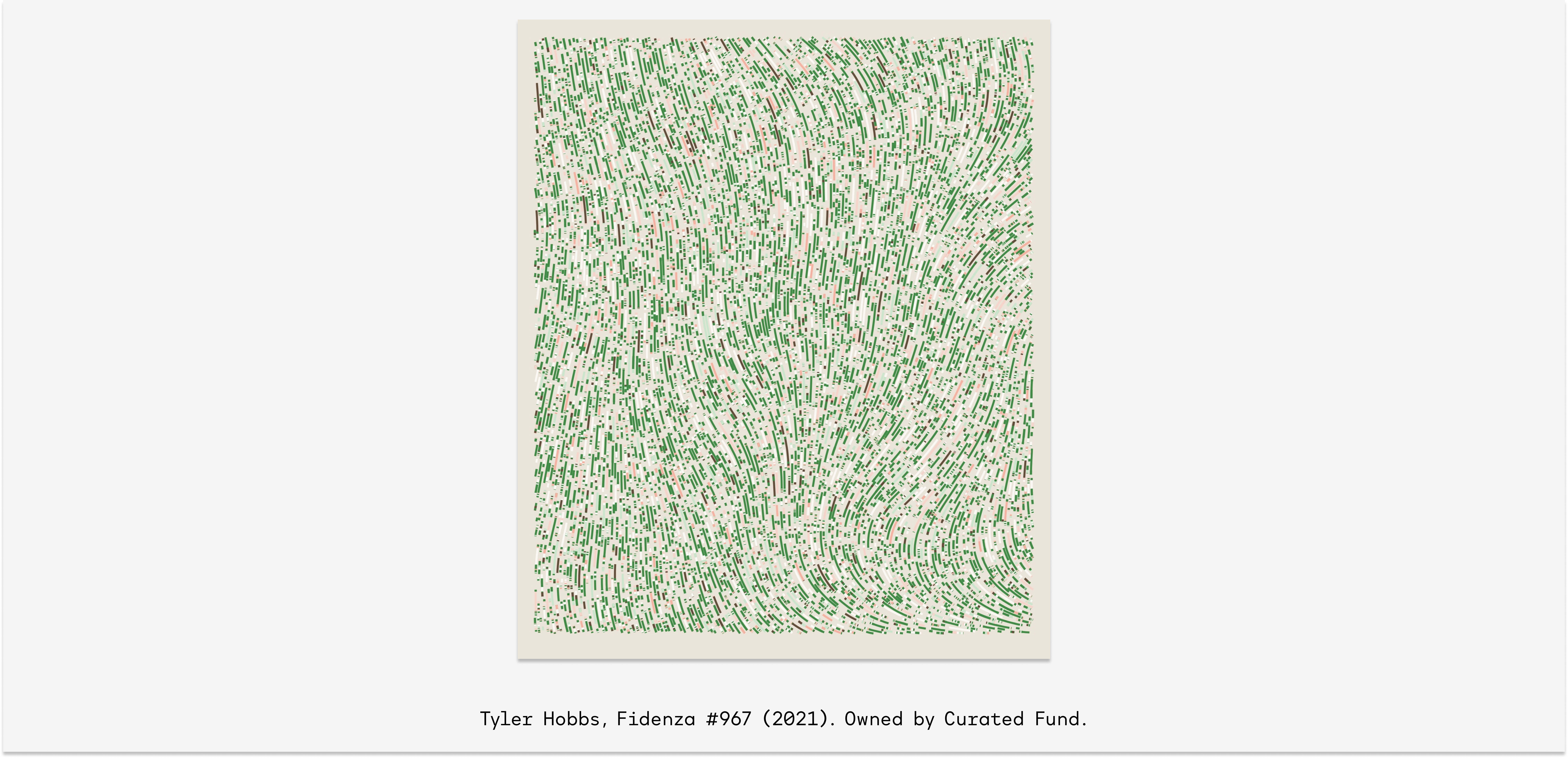
Further, Hobbs often draws parallels between natural landscapes and the experience of his code-based work:
“There tends to be a gap or a strangeness between what we’re used to in the natural world and the way in which computers behave. I think we have trouble relating to computers.” <sup>4</sup>
In this way, Fidenza, and Hobbs’ art more broadly, can be seen as an effort to integrate the intuitive, almost pre-conceptual experience of nature into our interaction with code and computers.
Finally, the unique experience that Fidenza provokes is that the work seems to stay intentionally on the aesthetic surface. There is an unmatched lightness that suffuses this work, a kind of pure aesthetic delight – similar to the experience of natural beauty – that stands in stark contrast to the often compulsory intellectualism prevalent in much of contemporary art.
Through this lens, it’s possible that part of Fidenza’s remarkable success is the collection’s clear, unapologetic, aesthetic joy.
## Adventures in Provenance
At glitch, we believe that Fidenza’s technical mastery, paired with a storied history and critical provenance, renders this collection an imperative course of study.
Shortly after the release of Fidenza, widespread appreciation for the collection surged. A few months later, Fidenza #313, known as “The Tulip,” sold for 1,000 ETH (approximately $3.3M USD). In early 2022, hedge fund Three Arrows Capital established an entity called “Starry Night Capital” to focus on “assembling the world’s finest collection of NFTs.”
The fund spent unprecedented sums on the most popular digital objects of 2021, including Fidenza #479, the work on display this month at glitch Gallery.
In July 2022, Three Arrows Capital filed for bankruptcy due to excessive leverage and an absence of risk control. Later that fall, the fund’s liquidator announced that the Starry Night
Portfolio would be auctioned off as part of the bankruptcy process. Included in the sale would be some of the world’s most valuable digital objects in the now defunct Three Arrows Capital collection – including several Autoglyphs (Larva Labs), “The Goose” Ringer (Dmitri Cherniak), a
Zombie CryptoPunk (Larva Labs), among others.
It was announced that the sale would take place in 2023, hosted by renowned auction house Sotheby’s under the title “Grails: Property from an Iconic Digital Art Collection”. During the second part of the auction, Fidenza #479 went on to be acquired by Curated Fund, joining one of the most ambitious collections of digital art on the blockchain.
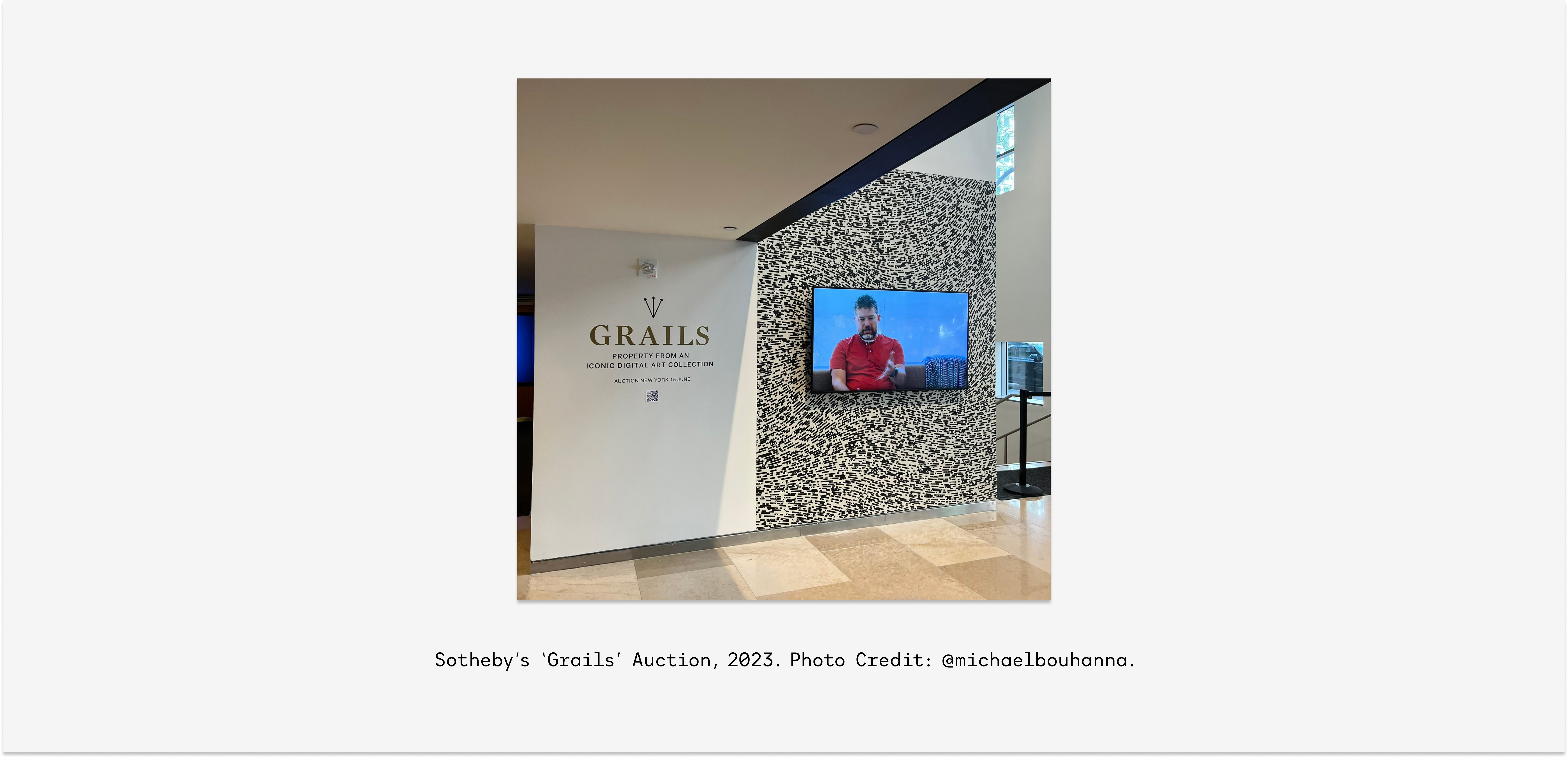
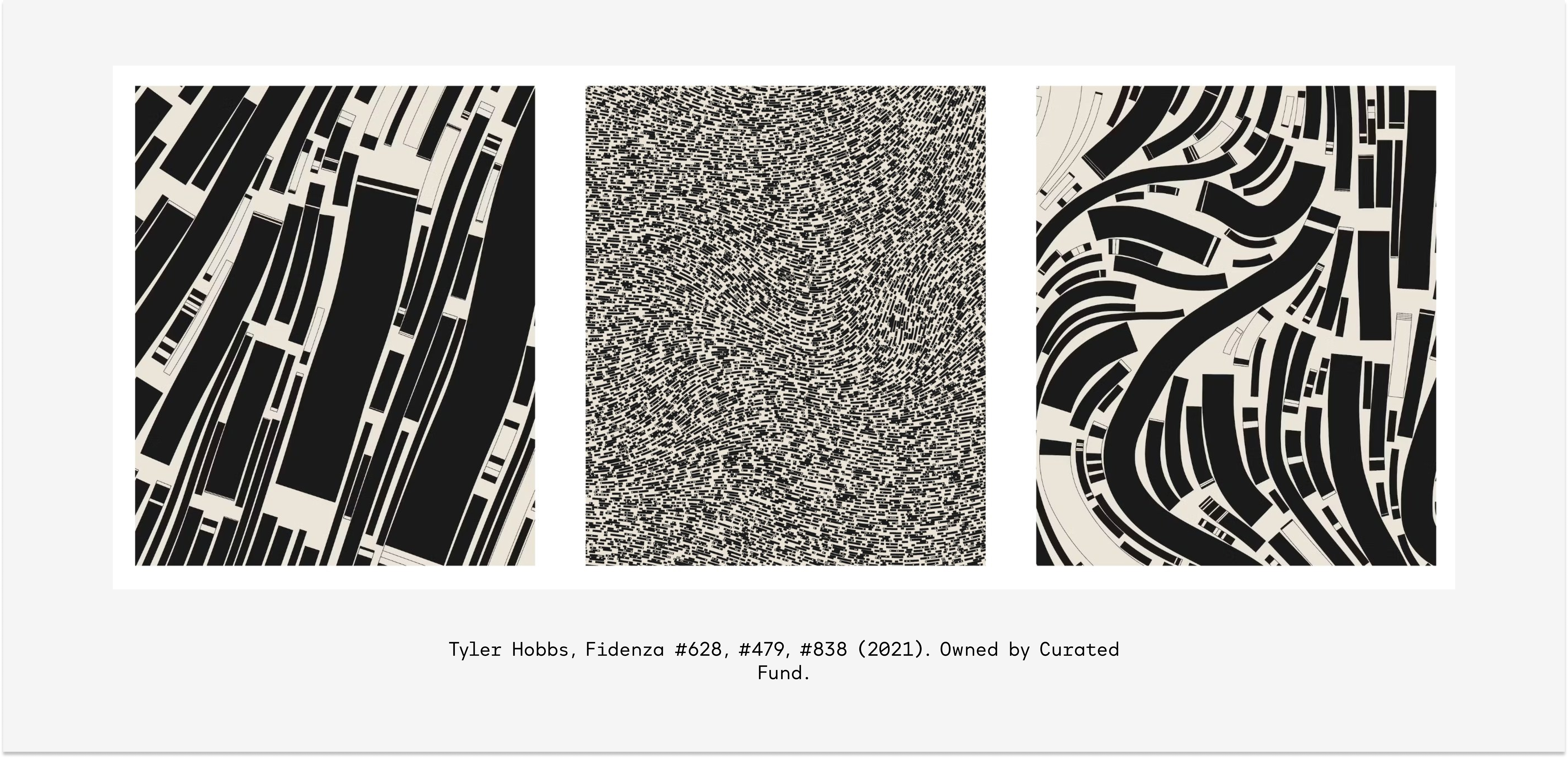
To date, Curated Fund has built one of the most thorough collections of digital art. The collection includes 24 Fidenzas, clearly curated to showcase the full scope of the algorithm, with a specific preference for rare works. Together with two other outputs, the micro-uniform Fidenza #479 forms a triptych in the monochrome subsection of the collection.
When asked about their approach towards collecting Fidenza, the fund’s founders explained:
“Collecting Fidenzas helped us refine our curatorial approach to collecting generative art algorithms. We always want to collect a set of artworks that are not only individually stunning, but together provide the best representation of a generative system. Each work we collect needs to be aesthetically pleasing. For Fidenzas, we value pieces that have good composition and balance. The majority of our Fidenzas have more common traits and fall squarely in the center of the algorithm. We’ve also been able to collect rarer edges of the algorithm, including white monos, unique palettes, spirals, and micro-uniform Fidenzas – including, of course, Fidenza #479, the black micro.”
Fidenza #479 is one of only two micro-uniform Fidenzas in the “Black” palette. The abstract composition displays a random distribution of small black and white rectangles that exhibit the typical flow field curve pattern, imbuing it with an organic feel.
The other two works in the diptych (#628 and #838) complement the piece as works with a “jumbo” scale and medium to low degrees of turbulence. Viewed together in a triptych, these works almost seem to evoke a sense of containment, as if the larger rectangles were details extracted from the micro-compositions.
Today, Fidenza stands as a pioneer on-chain generative art collection, as well as a testament to the evolving landscape of generative art history and creative coding.
Tyler Hobbs’ meticulous design choices, paired with the adaptability of the algorithm, exemplify the symbiotic harmony that can be achieved between machine and human. The interplay of technical precision and artistic intuition in Fidenza also reflects the broader trends shaping the future of creative coding, where artists leverage algorithms not just as tools – but as true collaborators. +
—
1. https://www.rightclicksave.com/article/an-interview-with-tyler-hobbs-part-1
2. https://www.rightclicksave.com/article/an-interview-with-tyler-hobbs-part-1
3. Tyler Hobbs, “The Importance of Generative Art,” https://tylerxhobbs.com/essays/2021/the-importance-of-generative-art
4. Quote from: https://outland.art/tyler-hobbs/
0x6e2F···aceE## Artist: Roope Rainisto
## Object: Life In West America
## Collector: rhyd0n
## Frames of Reference
Author: Malte Rauch
Editing: Madison Page, Derek Edwards
Date: January 1, 2024
Artist Interview: [Artist Interview](https://amber-electric-snail-94.mypinata.cloud/ipfs/Qmd8EzBy6Z7JHYru1B8nVP25yvtcicJuQ4L8LqZGXGi2eT)
Oftentimes in artistic spaces, acknowledgement of a work’s cultural importance unfolds over time.
In other moments, there is early recognition.
Roope Rainisto debuted “Life In West America” in February 2023, and with it, a seemingly new milestone in the advent of machine-assisted creative work was reached. Almost instantaneously, the AI-generated collection sliced through the stream of artificial media flooding our collective digital spaces.
Rainisto’s innovations didn’t just include the novel use of a (then) new high resolution diffusion model to create the collection’s images – a tool that had just started to gain widespread recognition amid the year’s mainstream interest in AI.
Rather, the collection’s strength emanated from the seemingly differentiated language distilled from these models – a cohesive collection of work that possessed a peculiar mix of comforting familiarity and unsettling historical fiction.
“Life In West America”, or LIWA, is a collection of 500 AI-generated images.
At first glance, the outputs reflect the tradition of documentary photo books, presenting stereotypical Americana scenes rooted in the 1960s milieu of Cadillacs, blue jeans, and diners.
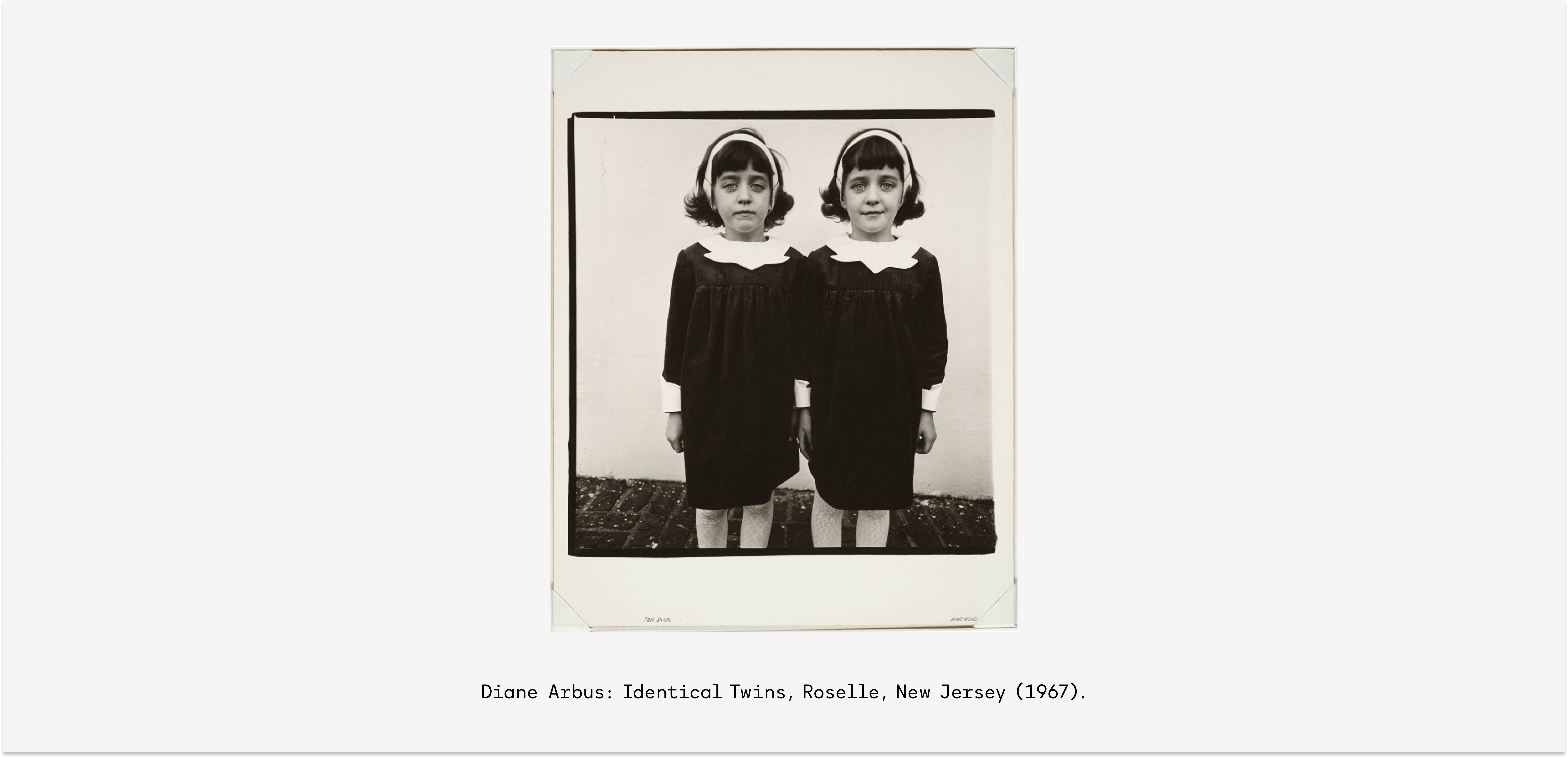
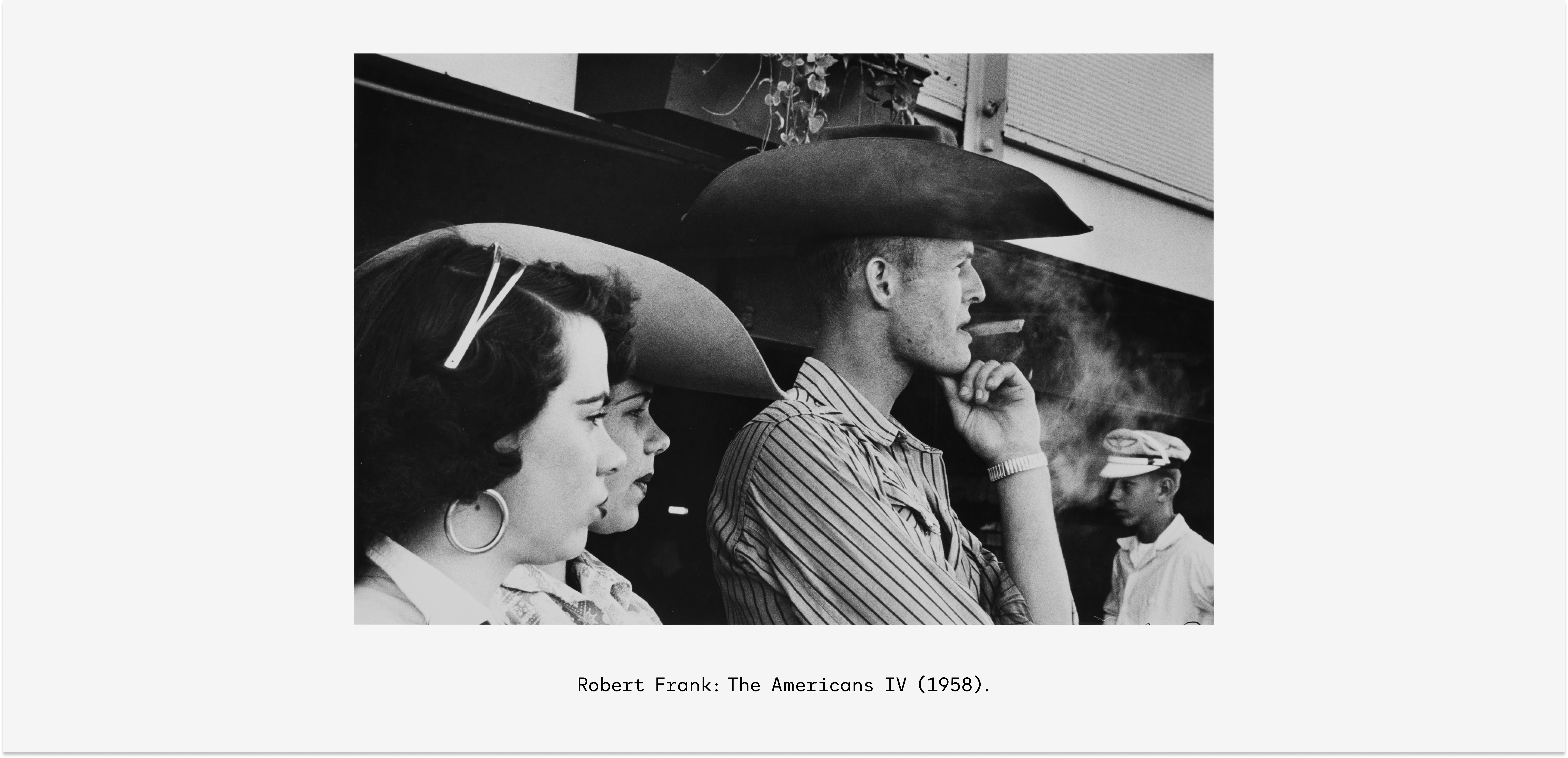
LIWA subtly echoes the works of Diane Arbus and Robert Frank’s “The Americans” (1958) – works that capture American society in the medium of photography.
In the introduction to the latter work, the writer Jack Kerouac praised the “humor, the sadness, the EVERYTHING-ness and American-ness of these pictures,” <sup>1</sup> a description that could be equally applied to the lives being lived in Roope’s “West America.”
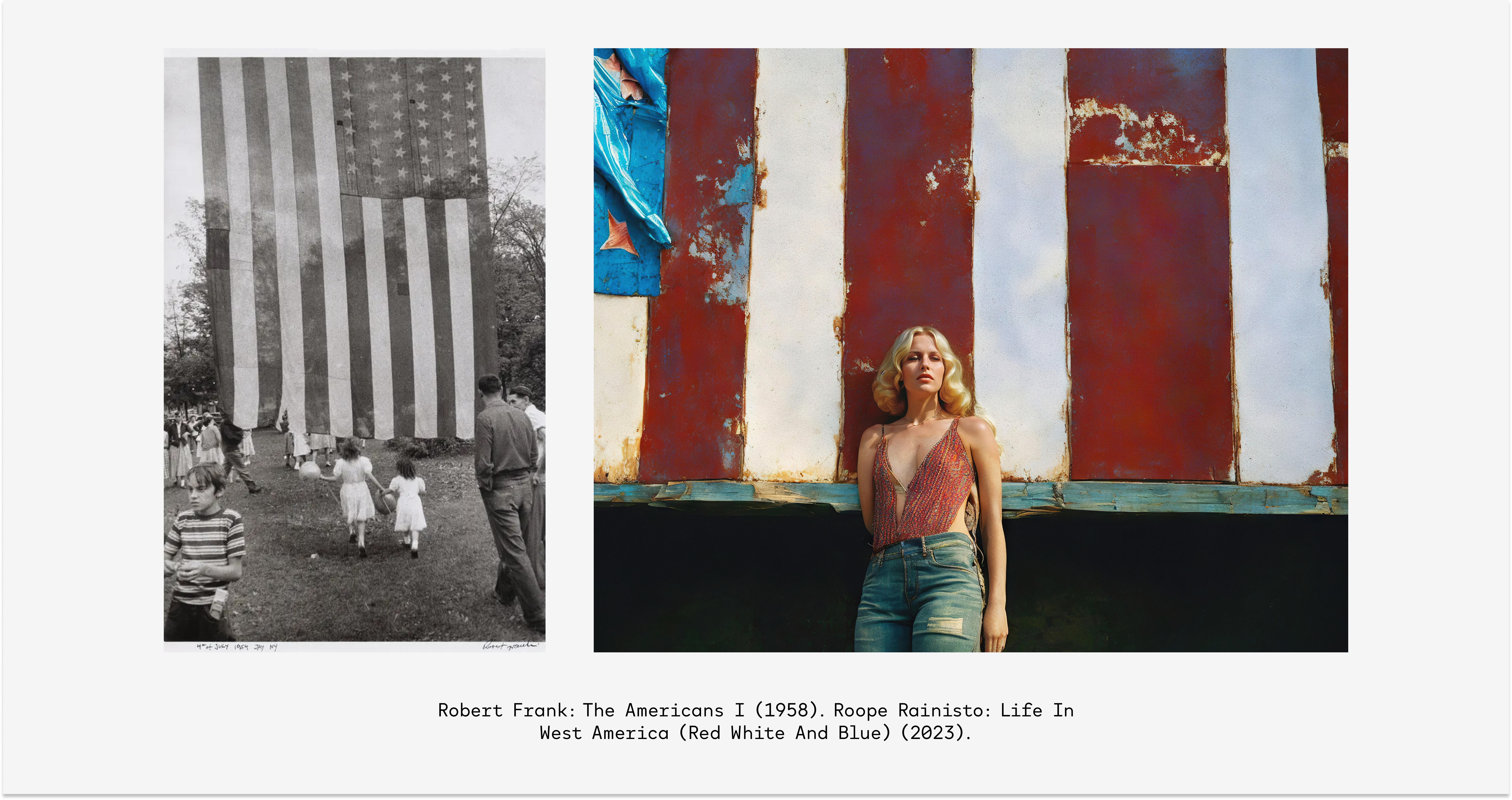
However, Rainisto’s work does more than revisit a distinctly American aesthetic with a sense of nostalgia. It reimagines it as a symbolic register for storytelling, using synthetic images to evoke emotional responses. To a global audience, “Life In West America” offers a sense of déjà vu, of recognition or, perhaps, a vague recollection, of the cultural versioning of America depicted over history.
While LIWA’s specific imagery may be fictional, the cultural fragments they’re composed of are not; simply, hints of each output are woven from the pop culture fabric that trained the generative model.
And yet, how could Rainisto, a Finnish artist, perfect this essentially American aesthetic?
This traditional American aesthetic, largely the product of advertisements and media idealizations, has been consumed worldwide for generations. For the same reason, this collection resonates and evokes emotional responses from audiences outside the US.
The expansive scope of the collection, encompassing various settings from intimate spaces to workplaces, underscores its lineage within the documentary photography tradition. LIWA zeroes in on social life, a perspective also evident in the traits of the collection, grouped by the artist in different ways the collection’s fictional subjects relate to one another in space (union, trinity, cluster, void).
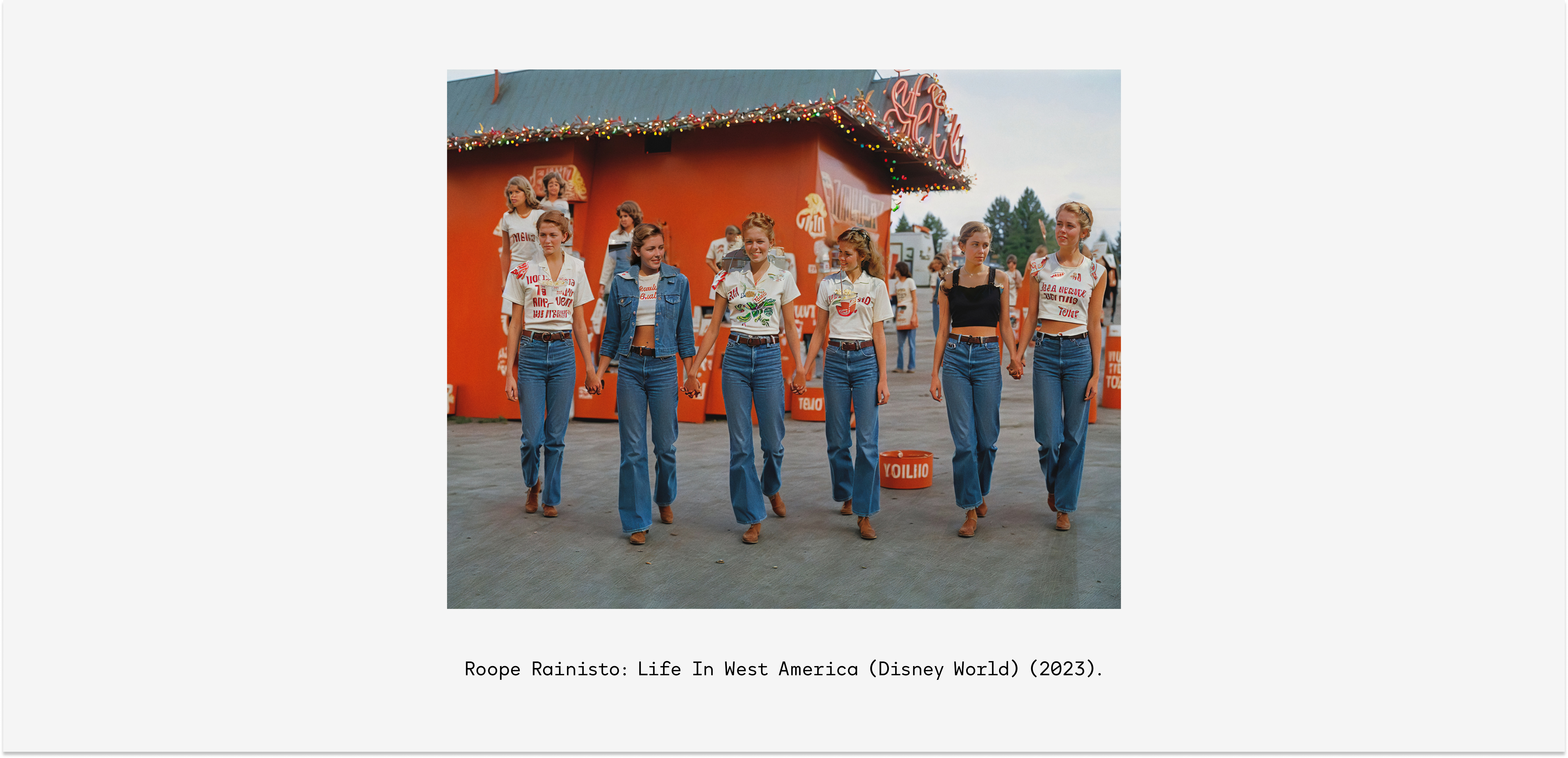
The refraction through AI is most evident in the glitches typical for diffusion models of the last few years – disfigured hands, misplaced body parts, fractured perspectives. These flaws disrupt the purely photographic nature of the project, infusing the foreign element with a surreal and occasionally grotesque character.
Rainisto’s deliberate selection of these anomalies showcases their potential for artistic impact, enabling the artist to simultaneously reference and estrange the documentary aesthetic.
## Life After Photography?
Remarkably, while Rainisto’s work nods to the documentary aesthetic of a past era, it concurrently serves as a contemporary chronicle, documenting the aesthetic evolution of advanced diffusion models. Such models start from a pattern of random noise and gradually refine it into a coherent picture, effectively “imagining” a text input. While earlier, groundbreaking AI works like Claire Silver’s “Genesis” poetically rendered the emergence of form from noise, <sup>2</sup> LIWA captures the last remnants of formlessness in generative images, documenting an era of transitions before image production is dominated by flawless models – a reality fast approaching.
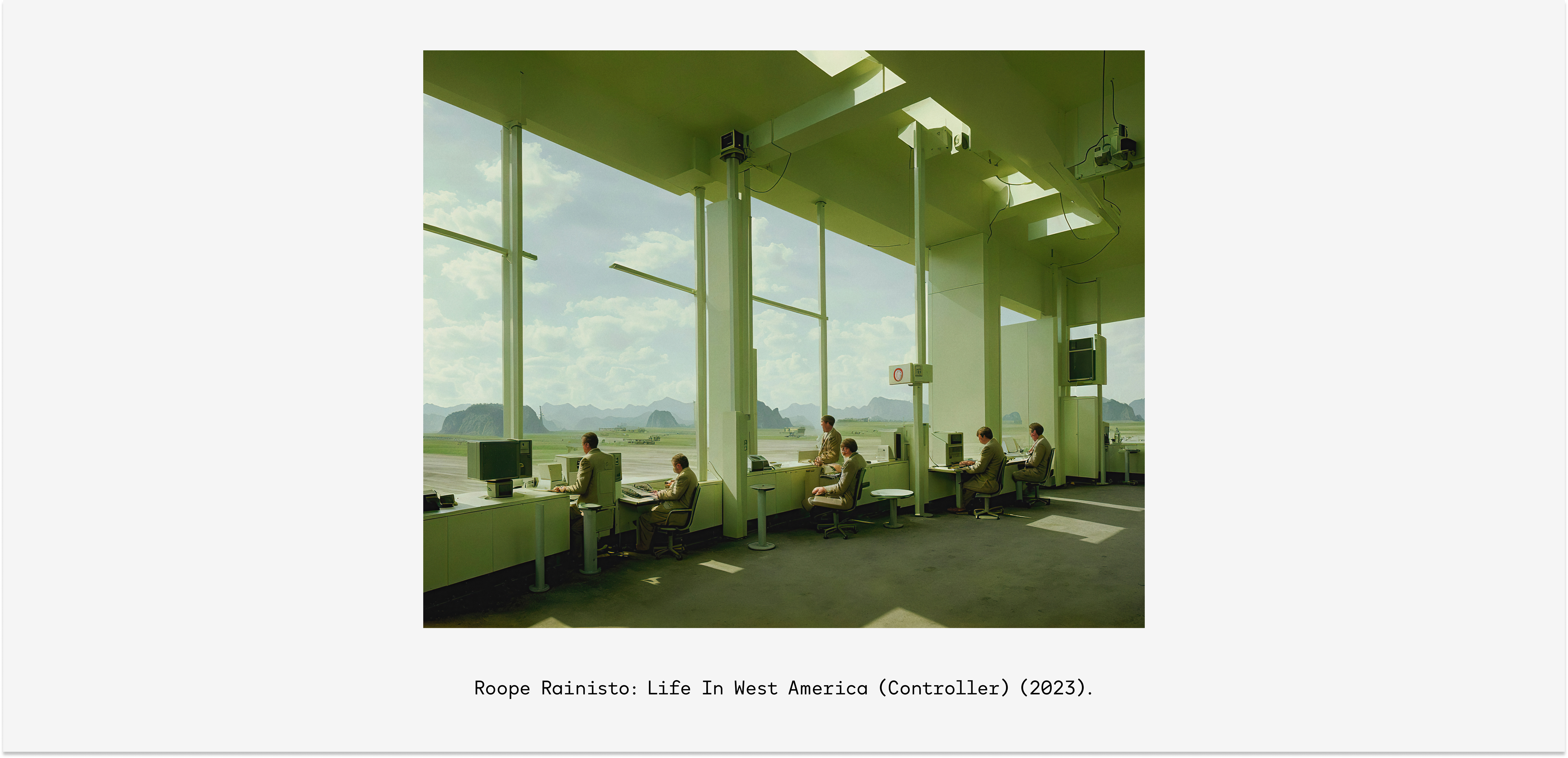
The transformative potential of generative AI in image-making is already evident. This gallery believes that the significance of Rainisto’s work will persist far into the future, as the impact of this technology broadens. Put simply, collections like “Life In West America” are poised to be recognized as among the earliest and most artistically significant explorations of this nascent technology.
Notably, the term that emerged in early 2023 to describe this work is “post-photography”.
Photography has always stood in relation to the material world, which it captured first on light-sensitive plates and eventually through digital detectors. Post-photography was intended in the sense of a technological era “after” photography, understood as a referential medium.
Post-photography does not picture the world. Rather, it imagines it based on a synthesis of existing images of the world. Such a form of image-making, the category of implies, severs the “direct” relationship to the world while retaining a connection to the visual language of photography.
There’s an inherent irony in considering that the term “post-photography,” conceived a decade prior to describe the work of artist-photographers navigating a digital world saturated with images,<sup>3</sup> is now applied to artistic work that has been described as an extinction event for art photography.
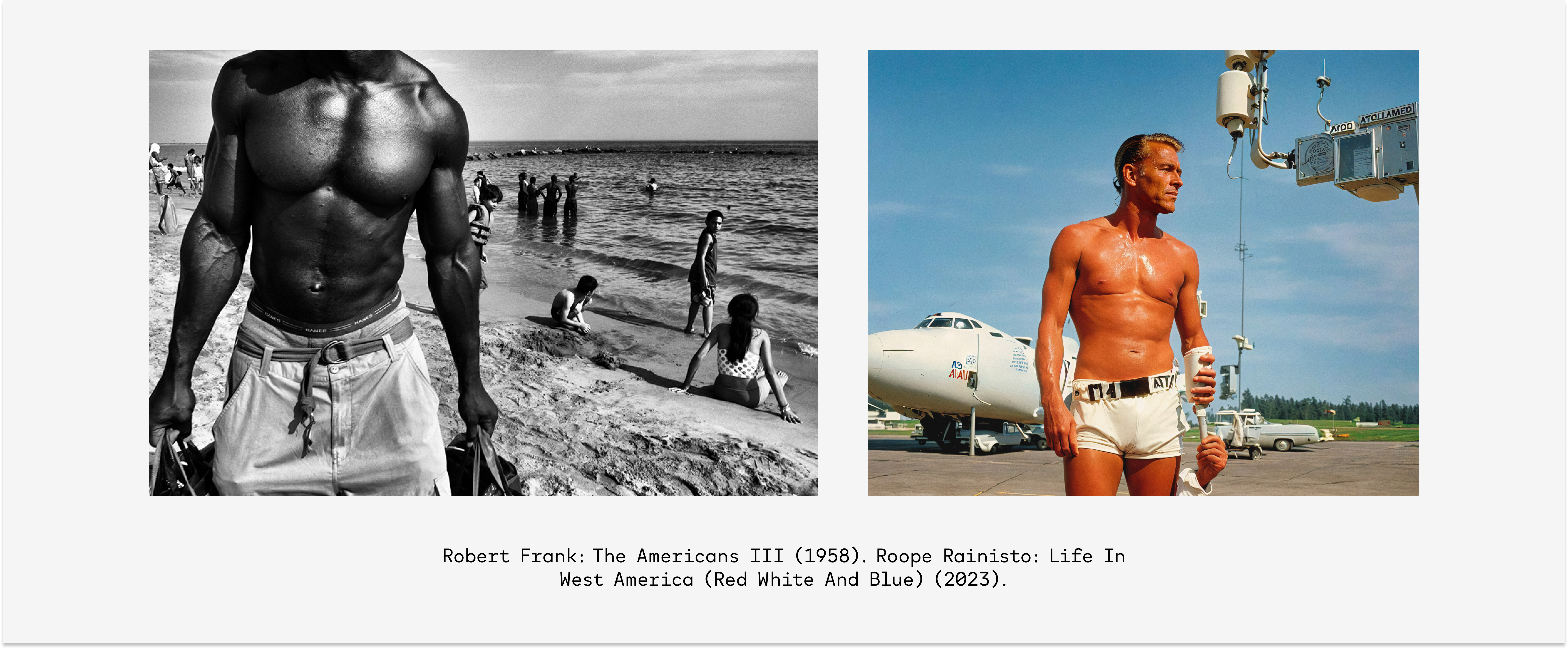
While it appears too early to find definitive categories for an evolving body of work, the notion of “post-photography” seems adequate insofar as it highlights the references to the photographic medium with regard to composition, lighting, and perspective.
As Alejandro Cartagena rightly points out: “[T]he computer models understand framing photographically […] These models are looking at images, and the most predominant type of image out there is the photograph.” <sup>4</sup>
For this reason, the critical appreciation of these images can continue to view them as part of the tradition of photography.
## Parallel Reality
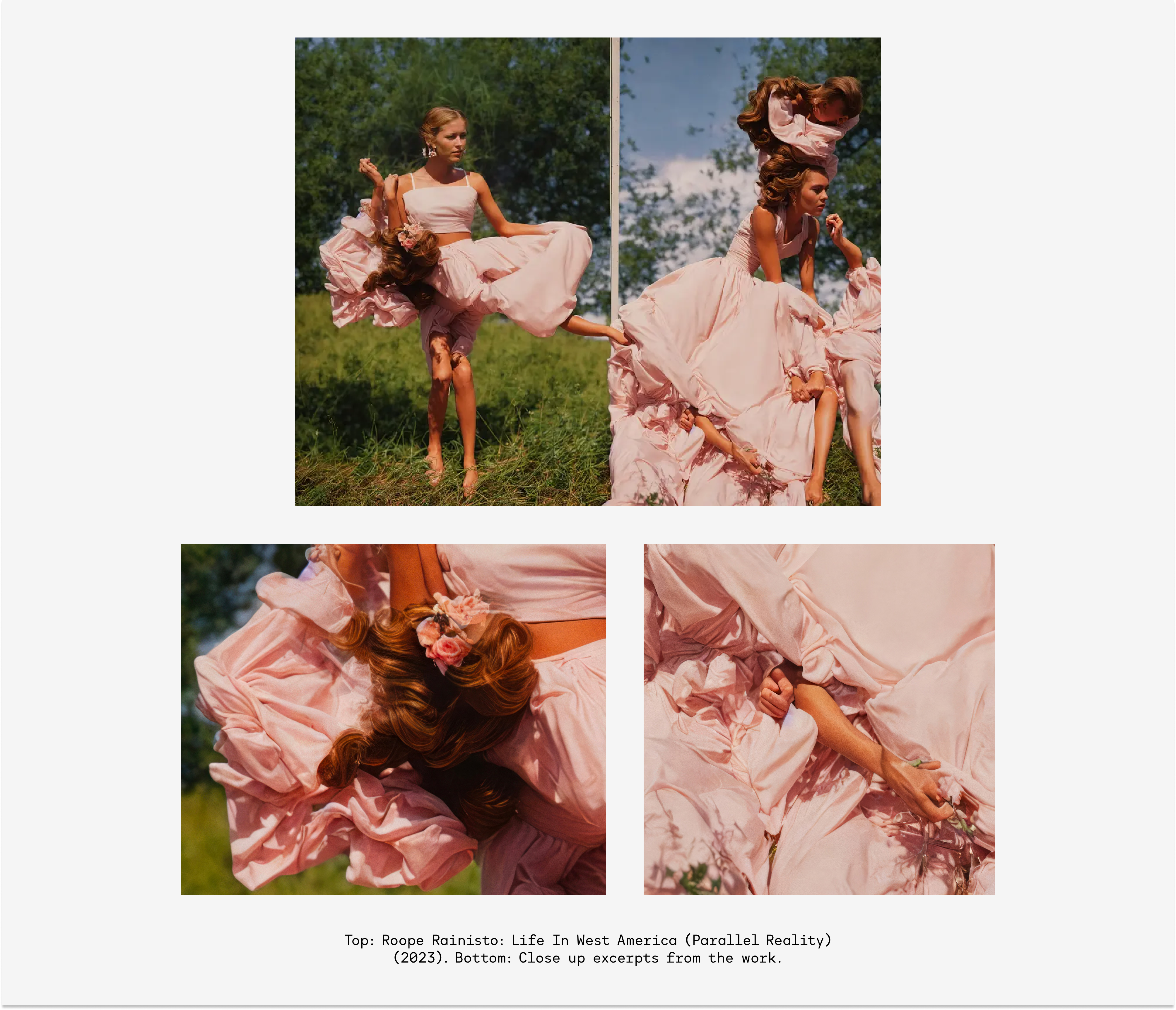
This month’s Every 30 Days exhibition features “Parallel Reality” from the “Life In West America” collection, showcasing a divided image reminiscent of a diptych’s form.
The twin rectangles border each side of the image, providing a sense of balance and framework.
According to the artist, it is LIWA’s only intended diptych in the series.
Each segment features a young woman, clad in pink, ensnared in a tumult of fabric, with additional hands and legs in disarray. The entire image is constructed in such a way that the viewer’s vision naturally gravitates towards the faces, which stare out of the image.
It is upon a second glance that the viewer becomes aware of the extent to which the image is populated with distorted shapes. Further contemplation reveals that the left and right sides are depicted from distinct perspectives. In this manner, the composition leads the observer from an initial perception of order to an appreciation of the underlying layers of disorder and noise.
Through its defects, the image deliberately reveals itself as artificially “made”.
The women’s poses, reminiscent of conventional photo shoots, are rendered with the polished aesthetic typical of high-gloss imagery. Such an eroticized portrayal, aligning with the standardized ideals of “feminine beauty”, is a predictable outcome for works derived from
training on existing pop culture visuals and should not be mistaken for an endorsement of it.
By relying on the conventions that are characteristic of photography, the image appears familiar at first – we have all seen countless images with similar poses.
Yet, such a display of “feminine beauty” is rendered absurd due to the exaggerated traits, and displaced fragmented body parts – hinting at the absurdity latent in this “American ideal”.
Unlike the violent depictions of body parts found in the works of Surrealist artists such as Hans Bellmer, however, this arrangement incorporates the visual turmoil into the scene, portraying it as an unexpectedly seamless shift from structure to disarray.
This “layered” composition thereby attains its unique sense of surrealness – the revelation of the profoundly unusual within the ordinary. The familiar aspect is our acknowledgment of the photographic and societal norms the models are trained on, while the remnants of raw chaos strike us as odd and non-human.
LIWA is a study of American types, tropes and myths. The collection presents a grotesque idealization of the female body as one such myth, yet it refrains from imposing a specific evaluation of this myth upon the viewer. Commentary occurs here by questioning the viewer’s perception. How familiar does this “parallel reality” appear? How ideal? How grotesque? And what does this say about our visual culture?
## The Value of Artificial Images
Generative AI is touted as a means to democratize creativity by unbundling the relationship between mastery of techniques and the artist who creates them. However, the more one encounters AI-generated art, the more distinct LIWA seems.
This distinction arises because the “amateur” use of AI tools often exhibits similar limitations seen in amateur work across other mediums: recurring themes, unbalanced compositions, and overly derivative styles, among others.
By contrast, Rainisto, a practiced photographer for decades, accomplishes with LIWA a true tour de force in photographic composition – as well as a masterful use of the characteristic AI glitches. The collection suggests that the proliferation of AI-generated images, rather than homogenizing creative expression, will emphasize the scarcity of high-quality work and the limited expanse of human attention.
As the influence of AI in society and culture grows exponentially over the coming decades, this gallery believes that value will concentrate and amplify where exceptional artistic quality is coupled with the scarcity of digital objects.
“Life In West America” is among such work.
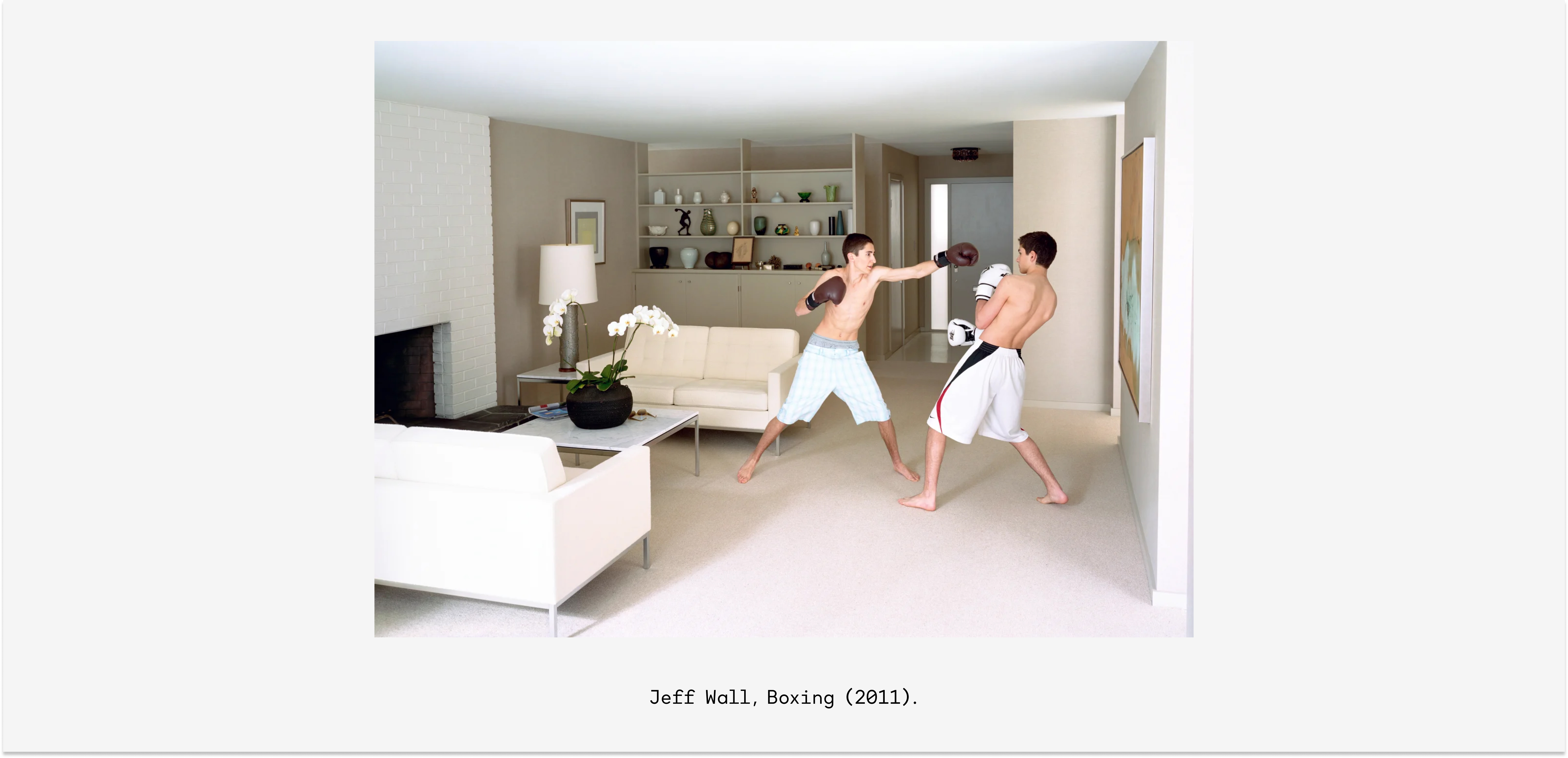
Generative AI might be viewed as a vast amalgamator, collapsing various media, styles, and references into a generalized eclecticism.
However, the distinct characteristics that have evolved within specific disciplines like photography remain vital for an artistic practice such as Rainisto’s. Despite the all-encompassing nature of generative AI, the nuanced elements and traditions of individual mediums continue to play a critical role in shaping and defining the art that emerges from this new technology.
Each of LIWA’s 500 pieces are distinct, yet they collectively exhibit an exceptional thematic harmony.
This coherence not only fosters the same kind of network effects that have solidified “long-form” generative art collections as a standalone media genre, but also allows the collection to construct a world that feels narratively structured.
Despite the fact that Rainisto’s work eliminates all attributes that have traditionally been associated with photography, it thereby opens a new function for “photographic” storytelling and documentation.
Ultimately, Rainisto’s LIWA offers a depiction of American society – not as it was, but as it chose to represent itself. The collection is a documentary and fiction delving into the dreams, archetypes, and fears ingrained in America’s visual self-portrayals, refracted through the lens of AI.
In this way, LIWA serves as a broken mirror; it doesn’t reflect our actual image but rather a prism of all the images we have consumed, documenting past archetypes and the visual language of a future already underway. +
—
1. Jack Kerouac, “The Americans: Introduction,” available at https://oscarenfotos.com/wp-content/uploads/2012/05/p1_americans_intro.pdf
2. https://www.glitchmarfa.com/e30dgallery/genesis/
3. Robert Shore, Post-Photography: The Artist with a Camera (London: Laurence King Publishing, 2014).
4. Cited in Giden Jacobs, “A.I. Is the Future of Photography. Does That Mean Photography Is Dead?,” available at https://www.nytimes.com/2023/12/26/opinion/ai-future-photography.html
0x6e2F···aceE## Artist: Deafbeef
## Object: First First
## Collector: Chris F
## Clean Slate: Deafbeef’s First First
Author: Malte Rauch
Editing: Madison Page, Derek Edwards
Date: December 1, 2023
Artist Interview: [Artist Interview](https://amber-electric-snail-94.mypinata.cloud/ipfs/QmdL54295YNYnaST7SmN7Cx6h5LeBFYaADPd7yqFua9uKr)
In September 2021, during crypto art’s first mainstream frenzy, Canadian-born artist Deafbeef released First First. The generative collection is the largest edition series created by
Deafbeef.
It may also be his least understood work.
The concept is simple – 5,000 digital objects featuring white text over black background. Each object’s words, created through an on-chain generative process, display a fictional news event as a categorical first event for crypto art.
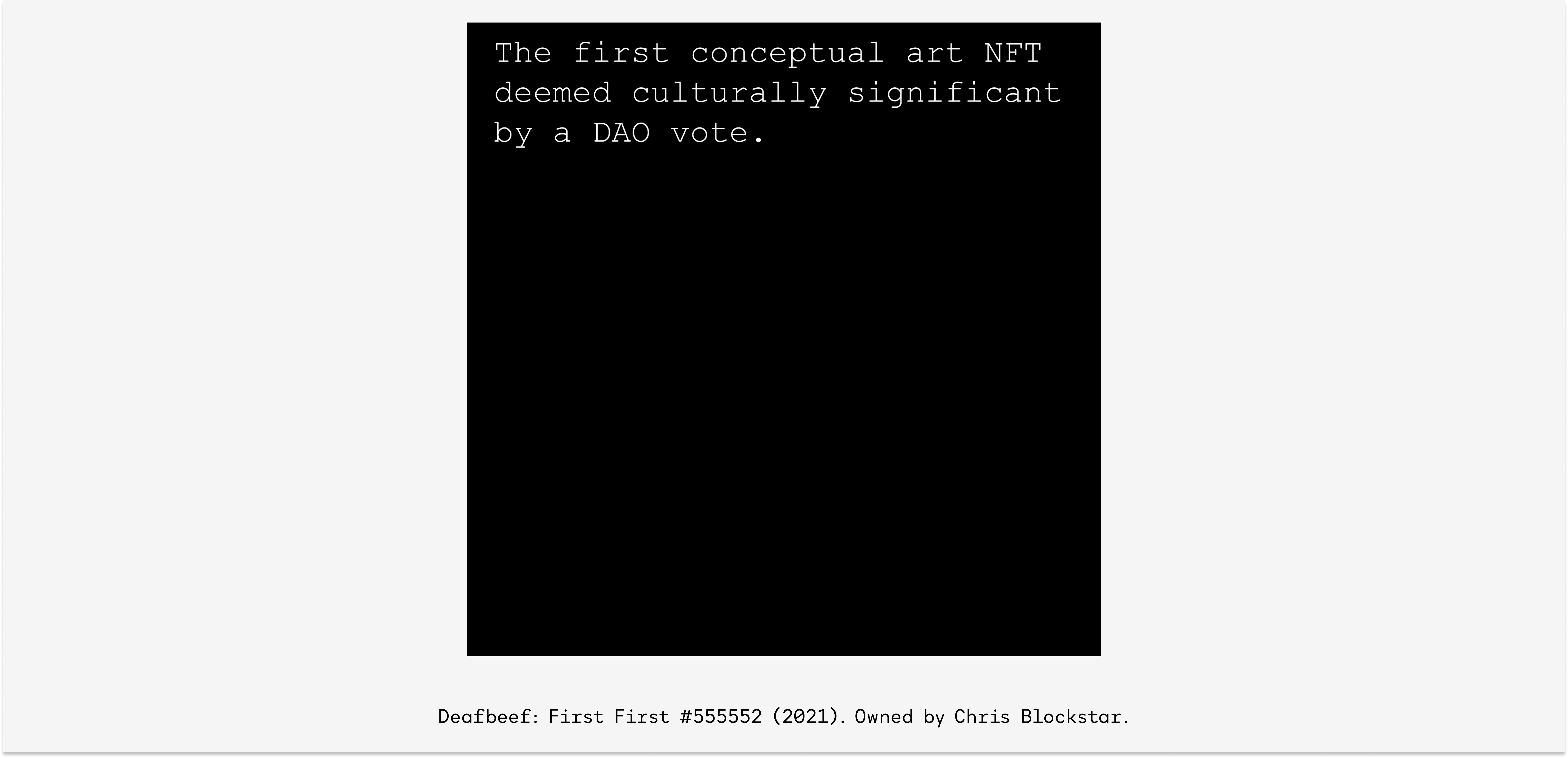
In each of the 5,000 outputs, the text is generated directly by the smart contract, with the syntactic elements (nouns, adjectives, and clauses) stored within the contract’s memory. Subsequently, the phrases are generated by the tokenID, which serves as a seed for producing each sequence of pseudorandom numbers.
Utilizing a so-called context-free grammar, consisting of if-else statements weighted probabilistically, a Solidity function deterministically creates the final text for each object.
Last, this string converts into an SVG and output as a data URL. Importantly, the contract does not rely on external resources or images for rendering. The process is entirely self-contained within the smart contract.
At once satire and fictive documentary, First First captures the convergence of cultural breakthroughs happening across both the NFT space and the ‘everything bubble’ that categorically defined Summer 2021. The collection of 5,000 objects is, perhaps, the best snapshot of this moment available in the medium of crypto art.
Appropriately, the contract describes the work in a self-referential fashion as the “first satirical on-chain generative text NFT about NFT firsts,” emphasizing (and questioning) its own contribution to the cultural environment in which it was released.
While First First reads as both a satire and commemoration of the crypto art space at its speculative peak, the austere and often overlooked work is one of the most fascinating windows into Deafbeef’s acclaimed practice as a whole.
### Austere Aesthetics
Despite entering the crypto art space deep into the 2021 cycle, Deafbeef quickly became one of the most thoughtful and respected crypto artists. With 20 years of experience across varied fields like electrical engineering, sound production, computer graphics and blacksmithery, Deafbeef grasped the Ethereum Virtual Machine’s potential as an artistic medium in its own right.
From the start, Deafbeef showcased a remarkably consistent artistic language across his projects. He developed a distinctive approach to the concept of “on-chain” digital art, opting for self-contained systems in C, a low-level programming language directly stored on Ethereum. Creating from a clean slate, unfettered by external dependencies or ready-made tools, Deafbeef was able to create remarkably coherent artistic language, singular in its expressiveness.
The artistic world that emerges from Deafbeef’s constraints appears closely intertwined with the machine, presenting a retro-futuristic landscape in grayscale, featuring ASCII characters and elements from signal processing. The impression conveyed by these artistic worlds is that limitations can be a style.
If you make them so.
No ornament, no decor, no triviality. Deafbeef’s work aligns with a tradition of artists who pursue an aesthetic of reduction and constraint – possessing a kind of solitary purity, reminiscent of the monochromatic painters, like Ad Reinhardt or Robert Ryman.
Deafbeef released his first work, “Series 0 - Synth Poems,” in March 2021.
This on-chain, audio-visual piece utilizes FM synthesis and XY oscilloscope visualization and minted in a limited edition of 128. His subsequent five works, also low-edition generative audio-visual projects, further developed his austere aesthetic and independent approach to on-chain storage. After the release of the sixth work in July 2021, these pieces were collectively referred to as the first volume.
[Watch DEAFBEEF AudioVisual Montage on YouTube](https://youtu.be/UwDdspefGkM?si=z7hO60D7GKioAkwU)
Akin to the sequencing of music on a record, Deafbeef’s sequential ordering of the projects underpin the coherence of this body of work, thus setting up a dialogue between them. These limited series have attracted one of the most loyal and dedicated groups of crypto art collectors today.
In November 2023, Deafbeef ventured into a uniquely performative IRL mint with “Hashmarks”.
As part of the Bright Moments chapter in Argentina, he released 100 unique hand-forged iron sculptures and cryptographically linked digital objects. Collectors selected the sculptures at the end of a communal trip to the ‘end of the world’ in Patagonia, a performance that highlights the artist’s growing interest in the intersection of digital, natural, and social systems.
The first and last thing to say about Deafbeef’s art – it demonstrates unity of the highest degree. His work adheres to a stylistic and almost atmospheric consistency, one that links all of his diverse projects. Feeling as though cast from one piece, emergent from the same austere monochromatic source.
### Conceptual Constraints
The role of constraint in Deafbeef’s work, and in First First in particular, invites a general discussion of the notion of conceptuality in contemporary digital art.
In the visual arts, the polymorphous notion of the “conceptual” in art is used to describe two interconnected yet distinct phenomena.
In a general sense, it refers to elements in art that transcend the merely aesthetic, moving towards an intellectual content. This general understanding of conceptual art is often traced back to Marcel Duchamp and other early 20th-century avant-garde artists, although they never used this terminology.
More specifically, it is used to describe a specific movement in the 1960s that introduced the term and sought to dematerialize the art object to frame it as linguistic or ideational. The central prepositions proclaimed by this movement was that ideas alone – independent of individual mediums or genre – can be works of art.
Deafbeef’s work is far too technical to be understood entirely as a response to the latter, yet the strict focus on language in First First invites a comparison to the role of language.
The core of conceptual art in the 1960s: “art without space”, art that would be entirely dematerialized and object-less. Artists such as Lawrence Weiner, Robert Barry, and Joseph Kosuth pushed the “art object” increasingly further in the direction of a pure statement. Curator Seth Siegelaub brought this tendency to its logical conclusion by organizing an exhibition that took place only as a catalog.
The development of conceptual art into a ‘pure’ language-based form was a key event in 20th-century art history. It demonstrated art’s ability to transcend traditional visual aesthetics, proving that art is not confined to any particular form or medium. However, the shift towards viewing art as a language eventually reached a kind of impasse, restricting art to a singular domain despite the liberatory impulse.
This concept of visual art as language, once radical in the 1960s, has lost its force in the visual arts today.
However, when Deafbeef released a series of restrained black and white text works in September 2021, this approach resonated with the earlier sense of radical reduction – coming, as it did, at a time when staggering sums were being spent on digital objects.
And yet, the emphasis on text in Deafbeef’s work does not suggest gestures of dematerialization — an idea that seems amusingly inappropriate for code-based digital objects stored on a decentralized database. Instead, the turn away from the aesthetic surface and towards language serves as a gesture of interrogating meaning and value at the speculative peak of hype.
Aesthetically, First First is inspired by Loot, a mint-from-the-contract gaming project that featured digital objects as “adventurer gear” released shortly before First First. The fervor and speculation that accompanied Loot led to a zenith in mania that saw the humble collection dominate headlines and venture portfolios. As an artist caught up in this frenzy, Deafbeef utilized First First as a conceptual mirror, processing his own experiences of excitement and bewilderment.
### Language Machine
In contrast to the 1960s version of art as language, First First also refrains from treating language as a reality in its own right. Instead, it subtly explores the system-based nature of language itself.
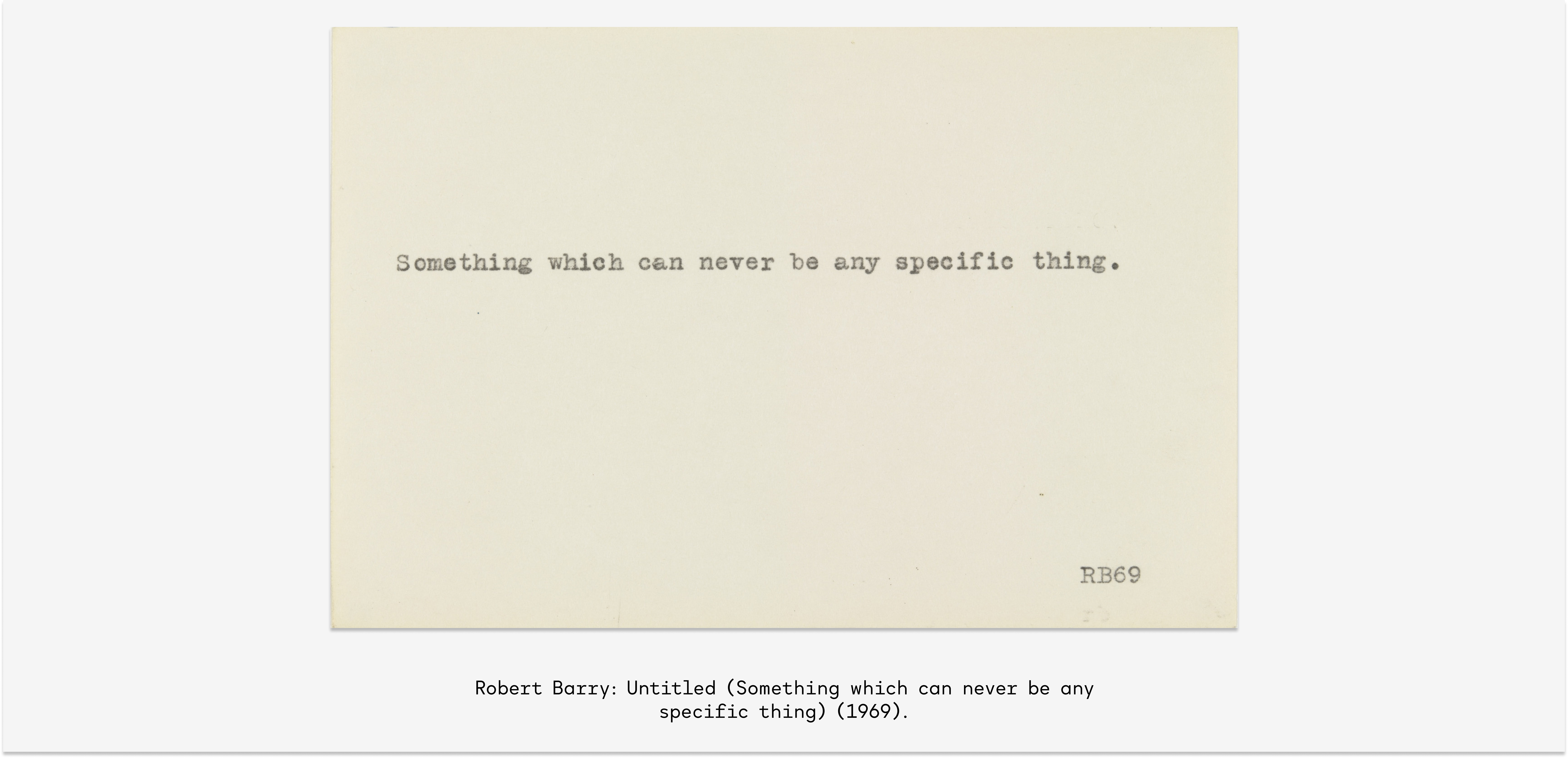
Language is a combinatory system, akin to a machine that generates meaning from elements that, individually, lack inherent sense. Meaning arises not from intention (from what one means) but from the relation of these elements within a system.
As previously mentioned, First First utilizes a context-free grammar, employing a series of if-else statements with weighted probabilities. The structure comprises three components:
(1) “The first” + (2) “(zero or more descriptive adjectives) NFT” + (3) “several different templates of qualifiers”.
A few hundred basic elements in (2) and (3) enable the generation of a vast range of assertions, spanning the spectrum from common sense to complete nonsense.
By defining a finite set of grammatical elements and randomly assembling them, the work creates a multitude of possible fictive “firsts”. The concept of being “first” holds a distinctive significance in Western culture. The first instance sets the paradigm, establishing an authoritative origin, an idea that goes back to the Greek word “arche,” which intriguingly means both “first principle” and “command.”
Digital art collectors have come to appreciate the phenomenon of emergence in generative art. In First First, one encounters a different type of emergence – not the manifestation of intricate compositions from simple rules, but the generation of fictitious worlds from language.
Thanks to its world-building power, the project is reminiscent of the experiments in literature by writers such as Raymond Roussel, who used mechanic, phonetic rules to create nonsensical poems and narratives, or Jorge Luis Borges, who in “The Library of Babel” imagined the concept of an infinite library, housing every possible combination of letters, spaces, and marks, effectively containing all sense and nonsense.
Despite encompassing a book’s worth of text, it’s unlikely anyone has read all the ‘firsts.’ Through its vast array of nonsense, it captures the cognitive dissonance of summer 2021, also reflecting on the arbitrary assertions that accompanied the hype.
However, perhaps the series’ most miraculous aspect is that its generative, senseless announcements have exceeded the function of commentary and partly forecasted the future.
In fact, Deafbeef frequently uses objects from the collection to comment on crypto art’s evolution. He connected “The first animal themed PFP NFT redeemable for a coupon at Walmart” <sup>1</sup> to the launch of Pudgy Penguin merch at Walmart.
Later, he responded to the by-now notorious “Beef Brothkos” exhibition by Die With The Most Likes at glitch Gallery with “The first edible dick pick NFT to be sold at a flea market.” <sup>2</sup>
Every event, no matter how absurd, seems to have been anticipated in Deafbeef’s encyclopedia of insane generative firsts.
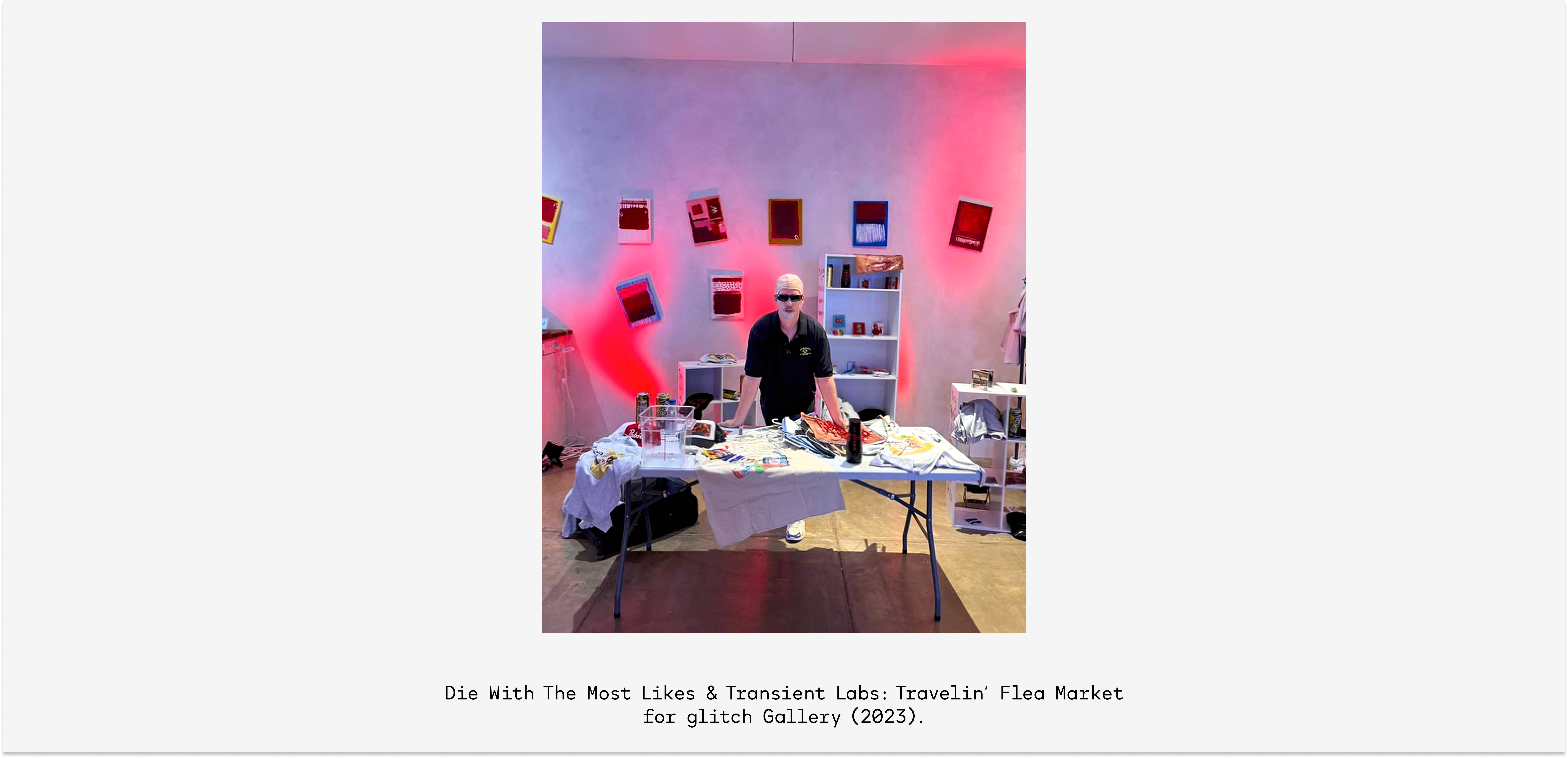
As this month’s Every 30 Days collector and Flamingo DAO member, Chris Blockstar notes:
“Initially, I viewed First Firsts like everyone else as parody and commentary on the NFT space, but its endurance has revealed there’s a lot more to it. Now, it can be viewed as a worldbuilding project using text and memetic distribution as a cultural operating system.
Each time we see a First First made real, the project further crosses a liminal boundary from fiction to fact.
It’s in this constant state of becoming, not through development or active guidance, but by having created space for a First to realize itself. It’s a very clever piece of performance, capable of claiming the insanity of our space as its own design simply by conceptualizing an outcome before it happens. There’s something emergent and wonderful here that we haven’t seen with any other NFT project. It stands alone.”
It is unlikely that the contemporary art world would afford an artist – one on a conceptual and technical level as Deafbeef – the freedom to develop his work.
The fact that the community of crypto art collectors has championed him is one of many testaments to this space turning into a context where some of the most conceptually advanced works of art are produced today.
Deafbeef is unique. His work stands alone.
In many respects, the sum of his previous creative efforts are considered by glitch Gallery to be among the finest artistic works produced in this space.
They won’t be his last. +
—
1. https://x.com/_deafbeef/status/1718662522234892673?s=20
2. https://x.com/_deafbeef/status/1706361819810447639?s=20
0x6e2F···aceE## Artist: Emily Xie
## Object: Memories of Qilin #600
## Collector: Bob Loukas
## Chimeras of Qilin: Emily Xie’s Memories of Qilin
Author: Madison Page
Editing: Malte Rauch, Derek Edwards
Date: November 1, 2023
Generative artist’s Emily Xie’s work is a meditation on inconclusive questions:
What is organic material in light of the computer and blockchain era? If code can show organic qualities, can it be organic? Playing between the figurative and symbolic, anecdotal and historic, old and new, Xie invites viewers to live in such paradoxes in November’s Every 30 Days Exhibition: “Memories of Qilin” (2022).
To start, consider the collection title.The qilin creature is the East Asian rendering of a chimera. Chimeras take on various parts of different animals to complete a miraculous, folkloric, contradicting existence. Versions of the mythical beasts weave their way across time and culture, with records suggesting they first appeared in art and texts from Lycia and Asia Minor between the 15th-14th centuries BC. <sup>1</sup>
Understood as a symbol for luck and good fortune, today the qilin appears on coins, visual motifs for Asian brands, contemporary iconography, and cultural objects alike. According to folklore, qilins are part of the four auspicious spirits in Chinese mythology. Kind hearted, noble and virtuous, the qilin materializes in peaceful and prosperous places, even aligning with Chinese philosopher Confucius himself. In some lore, Confucius witnessed a qilin’s birth and death; thereafter the qilin symbolized a sage-like role with its ability to predict the future. <sup>2</sup>
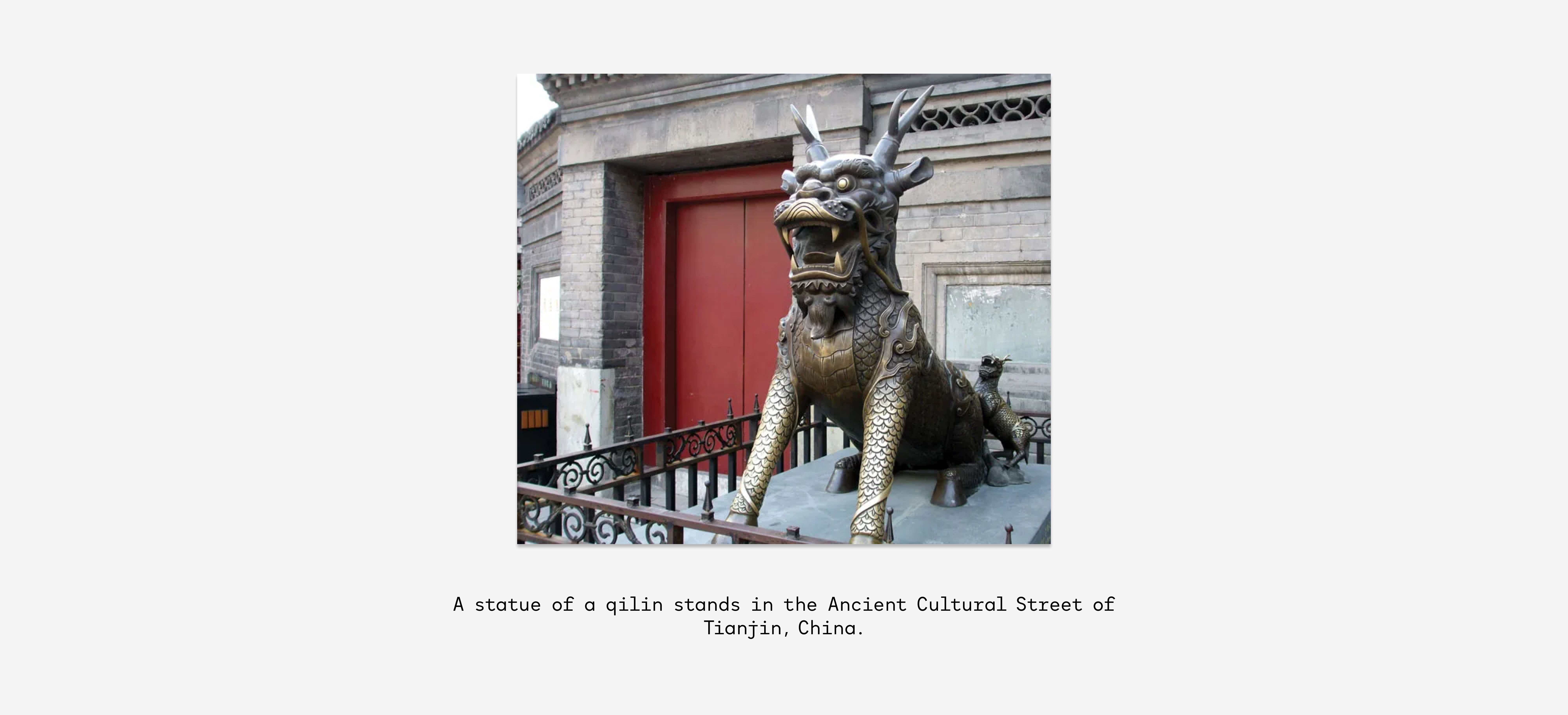
Yet, a qilin is never figuratively depicted in Memories by Xie. You won’t see a version of its physicality in any of the 1,024 outputs.
But – you do *almost* see it.
You almost see it as you almost see a flower, a landscape, a person, begging the question - why would a collection with such an intentional subject name be devoid of its depiction?
Because, it is the spirit of the qilin that is ever-present. We’re called to be with the collection beyond literal representations. Such is the mastery of Xie’s work, we’re compelled to dance between forms. Resembling figure ground reversal and anamorphosis techniques, the human eye tries to identify the imagery in each output.
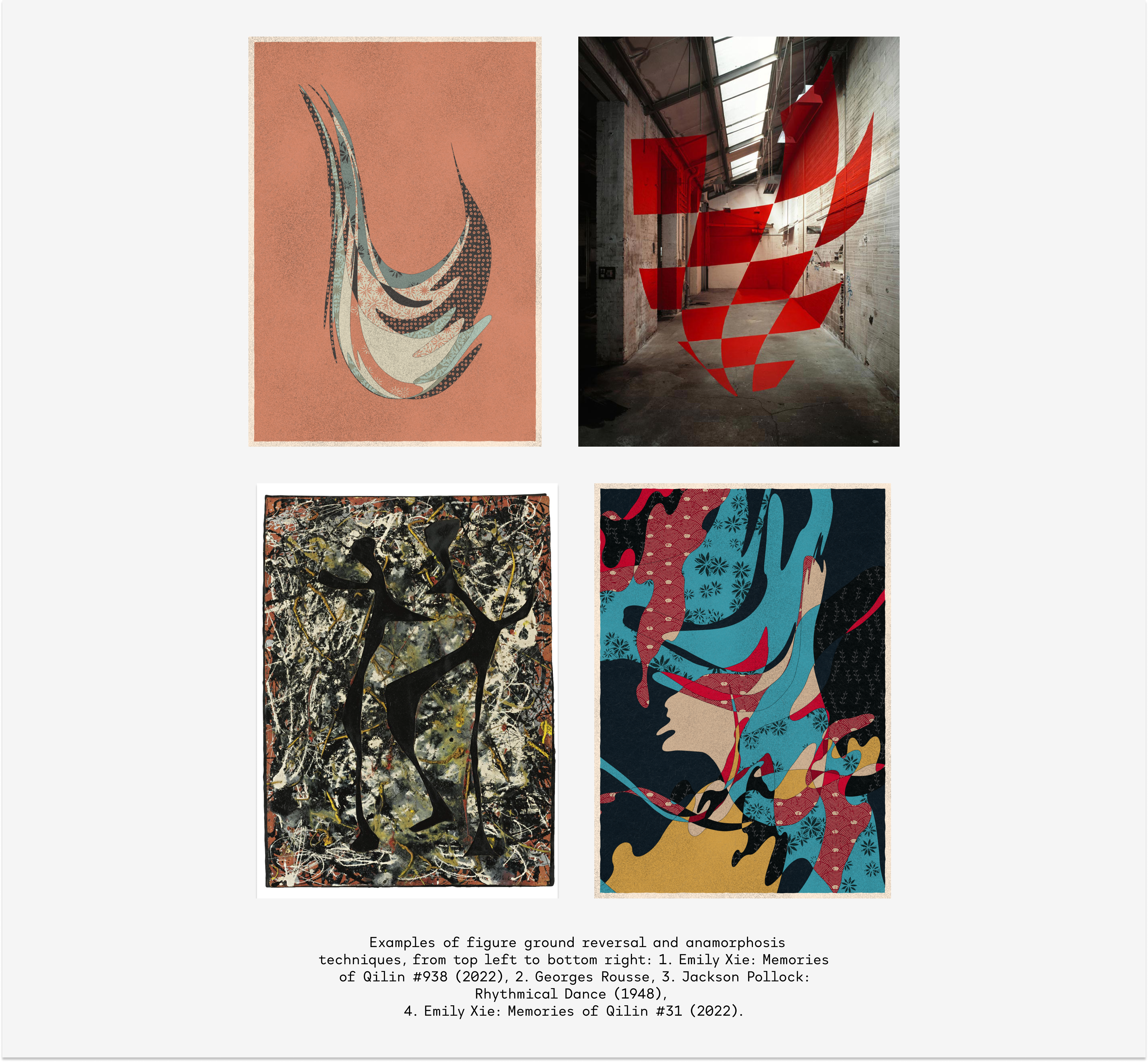
And yet, you can never quite get there.
As soon as your eyes settle and see a bird, they travel to another part of the composition and you’re looking at a night sky. Like clouds passing, you can breathe amongst the shapes and textures.
More slow dance than static image.
This dance from one allusion to another communicates with a form of abstract art that plays with semi-figurative expressions. Notably, Jean Dubuffet’s “Group Group of Four Trees” (1969-72), which today stands in downtown New York City, proposed a new way to relate to natural subjects and their surroundings. <sup>3</sup>
It’s as if in constructing life-sized trees he’s suggesting – “isn’t a real tree also as worthy of the attention we give this art piece?”
Indeed, we should apply this skillful attention in contemplating the subjects in Xie’s outputs.
Xie’s work also explores how personal heritage can be just as abstract and contradictory in these digital compositions.
To be sure, inspiration of ukiyo-e art (Japanese painting and woodblock prints) and Chinese brushstroke arise in the aesthetics of the collection. There are patterns, there are ink splots, there are curving lines. These marks, of course, are randomly generated and assembled through Xie’s collaboration with code, representational of an unreliable relic from a past that may or may not have happened.
Rather than reading from a history book, Memories is akin to listening to an elder recount stories of her youth. You’re never sure if such tales are historically accurate, or if they ever occurred.
That’s not really the point of a good story, is it?
It’s the narrative that captivates us.
In this way, the collection symbolizes a relationship to history and heritage so many Americans share. There is a vagueness to our shared lineage, so we cling to ancestral stories as a balm to soothe their mystery. Memories of Qilin makes our invisible stories visible and valuable, affirming our personal and familial folklore is worthy of such representation.
To be sure, the collection asks the viewer to survey the intentionality behind the abstractions and symbolism. Simultaneously, it demands a widening of the aperture to study Xie’s motifs through the lens of folk and resistance art.
Existing throughout millennia - quilts are a time honored folk art almost exclusively crafted by women. Some scholars date the technique to 3400 BC based on their appearance in Egyptian iconography. Early examples of quiltmaking date back to the Medieval times in Europe, India, and The Far East. These iterations are on display at The Victoria and Albert Museum – a museum dedicated to the global history of textiles and fashion. <sup>4</sup>
Patchwork quilts, the type of quilting created when two or more distinct pieces of fabric come together, have their own unique story. Enjoyed across cultures, locations, and historical periods – quilts were often made durable so as to be passed down from generation to generation, matriarch to matriarch.
In this way, quilting has often been understood to be a social activity – one that brings people together, allowing them to exchange ideas and preserve the legacy of their family, community, and culture. Some of the earliest and lasting examples of historical quilts exist today solely because of multi-generational sharing. However, as is so often the case with craftwork like textiles and fashion, these pieces rarely receive attention from traditional art institutions.
It is a joy, then, for us to see a craft passed down by women represented in a burgeoning tech space that still has the potential to make such art more visible.
And, an added joy that such a collection can be viewable outside of the traditional art lens, outside of institutions, and more democratically in the homes of everyone who wishes to see it on a screen.
Unlike the physical quilts from which she drew inspiration, Xie’s quilts will live on the blockchain for centuries to come without degradation, and at resolutions with far more detail than their analog counterparts.
In recent years, physical quilts and quilt iconography have become powerful tools to bring attention to pressing issues in skillful and urgent ways. We can thus rightly include Xie’s work in the canon with other artists drawing attention to domestic crafts in their practice. Notably, Tracey Emin’s “Hellter Fucking Skelter” (2001) uses the quilt motif to form memoir-like art. Paired with pink hues and bold lettering, Emin is not a quilt maker by trade. Instead, she used what is traditionally known as “women’s work”, quilting, to ensure such is visible in institutional settings. <sup>5</sup>
A strategy, to be sure.
And yet, Xie’s work is of course not made from fabric, but a computer. It leads us to marvel at an astonishing contradiction - immaterial code can create a feeling of materiality.
Launching in March 2022, Xie’s Memories is a long-form generative collection of collage-based artwork, minted on the premier ‘Art Blocks Curated’ contract and platform. In constructing the work through this system, Xie’s collectors created a variety of randomized outputs around a single on chain algorithm, devised using p5.js.
Thematically, patterns arise from swirling shapes resembling asymmetrical patchwork quilts. The blanket’s feel, the star and wave-like patterns – these overlap with circular objects. Warm reds and cool blues draped together help cozy the viewer to the collection. While some pieces offer a layered tapestry quality filling the entire frame, others are more graphic and gestural, if not symbolic. The crispness of the patterns and colors lie in contrast to the moving lines of each tableau.
There is an inherent difficulty of creating something with the computer (hard edged, click-clacky, decisive) while achieving these rounded, woven, and dance-like outcomes.
As we trod along in digital spaces, as they feel more and more like our normal, what do we see as organic material? Can we feel digital objects like we feel fabric? In the end, the collection lives in these questions rather than providing us with concrete answers.
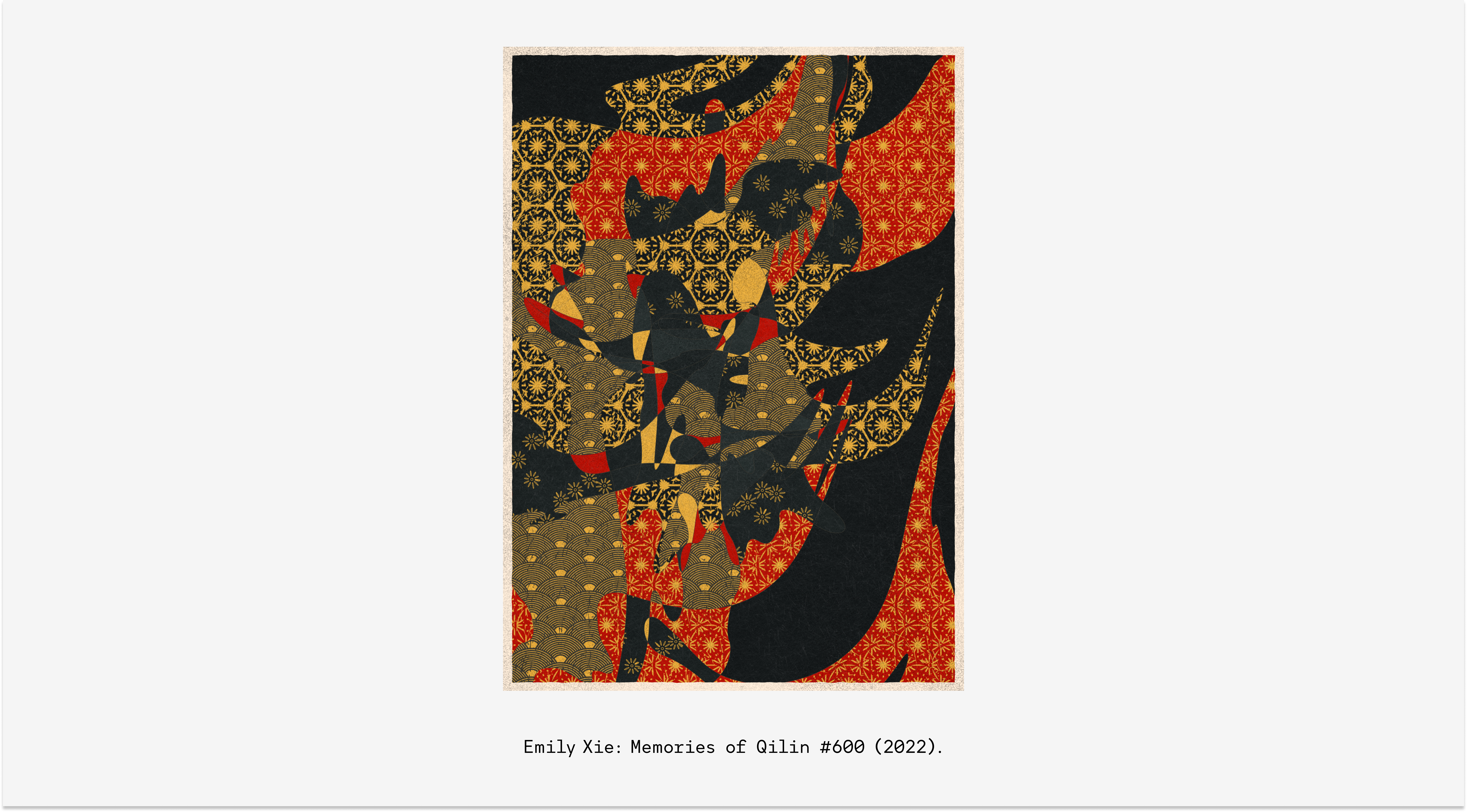
Conclusively, Memories of Qilin is a work of layers – traditional cultural and social references, quilted procedurally and on demand, immutably stored on a 21st- century global database.
In the years to come, this gallery believes Memories will be looked at as a stand-out collection embodying the chimeric nature of blockchain based art:
Stitched with code. Astonishingly contradictory. Imbued with cultural data.
*Thank you to Emily Xie whose interview helped direct the research of this piece, and to collector Bob Loukas for sharing his “Memories of Qilin” collection with us. To Derek and Malte for their deeply collaborative spirits, to PixelPete and Martina Negro for their suggestions and wisdom.*
*And always, to DES. +*
—
1. Britannica, The Editors of Encyclopaedia. “qilin”. Encyclopedia Britannica, 2 Feb. 2023, https://www.britannica.com/topic/qilin. Accessed 30 October 2023.
2. “Qilin — Mythical Creature of Benevolence, Strength, and Auspiciousness”. https://www.chinafetching.com/qilin. Accessed 17 October 2023.
3. Fondation DuBuffet, “Groupe de Quatre Arbres”. https://www.dubuffetfondation.com/oeuvres/248. Accessed 20 October 2023.
4. Victoria and Albert Museum, “An Introduction on Quilting and Patchwork” : https://www.vam.ac.uk/articles/an-introduction-to-quilting-and-patchwork. Accessed 20 October 2023.
5. Art Image, Hellter Fucking Skelter, 2001. https://www.artimage.org.uk/5145/tracey-emin/hellter-fucking-skelter–2001. Accessed 10 October 2023.
0x6e2F···aceE## Artist: Kim Asendorf
## Object: Cargo #793
## Collector: XX
## Order from Noise
Author: Malte Rauch
Editing: Madison Page, Derek Edwards
Date: October 1, 2023
Artist Interview: [Artist Interview](https://amber-electric-snail-94.mypinata.cloud/ipfs/Qma3BZQUvdnpX9HZADeDEvy1vVULCHomxjFdmQprDaw4Xp)
In the future, it may be surprising for historians to observe the thirty year period before the 2020s and find seemingly minimal interest in both digitization and the internet within the larger contemporary art movement.
This fact is particularly noteworthy considering these elements will have revolutionized nearly every aspect of modern life – from our personal lives to international commerce – and everything else in between. However, one of the first movements historians will find is the “net art” movement, which has its origins in the 1990s, when commercial trends of personal computing and home internet began to converge.
Kim Asendorf, the now critically-acclaimed digital artist from Germany, joined the net art movement in 2008. In 2011, Asendorf launched “Gif Market”, pioneering a new kind of marketplace for digital art pre-dating early blockchain-based marketplaces.
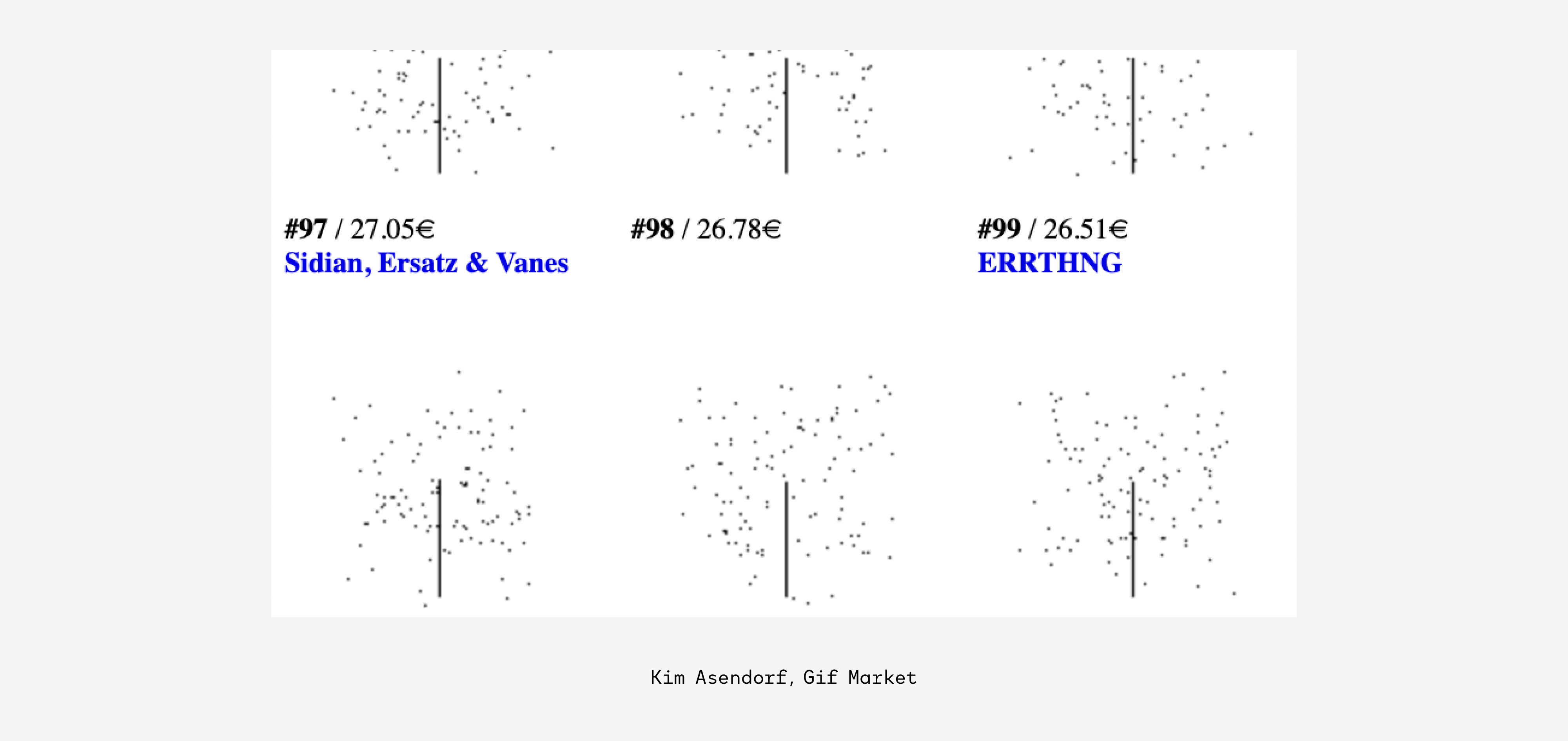
In Asendorf’s marketplace, buyers could select each of 1,024 pixel compositions characterized by descending levels of rarity. The initial composition consisted of a single pixel, and the final compositions were dense animations filled with numerous pixels, barely distinguishable from one another.
Artworks were sold using a dynamic pricing mechanism that gradually increased in value. After collecting, individual collectors could attach their names to the pieces – on display for the world to view on the Gif Market web page.
Among the early collectors who attached their names in 2011 was internet art pioneer XCOPY, for whom, reportedly, this was the first digital artwork they ever acquired. Interestingly, Asendorf had effectively predicted – and experimented with – a proxy for digital art ownership, long before blockchains were used to record digital object ownership.
Shortly after Gif Market, Asendorf, in collaboration with friend Ole Fach, started an online gallery titled “Fach & Asendorf Galerie”.
Rather than the traditional white cube space, the duo used a custom-built website that gave them complete freedom on the front end. Each month, the website hosted solo and group exhibitions, featuring artists such as Nicolas Sassoon, Sara Ludy, and Jan Robert Leegte.
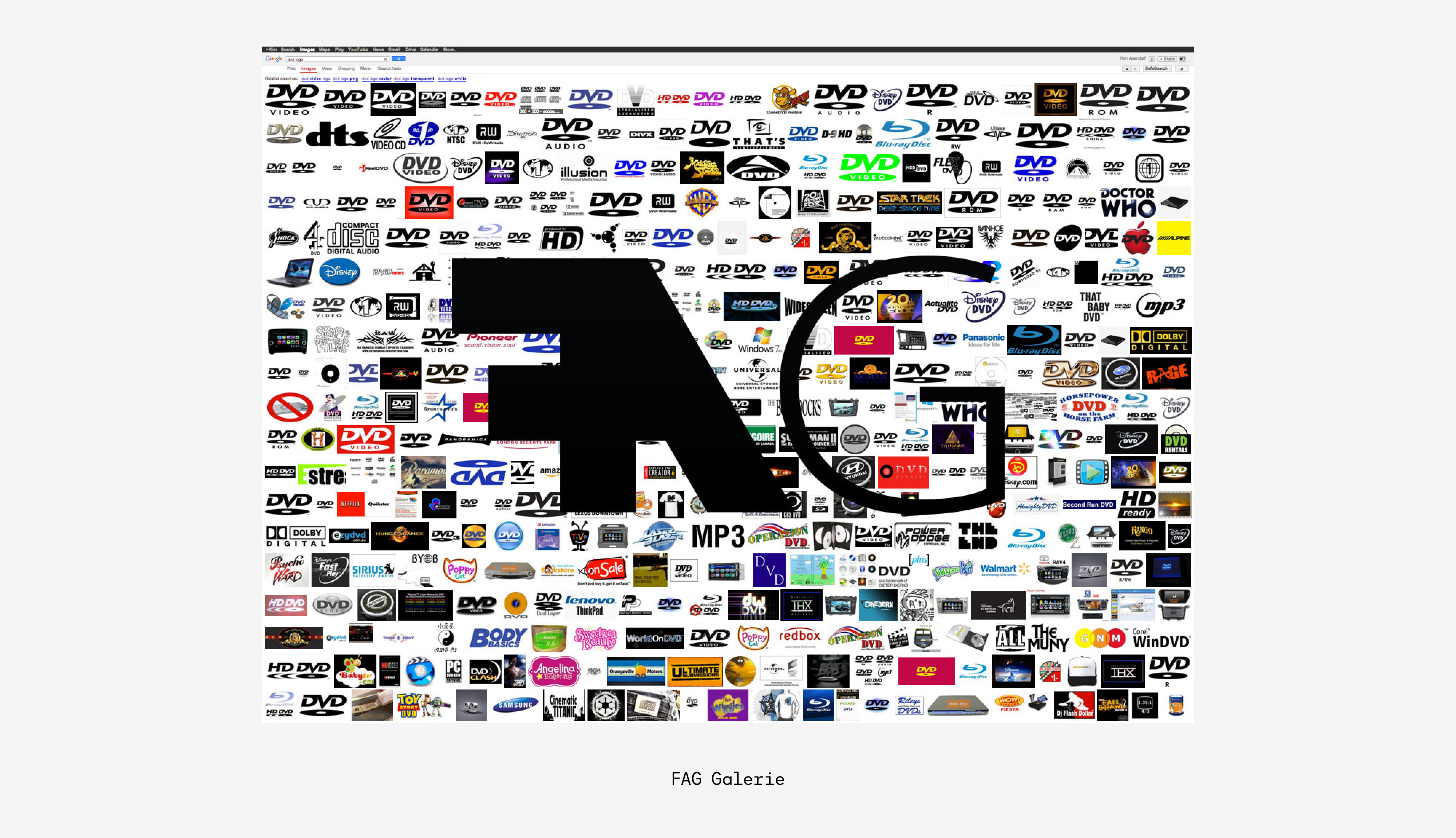
At the time, one of the gallery’s partners described it as follows:
“The Fach & Asendorf Gallery is the major online exhibition gallery for net art, media art, digital madness and satisfaction. They believe in electricity, bits, brains, glitch and curiosity.”
It was during this period that the website emerged as Asendorf’s favored medium, enabling viewers to fully immerse themselves in a new form of art. The medium allowed the art to dominate the entire screen, presenting digital work in an immersive manner. This preference could be interpreted as a form of “Umfunktionierung”, or repurposing, where the typically functional constraints of a webpage is transformed into a new digital canvas.
In 2017, Asendorf began working with WebGL, inspired by the work of artists like Andrew Benson and Ezra Miller. This is the period where Asendorf developed the signature style he is known for today – the pixel sorting algorithm and his unique, dynamic compositions.
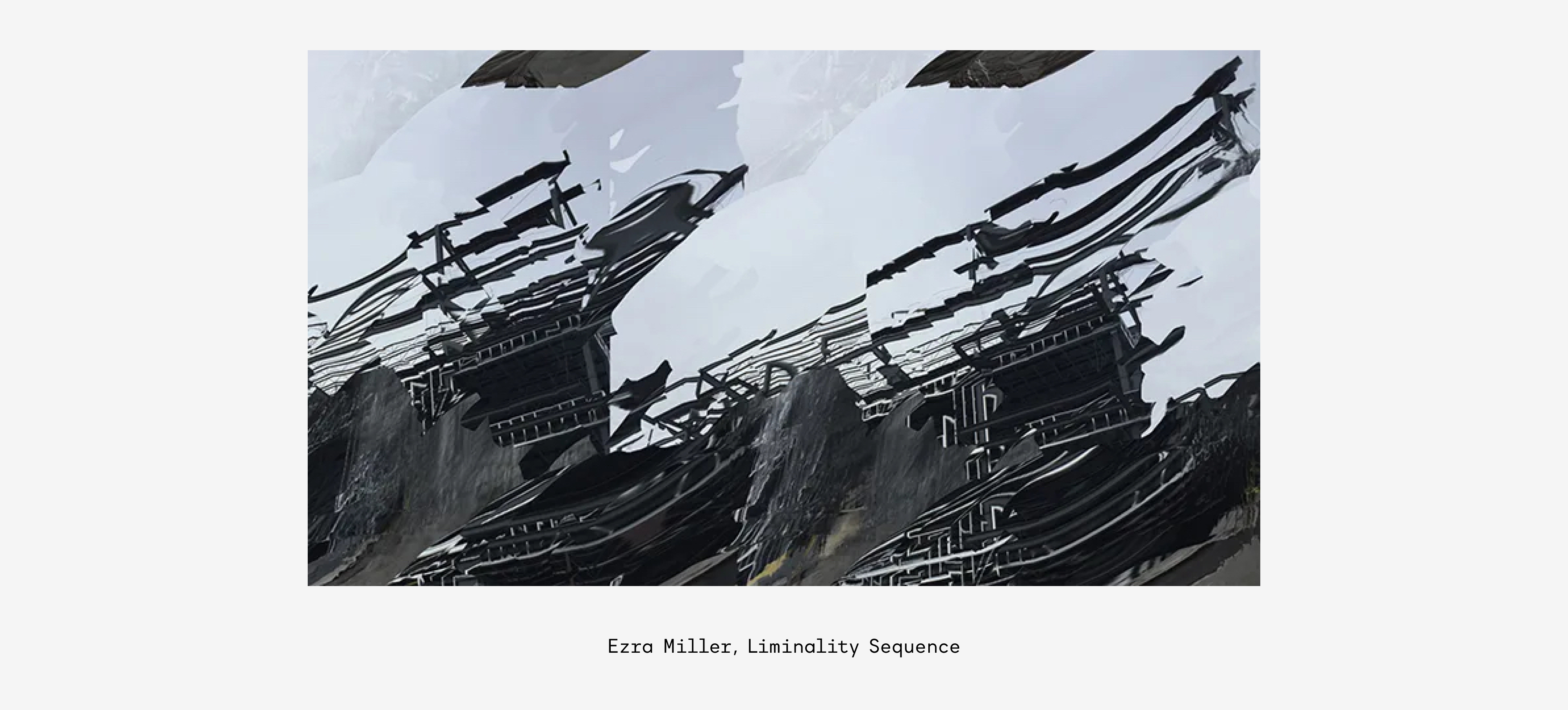
In 2021, at a time when the enthusiasm around digital objects started to reach a local zenith, Asendorf chose to join the movement from the margins, minting his first works via the Hic et Nunc contract on the Tezos blockchain.
Later, in October 2021, Asendorf manually minted 256 iterations of “Monogrid”—a signature work that would lay the foundation for his future projects on the Ethereum blockchain. With a proper auctioning mechanism still lacking, Asendorf reverted to his conceptual and performative style. He organized a Twitch live stream, accepted offers sequentially, with people placing live bids in response to announcements made during the stream.
After these initial experiments on Tezos across Hic et Nunc, Objkt and fxhash, Asendorf finally transitioned to Ethereum, as the blockchain’s properties provided him the opportunity to code his own smart contracts. Projects like “Sabotage” and “Rainbow Grid” would emerge, which further developed Asendorf’s pixel sorting style with specific foci.
### Concept and Composition
On Twitter (X), a modern day town square for conversations on technology, crypto, and digital art, debates frequently arise over whether an artist’s style should exhibit consistency – often interpreted as immediate recognizability and repetition of familiar elements. Some advocate for consistency as a criterion, while others champion uniqueness and variety.
However, we argue that framing the discussion as such is insufficient for evaluating an artist’s work. The trajectory of a timeless artist is characterized by evolution, where one series of works interacts with and responds to the next—either by elaborating on an emerging theme, addressing challenges encountered, or negating a previous direction. This progression cannot simply be a series of isolated, unconnected instances, nor a continuous repetition of the same elements.
Kim Asendorf’s work serves as an exemplary representation of such artistic development. He released the pixel sorting algorithm in 2010, and since then, has continuously refined it through a sequence of projects—each one immediately recognizable, yet entirely distinct.
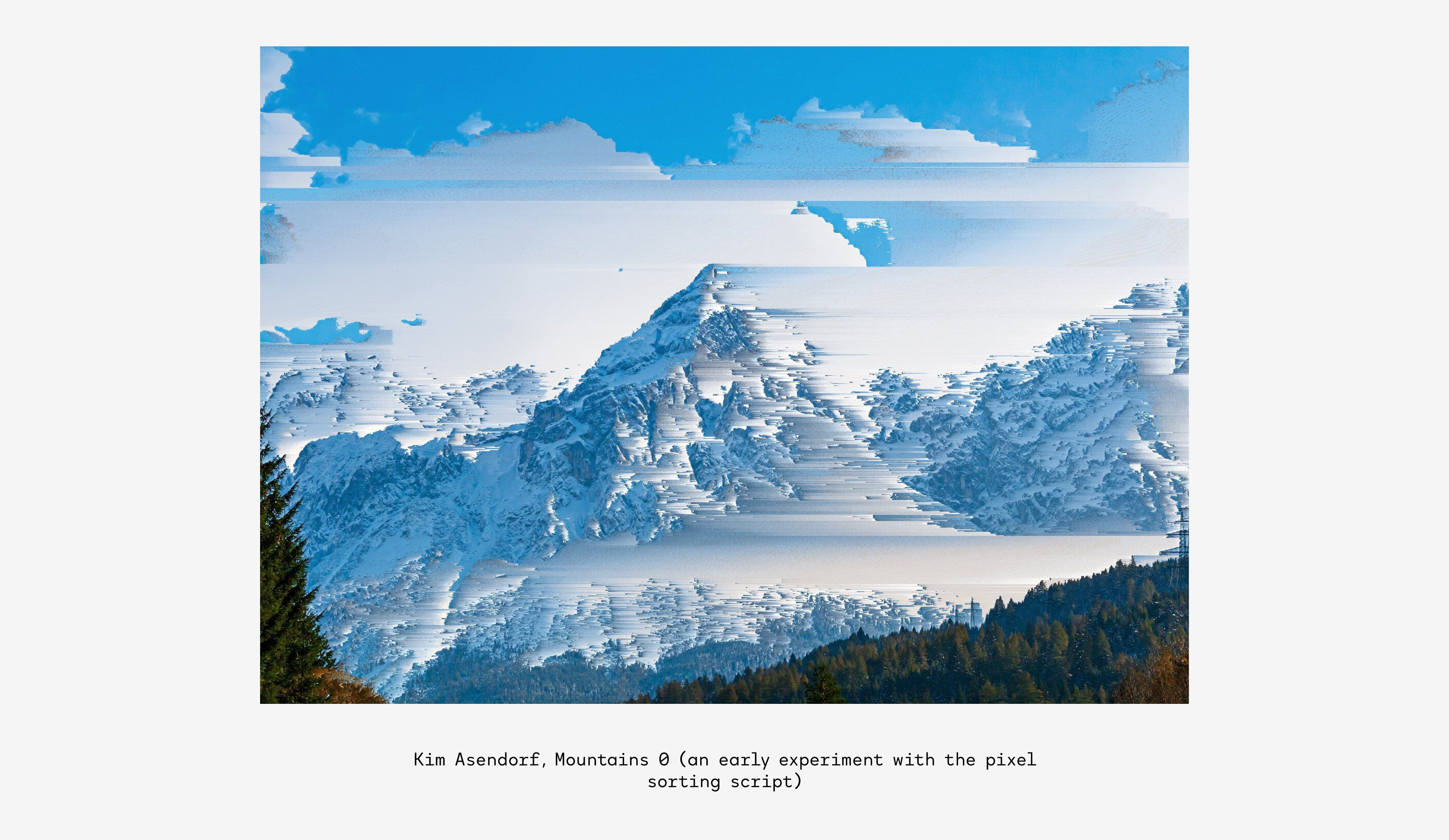
Conceptual art distinctly differs from visual art, grounded in ideas, rules or instructions whereas visual art anchors itself in aesthetic stimuli. For conceptual artists, the sensation is the idea itself, not the image. In Asendorf’s work, one can observe how this focus on a set of rules can lead to visual spaces no one has explored before.
The pixel sorting algorithm provides a conceptual solution to questions regarding composition within generative systems. As discussed in our previous articles, generative art is fundamentally rooted in chance. Randomness, however, introduces complexity to composition, allowing only partial control over the arrangement of elements. Many generative artists mitigate this by optimizing their algorithms to avoid undesirable outcomes, biasing them towards harmonious ones.
By contrast, Asendorf employs a dynamic and conceptual approach to composition. The foundational compositional principle of his pixel sorting algorithm is a balance between order and chaos. Composition takes the form of a balance between these poles, which hold the output in a state of a dynamic tension.
### Cargo
In March 2023, 1,000 outputs were generated off the Art Blocks contract that appeared vastly different than anything the generative art community had seen from the Art Blocks platform.
* Each output could be freely adjusted to any resolution or screen size;
* Each work’s live animation represented a dynamic balance between order and noise;
* Each output’s “liveness” captured audiences in ways often unattainable with purely static work.
Early on-chain generative art collectors tend to favor static aesthetic works over dynamic conceptual ones. Yet Asendorf’s Cargo extended the dynamic conceptual framework in a new direction, and interest surged shortly after the Dutch auction, which settled at 0.24 ETH. Soon, Cargo was swiftly recognized as one of the most outstanding generative releases of the year.
Technically, Cargo is a real time WebGL animation written in JavaScript and GLSL. It is a dynamic artwork that automatically adjusts to fit any screen size. The overall structure of the ‘macro block’ can stretch both horizontally and vertically, and the micro blocks within each composition adjust simultaneously.
When running “live” in the Art Blocks generator, Cargo stretches to fill the entire browser window, adapting to its dimensions, a continuation of Asendorf’s emphasis on a website as his preferred medium for viewing art.
In many respects, Cargo encapsulated several years of Asendorf’s practice, from his net art days to his engagement with on-chain generative art. Like all of Asendorf’s pixel sorting works, Cargo operates on two interconnected layers:
On one layer, a macro block represents the entire image.
On the other, micro blocks work within the larger block and modify it through feedback loops. The moving elements within these micro blocks are pixels, which themselves are micro rectangles.
When Asendorf repeatedly refers to his works as paintings – and in turn labels Cargo as a series of abstract paintings – it stems from the continuity of the rectangular shape: from the elementary building block of the pixel, to the micro and macro block structure. Just as Piet Mondrian and Josef Albers devoted lifetimes to exploring rectangular compositions on canvas, revolutionizing composition and color theory, Asendorf seeks to achieve the same with his blocks of pixels on the digital canvas.
The outputs exhibit a high degree of diversity despite having a constrained range of variation. The color palettes are typically confined to black and white, are duo-chromatic, or incorporate up to three colors. Characteristically, the colors used are highly saturated, a nod to the palettes of early computer graphics.
Above all, it is the dynamic compositional principle that can produce both minimal and highly complex, dense works, making each piece unique.
Asendorf’s visual world is made of raw, visual pixels, inspired by nineties consoles and an era of computer graphics in which every attempt at representation would betray the abstract, rectangular shape of the pixel. In our contemporary world of interpolation screens, which present images with more pixels on the screen than actually exist in the image matrix, his works seem to pierce beneath the surface and remind us of an earlier, more immediate relationship with the display.
Asendorf’s ‘living’ systems liberate generative art from being confined to thumbnails on marketplaces, where it is often viewed as just one of many elements on the screen. His artworks, dominating the browser window, invite viewers to abandon their other activities and immerse themselves in the meditative interplay of macro and micro blocks.
The system’s outputs are characterized not so much by their lack of order as by the rhythm with which every form that arises within them vanishes. They represent an infinitely layered space in which all forms emerge only to vanish instantaneously.
Perhaps surprisingly, there is a deep satisfaction in experiencing this endless emergence and disappearance of forms, like waves that create patterns in the sand only to wash them away again.
Anyone who has sat daydreaming in front of a screensaver as a child, mesmerized by the movement on the screen and oblivious to their actual tasks, will find a sense of nostalgia and recognition in the absorption offered by Asendorf’s Cargo.
We’re excited to unveil this month’s Every 30 Days poster as our first poster with design input from the featured artist. Designed and conceived by Atley Kasky, Asendorf put the work through the original Cargo algorithm. Kasky and Asendorf worked together to release the final output. +
0x6e2F···aceE## Artist: Snowfro
## Object: Chromie Squiggle #9951
## Collector: ?
## The Rainbow Soul of Generative Art
Author: Derek Edwards, Malte Rauch
Editing: Madison Page
Date: September 1, 2023
Chromie Squiggle (November 2020), the seminal blockchain-based art project by Snowfro, is a collection of 10,000 rainbow squiggles, randomly generated on demand.
Benefiting from a revolutionary technical process developed by Snowfro, each squiggle exists in a state of pure potential before a specific output is minted. Using the original collector’s token hash (a unique string of characters used to verify data integrity on the blockchain) as the input for the squiggle algorithm, the variables of each rainbow line are ultimately decided by the Ethereum blockchain.
As such, Snowfro pioneered a new system for creating generative art that would eventually inspire nearly every category of blockchain-based media.
To celebrate this groundbreaking innovation in generative media, we aim to contextualize the Chromie Squiggle collection, and explore its influence on history from various perspectives.
### Life
Erick “Snowfro” Calderon was born in Mexico City in 1981.
At 12, he coded his first software – a calendar reminder app for his personal beeper. For Calderon, it was the moment he understood technology’s unique ability to empower the people around him.
At the University of Texas, Calderon started DigiPrint, a digital photo printing service run out of his dorm room. Leaning into the growing connectivity of the online world in 2001, Calderon paired his physical printing service with an online photo-sharing platform, aiming to find new ways to share photography with others over the internet.
Later, Calderon oriented his creative focus toward the intersection of consumer experiences and technology. He created a snow cone stand to keep students cool during the hot summer months in Texas (giving rise to his online alias, Snowfro). He experimented with programmable LED light bracelets that bands and venues could customize for events and festivals. He explored projection mapping during live concerts, pioneering audience-based art creation that would later find an echo in the architecture of the disruptive Art Blocks platform.
In 2004, he started La Nova Tile, importing Spanish and Italian ceramic tile to the design industry in Houston, Texas. He also transitioned his creative practice into 3D printed objects and sculptures, facilitating his dive and exploration into color theory and composition.
More than a decade later, these unique experiences would converge into a single grand trend line.
### Crypto Art Origins
In 2017, a two-person game design studio called Larva Labs launched a digital art experiment on the Ethereum blockchain called CryptoPunks. Living somewhere between generative art piece, collectible, and technical accomplishment, the pioneer project quickly stood out for being the first off-chain generative art project to use blockchains as a format for data storage.
After stumbling across a post in the crypto-focused Reddit communities he followed, Snowfro participated in the original CryptoPunk launch event. He claimed over 30 CryptoPunks, including some of the most rare and desirable objects in the collection.
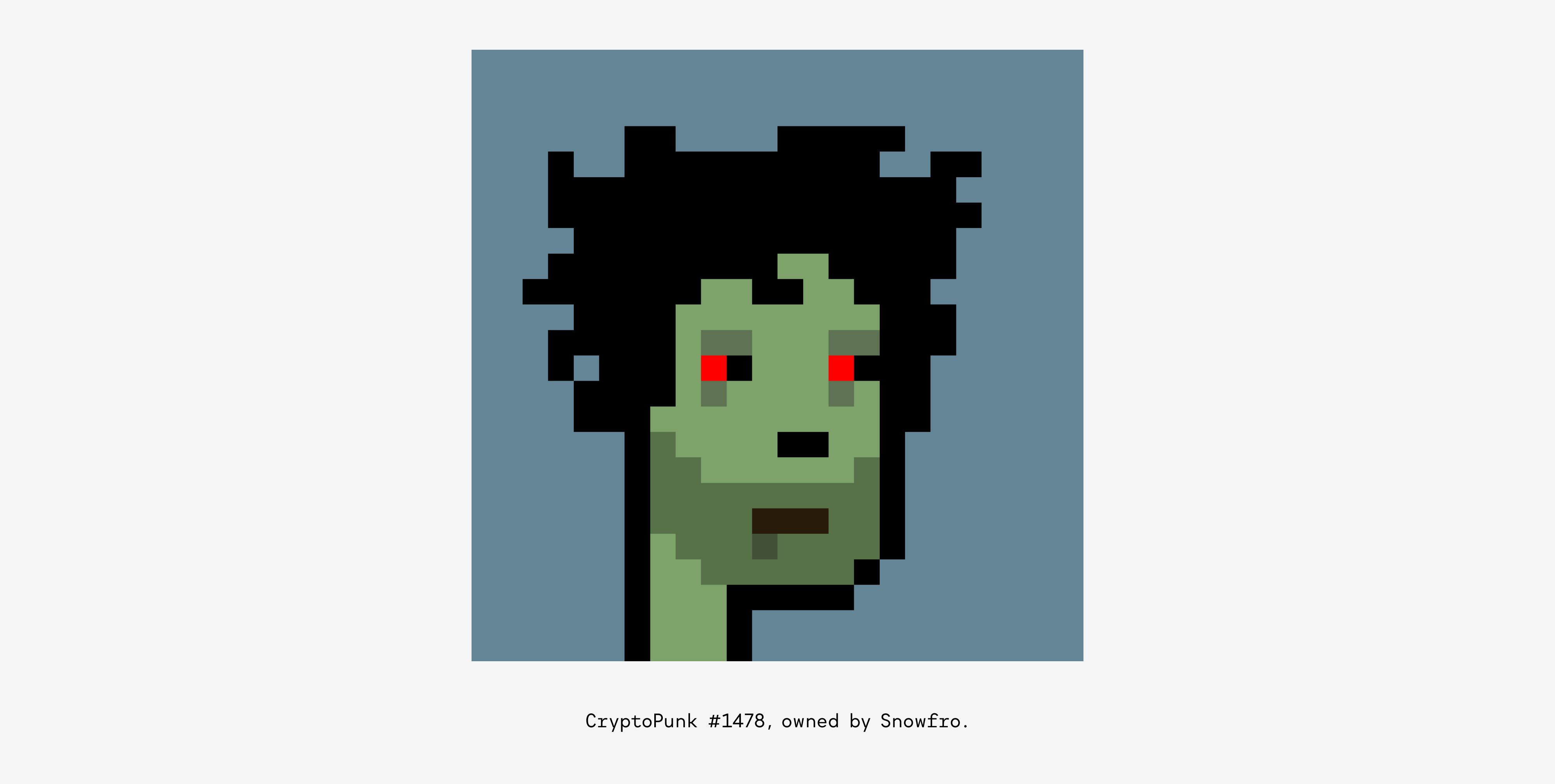
As he reflected on this claiming process, Snowfro wondered:
**First**, could an entire generative art piece, from artist algorithm to each unique output, live 100% on the Ethereum blockchain?
And **second**, could a blockchain be used as part of the artist’s full creative process, instead of just the terminal recording format?
Inspired by the technical innovations of the CryptoPunks project and his own passion for generative art, Snowfro began to brainstorm ways to extend Larva Labs’ innovations. Over the following months, he started to share these novel ideas of blockchain-based procedural randomness – first inside the CryptoPunks Discord, and later through public experimentation.
On September 17th, 2018, over two years before Art Blocks would publicly launch, Snowfro tweeted out his innovation that would later inspire a global online movement.
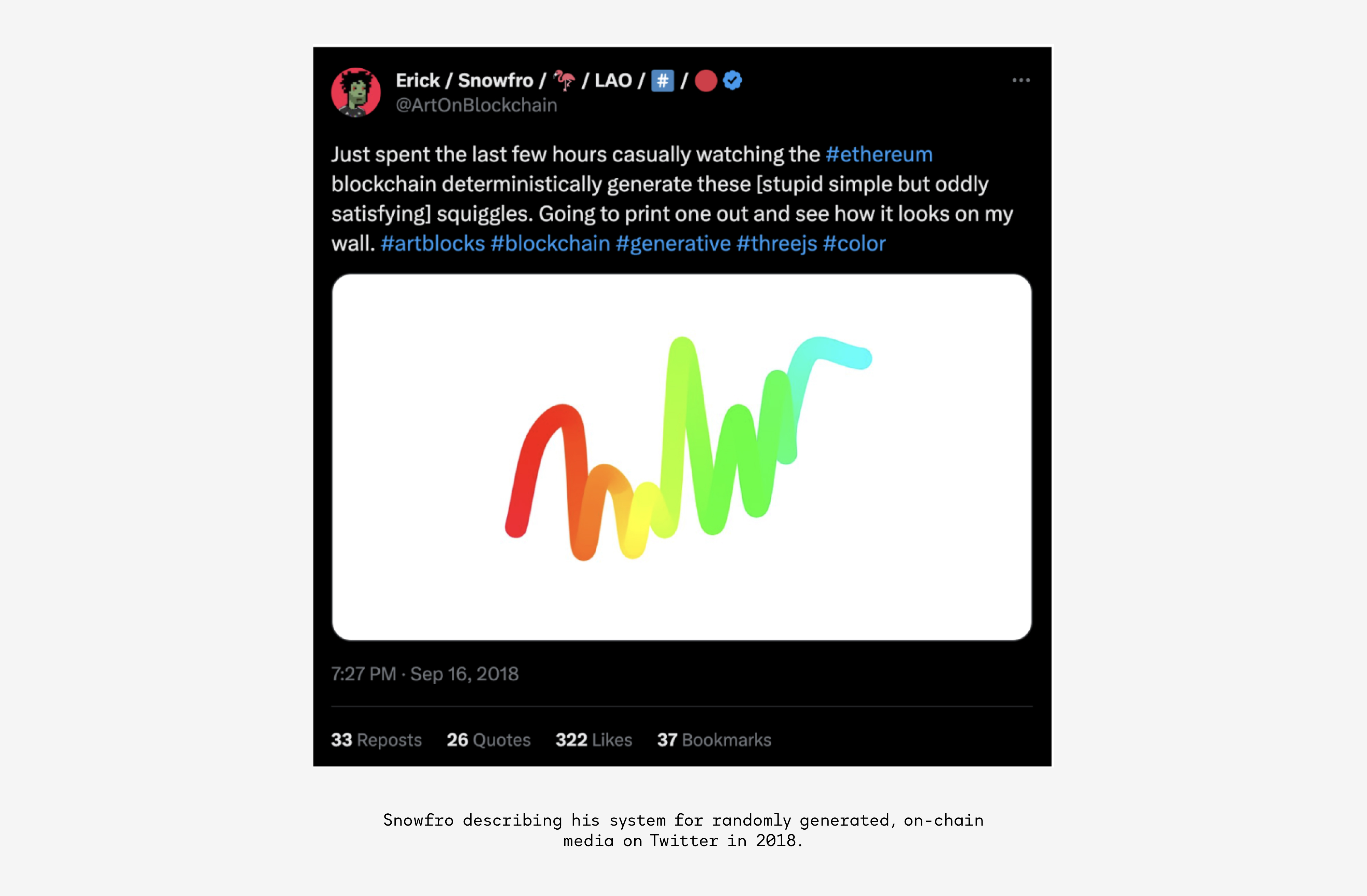
### Inspiring The Movement
On November 27th 2020, Snowfro launched Art Blocks, the internet’s first marketplace for on-demand, on-chain, generative art. Chromie Squiggle, the generative script he had been developing for two years, was uploaded to the Ethereum blockchain as Art Blocks Project #0.
A 10,000 piece generative collection, Chromie Squiggle acted as both a generative art homage to CryptoPunks, while serving as an accessible proof of concept for the groundbreaking Art Blocks contracts. Incredibly, and unlike the pre-assembled CryptoPunks collection, squiggles would be procedurally generated in real time, on-chain, with the help of each collector.
CryptoPunks were digital images generated using a computer program, curated by the Larva Labs team, and subsequently uploaded to the blockchain. As a result, collectors could “claim” an individual CryptoPunk by selecting their desired image in 2017. In contrast, each Chromie Squiggle (and the random, probabilistic features that would make it unique) could not exist until it was minted on-demand.
Here’s how it worked:
For .035 ETH (~$30 USD), new squiggle collectors could click a “mint” button that triggered a transaction on the Ethereum ledger. The transaction hash was then referenced as a seed against the on-chain Chromie Squiggle algorithm, populating a unique rainbow squiggle. Up until the moment the transaction processed, both Snowfro and the collector would remain in suspense, unaware of the unique output that might appear on the screen.
Put simply, Snowfro had invented an innovative standard for procedurally generated, on-demand, on-chain generative art.
Further, Snowfro’s Chromie Squiggle demonstrated that complex digital objects could enjoy superior permanence guarantees. For artists, it is prohibitively expensive to create media that has to be stored directly on a blockchain. As a result, many blockchain-based tokens are coded as a “pointer” asset (the code points the holder to view an off-blockchain storage of the media). However, if that off-blockchain storage system is ever deleted, removed, or taken down, the art associated with the ownership token would be lost forever.
Instead, Snowfro insisted on architecting a recording standard that relied on immutability, permanence, and resolution agnosticism. Because all components of the Chromie Squiggle project live securely on-chain, any object in the collection can be privately owned and publicly rendered at any display size with zero quality degradation, for as long as the Ethereum blockchain produces blocks.
In early 2021, a handful of artists and collectors started to recognize the impact of Chromie Squiggle and Art Blocks. The architecture and construction of the collection demonstrated a seismic innovation in the world of digital art, blockchain-based media, and on-chain crypto art. As a result, news of the colorful project spread quickly, attracting an incredible amount of interest.
On January 16th, 2021, Snowfro paused the Chromie Squiggle minter at 9,100 unique iterations, with plans to mint the remaining ~900 in the collection to mission-aligned contributors, charities, and positive organizations over time.
It would take less than one year for the contemporary art world to be put on notice.
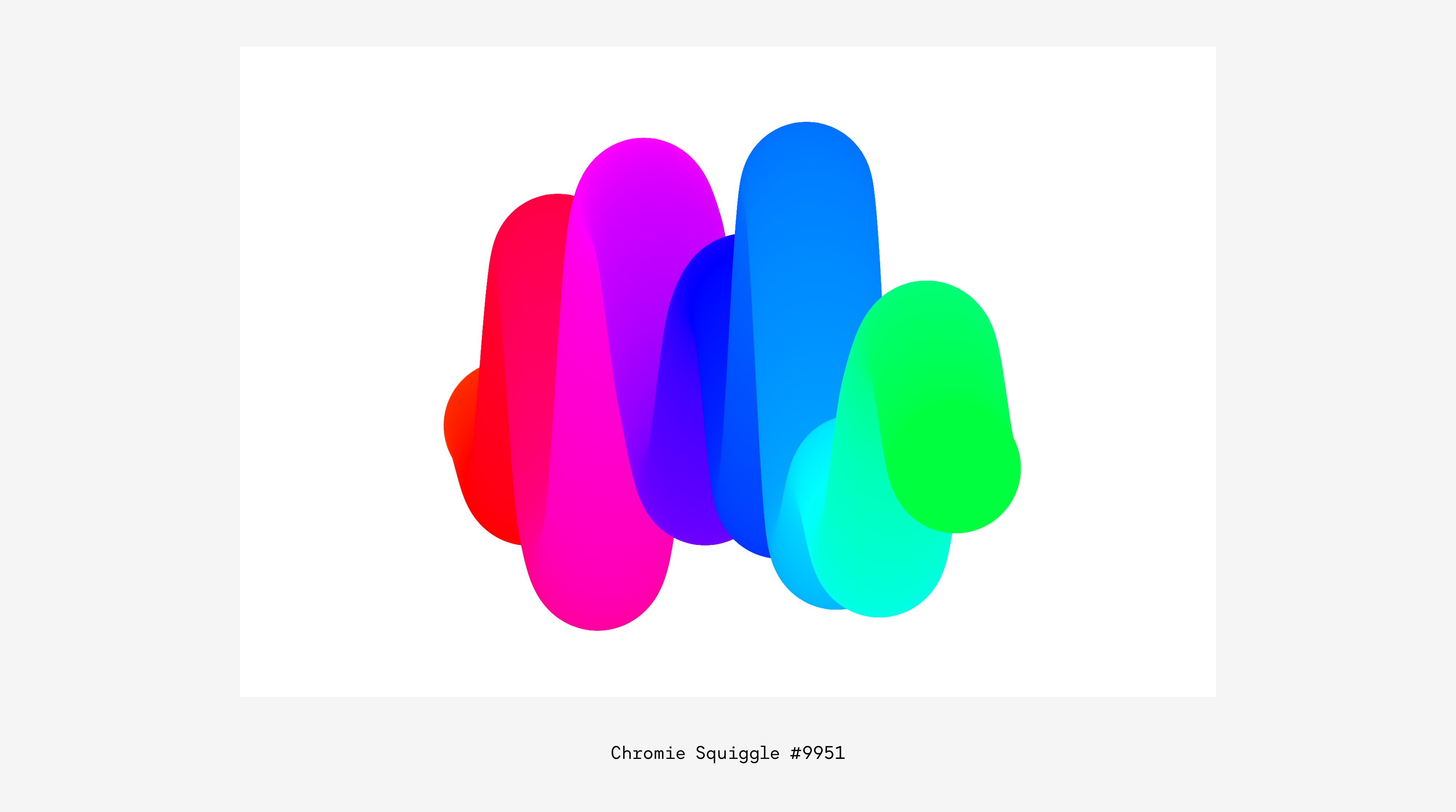
### Art
With its minimal composition, Chromie Squiggle displays the richness that can emerge from the interplay of rules within a generative system. The project beautifully underscores the dual nature of generative art: (1) the systematic essence of the algorithm; and (2) the unique singularity of each specific output it produces through randomness.
Allow us to expand on this notion of randomness: to understand the role of the randomly generated token hash is to understand the squiggle. Every character in the hash signifies a value between 0 and 15, and every pair represents a value between 0 and 255. This random assortment of characters will determine the specific “color spread” of each Squiggle. The spread dictates the variety of colors on a Squiggle, with fewer colors appearing at higher values.
 <sup>1</sup>
Further, each squiggle can take one of six rainbow “types”:
* Normal
* Slinky
* Fuzzy
* Ribbed
* Bold
* Pipe
Each one of the six rainbow types has their own upgraded “HyperRainbow” trait, prefixed with “Hyper-”. If a squiggle belongs to the statistically rare “HyperRainbow” spectrum, the visual output showcases a tight color progression.
All “Hyper-” variants are highly sought after as collectible assets given their statistical infrequency within the collection; however, the rare **Hyper-Bold** (only 7 in existence) and even rarer **Hyper-Pipe** (only 4 in existence) are often considered to be the two rarest “artist intended” trait categories within the Chromie Squiggle collection. An appropriate comparison used by generative art enthusiasts is the “Alien” trait category (only 9 in existence), designed by Larva Labs in the CryptoPunks collection. <sup>2</sup>
In early 2021, well-known CryptoPunks collector Von Mises uncovered and subsequently proposed two additional Chromie Squiggle traits. First, the “Full Spectrum” Squiggle (43 in existence), which displays 256 color hues with a variation of +/- 1%. Second, the “Perfect Spectrum” Squiggle (23 in existence) which displays exactly 256 color hues. On January 18, 2021, Snowfro made these important traits the first “invisible” traits to be added to the collection. Community supporters of the Chromie Squiggle have since added more invisible trait categories, which can be found on the Squiggle DAO platform. For example, Day 0 (542 in existence) and Harmonic (38 in existence) are two of these highly collectible traits.
Notably, the invisible trait categories should be understood as distinct from Snowfro’s “artist intended” rarity system, yet symbolic of the probabilistic outcomes created from the on-chain entropy system Snowfro pioneered.

In its entirety, Chromie Squiggle showcases how simple form and color combinations can produce 10,000 distinct outputs – each unmistakably a squiggle, each provably unique.
As such, the project captures the essence of the innovation Art Blocks introduced to the art world. Once uploaded to the blockchain, the artist relinquishes control over the creations that emerge from the algorithm to a large degree. A generative system minted through this setting must therefore be diverse enough to sustain a vast output space while maintaining enough cohesion to prevent undesirable compositions.
And while generative art has faced challenges with suitable storage solutions in the past, Chromie Squiggle, as the inaugural project on the Art Blocks smart contract, showcased how blockchains could serve as an ideal steward for the medium.
Today, Chromie Squiggle stands as one of the most significant and most widely recognized pieces of generative art ever created. Any discussion of the work must begin with the groundbreaking innovation it introduced to the world of generative art, and the lineage of work and artistry that Snowfro inspired as a result.
Yet, one can also see the Squiggle as extending a current in modern and contemporary art – that of reflection and reduction.
The move towards abstraction in painting, for instance, can be understood along formalist lines as reducing a work to its quintessential elements to uncover the essence of the medium. Artists from Roy Lichtenstein to Cy Twombly emphasized the brushstroke as the elemental condition for a work to be considered art. In a different way, this approach feels palpable in the paintings of De Kooning, with some of his pieces being counted among the priciest paintings ever auctioned.
The squiggle resonates with prior thematization of the brushstroke, a connection that extends beyond mere formal kinship. It is a brilliant visual project – as straightforward or as complex as the viewer wants to enjoy the collection. On the surface, the squiggle appears to be a basic, computer-generated, rainbow line.
So, it forces the viewer to ponder – how can something so simple be art? Be valuable?
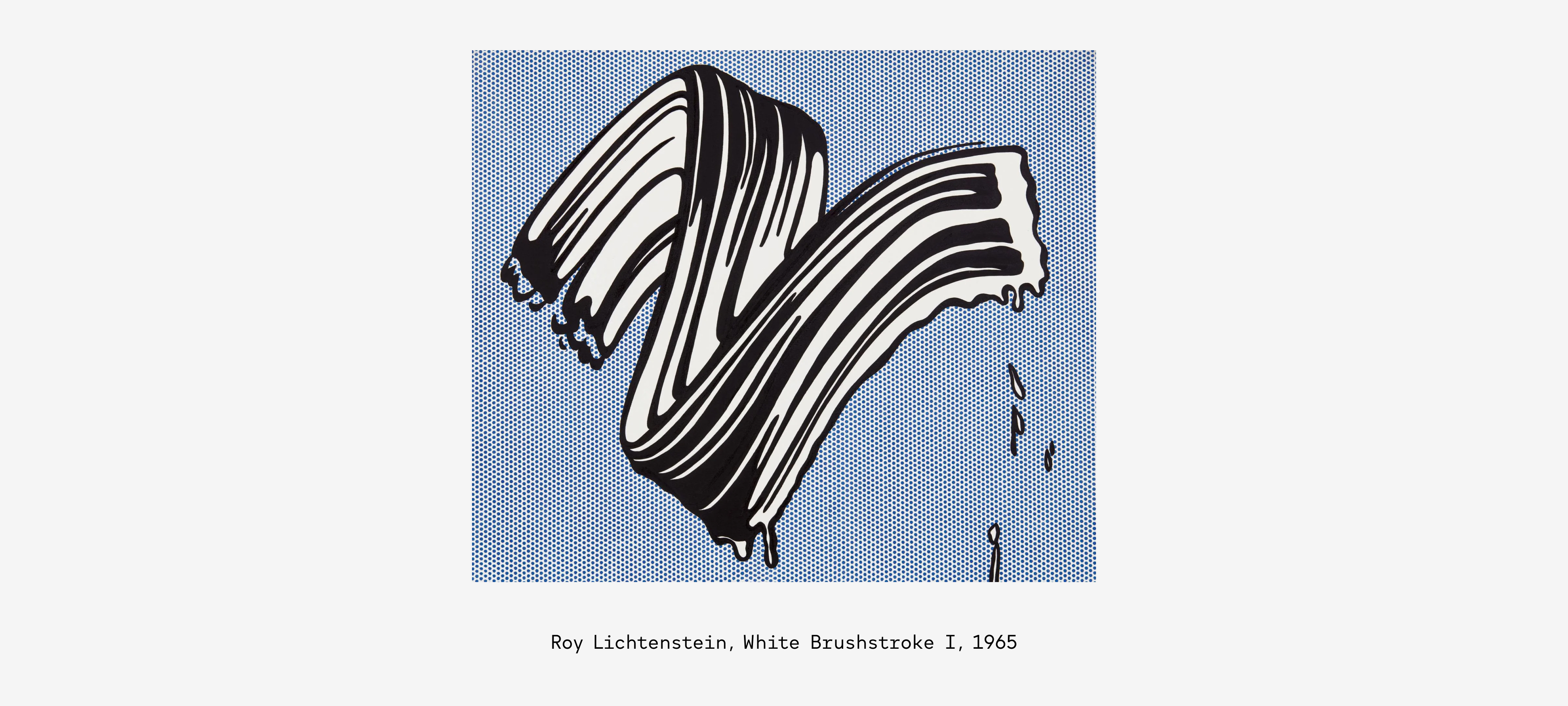
At the same time, Chromie Squiggle is reminiscent of the great modernist experiments in colorism and color theory by painters from Paul Klee to Josef and Anni Albers. Comparable to their exploration of color in abstract compositions, Chromie Squiggle delves into specific variations of a color spectrum using procedural randomness.
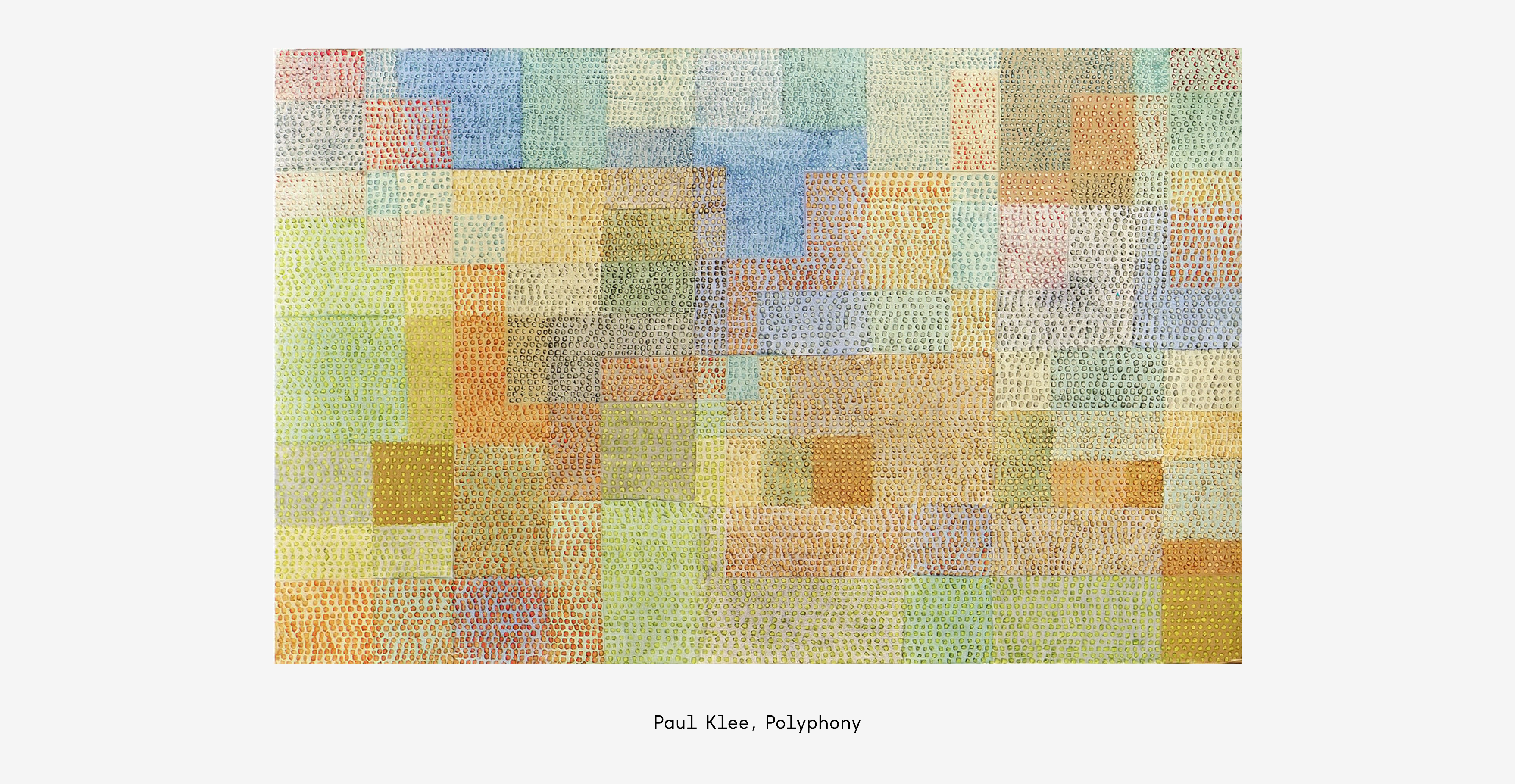
Finally, one can view Chromie Squiggle in relation to minimalist artist Donald Judd. The kinship is more conceptual than aesthetic, even though Snowfro has a personal fascination with Judd and architecture more broadly.
In pieces like “100 Untitled Works In Milled Aluminum,” Judd demonstrates how a simplistic system yields forms strikingly similar, yet distinctly unique. Observing one work, and then another nearly identical but with minute differences, naturally prompts questions about art – what is the meaning of a part in relation to the whole? What changes with variation? How can constraints be the source of creativity? When is a system finished, exhausted or completed?
The design of Chromie Squiggle and the Art Blocks contract raises similar questions about systematization, variability, and uniqueness in rule-based digital systems.
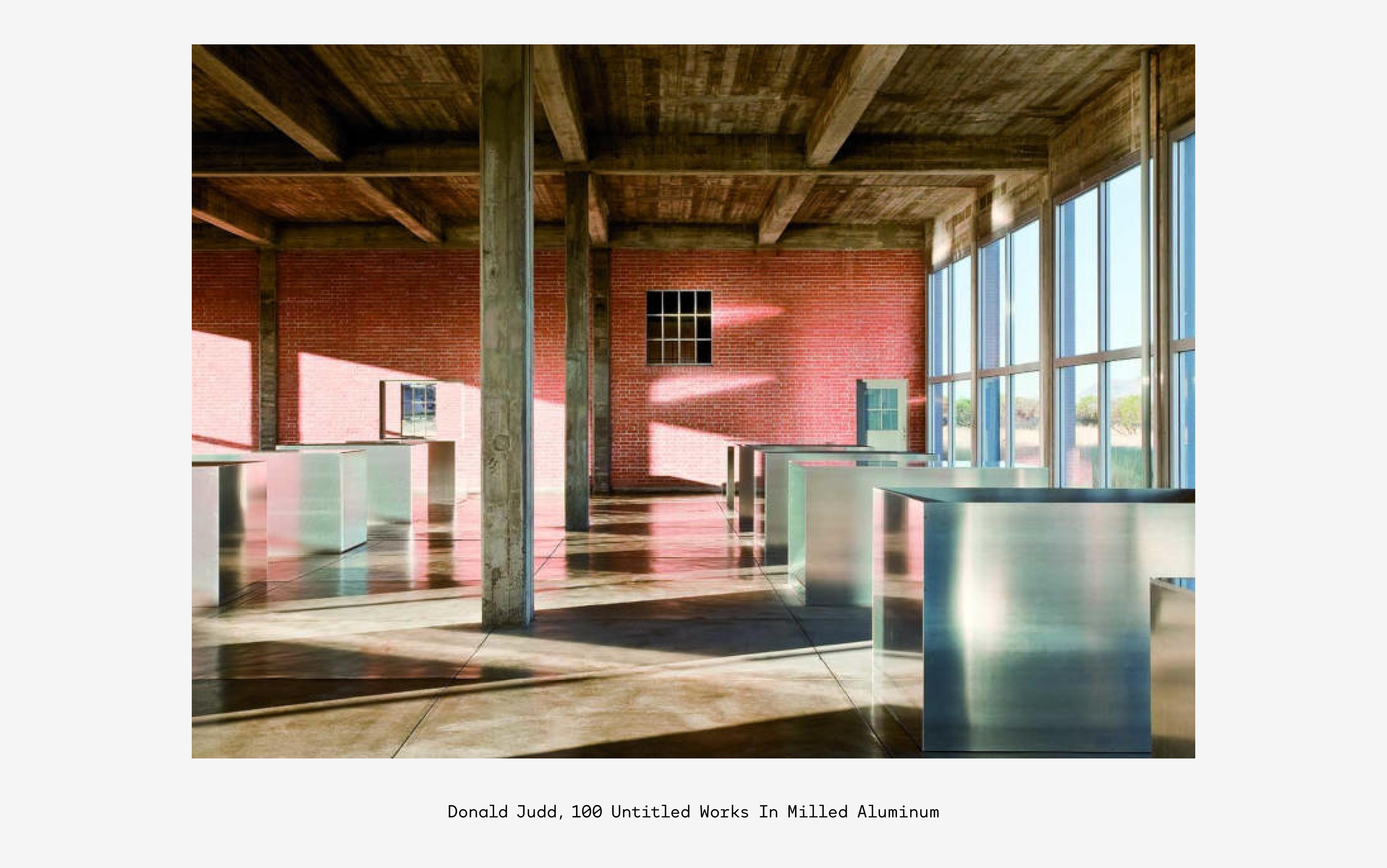
### Culture
As Chromie Squiggle continued to mint through January 2021, Snowfro started to spend more time with collectors in both the Art Blocks and CryptoPunks online Discord channels, discussing his technical and design decisions for creating the Art Blocks infrastructure and its originating Chromie Squiggle project.
His ideas spread like wildfire.
Influential artists entered the Art Blocks Discord to learn more each day. The Chromie Squiggle collection began to act as an instructional guide for many of these generative artists. Minting a Chromie Squiggle allowed them to gain a clearer understanding of the parameters for applying these on-chain design constraints in their own generative art projects.
Eventually, this prompted artists to release their own collections on the Art Blocks platform, often projects they had worked on over years. This wave of releases included now-historical collections like Fidenza by Tyler Hobbs, Archetype by Kjetil Golid, Subscapes by Matt DesLauriers, Ringers by Dmitri Cherniak, and numerous others, in quick succession.
Chromie Squiggle’s collection value reflects this legacy. The price of a standard Chromie Squiggle escalated from mere tens of dollars to tens of thousands of dollars today, with many of the rarest iterations commanding prices in the millions of dollars.
Even more astounding than the meteoric price surge is the perception of the squiggle as a de-risked store of value. <sup>3</sup> The collection has maintained one of the most consistent price bands in the market for blockchain-based digital objects, rivaling only that of CryptoPunks. And according to on-chain data, the outputs are priced as exceptionally low-risk collateral in lending markets. In essence, Chromie Squiggle is perceived and priced by the market as a foundational project for the categories of on-chain, procedurally generated crypto media, and using the constraints of blockchains as part of a work’s creation process.
For the artist himself, the iconic quality of the work is closely tied to its capacity to stand for a specific set of values. Snowfro has remarked that his “personal hope for the Squiggle is that it should not only represent art, but a certain culture.[…] We need more kindness, more empathy in the world. And if the squiggle can make a contribution to this, I am satisfied.” <sup>4</sup>
### Conclusion
Looking back across history, legacy art movements can typically be viewed as reactions to prior art movements and relevant cultural events. Today, blockchain-based generative art encapsulates modern generational values of technology, permanence, individuality, collaboration, and collectivism.
Over time, generative media will continue its inevitable march across industries – from the art hanging in our homes, to the structures we work within, to the furniture we rest on. The growing efficiency of AI-assisted engineering, 3D printing, and generative manufacturing will only accelerate current trends toward programmatic variety.
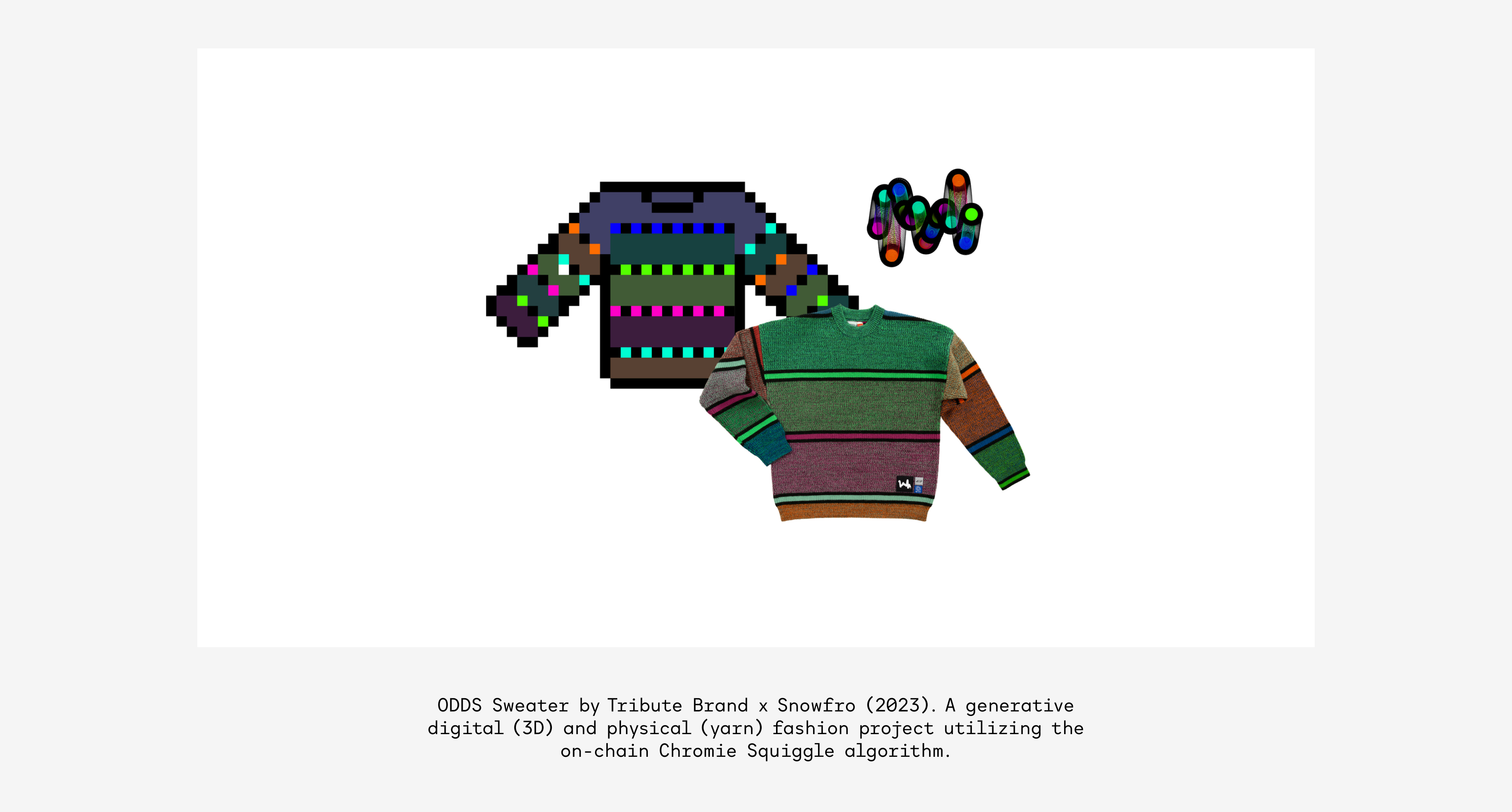
Given its continued (and growing) impact, it is this gallery’s view that on-chain, generative media will be recognized as one of the most influential and important forms of computer art. And over time, the origin of its history will be drawn back to Snowfro’s Chromie Squiggle:
* The project created innovative technical standards that would inspire an entire industry of artists, coders, and on-chain communities.
* The project was the genesis project for Art Blocks, a platform which facilitated a new design space for creating and collecting on-chain objects, generated on-demand.
* The project was an instructional guide for the world’s creative coders to employ verifiable randomness to their algorithmic work.
* The project is a perfect challenge to the preconceived value of computer art. And more simply, a computer-generated rainbow line itself is a response to what art should be, or even look like.
* The project’s simple, unique, and colorful aesthetics have empowered the collection to become a true symbol of internet art and culture – proudly used on everything from identity marks to physical objects of fashion.
Today, as both an object of art and an icon of history, Chromie Squiggle represents one of our space’s most influential collections.
And in time, we believe Snowfro will be recognized as one of history’s most important artists.
*The E30D object this month, Chromie Squiggle #9951, was be given away on September 29th, 2023. E30D “Full Set” collectors have received one copy of this exhibition poster in advance of the exhibition.* +
—
1. Andrew Jiang and Todd Goldberg, Collecting The Algorithm: Chromie Squiggle. https://www.curated.xyz/editorial/collecting-chromie-squiggles
2. Larva Labs, Crypto Punks and Attributes https://cryptopunks.app/cryptopunks/attributes
3. Derek Edwards, “Storing Value in Digital Objects”.
4. Snowfro, interview with Malte Rauch. https://www.brightmoments.io/quarterly/snowfro
0x6e2F···aceE## Artist: Mathcastles
## Object: Terraforms Level 7 at {22,3}
## Collector: HEEEEEEEEEEE
## The Republic of Dreams: Mathcastles’ Terraforms
Author: Malte Rauch
Editing: Madison Page, Derek Edwards
Date: August 1, 2023
Artist Interview: [Artist Interview](https://amber-electric-snail-94.mypinata.cloud/ipfs/QmPeVS6wVSdvqtMyxzmdbRVc3XiU8ghMmAsMGFN5qmqfWG)
Terraforms, a digital art collection by the anonymous coding duo Mathcastles, was a radical rejection of the status quo when it launched on the Ethereum blockchain in December 2021.
The work finds positive meaning through a series of rejections:
* that blockchains are merely a storage device for finished work.
* that digital art objects should be complete upon collection.
* that visual aesthetics are the primary criterion for art.
On this final point, one of the earliest and most radical proponents of this idea was early 20th-century artist Marcel Duchamp. He presented ordinary objects as art and issued imaginative cheques and bonds as his works. These pieces reinforced his view that art could exist beyond traditional skill or craftsmanship by presenting ordinary, everyday objects within a new context.
In line with this, Duchamp rejected the art of most of his peers as “retinal”, art which only appeals to the immediate visual satisfaction. Duchamp’s views challenged prevailing notions that art was first and foremost about visual beauty.
A rejection of aesthetics as the sole criterion for art encourages the viewer to explore a work’s potential as a means of conveying ideas—in Duchamp’s case, the authenticity of art and the role of the artist. In embracing such a “conceptual” approach, artists often explore unconventional materials and methods to create work that goes beyond the surface to engage the mind of the viewer, and to challenge audiences to seek deeper meaning and interpretations within a work.
Today, Terraforms emerges as a category-defying work which carries Duchamp’s outlook into the realm of digital art on the blockchain.
Artistic innovation challenges the categories previously employed and relied upon. In effect, the process of categorization, let alone comprehension, trails behind the difference brought about by innovation.
To understand the challenges involved in categorizing the Terraforms project, look no further than the struggle faced by one of the project’s artists – 113 – to describe it within the clean lines of pre-existing concepts. In a recent tweet, 113 speculates about the right classification for Terraforms: “World Computer Art, Art World Computer, Art Worlds Online, World Computer, Runtime Object Artwork.”
At glitch Gallery, we aim to think about the project as an exploration of three essential concepts:
(1) World
(2) Computer
(3) Art
### World
Terraforms is represented by 11,104 objects, each arranged in a 32x32 grid of unicode characters. Aesthetically striking, these individual works are merely the outward-facing facade of the Terraforms system.
Each grid within the architecture of Terraforms is characterized by several traits, providing an initial glimpse into the wider structural design. The architecture is composed of 75 distinct ‘Zones,’ each associated with a unique color palette, and 92 ‘Biomes,’ prescribing the set of glyphs used in the grids for the animation. The ‘Chroma’ property sets the pace of the animation, akin to a heartbeat pulsating at varying speeds throughout different elements of the structure.
The individual objects, also referred to as “parcels” within the Terraforms ecosystem, essentially serve as components of an overarching “Hypercastle” architecture. Each work’s title and metadata specifies its position within the greater structure, placing it along the x and y axis, and on the twenty-level structure.
Furthermore, each parcel is characterized by a unique topography or heightmap, which is not immediately visible but can be accessed from the contract using the “tokenTerrain” query. This topography introduces another temporal dimension, given that the height of various elements fluctuates over time.
Collectively, the 11,104 parcels constitute the overall architecture, which assumes a diamond-like shape with varied numbers of parcels across its structure. The rhombic structure is apparent in its distribution of parcels: level 1 features 13 parcels, level 13 contains 2,075 parcels, while level 20 again holds 13 parcels. Each level can be perceived as a floating terrain, each portraying a unique virtual landscape defined by its zones and biomes.
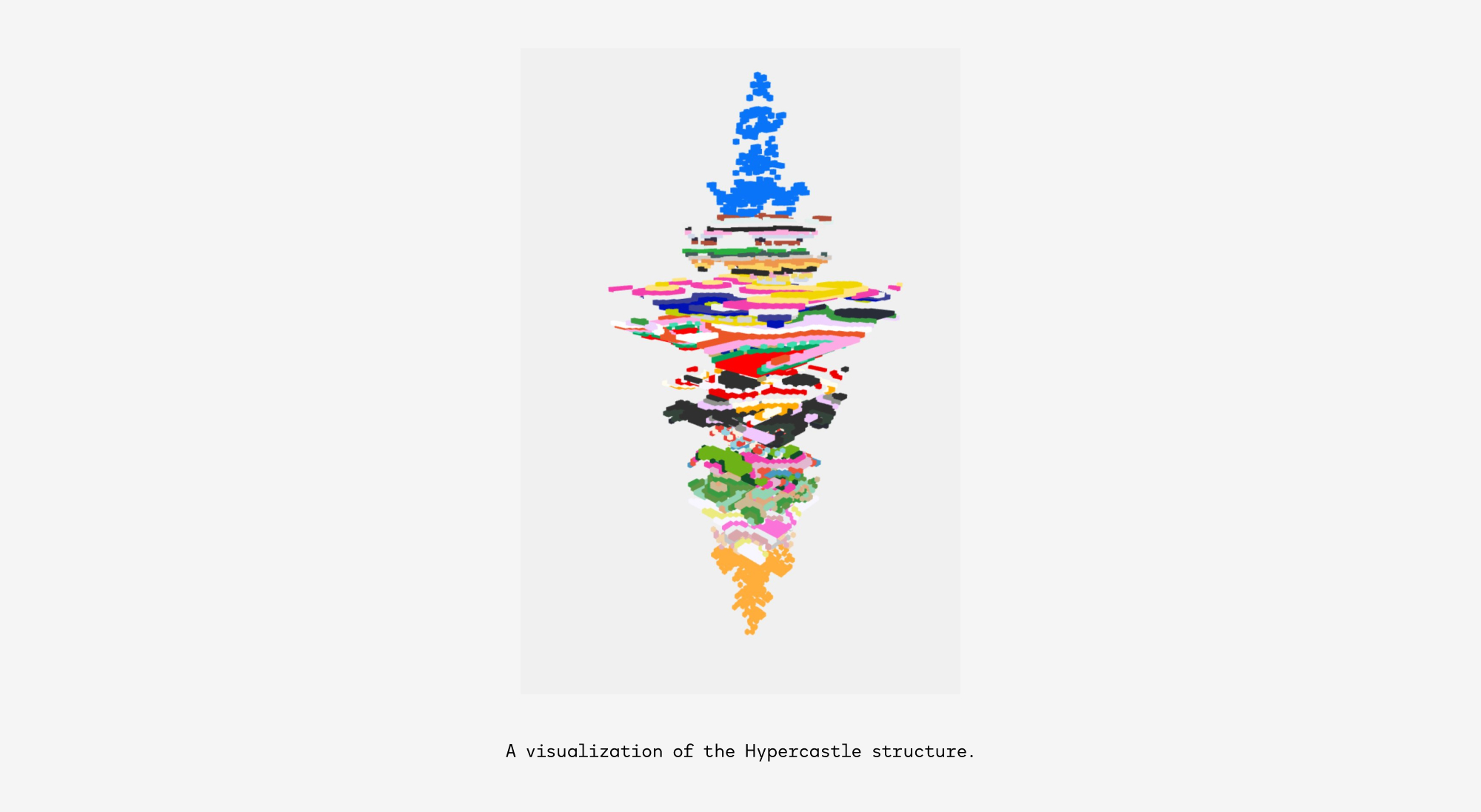
One of the often-overlooked aspects of Terraforms is its organic undercurrent. The ‘Chroma’ rhythm, akin to a pulsating heartbeat, permeates the structure. The evolving topography within each parcel parallels the shifts within a landscape over time. And, most notably, Terraforms possesses an in-built entropy: over the course of the next 10,000 years, the structure will gradually unwind and decay.
Dynamic generative artworks are autonomous systems that can truly “live” on decentralized blockchains.
Alongside artists Deafbeef (Entropy) <sup>1</sup> and Casey Reas (Century 2052), Terraforms is one of the pioneering projects to exist, evolve, and ultimately perish on the blockchain. However, the Terraforms world operates on a scale more akin to geological than human time, detaching the temporal aspect from any value consideration.
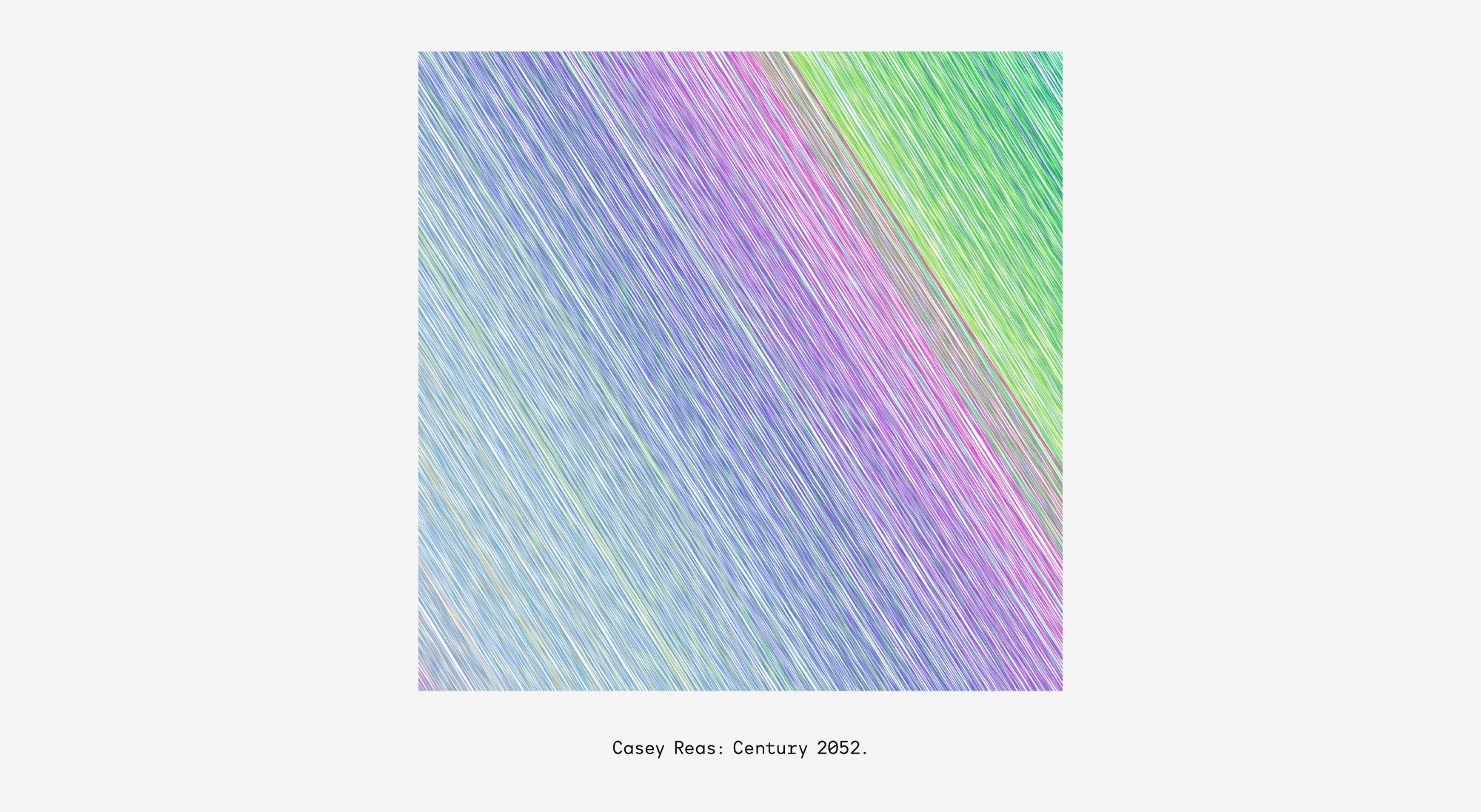
In its role as a virtual world creator or a form of 3D land art, Terraforms shows a deep affinity with avant-garde architectural projects, specifically, Constant’s “New Babylon.”
Over a span of 20 years, the Dutch architect endeavored to design an utopian city envisaged as a dynamic network. Constant aimed to construct a macro-structure that could be continually transformed and reinterpreted by its inhabitants. In this context, “Art” ceases to be a static, self-enclosed object. Instead, it transforms into the dynamic interaction between a visionary structure and the actions of those who inhabit and engage with it. <sup>2</sup>
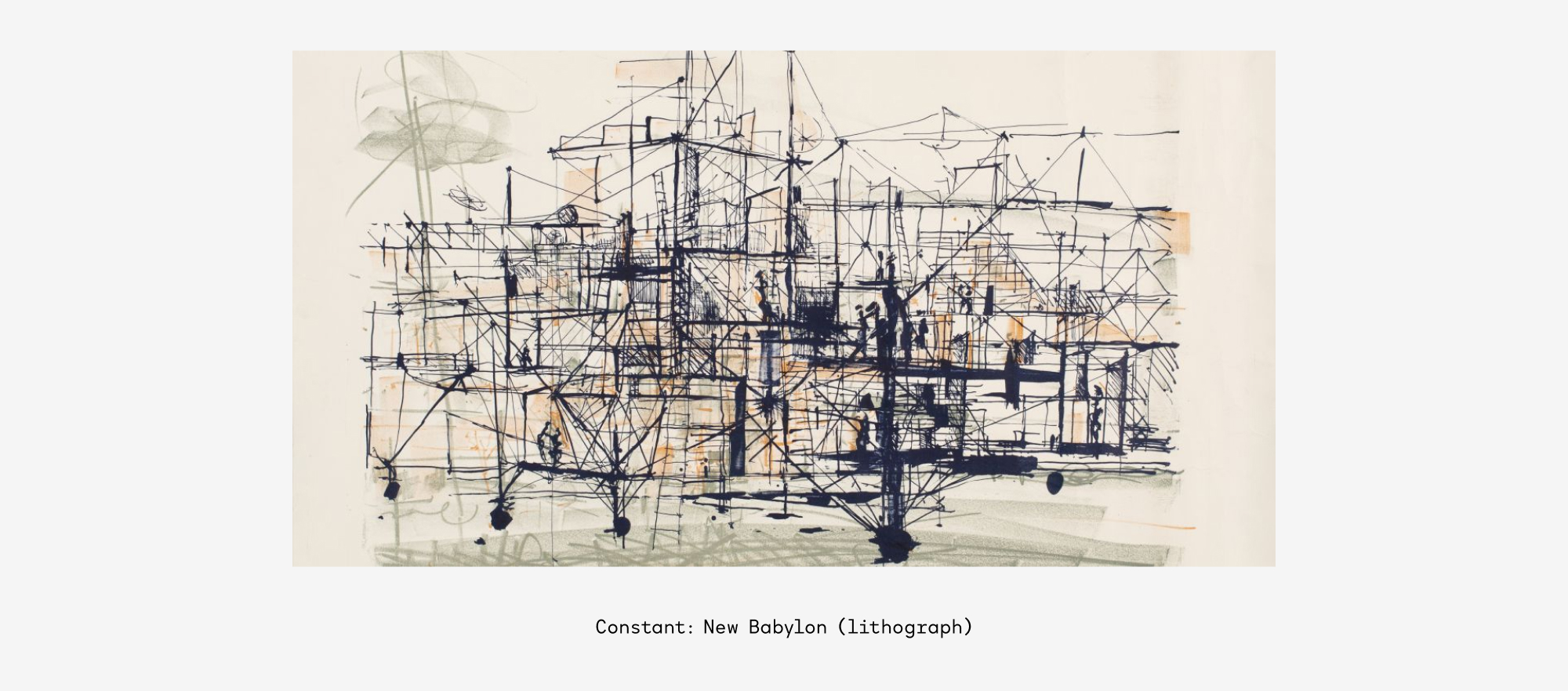
New Babylon was both a visionary Gesamtkunstwerk and a tangible technical proposal. Despite Constant’s optimistic expectations that robotics and automation could actualize the plan, it ultimately remained an unfulfilled vision only imagined through a myriad of models, drafts, and sketches, yet never realized as a built structure.
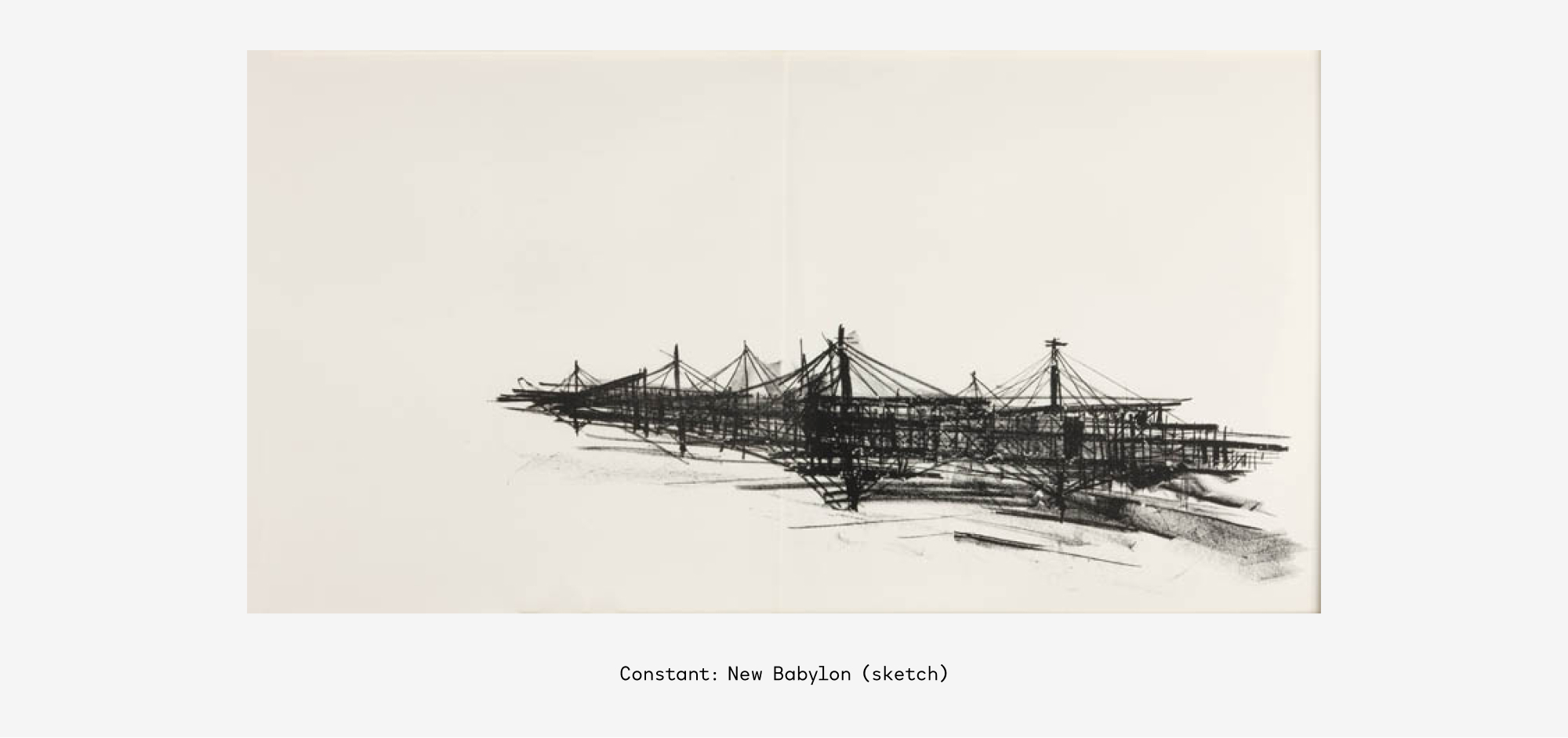
Similar to “New Babylon,” Terraforms is an abstract macro-structure that can only be interpreted and completed by its community. Mathcastles could have supplied the necessary tools to visualize the entire Terraforms architecture or given a final interpretation of all features.
Instead, they decided to leave it to the community to use the project’s on-chain data to interpret and visualize the Hypercastle. As 113 notes: “The 3D structure of Terraforms is non-visual. It’s not rendered. It has no definitive visual presentation. It’s an abstract reinterpretable skeleton.” <sup>3</sup> Thus, community members like Matto and 0x0112 have developed tools to visually interpret the architecture. And there are also impressive community activities focused on deciphering some of the references buried in the Zones.
When asked about the role the community plays in the project, Matto notes:
“Terraforms gestures towards a world where meaningful computing and software literacy becomes widespread and people engaging with computers transcend the role of ‘user’ to become something more like a ‘digital citizen’ an empowered participant in a system. This is exemplified in the Mathcastles studio’s engagement with the community of collectors and enthusiasts around the project. By intentionally leaving some facets of the piece absent they create a negative space to be filled by creators like myself in creating the Hypercastle Explorer application and Unity SDK, El Ranye in creating the Terraforms Explorer website and 0x112 who created http://enterdream.xyz (among many other great contributors). This spirit of decentralized creation, of networked art and tool making has helped to foster a tight knit community around it while also allowing the work to be understood and experienced through a variety of views, expanding the ways in which it can be approached and appreciated.” <sup>4</sup>
Essentially, Terraform’s architecture guides the viewer from the perceptible – the 2D parcel – to the imperceptible – the true architecture of Terraforms, which is art manifested through computation.
### Computation
Terraforms engages with computation as an artform, specifically utilizing Ethereum, the decentralized and permissionless world computer, as a medium in its own right.
Code and computation are fundamentally non-visual. They operate within a broadly conceptual framework based on instructions and calculations. When 113 insists that Terraforms’ essence lies beyond the visual, they point to the idea that the project’s depth is understood primarily through its technical infrastructure. Code and computation are not merely a means to an end here, but the thing itself.
Let it be said plainly:
Terraforms isn’t just another project with vague language about the “intersection of art and technology.” Rather, it is the attempt to artistically “utilize” smart contracts in the most ambitious manner, enabling the creation of something that is irreplaceable in any other form. This encapsulates the real meaning of engaging with computation as a medium.
Written by xaltgeist, the second anonymous coder behind Mathcastles, the project’s smart contract has been celebrated for its elegance and complexity. <sup>5</sup> It is organized through several components. The primitive raw data for constructing the grids in Terraforms is stored in two distinct contracts, one housing Unicode glyphs for biomes and the other holding hex color codes for zones.
Furthermore, there is a separate contract that determines the overall architecture of Terraforms and, finally, there is a Perlin noise library that adds a “natural feel to the animation, topography, and layout,” as the developer and artist Michael puts it.
The Terraforms contract employs all of these components to generate the animation at “runtime.” In computer science, “runtime” refers to the period during which code is being executed as machine code on a computer’s CPU—the operational phase in the “lifecycle” of a program.
By analogy, runtime art in cryptoart is defined as a form of dynamically computed art at the smart contract level, running as long as the Ethereum blockchain is running. Hence the lifecycle of the artwork is identical to the lifespan of Etherum, which we consider to be unrestricted.
HEEEEEEEEEEE, collector of this exhibitions object, writes:
“In a time where artists have been sold provenance and (often circumventable) royalties as the ultimate justifications for NFTs and blockchain, Mathcastles gestures toward a future that embraces the unique affordances of distributed computing as an artistic medium for its own sake, rather than as utilitarian feature extension of existing digital art.
The extent to which Terraforms, a gateway drug by admission, fully delivers on this promise is subject to interpretation, but I am extremely confident that future efforts by the studio will actualize these ambitions for artists, collectors, and skeptics alike.”
Various approaches are available for the Terraforms community to interact with, build on top of, and contribute to the development of Terraforms. One aspect already discussed is the community-led interpretation and visualization of the Hypercastle.
Owners of each digital Terraforms object can also opt to transition their parcel from the initial “Terrain” mode to the “Daydream” mode. Here, they can inscribe their own drawing onto the parcel, and save it on-chain by moving into the “Terraform” mode. While the shift from Terrain to Daydream mode is irreversible, the transition from Daydream to Terraform mode can occur indefinitely, facilitating continuous modifications and perpetual overwriting of each parcel.
Lastly, the Terraforms smart contract is designed to enable developers to construct software atop the existing structure, or alternatively, utilize a different seed value to create variant versions.
Terraforms embodies an artistic use of Ethereum smart contracts as a permissionless, unmediated, and interoperable form of computation. It stands as one of the most demanding examples of utilizing this technology’s full potential as an artistic medium.
### Art
In a recent tweet, 113 made the following observation about Terraforms: “The visuals are almost a trojan horse. Package design. A 2021 legibility costume.” <sup>6</sup>
We are now in a better position to understand the reasons behind this claim. Terraforms is an intentionally abstract and indeterminate project that purposefully avoids visualizing or depicting the virtual world it enables. Instead, it focuses on providing the underlying infrastructure of the “invisible” Hypercastle on the smart contract level, establishing the conditions that make this virtual world possible.
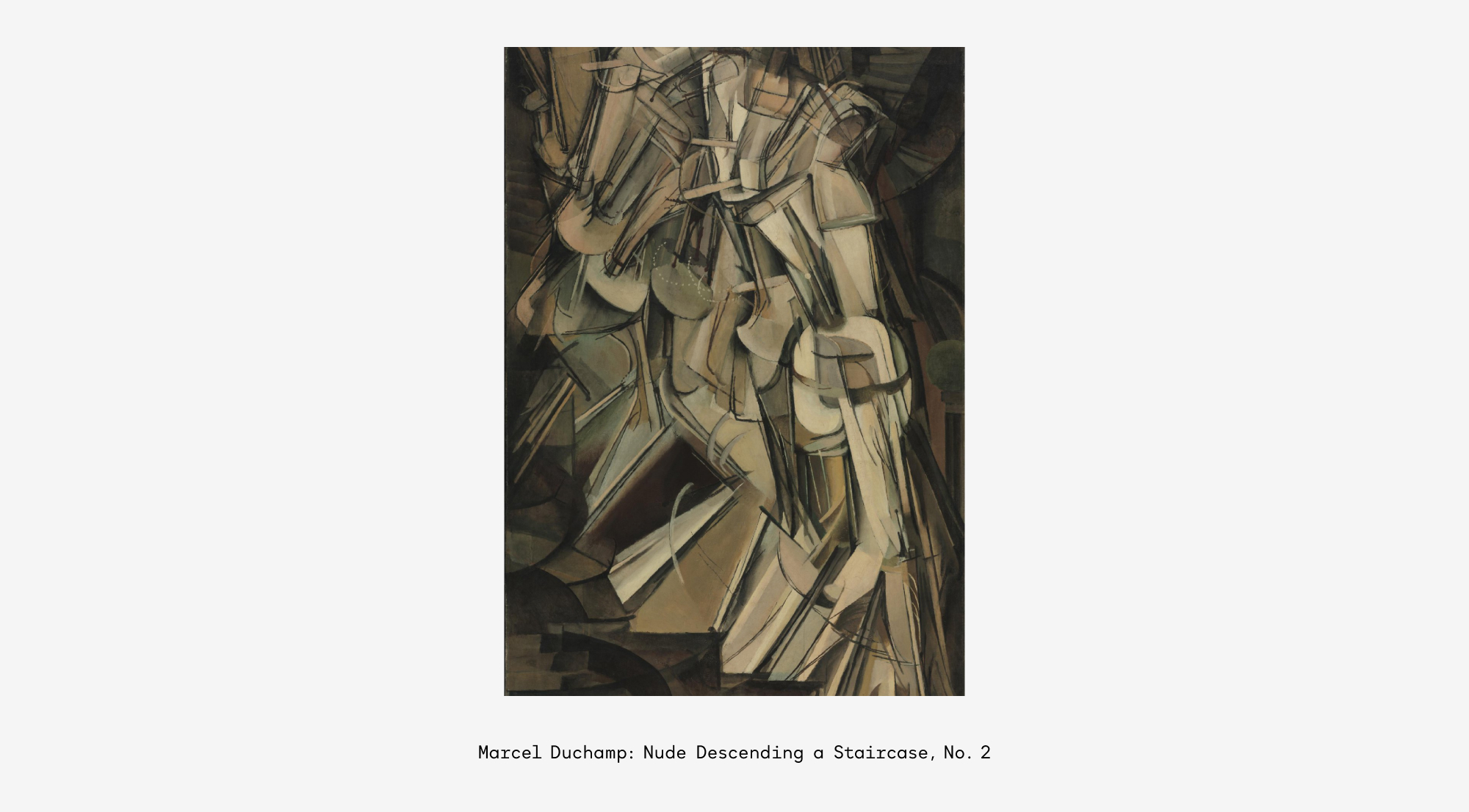
Decades ago, Duchamp, stated: “Painting should not be only retinal or visual; it should have to do with the gray matter of our understanding, not alone the purely visual.” <sup>7</sup>
Today, Terraforms proposes the same for digital art on the blockchain. According to the project’s philosophy, the most advanced form of digital art ought to transcend aesthetics and engage with the possibilities of the medium in a deeper way.
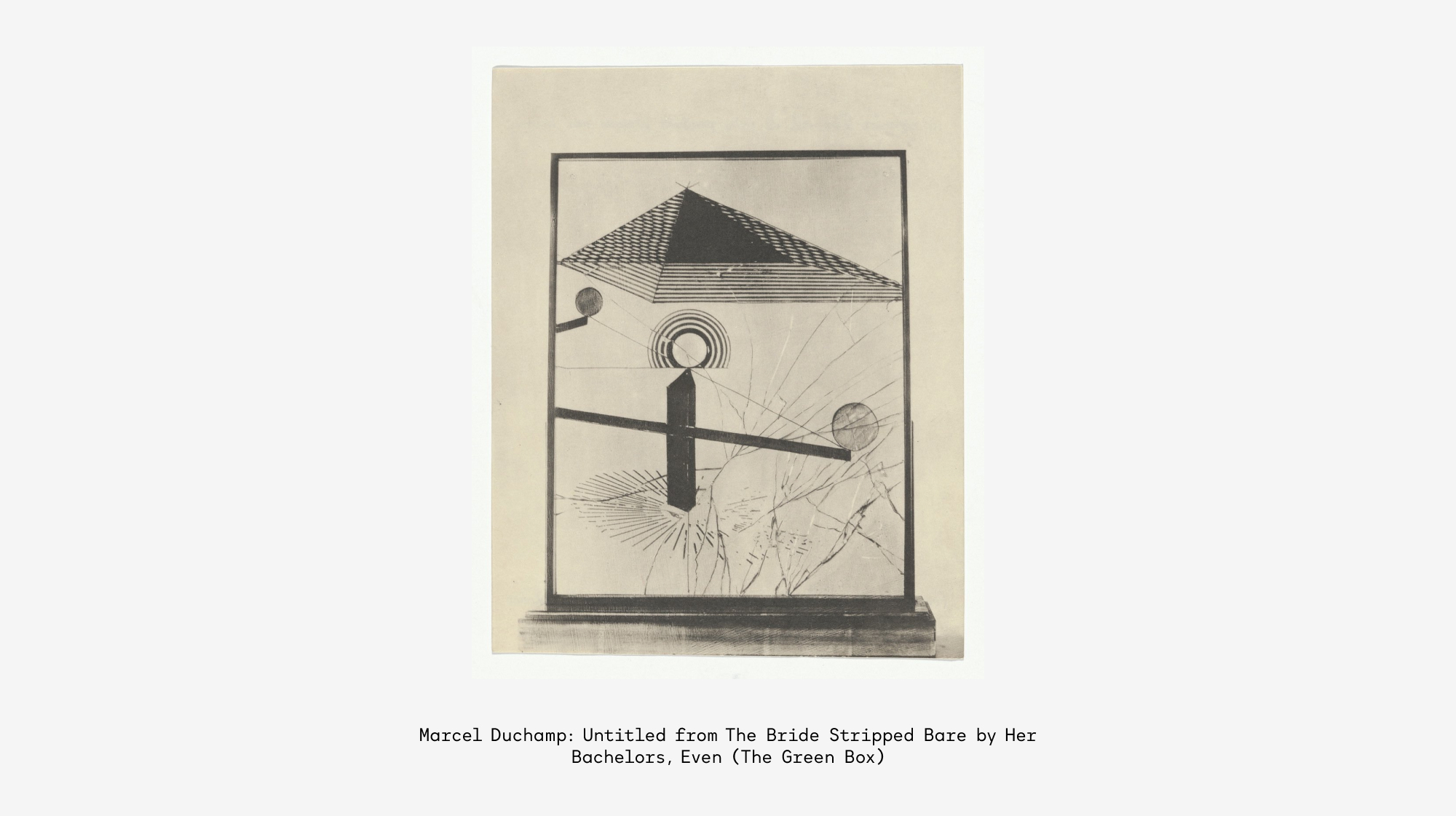
Positioning themselves, be it intentional or inadvertently, within a lineage that stretches from Raymond Roussel to Marcel Duchamp and Constant, Mathcastles aligns with an artistic perspective that embraces a conceptual understanding of art and celebrates the imaginative worlds opened by the mind. As Kevin Buist nicely puts it, “Terraforms is a reminder that the best virtual worlds are imagined, not simulated.” <sup>8</sup>
To a certain extent, this artistic understanding explicitly articulates what is implicitly present in every form of art and recognized by anyone who has experienced meaningful encounters with art: significant works of art transcend mere aesthetic pleasure. While they may possess striking beauty (and many Terraforms parcels are among the most beautiful works of character-based art today), their true significance extends beyond immediate visual enjoyment. They possess a profound “depth” and inherent indeterminacy that invites endless interpretations.
This rigorous demand placed on art is born from a genuine respect for it. If one does not take art seriously as a form of independent thinking, there would be no reason to impose such demands. The very essence of setting these standards is rooted in a profound recognition of art’s significance.
Reading through 113’s tweets, it is therefore no surprise that one finds a clear ambition for Terraforms:
* Inscribing itself in the lineage of Larva Labs and Art Blocks as a defining project of generative art on the blockchain.
* Fundamentally changing the very category of the digital artwork, as it is understood by the crypto scene as well as the contemporary art world, by using the full potential of decentralized, permissionless computation as a medium
* Transforming the crypto space into the primary context for digital art and revealing the superficiality of much contemporary digital art that only vaguely references digitization.
In previous articles, we have described the genesis of unique digital objects and arrival of generative art on the blockchain.
With Terraforms, we see digital objects morph into something different as the very idea of digital art is redefined through the project. Seen as a whole, Terraforms is an open, living work in which art provides the base layer for a virtual world.
Each digital object in this macro-structure becomes a kind of indeterminate element with entirely new functions: running live on the Ethereum virtual machine, endlessly evolving, inherently interoperable, radically networked, and indefinitely open to reinterpretation by the community.
In the early 20th century, Duchamp aimed to demonstrate that the essence of artwork is not visual but conceptual. Mathcastles’ Terraforms is an open-ended experiment that invites a community to collectively define the significance of digital art on the blockchain beyond aesthetics.
We believe the impact may be comparable. +
—
1. https://deafbeef.com/series/3
2. Constant insisted that only the inhabitants themselves could complete the work: “New Babylon is the work of the New Babylonians alone, the product of their culture.” Constant “New Babylon” (1974), https://www.readingdesign.org/new-babylon
3. Quote from 113 in “Five Views of the Metaverse,” https://outland.art/five-views-of-the-metaverse
4. Matto, private message to the author.
5. The best overview of the technical side of Terraforms can be found in Michael’s “An Ode to Terraforms,” https://ilikecalculus.substack.com/p/an-ode-to-terraforms. The technical summary is based on this article.
6. [X post, @0x113d](https://x.com/0x113d/status/1660376498107301889?s=20)
7. From “A Conversation with Marcel Duchamp and James Johnson Sweeney,” ed. and intro by James Nelson (New York: W.W. Norton & Company Inc., 1958), p. 97.
8. Kevin Buist, “The Map is the Territory,” https://outland.art/terraforms-by-mathcastles/
0x6e2F···aceE## Artist: Larva Labs
## Object: CryptoPunk #1478
## Collector: Erick Calderon
## All Roads Lead to Punks
Author: Malte Rauch
Editing: Madison Page, Derek Edwards
Date: July 1, 2023
Artist Interview: [Punk Round table Interview](https://amber-electric-snail-94.mypinata.cloud/ipfs/QmPooHy8We2VKYNpyw847cq9Ugamzk54pchJ41KX1WLWPo)
In 2017, Larva Labs, a game design studio by John Watkinson and Matt Hall launched a digital art experiment on the Ethereum blockchain.
The project paid tribute to London’s early ‘70s punk scene, cypherpunks, and pixel art. It came in the form of 10,000 unique, randomly assembled, 24x24 pixel art characters featuring an assortment of humans, zombies, apes, and aliens.It was called CryptoPunks.
For a few weeks, anyone with an Ethereum wallet could claim these tokenized digital characters for free on the Larva Labs website. Living somewhere between generative art piece, collectible, and technical accomplishment, the project quickly stood out as having a number of differentiated characteristics compared to previous digital art projects:
* Each CryptoPunk could be uniquely identified on a public, trust-minimized database;
* Each CryptoPunk could be self-custodied in a sovereign controlled wallet;
* Each CryptoPunk could be bought or sold on a global, 24-7 blockchain marketplace created by Larva Labs.
The project’s characters, a radically diverse group of 8-bit personas, became an immediate cult collectible.
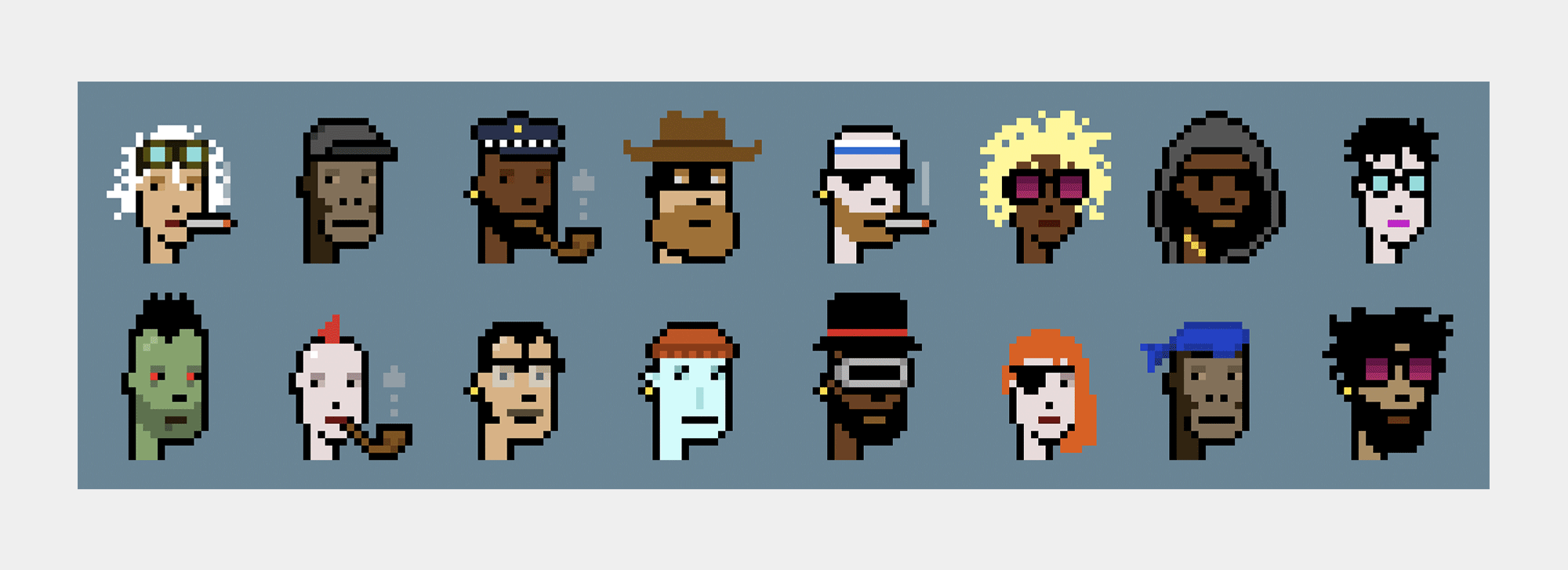
Since 2017, no project in the crypto art space has done more to help facilitate the formation of unique online personas.
Originating from the Latin “persōna,“ the word “person” initially referred to a theater mask. This type of mask is no mere disguise – it is a conduit for embodying a role, a separate identity.
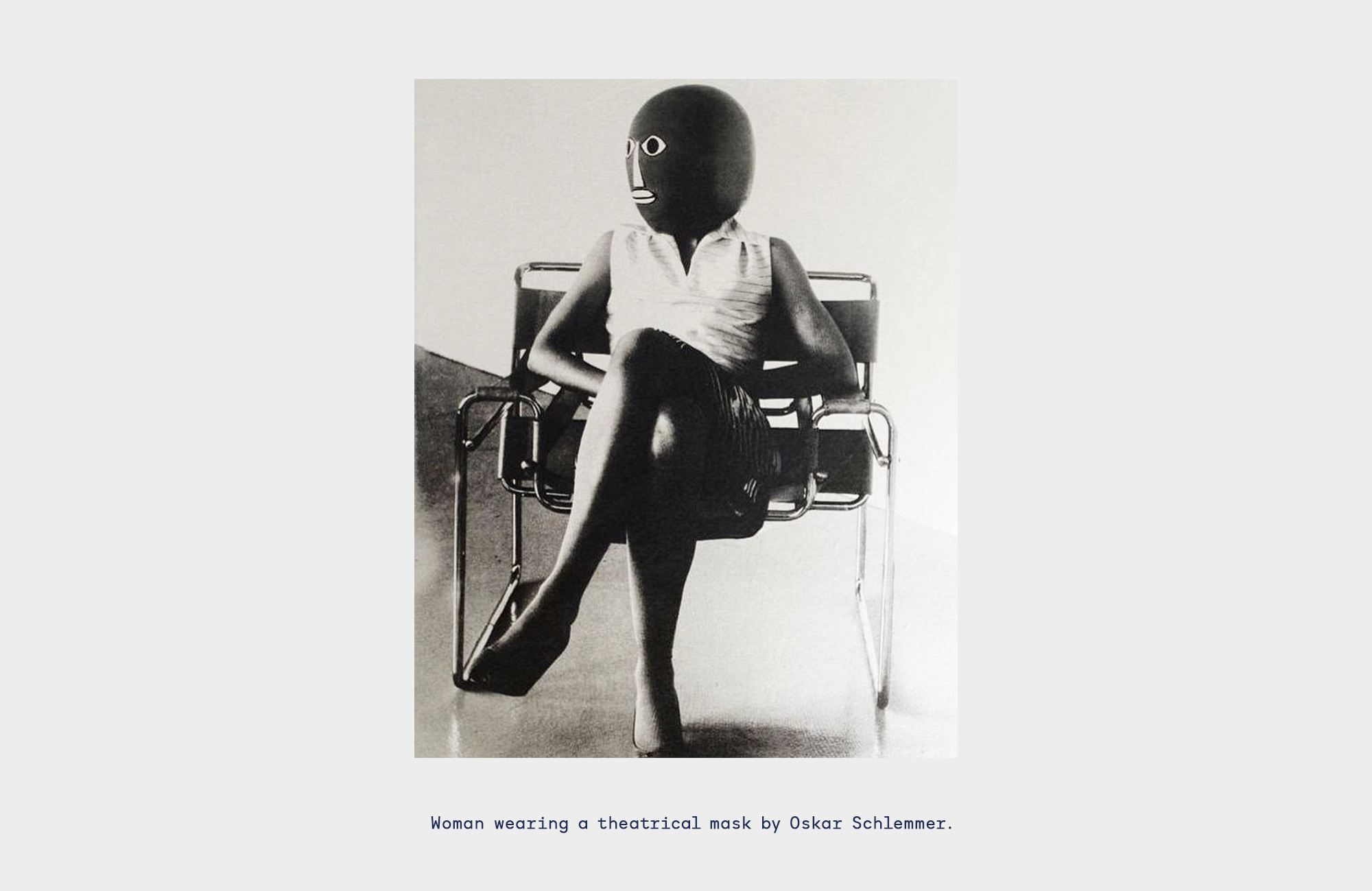
In many ways, a person’s identity can be seen as a collage of varied personas or masks: public, private, and professional, among others. It’s not primarily about the mask concealing the true face; rather, it’s about making room for various masks to emerge in different contexts.
Over the past two decades, the rise of social media ushered this concept into digital environments. Today, a blossoming internet economy brings a new stage for social performances: curating vacation pics, sharing professional victories, posting personal tributes publicly are the new tools for shaping modern masks.
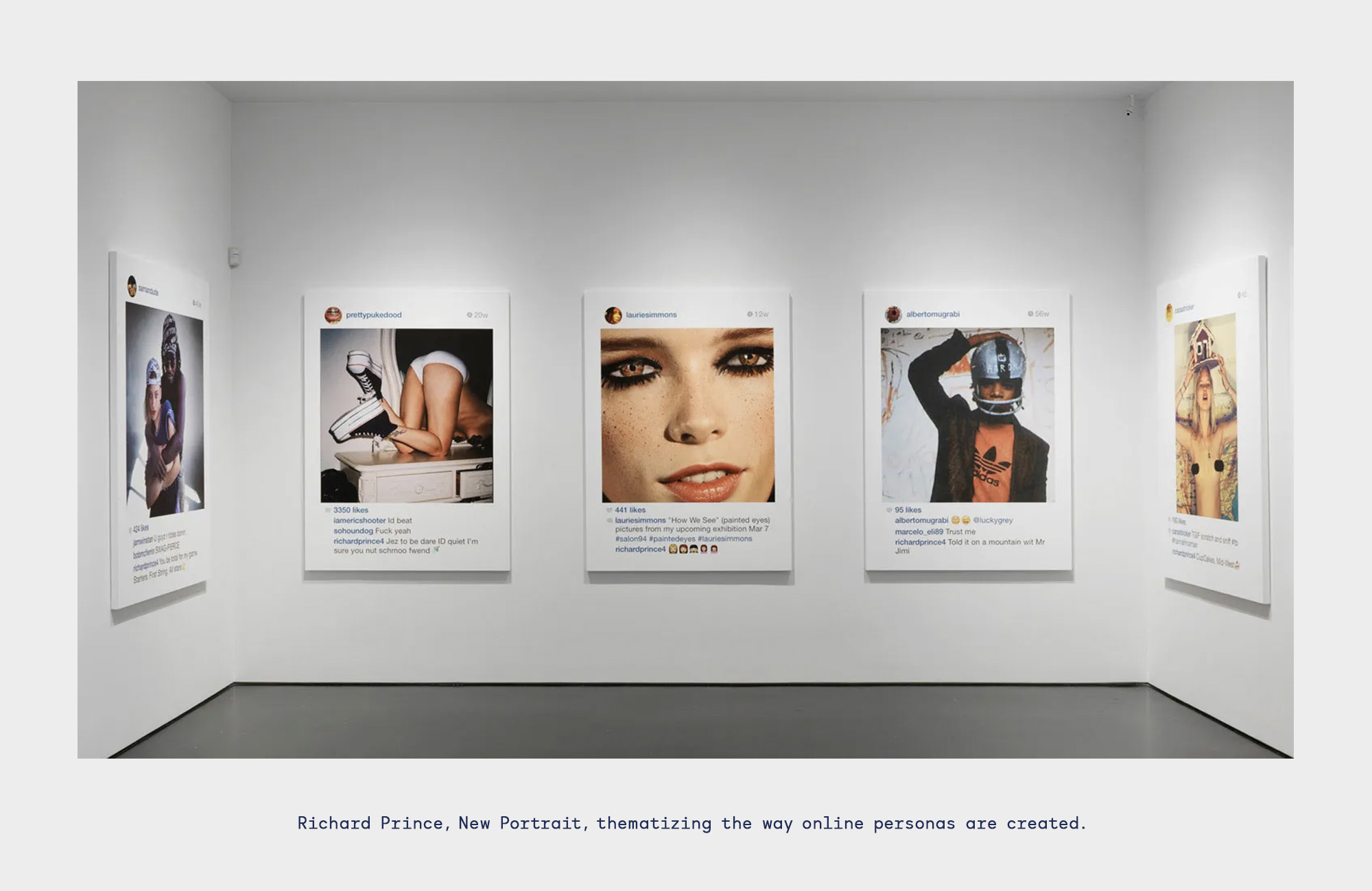
After the launch of CryptoPunks – and the breakthrough innovation of blockchain-based media – these digital identity tools have sharpened.
In the past, any digital file could serve as an online identity representation. In the wake of CryptoPunks, a growing number of blockchain tech enthusiasts have started to present their “owned” Punks as a marker of their online identity — swapping their Twitter, Telegram, and Discord profile pictures for images of their 24x24 pixel personas.
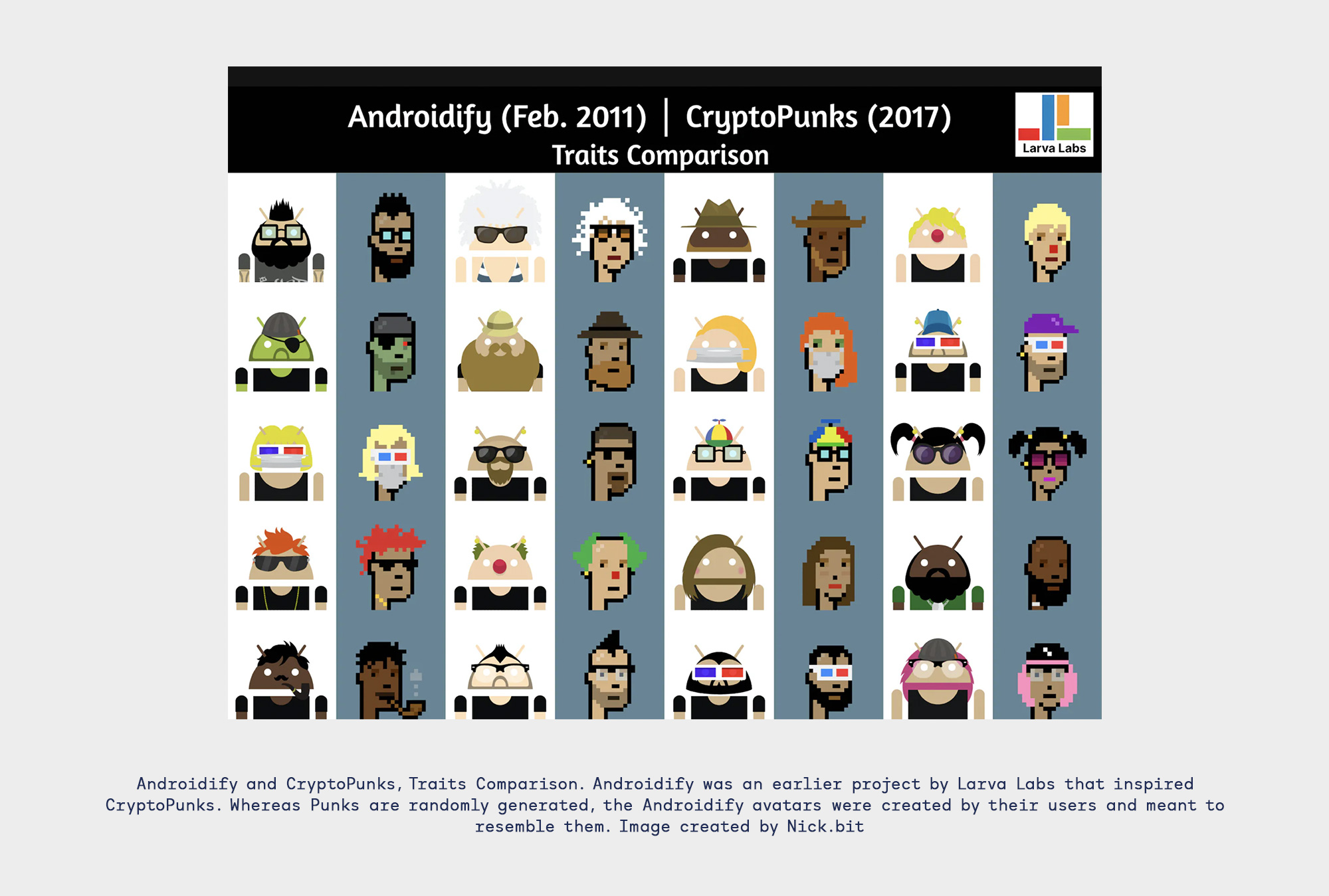
For many of these early blockchain technologists, builders, and enthusiasts, the CryptoPunk profile picture quickly reflected a more authentic version of their identity compared to a photorealistic image of their physical form. While an individual’s physical appearance is shaped by factors such as their environment, upbringing, and age, their digital masks, unencumbered by these constraints, gives them the liberty to architect a persona for internet-native spaces. As the theoretician of social mimicry, Roger Caillois, suggests, “the mask disguises the conventional self and liberates the true personality.” <sup>1</sup>
Adorning the digital Punk mask has allowed those holders to project a unique identity, yet remain linked to a larger collective – a group of true-believers who support the promise of trust-minimized technology.
Further, the pixelated Punk mask facilitated the creation of the pseudonymous identity in internet and crypto-native spaces, where the merit of one’s work product was often more interesting than their physical appearance. In addition, the cyberpunk imagery and the anti-authoritarian, anti-statist ethos of punk culture, which the collection alluded to, resonated with the libertarian leanings of the initial cryptocurrency community.
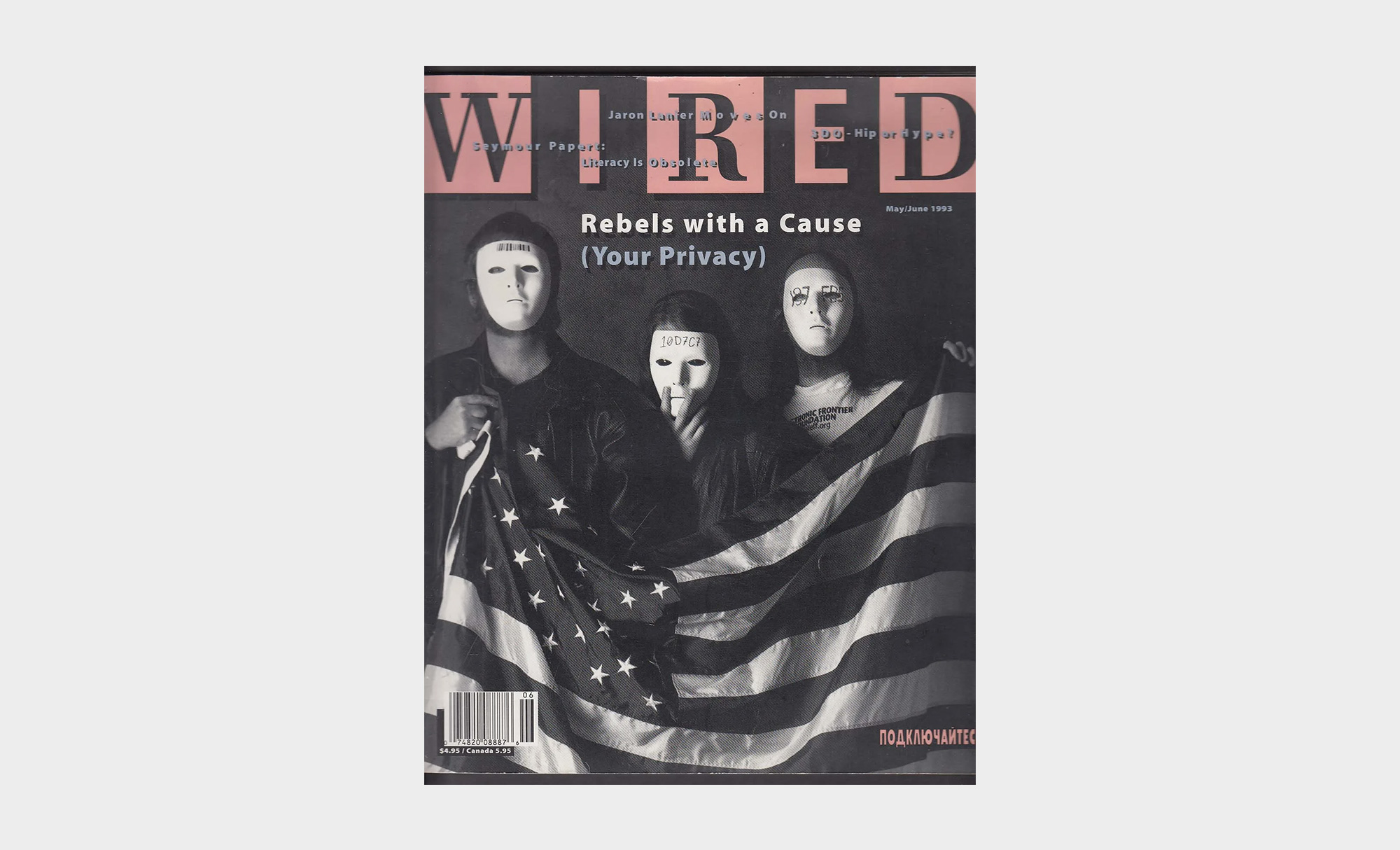
In the absence of any central authority, the community of Punks established a kind of decentralized ethos through mimicry, where nearly every member adheres to thoughtful commentary, building, and an overall aversion to excessive hype. Without exception, the sharpest people in the web3 space are Punks and many early adopters still set the tone for the digital object community.
Aesthetically, Punks exist on the fringe between figuration and abstraction, serving as a form of generative portraiture while also referencing the restraints of early computer graphics and the abstract nature of pixels.
When Georg Bak, a Swiss curator, met the Larva Labs duo in 2018, he expressed to them that their work was making art history. He invited them to exhibit in one of the first group exhibitions about blockchain art in Zurich alongside Kevin Abosch, Sarah Friend, Rhea Myers and Harm van den Dorpel.
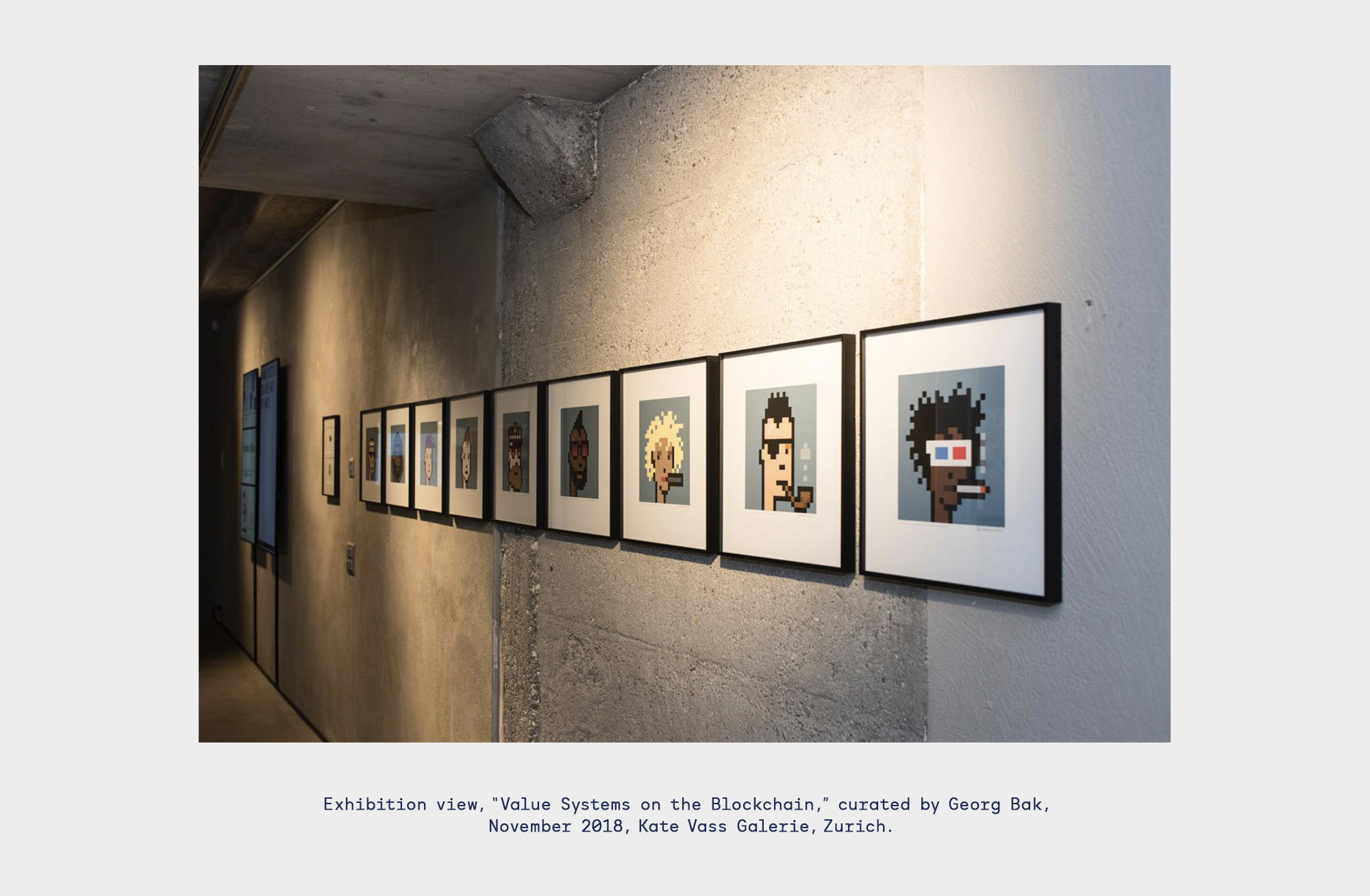
Asked about his prompt recognition of the cultural value of Punks, Bak notes: “I instantaneously knew the CryptoPunks were the Andy Warhol’s of our time and I told Kevin Abosch that it’s just a matter of time that collectors will pay more than a million for a CryptoPunk. He was laughing at me at the time.” <sup>2</sup>
While envisioning the project, Hall and Watkinson drew inspiration from Magic card collecting, aiming to replicate the elements of scarcity, uniqueness, and lasting value in a digital space. Their initial focus was building on Bitcoin, but ultimately, they found Ethereum to be the only feasible solution for hosting these unique digital items with inherent scarcity. <sup>3</sup>
Larva Labs modified the ERC-20 protocol for fungible tokens in such a way that it could produce unique digital objects, a move that would later inspire the design of the ERC-721 standard for non-fungible tokens, and the NFT industry as it exists today.
Faced with Ethereum’s storage limitations, Larva Labs originally developed a strategy of merging all 10,000 Punks into a single, comprehensive image. Tokens associated with each punk specify their respective locations within this unified visual map. The Punks contract incorporates the hash to verify the image file, thus providing a distinctive identifier for every punk—its positional data—that is stored in the metadata of the tokens.
Simply, Punks encompassed multiple innovations in one project:
They brought generative art to the Ethereum blockchain.
They inspired the very category of unique digital objects and blockchain-based media.
They created the first marketplace for exchanging unique digital objects.
Punks are, as Hall and Watkinson remark, “possibly the first work of art with a self-contained mechanism for recording and transacting its ownership.” <sup>4</sup> Launching the marketplace function in tandem with this self-contained mechanism was pivotal to the success of Punks and the subsequent trajectory of digital objects, a fact often overlooked.
The influence of the CryptoPunks cannot be overstated. Erick Calderon, the generative artist known as Snowfro, became an early community moderator for the CryptoPunks Discord, and facilitated discussions about blockchain-recorded art to collectors and community members from 2017-2020.
After the Punks contract deployed, Snowfro discovered that the rarest—aliens and apes—were already secured by other collectors. So, he targeted Zombie Punks, another rare sub-collection, acquiring 34 out of the 88 available. In 2020, he sold five of these Zombies, and went on to use those sales to seed the initial development of the Art Blocks platform. Among his remaining collection is Punk 1478, a wild-haired Zombie, displayed at this month’s e30D exhibition and serving as Snowfro’s iconic avatar on both Twitter and Discord.
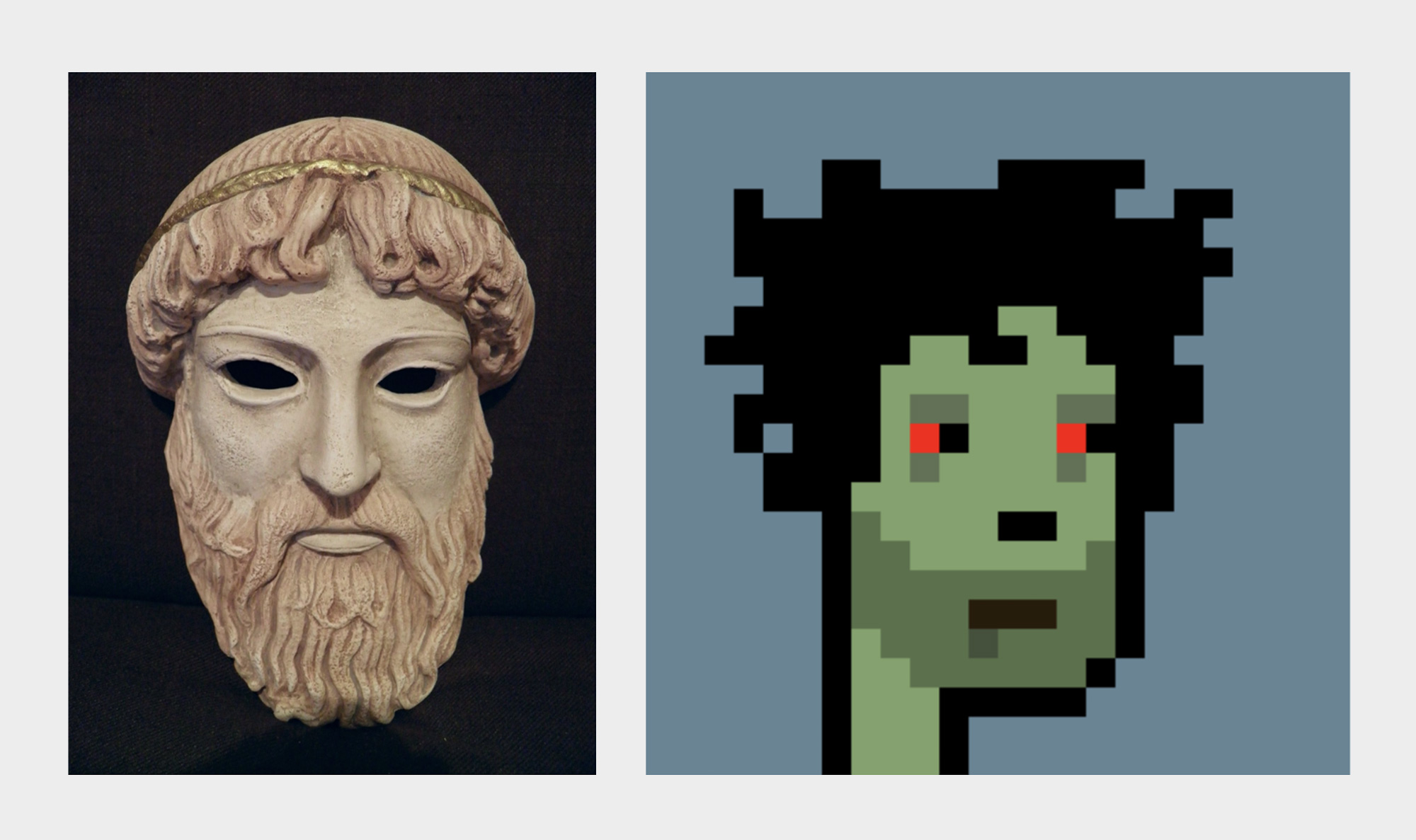
When asked about his view on the CryptoPunk’s lasting collectibility, Erick shares:
“CryptoPunks is a pure demonstration of technological brilliance and experimentation in the world of digital art. The project will carry lasting power as both a pioneering generative art collection, and a proof of concept that demonstrated ownership of a digital object on a public blockchain database. Larva Labs is the team that lit the fuse for my own love of the blockchain space, and I’m forever grateful for the role they played in bringing awareness to art and blockchain.”
Inspired by the technical innovations of the CryptoPunks project, and his own passion for generative art, Erick would later go on to extend Larva Labs’ innovations and create groundbreaking on-chain generative art projects of his own – the Chromie Squiggle, and the wildly successful Art Blocks platform. In particular, Art Blocks has opened the door for creative coders on the internet to build on-demand, on-chain, generative art projects for digital art collectors around the world.
In 2021, two of the leading on-chain crypto artists – Snowfro and Deafbeef – approached Larva Labs and suggested an upgrade to move Punks entirely on-chain. Instead of referencing the composite image, each Punk, along with all its attributes, was now stored directly on the Ethereum blockchain facilitated by a compression algorithm. Today, querying the contract on Etherscan directly provides the image of a Punk as either a raw set of pixels or an SVG –
solidifying the status of individual Punks as unique, on-chain stores of values.
Value-accruing objects like fine art typically have low utility; they’re mainly stores of value meant to be left untouched. For the most part, this also holds true for items like watches and jewelry, which are solely worn as social status indicators.
While Punks have drawn parallels with such objects, they diverge from status-signaling value stores like jewelry and watches insofar as they allow users to craft comprehensive online identities. Viewed this way, Punks stand as pioneering assets combining the status of high art, value storage and a new type of digital use. <sup>5</sup>
As of this writing, the “market cap” of Punks (calculated by multiplying the floor price with the collection size) is greater than $950M+, positioning CryptoPunks in the uppermost tier of the art and collectibles market. To provide perspective: this conservative estimation would rank CryptoPunks—taking the collection as a whole—among the 100 most expensive paintings ever auctioned. Considering that the top 10 Punk sales have already surpassed $50M, the genuine financial value of Punks—as a whole—could approach the worth of the most valuable cultural objects ever exchanged on the open market.
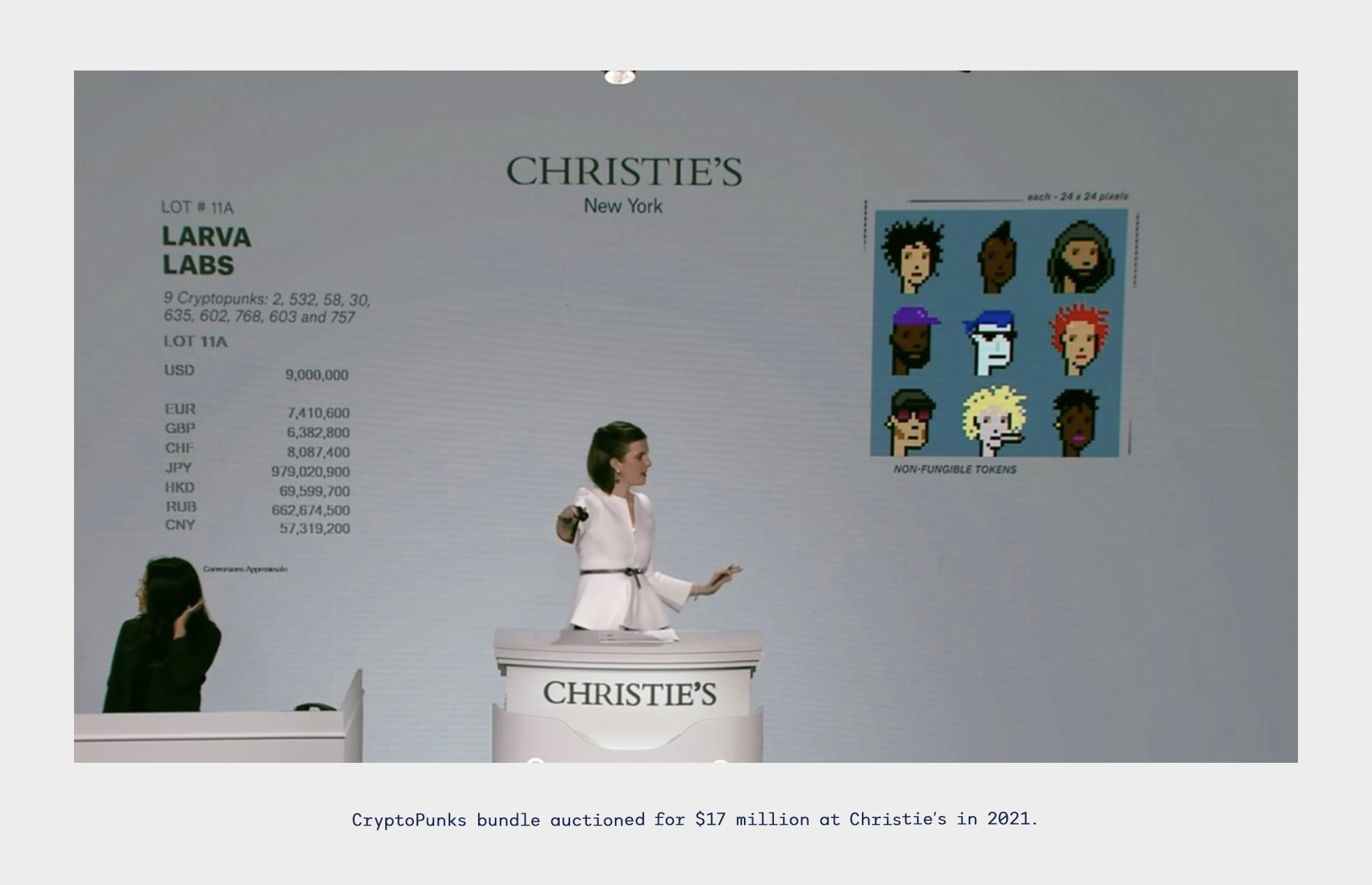
The unique blend of provenance, community, and social signal, all embedded in a hard capped supply, defines the value proposition for Punks. For the era of personal computers, we have Metcalfe’s law, which asserts that the value or influence of a telecommunications network is directly proportional to the square of the number of users connected to the system. In the era of digital objects, the glitch teams suggests a similar principle: Punk’s Law: the greater the number of wallets actively participating in the exploration of digital objects, the more attention will be attributed to Punks, with their value compounding over time.
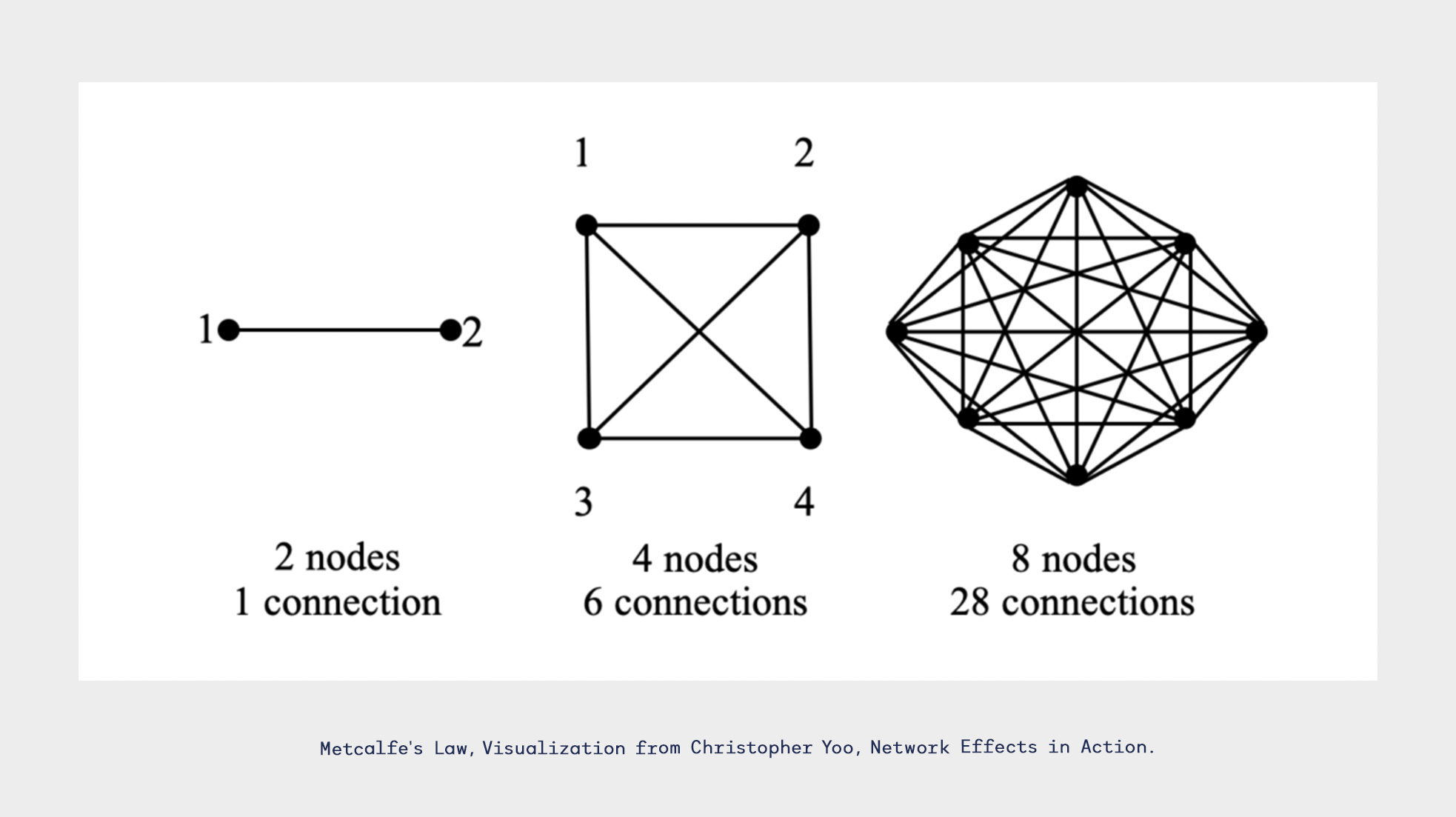
As a result of the continued success of CryptoPunks and the Art Blocks platform, it is our view that blockchain-based generative art will eventually be recognized as one of the most important movements in art history, a form that encapsulates values of digitization, technology, individuality, collectivism – tethered to dynamic, internet-formed communities in real time.
And centuries from now, as digital historians draw a line back through time, they’ll eventually land in the same place: All roads lead back to the Punks. +
—
1. Roger Caillois, Man, Play, and Games (Chicago: University of Illinois Press, 1958), p. 21.
2. Georg Bak, private message to the author, June 14th.
3. On this, see Sandra Upson, “The 10,000 Faces That Launched an NFT Revolution”
4. Quote from the article “10 things to know about CryptoPunks, the original NFTs”
5. Note that this notion of “use” carries a radically different meaning from the idea of “utility” associated with PFP projects. These types of utility are best thought of as services, whereas Punks function as stores of value assets. On this distinction, see Derek Edwards, “Storing Value in Digital Objects.” The “use” of Punks emerges through decentralization (they have no “external dependencies,” as Edwards puts it); the “utility” of PFPs is a service facilitated by a centralized company. This is one, if not the reason why Punks created and outlived the PFP hype.
0x6e2F···aceE## Artist: Claire Silver
## Object: Genesis
## Collector: Flamingo DAO
## The Mother of the Muses: Claire Silver’s Genesis
Author: Malte Rauch
Editing: Madison Page, Derek Edwards
Date: June 1, 2023
Artist Interview: [Artist Interview](https://amber-electric-snail-94.mypinata.cloud/ipfs/QmQTkTesesC5dpobeE8wthbYkWX1nnRjmeUbZbGRCw5mdt)
More than 70 years ago, Alan Turing first posed the simple question, “Can machines think?” <sup>1</sup>
Few would doubt that the development of computation in the last decades has led ever closer to an affirmative answer. When speculating about future progress in artificial intelligence, even Turing confined himself to the thesis that “machines will eventually compete with men in all purely intellectual fields.” <sup>2</sup> Purely intellectual fields refer to calculation and logical inference, whereas human creativity is often imagined to operate in a vastly different realm, an idea that still persists today.
So, what is genuine creativity? Usually, it is understood as creating the radically new, incommensurable, heretofore unseen. However, the notion of radical innovation, of an original and unprecedented creation, is a dubious leftover from the Renaissance cult of the artist, in which the language of divine creation became entangled with that of artistic skill. <sup>3</sup>
Nothing comes from nothing. Everything references something. Culture is never, bang-bang, emergence from the void. It has always been a kind of bricolage. In the domain of fashion, the cyclical reinvention of trends illuminates this concept; “new” styles are created by revisiting and updating past styles. Walter Benjamin captures this paradox, noting that fashion “has a flair for the topical, no matter where it stirs in the thickets of long ago.” Beyond the fashion sphere, this pattern prevails across all cultural fields to different degrees, which continuously remix and repurpose existing elements to form new constellations.
In other words, culture is based on the principle of remixing. And it is no coincidence that the most ancient notion of art has its origin in the Greek “tékhnē,” the concept of technology.
By definition, art is and has always been in dialogue with technology.
Claire Silver, an AI artist who prefers to remain anonymous, proclaims in her Twitter bio: “Taste is the new skill.” This by now often-commented statement seems self-evident: digital technology has enabled access to creative tools on a scale previously unimagined, a trend that has been catalyzed further by the recent advent of various generative AI tools. After these tools have leveled the playing field for creatives, it is style (rather than technical proficiency) that becomes the ultimate metric of artistic merit.
Nevertheless, there is a deeper implication at play in Claire’s motto, one that brings to the fore the very nature of creation and the relationship between artists and their art.
As the landscape of AI artists continues to expand, Claire Silver stands out for her articulation of the innovative approach to creation. Defining herself as a “collaborative” artist, she frames her work with generative AI as a partnership, setting it apart from the common perception of AI as a mere instrument or tool. In Claire’s practice, the interaction with AI generators resembles a conversation rather than simple means-end-relationship.
As a result, her work introduces a novel type of the 21st-century artist: engaging in co-creation as opposed to singular innovation, prioritizing taste and curation over proficiency understood in the narrow sense as inherited craftsmanship, fostering open dialogue instead of inscrutable opacity, and embracing anonymity over idealized personality cults. In these ways, Silver gives rise to a distinct visual poetry, rich with references to art history and meta-commentary about AI art.
In the period when Turing established the principles of artificial intelligence, art historians were developing photographic analog models anticipating our current image generation tools. The proliferation of illustrated art books, facilitated by the progress of photography, liberated visual artifacts from geographical and chronological constraints for the first time. In a period when experiencing art no longer requires physical presence, these works could cross boundaries and form new connections. André Malraux explored the idea of an “imaginary museum” without physical borders, denoting the possibility of assembling and juxtaposing every artwork that had ever been photographed.
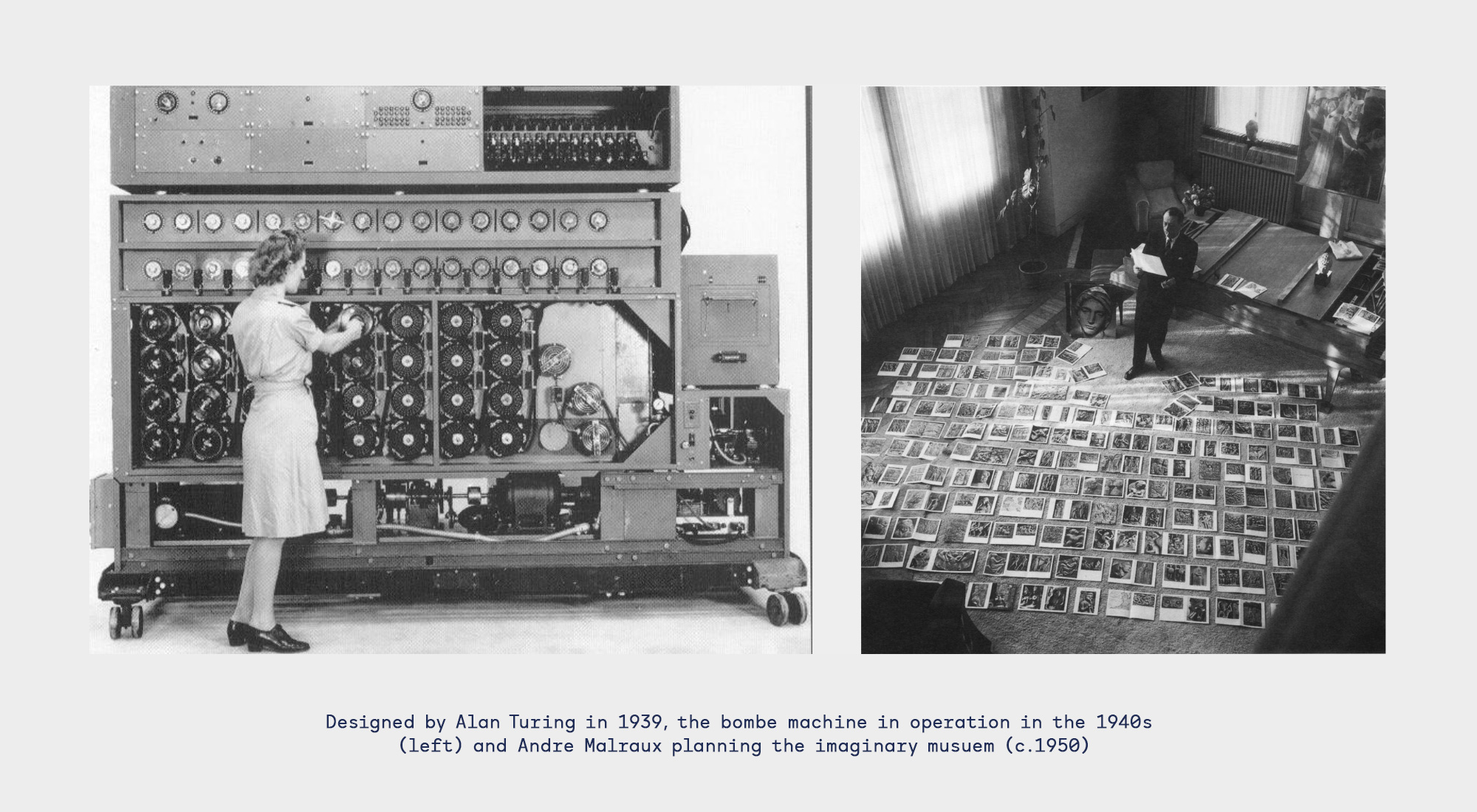
During the 1920s, art historian Aby Warburg engaged in an examination of the unfolding of visual motifs and patterns over time, utilizing photographic plates to track the emergence of specific themes. Warburg traced something like a collective visual subconsciousness and dubbed his project after “Mnemosyne,” the Greek goddess of memory and mother of the muses: that is, of inspiration itself.
While Malraux’s “imaginary museum” and Warburg’s “Mnemosyne” project explored the idea of juxtaposing various data points from cultural history, AI image tools allow users to synthesize the entirety of cultural history to new visual objects. After photography has made the history of visual artifacts available as an archive, AI tools transform this archive into an extended power of imagination. In the history of images, this possibility of co-creation—or “collaboration,” in Claire’s terminology—is on par with, or may even exceed, the “liberation“ of artworks through photography. Regardless of artists employing self-trained data or utilizing diffusion models, the breakthrough of image generators is marked by the ability to establish semantic relationships between visual components. Nothing has ever come as close as these models to a collective visual subconsciousness.
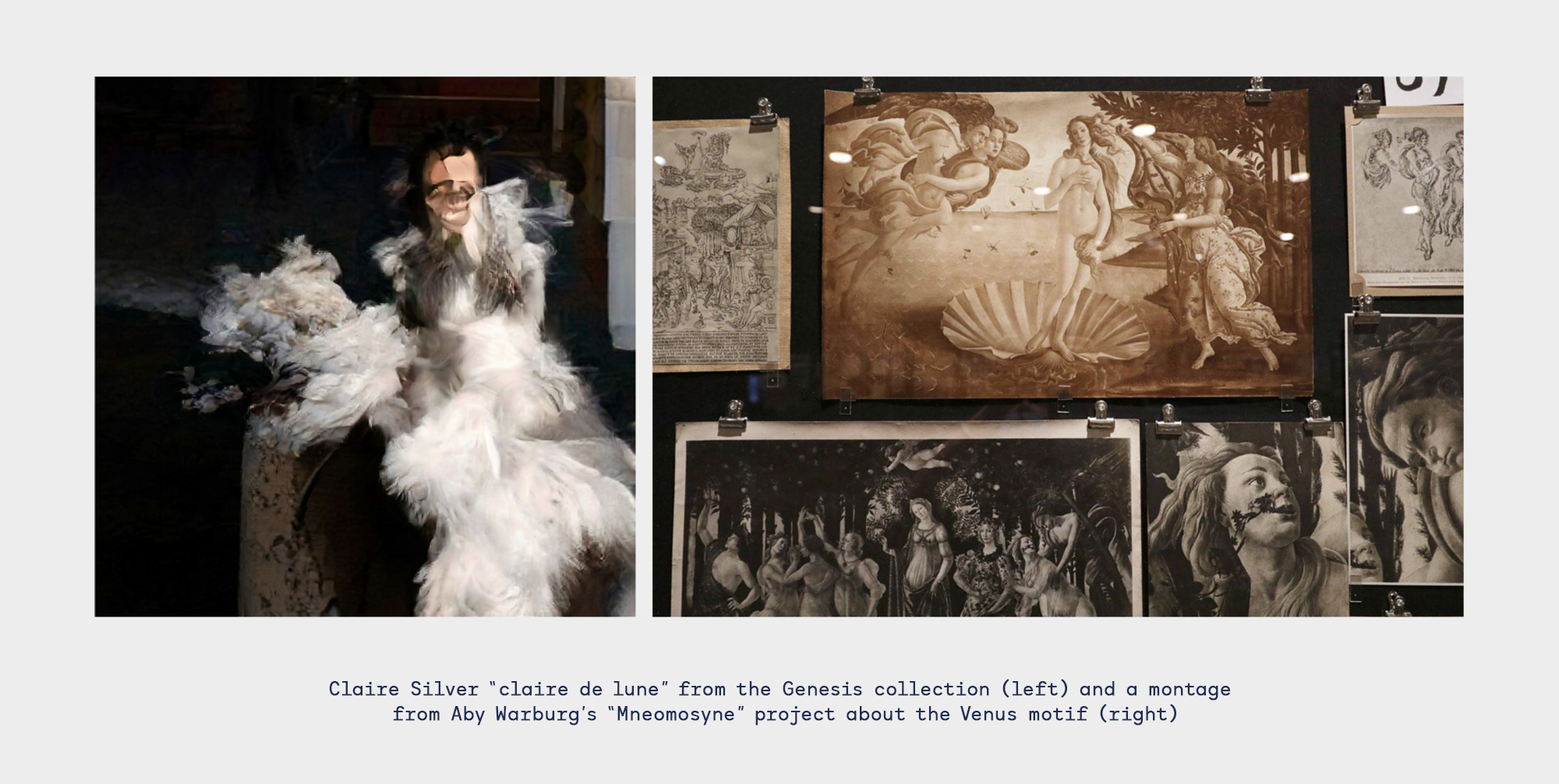
Silver’s “Genesis” project encompasses 500 uniquely titled outputs. Minted on the first day of the Braindrops AI platform launch in April 2022, the output space is organized through narrative-guiding attributes. The “chapters” trait comprises categories such as “transcendence,” “crossroads,” and “relics of aristocracy.” The “cycle” trait features “nocturne,” “daybreak,” and “sunlight,” while the “descriptive” trait classifies images with labels like “garden,” “architecture,” “ghosts of future past,” and “android.” The images exhibit a dark and opaque atmosphere, imbued with a unifying poetic quality that encourages viewers to envision diverse narratives while perusing the collection.
Viewers familiar with painting history may encounter a persistent déjà vu, as numerous outputs evoke familiar compositions, lighting arrangements, and motifs. These images employ a visual language that subtly echoes patterns recognizable to the viewer. Yet, these echoes remain intangible, they do not reference any work in particular.
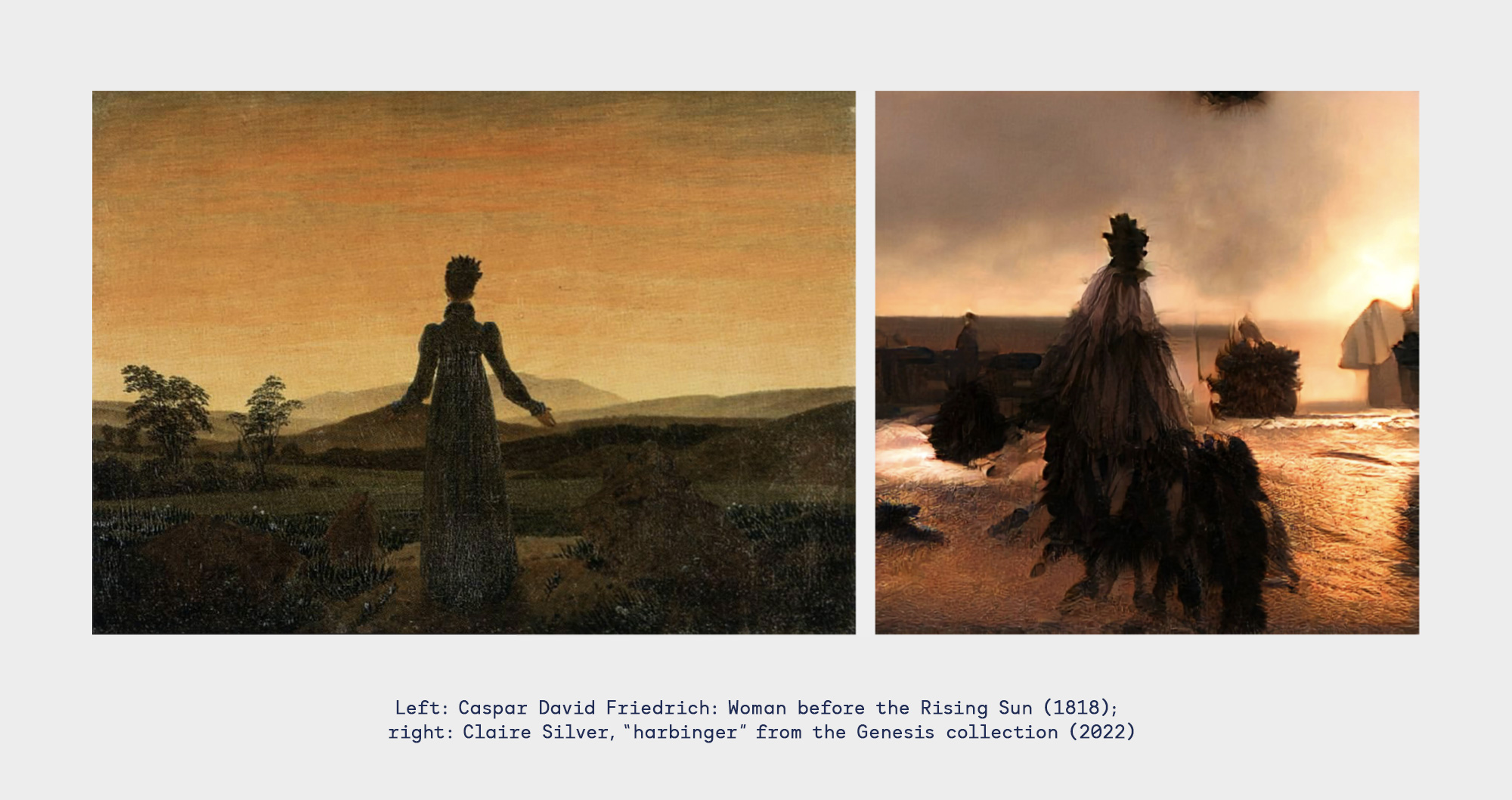
Viewed collectively, “Genesis” presents itself as a cryptic assemblage of allusions and narrative fragments, akin to pages from a once-cohesive book now rendered indecipherable.
The selected output for the current exhibition at glitch — titled “bug” and owned by the premier decentralized collecting group Flamingo DAO – belongs to the “daybreak” chapter and features an “exterior” locale. It depicts two white figures set against what seems to be a mountain range with a structure or wall in the foreground. Do the white garments signify religious attire? Are the figures convening at daybreak for a ritual? Are they departing the city for work? The image’s semi-figurative and semi-narrative nature both invites and defies interpretation, partly due to the visual language’s inherent indeterminacy.
The figures appear slightly distorted and blurry, while the semantic connections between the visual elements are discernible. This peculiarity often leads observers to describe the AI generated images as “surreal.” The surreal, like the uncanny, embodies the extraordinary within the familiar. The semantic relationships forged between various visual elements by AI models from over a year ago approach our perception without truly attaining it, resulting in the distinctive distortions and formlessness. It is not the extraordinary, but rather the subtly altered ordinary that evokes the most eerie and mysterious sensations, and it is precisely this effect to which Silver’s work lends a poetic nuance.
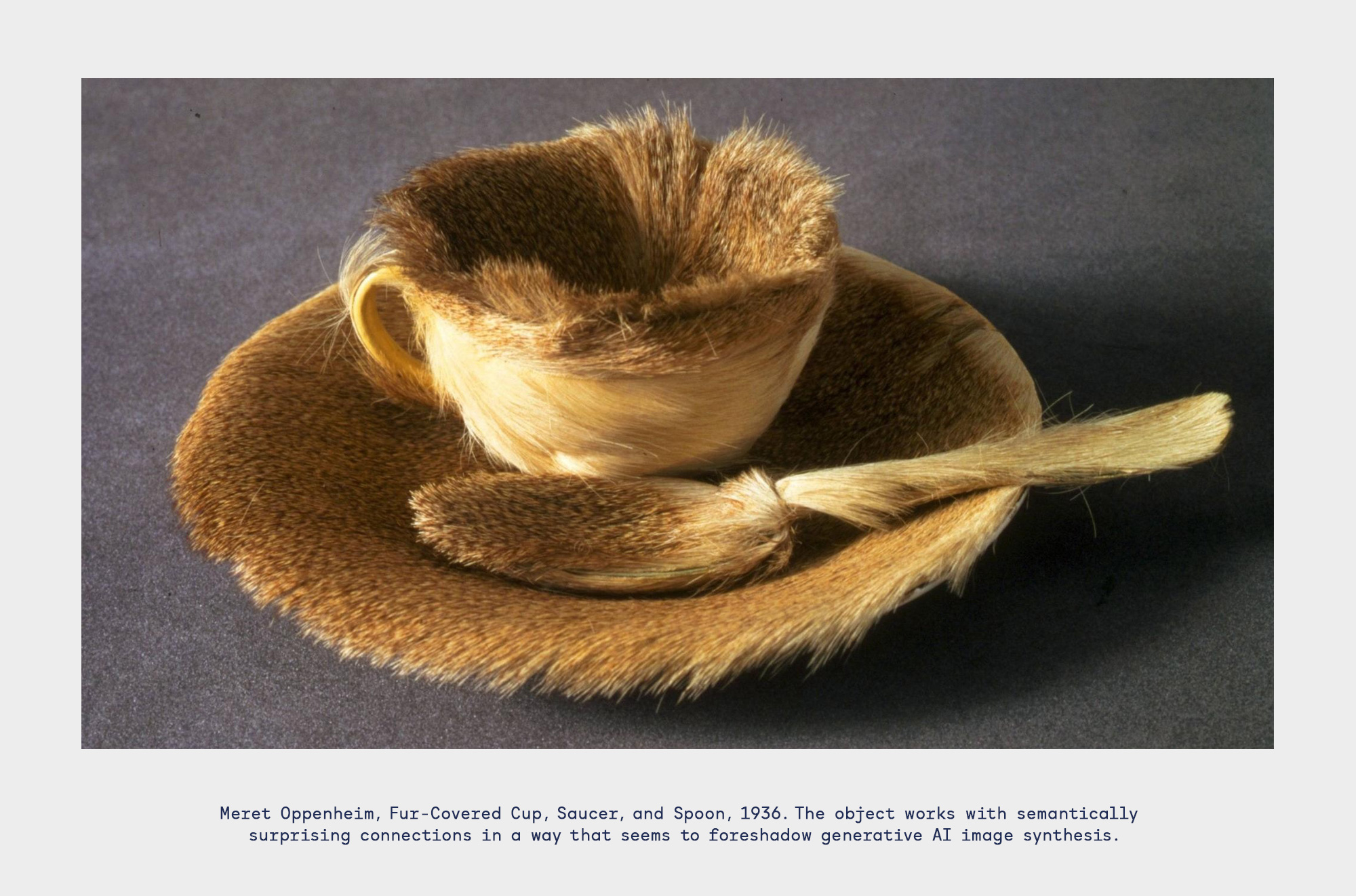
Digital art collectors, particularly those focused on on-chain generative art, were ideally situated to comprehend this type of “long-form” AI art. Both on-chain generative art and AI art can be encompassed under the “generative” art umbrella, with both forms relying on randomness and emergence. However, the specific nature of their random components diverges. On-chain generative art operates within a deterministic framework, where certain attributes possess specific probabilities. Randomness is defined as an arbitrarily deterministic event with a pre-specified probability distribution, and the token hash used as input generates a random output from this probability. The same token will consistently determine the same output. In contrast, AI art may produce different outcomes from the same output at varying times. With regard to Silver’s work, this means that the process of defining attributes is an ex-post form of manual curation and story-telling rather than defining probabilistic traits.
The digital realm has always been defined by the principle of abundance, as marginal costs approach zero. Both generative and AI art employ content creation processes that align with this abundance principle. AI tools, in particular, are set to accelerate task automation and cost reduction significantly in the years to come. <sup>4</sup> As such, they minimize the marginal costs of creative production, potentially leading to content inflation on an unprecedented scale.
Instead of undermining scarcity, however, this new reality will accelerate the adoption of blockchain-based databases: digital environments that can establish property rights for unique digital objects — regardless of whether these objects are created by machines, humans, or in partnership between the two. +
—
1. Alan Turing, “Computing Machinery and Intelligence,” Mind, Vol. LIX, No. 236 (October 1950): pp. 433–460; p. 433.
2. Ibid., p. 460. Our italics.
3. Patricia Emison, Creating the “Divine” Artist: From Dante to Michelangelo (Leiden: Brill, 2004)
4. See Joseph Briggs et al., “The Potentially Large Effects of Artificial Intelligence on Economic Growth,” Goldman Sachs Economic Research (March, 2023).
0x6e2F···aceE## Artist: XCOPY
## Object: Right Click and Save-As Guy
## Collector: Cozomo de’ Medici
## Saints of Scarcity: XCOPY’s ‘Right-Click and Save as Guy’
Author: Malte Rauch
Editing: Madison Page, Derek Edwards
Date: May 1, 2023
Why would I buy it when I can right click and save as?
These thirteen words act as the sole description of XCOPY’s most iconic digital artwork, minted on December 6th, 2018.
Like few other works, “Right-click and Save As guy” captures an antiquated prejudice against digital art objects — computer files anyone can “own” by saving them with a mouse click. The work represented a shift toward what the world deemed previously impossible — the ability to imbue a digital object with scarcity.
Changes in technology, especially technologies of reproduction, have always affected the shape of art and its socio-economic significance.
When photography and cinematography began to demonstrate widespread influence in the early 20th century, critic Walter Benjamin noted that the “…work of art becomes a creation with entirely new functions.” <sup>1</sup> In a similar vein, non-fungible tokens on decentralized blockchains change the objecthood of digital art. Through the ERC-721 token standard, digital artworks turned into unique, persistent objects that can accrue value: an essential shift in what it means to be an art object in the digital realm.
Part of the cultural significance of “Right-click and Save As guy” is, of course, its prognostic power. At the dawn of crypto art, the work anticipates the shift from a technical possibility to a cultural reality. When this shift occurred, the parabolic cultural and economic success of the work – which skyrocketed from 1 ETH in December 2018 ($90) to 1600 ETH ($7M) three years later – confirmed its genre-defining status.
Developments like this are not unprecedented in the history of art. But the speed of which it occurred most certainly is. In less than three years, XCOPY’s “Right-click and Save As guy” defined the very category of a unique digital art object, and this is why glitch chose this work to premier the Every 30 Days exhibition. “Right-click and Save As guy” is an artistic proof of concept for digital ownership, and an important symbol of our movement.
The anonymous XCOPY uniquely positioned themselves to take full advantage of this cultural shift. In the decade before their first sale, the artist developed a distinct visual vocabulary and established a cult following by posting their art (for free) on Tumblr, a microblogging social network founded in the early 2010s. As venture investor and crypto art collector Derek Edwards argues, the value of digital objects is tied to their capacity to be “networked with attention.” <sup>2</sup> The audience that XCOPY built on web2 rails created the foundation for success they would later enjoy in web3.
Importantly, XCOPY detaches ownership of the digital object from the legal layer. All copyright of his digital work has been relinquished and dedicated to the public domain (CC0). This mechanic invites the artist’s audience — not just owners of his work — to spread, cite and remix the work over time.
One might assume that CC0 mechanics dilute the influence of artwork at hand – but this could not be further from reality. In the age of the internet, CC0 designations have a unique ability to expand the invisible networks around a digital object. Ownership over a digital object must be provably scarce. But non-original derivatives of a digital object are no longer enemies of the original; they are the transmission and distribution vehicle for a global audience. In the world of blockchain-authenticated digital objects, the contested modern notions of “original” and “copy” no longer stand in a competitive relationship. They are complimentary. XCOPY’s work is an iconic commentary about these shifting nuances in the meaning of originality, value, and uniqueness in a new digital era.
“Right-click and Save As guy” is not only iconic in the metaphorical sense in that it defines an era. The adjective “iconic” derives from the Greek “eíkōn,” meaning likeness, image, pattern, and archetype. The category that has become mostly closely associated with the term are the portraits of saints in Byzantine art.
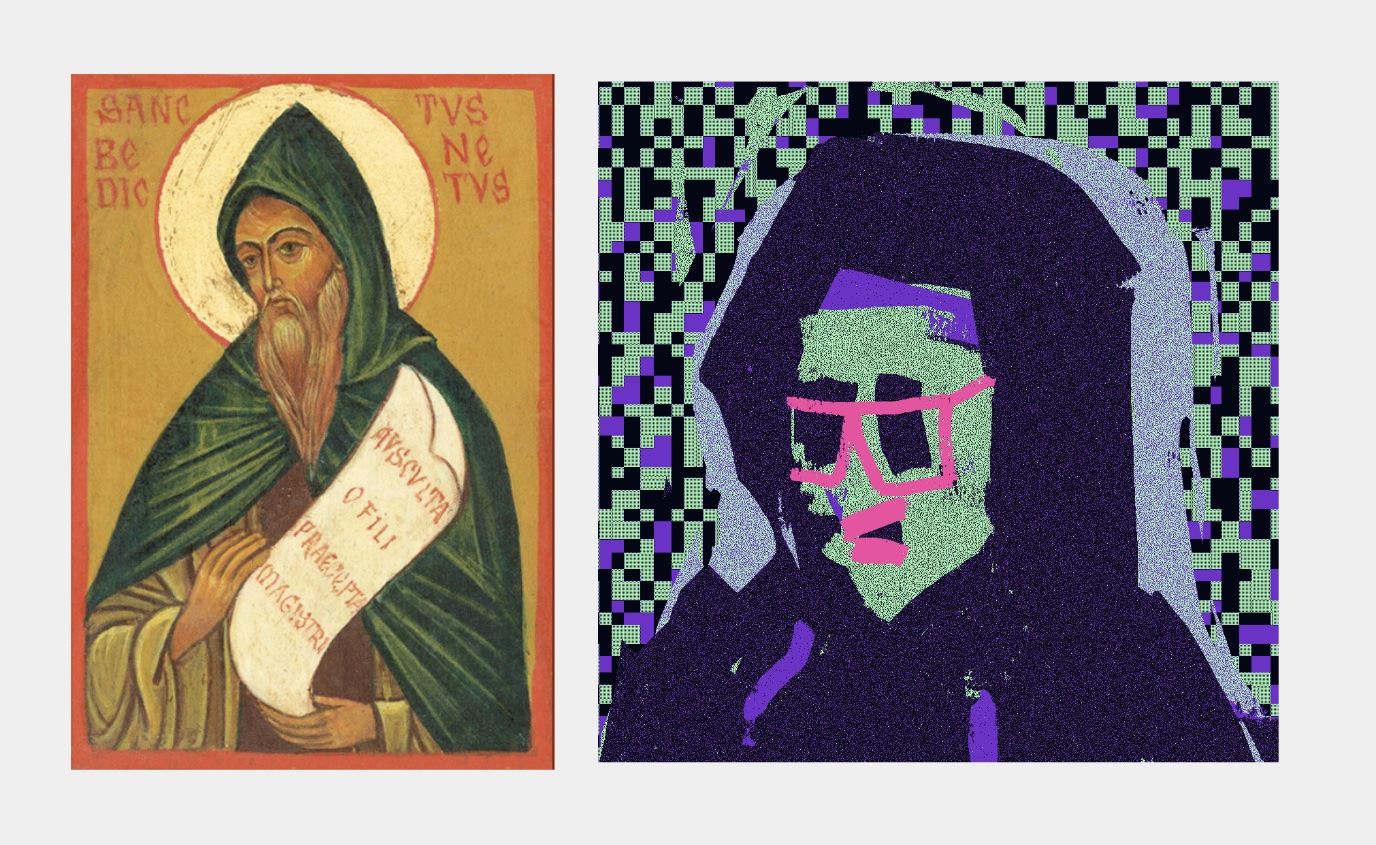
And, whether intentionally or not, “Right-click and Save As guy” bears a striking resemblance to this aesthetic. With the figure’s gaze cast down and its face framed by a hoodie that resembles a dark hollow, the portrait feels like a contemporary version of an iconic portrait. Other works by the artist—“Jesus Mob” and “Saint Less,” in particular—make it likely that this reference to Christian iconography is indeed intentional.
But what makes icons special? And why do we call significant works of art “iconic” in the sense of something notable, recognizable, memorable, or popular?
Before the modern concept of art was born in the Renaissance, icons were objects of veneration to which people attributed a certain “agency.” <sup>3</sup> Similar to memes in 21st century internet culture, icons spread through a viral network logic. They traveled across physical borders and language barriers in the age before the printing press introduced mechanical reproduction for texts. The portrait form has retained its remarkable power since then, capable of capturing moments of cultural significance in a single image. It is no coincidence that the most famous painting in the world, the Mona Lisa, is a portrait.
And just think of how Andy Warhol’s iconic pop art portraits capture the atmosphere of the 1960s. From this perspective, it is quite consistent that the paradigmatic digital art object, whose value stems from its capacity to be “networked with attention,” would take the form of an iconic portrait.
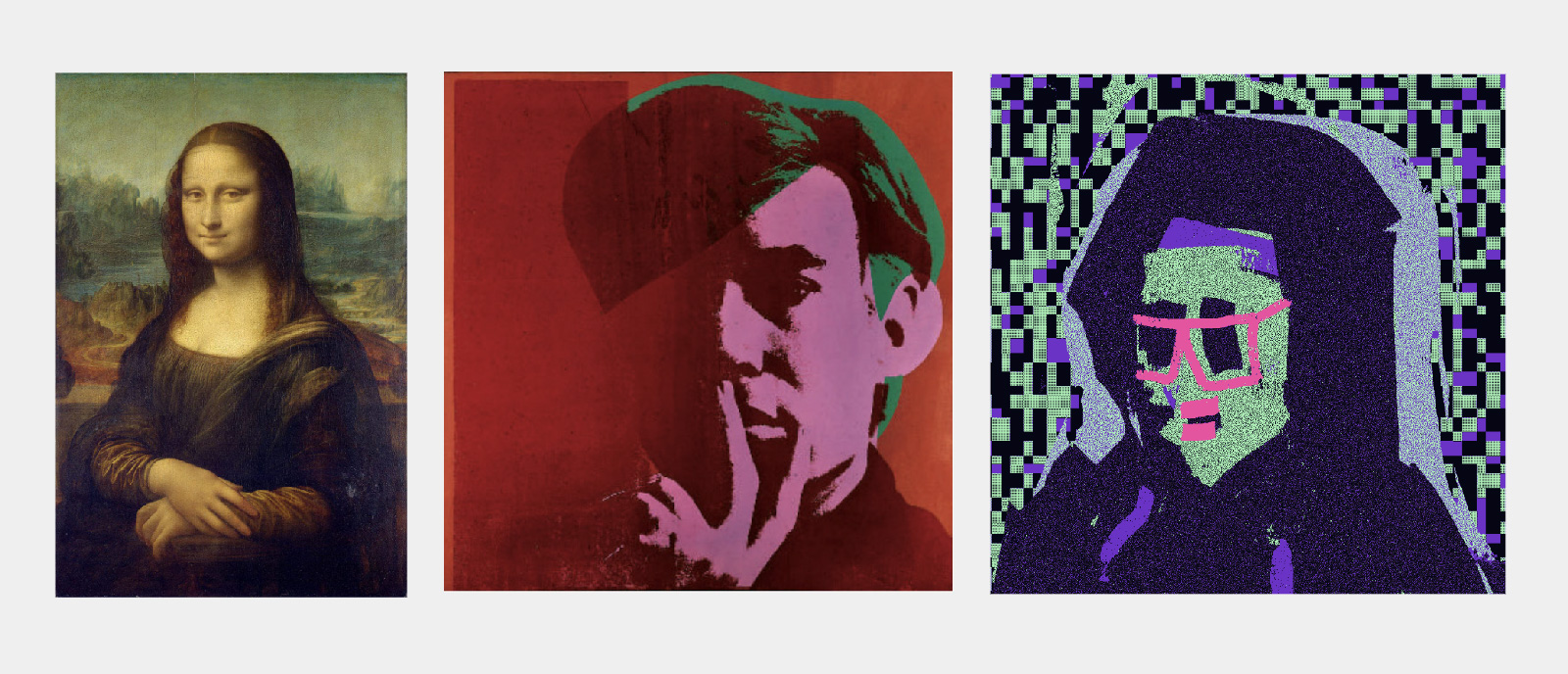
“Right-click and Save As guy” updates the iconic portrait form with a unique glitch aesthetic. A pixelated face, flickering pixels in the background, heavily saturated colors, and moving pink lips lend the image the sense of distortion so characteristic of XCOPY’s style. There is an intensity in the artist’s work that makes it seem as if the surface of the screen has been scratched open to excavate the base layer of raw pixels. Yet this visual violence balances easily with the recognizable portrait form.
It is, perhaps, precisely this carefully curated clash between the classic format of the portrait and the flashing glitchcore chaos that gives XCOPY’s work its mesmerizing force. A similar montage is at play in XCOPY’s thematization of entropy, death and decay. Allusions to meaninglessness in contemporary consumer society abound in their work, and they are often blended with the allegorical themes of memento mori, danse macabre and vanity.
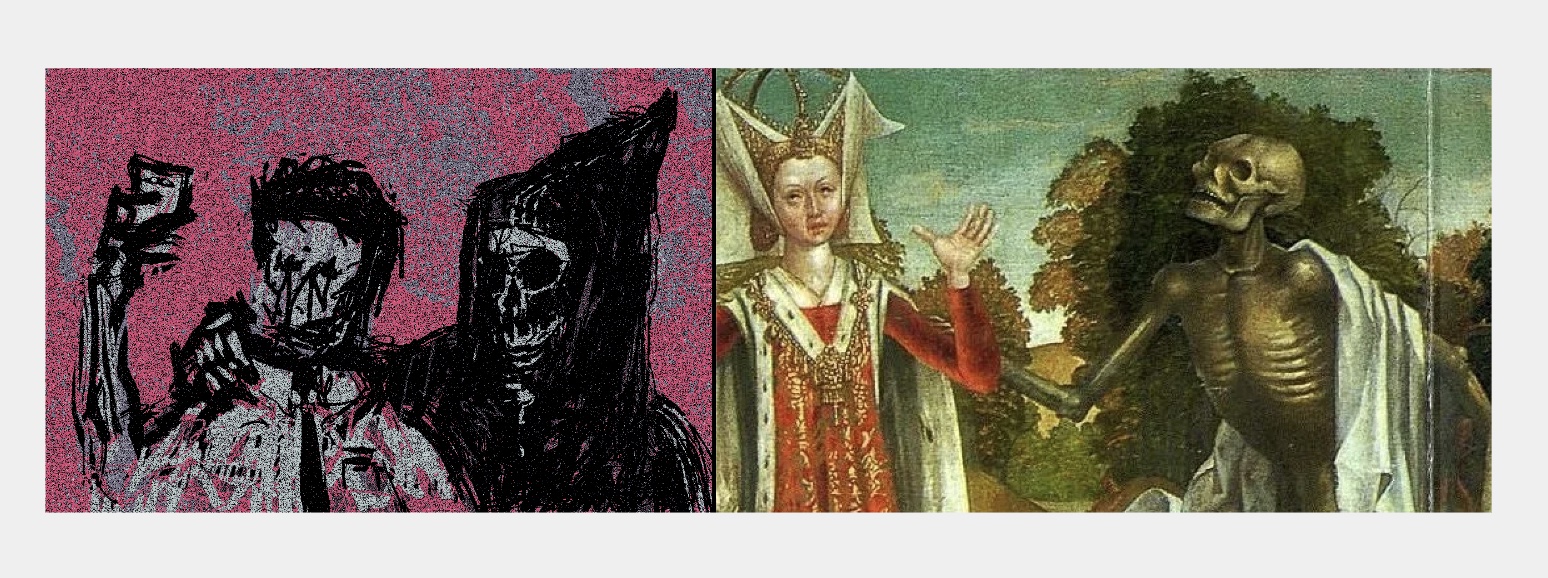
In the images that captivate us, there is often more than meets the eye. XCOPY’s work in particular is rich with themes that the artist both evokes and erases (appropriately enough, their work “ART HISTORY: VOLUMES I-X” shows an open book with burning pages). The figures in the artist’s world are dark, apathetic, but never too serious. They appear as happy nihilists, cognizant that death will have its day, yet still joyfully embracing the memes of crypto culture – making “Right-click and Save As guy” something like the patron saint for the collectors of digital objects. +
—
1. Walter Benjamin, The Work of Art in the Age of Its Technological Reproducibility and Other Writings on Media (Cambridge, MA: Harvard University Press, 2008), 26.
2. Derek Edwards, [Storing Value in Digital Objects](https://medium.com/collab-currency/storing-value-in-digital-objects-a92f54fa98cc)
3. Hans Belting, Likeness and Presence: A History of the Image before the Era of Art (Chicago: The University of Chicago Press, 1993).
V[PPPPPPPPPPPPPPPPPPPbERC1967: new implementation is n`DAddress: call to non-contractAddress: call to non-contractAddress: low-level delegate call failed3Address: low-level delegate call failedE30D by glitch gallery