# RRC 41: Response to RRC 39 - Proposed Mechanics of Secondary Fee Collection
Authors: Eugene Nacu, Jana Bertram, Alex Salnikov
## [](#abstract-1)Abstract
This proposal responds to [RRC 39](https://www.tally.xyz/gov/rari-foundation/proposal/102492744419805214253529798326396687684022669491137583762418006180386413791366), where the RARI DAO requested the RARI Foundation to manage secondary fee collection manually while the DAO implements multichain on-chain governance. This document outlines the mechanics of the proposed fee collection system and its implementation steps.
## [](#rationale-2)Rationale
The DAO requires an interim solution to ensure secondary fees are collected efficiently across multiple ecosystems. Since fees are already established on Ethereum, implementing a structured collection mechanism will provide stability and transparency while the DAO finalizes a long-term governance framework.
## [](#motivation-3)Motivation
By implementing this solution, the DAO ensures that fees are properly aggregated and transferred to the treasury, maintaining financial accountability. This also establishes a clear and operational process across multiple chains, mitigating inefficiencies and delays.
## [](#specifications-4)Specifications
The RARI Foundation will manage a multisig wallet in the following ecosystems to collect secondary fees:
ETHEREUM
POLYGON
MANTLE
ARBITRUM
CHILIZ
LIGHTLINK
ZKSYNC
ASTARZKEVM
BASE
RARI
CELO
FIEF
XAI
KROMA
ZKLINK
OASYS
QUAI
SAAKURU
OASIS
PALM
MATCH
FIVIRE
SEI
CAMP
LISK
MOONBEAM
ETHERLINK
ZKCANDY
ALEPHZERO
BERACHAIN
ABSTRACT
SHAPE
TELOS
HEDERAEVM
If additional chains are added to the Rarible Protocol in the future, RARI Foundation shall collect fees on behalf of the DAO here as well.
### [](#fee-collection-process-5)Fee Collection Process
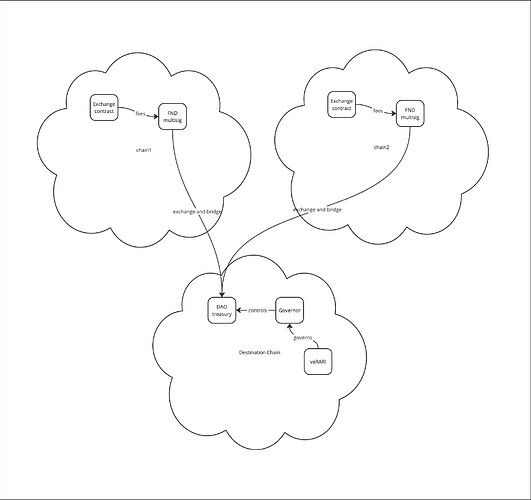
* For secondary sales paid in ETH: Fees will be bridged to the DAO treasury in ETH.
* For secondary sales paid in other tokens: Fees will be swapped for USDC before bridging to the DAO treasury.
* Bridging to the DAO’s treasury will be conducted at a minimum of monthly, at a maximum of quarterly, depending on the volume of the fees collected.
* Foundation will record levels of collected fees as part of quarterly transparency reports.
A diagram outlining the collection mechanism is attached to this proposal.
## [](#steps-to-implement-6)Steps to Implement
1. DAO Approval: The DAO votes to approve the proposed fee collection mechanism.
2. Multisig Deployment: The RARI Foundation deploys multisig wallets on each of the listed chains.
3. Contract Adoption: Rarible adopts the fee collection contracts.
## [](#timeline-7)Timeline
* Week 1-2: DAO discussion and approval process.
* Week 3-4: Deployment of multisig wallets across ecosystems.
* Week 5+: Integration with Rarible and initiation of fee collection.
## [](#costs-8)Costs
* Administrative oversight required for set up and execution as well as operational costs for ongoing maintenance, will be absorbed by the Foundation’s operational budget
* Transaction costs associated with bridging and swaps
This system is ready for immediate implementation pending DAO approval.
# RRC 38: Updating and Migrating Delegate Launchpad Program to RARI chain
Author: Janabe
Reviewer: Addigator, StableLab, Governance Working Group
***
### [](#abstract-1)Abstract
This proposal seeks to update the Delegate Launchpad program in alignment with the governance migration to the RARI chain. The updated program will retain its core structure while incorporating adjustments to voting power allocation, cohort participation rules, and the integration of multi-chain governance. These changes aim to ensure the program continues fostering diverse and active participation in the RARI DAO.
***
### [](#motivation-2)Motivation
The Delegate Launchpad program has been instrumental in onboarding new voices into the RARI DAO. With the governance migration to the RARI chain, there is an opportunity to enhance the program’s structure to better align with the evolving ecosystem. This proposal addresses the need for:
* Improved alignment with RARI ecosystem’s governance framework.
* A sustainable approach to delegate participation and development.
* A streamlined transition for existing cohorts during the governance migration.
***
### [](#rationale-3)Rationale
The proposed adjustments are designed to:
1. Reflect the shift from vote-escrowed tokens to the custom L2 token mechanics by removing voting power decay.
2. Incentivize long-term delegate commitment while maintaining opportunities for new participants.
3. Facilitate a smooth migration for active cohorts from Ethereum Mainnet to the RARI chain.
4. Support the integration of the Event Horizon delegation model, enhancing governance efficiency.
***
### [](#specification-4)Specification
1. Program Structure:
* Two cohorts annually, spaced six months apart.
* 15 recipients per cohort, each receiving 2,000 RARI voting power for a period of 6 months.
* Voting power allocation will remain constant over the six-month period without decay.
  2\. Re-admittance and Voting Power Scaling:
* Delegates may apply for multiple cohorts.
* Upon a third acceptance, delegation increases to 5,000 RARI, enabling proposal sponsorship.
1. Program Duration for Individuals:
* Delegates may participate for a maximum of four cohorts (two years).
* After this period, delegates transition to relying on community delegations to promote inclusivity and diversity in the program.
1. Migration to RARI Chain:
* All future Delegate Launchpad cohorts will operate exclusively on the RARI chain.
* Cohort 3 (launched on Ethereum Mainnet in October 2024) will have delegations enabled on both Ethereum Mainnet and the RARI chain for a transitional period. Multi-chain governance mechanisms will ensure seamless coordination.
1. Event Horizon Integration:
* Include the Event Horizon delegation model as part of the governance framework for improved efficiency with a delegation of 2000 RARI.
* This delegation shall exist outside of the Delegate Launchpad program and does not impact the number of openings in each cohort.
***
### [](#steps-to-implement-5)Steps to Implement
1. Proposal Approval:
* Submit the proposal for DAO approval.
* Secure community consensus on the revised structure.
1. Program Adjustments:
* Update Delegate Launchpad documentation to reflect the changes.
* Inform current and prospective delegates of the new rules.
1. Transitional Arrangements for Cohort 3:
* Enable dual delegations for Cohort 3 on Ethereum Mainnet and the RARI chain.
* RARI chain based delegation will remain active for the duration of the Ethereum Mainnet delegation.
1. Launch new cohorts on RARI Chain:
* Establish governance contracts and delegation mechanisms on the RARI chain.
* Initiate Cohort 4 under the new program structure (Apr 2025).
1. Monitor and Evaluate:
* Track the performance and feedback of revised cohorts.
* Present a report on outcomes to the DAO after the first year of implementation.
### [](#costs-6)Costs
N/A
RARI Foundation was entrusted with 90k RARI for the Delegate Launchpad program per [RRC 9](https://www.tally.xyz/gov/rari-foundation/proposal/4998212454959764411677761814601920941258702940035724218302264365950572124990). While these tokens are fully locked and distributed in delegations in Cohort 3, they will become available for Cohort 4 and the Foundation can use RARI from the operational budget for the interim additional delegation Cohort 3 will receive on RARI chain.
### [](#timeline-7)Timeline
Delegations to Cohort 3 on RARI chain will be executed within 2 weeks of the proposal’s passing. The delegates will then be able to start testing RARI chain-based governance.
***
This proposal ensures the Delegate Launchpad program evolves in tandem with the RARI DAO’s governance migration, fostering robust participation and inclusivity across the ecosystem.
# RRC-37: RARI Foundation 2025 Operational Budget
### Authors: JanaBe
Reviewers: Campbell Law, Autonomous
### [](#abstract-2)Abstract
This draft proposal outlines RARI Foundation’s funding needs for 2025, along with laying out high-level objectives of what the team will be focusing on. The budget estimated for 12 months of operations is 2,040,000 USD and it enables continuity of operations and team & vendor growth as it reflects on the RARI ecosystem growth.
### [](#motivation-3)Motivation
The RARI Foundation works on behalf of the RARI DAO and helps it achieve its mission of building decentralized NFT infrastructure to power innovative NFT use cases. In doing so, the Foundation deploys resources that span contractor salaries, vendors, legal, and marketing costs, amongst others, that ensure a smooth continuation of operations and allow for the expansion of the Foundation’s efforts to help grow the RARI ecosystem. The assumption is that the Foundation will continue working with the most skilled and professional contractors in the market, and it is necessary for the Foundation’s success to be able to offer compensation in stable coins or fiat money instead of $RARI in order to be competitive.
### [](#rationale-4)Rationale
The Foundation has been actively expanding the RARI ecosystem in 2024, seizing new growth opportunities.
Most notably, it spearheaded the launch of RARI chain, initiated Treasury diversification, completed the technical decentralization of the Rarible protocol. The Foundation also aided increased governance participation, and embarked on governance upgrade to minimize barriers to participation in the RARI DAO and to enable multichain governance of the Rarible protocol opening paths to multichain revenue.
In doing so, the Foundation proposes a budget that will allow for accomplishing of the following goals:
1.  Governance
* Transition governance to RARI chain as the governance hub
* Support the DAO in efforts to enable RARI token staking for governance
* Design and audit cross-chain revenue collection model
* Adopt Multichain governance (flexible voting governor contract)
* Assist in decommissioning of veRARI and Mainnet DAO
* Transfer ownership of RARI chain to the DAO
* Relaunch the delegate launchpad program & run 2 cohorts
  2\. Ecosystem growth
* Support key ecosystem projects in driving user acquisition that will benefit protocol transaction volumes
* Collaborate with partners in developing growth initiatives and activating RARI ecosystem
* Targeted grant deployment to drive adoption of RARI tech stack
 3\. Marketing
* Raise awareness of RARI ecosystem, and drive acquisition via the usage of owned channels, PR, co-marketing, ambassadors, IRL events, and sponsorships
* Focus on Q1 and Q3 as tentpole moments
4\. Finance
* Execute Treasury diversification strategy per the mandate given
KPIs:
* Fully transition to multichain governance and mainnet DAO decommissioned by end of Q2
* Attract 500k+ RARI for governance
* Aid DAO-approved efforts in increasing 5x monthly active end users and transactions of Rarible Protocol
* Continue promoting RARI chain projects, aiming for incremental 4M+ transactions on RARI chain
Note: the Foundation will publish an end-of-year transparency report that will summarize the results of 2024.
### [](#key-terms-5)Key Terms
Rarible Protocol - multichain indexer and order book with SDK
RARI Chain - royalties enforcing L3 built with Arbitrum Orbit
RARI Ecosystem - applications utilizing the Rarible Protocol and/or the RARI Chain
$RARI - ERC 20 token, used in the RARI DAO governance
### [](#specification-6)Specification
The proposed 2025 budget of 2,040,000 USD reflects the above goals, team, and resource needs. It’s roughly one-third higher than the 2024 operational budget, which reflects on the growing operations and RARI ecosystem.
Salaries 1,030k
Legal costs 170k
Vendors 255k
Marketing 300k
RARI chain 80k
Security audit 150k
Others 55k
Total 2,040k
Specifics:
* Salaries cover 8 FT and 2 PT contributors (FT: 1x Strategy, 2x Growth, 1x Community, 2x Marketing, 1x Tech, 1x Treasury; PT 1x Tech, 1x Design)
* Legal fees include Cayman Island counsel, US counsel, and a paralegal
* Vendor fees include administration costs (Director of the Foundation and the Supervisor of the Foundation, both roles are required for the set up of the Foundation under the Cayman law), professional delegate fees, Security Council compensations, accounting services, engineering vendors
* Marketing costs cover sponsorships, production, marketing agency fees (to be incurred ad hoc as needs arise), and ambassadors
* RARI chain costs include infrastructure vendor fees
* Security audit costs include review of smart contracts related to multichain fee collection for the DAO
* Other costs include travel costs to crypto conferences, and miscellaneous expenses such as office supplies, subscriptions, and event tickets.
* This proposal uses the 7-day average price of 2.54 USD for RARI (as of Jan 7 using coinmarketcap data) and requests 803,145 RARI for 2,040,000 USD 
Notes:
1. The Director of the Foundation is responsible for the budget. They may opt to delegate day-to-day budget management tasks to the Foundation team.
2. Budget spending shall be monitored by the Foundation’s appointed accountant.
3. Periodic budget spending reports shall be shared with the community quarterly, no later than 45 days after the end of the quarter. The community may request budget updates at any point. In such event, the Foundation shall present the budget status no later than in 15 working days.
4. If there are unspent funds at the end of the budget cycle, the Foundation may propose to keep the amount in an operational reserve. Otherwise, it shall be returned to DAO’s treasury within 90 days of the budget cycle’s end.
5. The Foundation team shall respect the budget allocations as specified in the subtotals. It is understood that variations may occur. However, transfers between the budget groups should not exceed 30%. Budget reallocations larger than 30% will require DAO approval.
6. Should $RARI price deviate from the USDC conversation rate at the date of the proposal submission, the Foundation shall either submit an additional proposal to request funds to cover the exchange loss or report the excess funds at the end of the budgeting cycle.
7. Contributors (Team) are to be paid once a month in USDC unless otherwise agreed in their contracts.
8. Legal and Administrative costs are to be paid upon receiving invoices from the Foundation service providers as per engagement letters or agreements with such entities.
### [](#steps-to-implement-7)Steps to Implement
Upon the budget approval, the full corresponding $RARI amount will be transferred to the Foundation’s operational wallet (0x2a83d2891Ef3df6967E3C2e9b69cCc7aD029736B), the Foundation will convert it to USDC to reduce the exchange rate fluctuation risk and the exchanged amount will be stored on the operational wallet (0x2a83d2891Ef3df6967E3C2e9b69cCc7aD029736B).
The Foundation may opt to halt conversion to USDC, should the exchange rate start falling below the desired conversion rate, and resume when the desired rate is met or if a conversion must be made in order to meet Foundation’s payment obligations. Payments within the approved budget in accordance with signed contracts are to be made by the Foundation administration, who will be responsible for the budget.
# RRC-33: Continuation of RARI DAO Security Council
**Abstract**
This RRC-33 proposes to extend the term of the current committee consisting of a DAO-appointed 5-member multi-sig (“Security Council”), which has the ability to perform emergency and non-emergency actions such as urgent upgrades, minor, routine maintenance to the Rarible Protocol, and stoping DAO hack attempts.
**Motivation**
A vital body to mitigate risks associated with decentralization of the Rarible Protocol and RARI chain is the security council. All 5 members of the DAO-appointed multisig expressed desire to continue their engagement and would like to extend their term. This proposal suggests to extend all 5 of them until end of September 2025 (12 months). A functioning Security Council is a mechanism to prevent governance attacks in which an attacker acquires voting power through legitimate means (e.g. buying tokens on the open market) but uses that to manipulate votes to their own benefit - e.i. exploiting the DAO’s treasury or the Protocol via skewing governance or introducing Protocol vulnerabilities.
**Rationale**
All current Security Council members performed their roles diligently and in a timely manner. They are trustworthy and engaged members of the DAO community.
**Specifications**
(A) Proposed Security Council members
The RARI Foundation nominates the following members of the Security Council for a 12-month term:
1. Campbell Law, current Director of the Foundation; wallet address: 0xd9C3EeD65968443F8587Bb068e6530A48dB5d177
2. Andrei Taraschuck, current delegate; wallet address: 0x25Ad94C7768108666BfDB6742aB66b109CA82946
3. StableLab, professional delegates, represented by Mattew Stein; wallet address: Stablelab.eth
4. Jafett Sandi, current delegate of the RARI DAO and grants committee member; wallet address: 0x636e1f9A9Cb926a69441DcE54Aa9e490CFe6D4D6
5. Eugene Nacu, current Tech lead of RARI Foundation; wallet address: 0x978EBcd18c5A0d829C061566AA84227e9618C1A4
The Safe multisig wallet addresses the Security Council uses to perform its functions are:
1. Veto function: eth 0xd35ec9F67Aa082Ae666be1716C79291f1f6e4E0a
(majority threshold: 3/5)
2. Upgrade function: eth 0xa5e4514145463385aEF763Fc8161CB42b92c74f2 (majority threshold: 4/5)
(B) Appointment and Removal
1. The members of the Security Council will serve a term of 12 months. The future members of the council may be appointed via the RRC process or via an on-chain election process if the community decides to establish on-chain elections with a stand-alone proposal.
2. The members of the Security Council must act upon the direction of the director of the RARI Foundation as well as the RARI token-holders pursuant to the RRC. Failure to act in accordance with directions from either the director of the RARI Foundation or the RRC Process constitutes a reason for an ad hoc removal of Security Council members. Such removal shall follow the RRC Process, and one member of the Security Council must remain in place.
3. The number of members on the Security Council may also be expanded or reduced pursuant to the RRC Process, provided that (i) there must be at least 1 member on the Security Council and (ii) at least 1 member of the Security Council must be a director of the RARI Foundation.
(C) Compensation
Security Council members are entitled to compensation of 2,000 USDC per month.
**Steps to Implement**
N/A. All proposed Security Council members are already part of the multi-sig committee.
**Overall Cost**
$120,000 per year, to be covered from the Foundation’s operational budget.
# RRC 30 - Enhancing RARI DAO Governance: Plan for upgrade
This proposal is submitted by the Rari Foundation, as instructed by the RARI DAO given their desire to make RARI DAO governance more accessible and effective.
## Abstract
The RARI DAO seeks to enhance its governance framework by upgrading the RARI token contract and bringing its governance from Ethereum mainnet to the Arbitrum ecosystem. This proposal outlines the implementation of a custom L2 token on Arbitrum, facilitating efficient governance processes while reducing user costs and improving overall accessibility for RARI DAO. This proposal asks to register the custom L2 token and to propose the Arbitrum DAO to implement a custom gateway on Arbitrum native bridge.
## **Motivation**
The RARI DAO is governed by the $RARI token, which, when locked in veRARI, grants voting access. The current token contract and governance hub are on the Ethereum mainnet, making participation in governance costly due to high gas fees for locking, delegating and on-chain voting. The RARI DAO has repeatedly asked to reduce governance fees, which is now possible thanks to the possibility of migrating governance to RARI chain and upgrading core governance contracts, including the token contract.
The current token contract is on Ethereum mainnet and is not upgradable. The RARI DAO wishes to upgrade its governance, a part of which is a token contract upgrade with snapshots and delegations embedded. We will also need to change the mapping on the Arbitrum native bridge router and implement a custom gateway pending a successful Arbitrum DAO vote.
## Rationale
The RARI DAO governance upgrade is designed to make governance more accessible by simplifying the UX, reducing gas fees, enabling new token functions, and allowing for multichain governance. This will allow for higher governance participation and will position the DAO to be able to govern the RARI ecosystem beyond Ethereum Mainnet, which is an imperative given that the Rarible Protocol is a multichain product and that the DAO governs the recently launched RARI chain.
As the RARI token contract is on Ethererum mainnet, and not upgradable, a new custom token contract needs to be deployed. This proposal outlines the plan for a custom L2 token implementation, starting with the Arbitrum ecosystem.
## Key Terms
RARI token: RARI DAO governance token (<https://etherscan.io/token/0xfca59cd816ab1ead66534d82bc21e7515ce441cf>
RARI DAO: body governing the Rarible Protocol and RARI chain
Custom L2 RARI token: upgraded and simplified RARI token to be used in RARI DAO multichain governance moving forward
Arbitrum ecosystem: Arbitrum One and RARI chain L3
## Specifications
RARI token in question (<https://etherscan.io/token/0xfca59cd816ab1ead66534d82bc21e7515ce441cf>) does not have upgradability nor allows the owner to register in the Arbitrum token bridge router.
As such, a new customer L2 contract with snapshotting and delegation functions needs to be deployed. The proposed upgraded token contract was fully audited and can be found here: 
token: <https://github.com/rarible/protocol-contracts/pull/305>
audit: [https://github.com/pessimistic-io/audits/blob/b14c14f9b5dfac20524fdf82ab4d779f78b2\[…\]%20Bridged%20Token%20Security%20Analysis%20by%20Pessimistic.pdf](https://github.com/pessimistic-io/audits/blob/b14c14f9b5dfac20524fdf82ab4d779f78b2db5e/Rari%20Bridged%20Token%20Security%20Analysis%20by%20Pessimistic.pdf)
Token contract was deployed to Arbitrum Sepolia, RARI testnet (which is on top of Arbitrum Sepolia) and all contracts were tested manually as well.
For this contract to be deployed on Arbitrum One and RARI chain mainnet, a custom L2 token pathway needs to be enabled in the Arbitrum native bridge, for which the RARI Foundation will submit a proposal, pending this proposal being voted in.
For context, there will be several more actions to take place for the governance upgrade to be complete on a technical level:
* custom L2 token implementation
* custom pathway in Arbitrum native bridge
* multichain governor contract upgrade
* current RARI token wrapping contract for mainnet tokens to be usable in the multichain governance
As a result, the L2 RARI tokens, and the wrapped mainnet tokens will be possible to use for RARI DAO governance as they are. The veRARI model will be dropped and all locks will release once as the upgrade is complete.
RARI token holders will then be incentivized to bridge to the RARI chain (new governance hub), at minimum, by offering costless bridging. The RARI chain will in the meantime complete DeFi integrations to ensure there is liquidity and trading options for RARI tokens as they enter the ecosystem.
## **Steps to Implement**
1. upon passing of this proposal, the custom L2 token contract will be deployed on Arbitrum One and RARI chain
2. RARI Foundation will then submit a proposal to the Arbitrum DAO to enable the custom gateway on the native bridge and investigate incentive funding possibilities
3. Once the custom pathway is enabled, further proposals will be submitted to the RARI DAO to complete the governance upgrade (e.g. new governor contract, planned incentives)
4. Full governance migration will be announced during fall '24; exact timing will depend on technical readiness
## Timeline
A custom L2 token contract is ready to deploy upon this proposal's passing.
The Arbitrum proposal is ready to be submitted to the Arbitrum DAO's forum upon this proposal's passing.
## Overall costs
N/A
# Placebo proposal to test if DAO voting process works with Protocol Contracts
**Abstract:**
This is a placebo proposal to test if the whole Rarible Protocol governance flow works and if DAO is able to control and manage Procotol Contracts as expected.
 
**Motivation:**
Rarible successfully transferred ownership of the Rarible Protocol contracts to the DAO and this test is the final stage in validating proper functioning of the Rarible protocol governance.
**Rationale:**
The Rarible Protocol ownership transfer design has been audited and internally tested. This live test via on-chain governance flow is the final stage in confirming the ownership transfer functions fully and that the DAO is all set to start voting on proposals that affect the Rarible Protocol contracts (e.g. Protocol fee collection).
**Specifics:**
This proposal sets the Rarible Protocol fee to zero (which is the case currently, hence it's a placebo proposal)
Executable code:
* Timelock contract to call execute function in UpgradeExecutor contract ([0xb23BCD4F668365B1c9Ec4B4DF79915bF8c76C5b5](https://etherscan.io/address/0xb23BCD4F668365B1c9Ec4B4DF79915bF8c76C5b5#code))
* upgrade address: [0xcaC1fE02cB051672D93eE390136B8E10301B6709](https://etherscan.io/address/0xcaC1fE02cB051672D93eE390136B8E10301B6709#code) (SetProtocolFeesAction)
* calldata: 0x828bd7fe000000000000000000000000000000000000000000000000000000000000000000000000000000000000000000000000000000000000000000000000000000000000000000000000000000000000000000000000000000000000000000000000
* value: 0
**Timeline:**
Proposal is executed upon passing of the on-chain vote.
**Costs:**
N/A 
# RRC-16: RARI Foundation 2024 Operational Budget
Authors: JanaBe
Reviewers: Campbell Law
### [](#abstract-1)Abstract
This draft proposal outlines RARI Foundation’s funding needs for 2024, along with laying out high-level objectives of what the team will be focusing on. The budget estimated for 12 months of operations is 1,650,000 USD and it enables continuity of operations and team & vendor growth as it reflects on the RARI ecosystem growth.
### [](#motivation-2)Motivation
The RARI Foundation works on behalf of the RARI DAO and helps it achieve its mission of building decentralized NFT infrastructure to power innovative NFT use cases. In doing so, the Foundation deploys resources that span contractor salaries, vendors, legal, and marketing costs, amongst others, that ensure a smooth continuation of operations and allow for the expansion of the Foundation’s efforts to help grow the RARI ecosystem. The assumption is that the Foundation will continue working with the most skilled and professional contractors in the market, and it is necessary for the Foundation’s success to be able to offer compensation in stable coins or fiat money instead of $RARI in order to be competitive.
### [](#rationale-3)Rationale
The Foundation and the delegate community reviewed 2024 goals and the below budget reflects the resources needed to accomplish these goals.
Full overview of the goals can be found in Community Calls recap (Dec 19,2023). A condensed version or goals per focus area is below:
1\. Governance
* Re-run Delegate launchpad program twice
* Increase average unique voter per proposal from 10 to 20
* Implement Security Council expansion
2\. Product
* Distribute allocated Protocol Grants in full
* Establish RARI Chain grants budget
* Launch RARI Chain mainnet
* All Protocol contracts owned by the community
* Design solutions for potential multichain Protocol fee collection by the DAO
3\. Finance
* Establish a Treasury diversification strategy (via a community vote) and commence execution
* Establish Treasury revenue inflow:
(a) Assist the DAO with technical resources in case of potential Protocol monetization
(b) Establish RARI Chain revenue model
4\. Marketing
* Increase awareness of the RARI ecosystem:
* Active presence at 4-5 industry events
* Grow community and audience by 100%
* Boost presence and assistance with the developer community
* Establish a presence at key hackathons
5\. Team
* Increase current PT Community & Ops lead to FT
* Boost Social Media & Content manager with a FT lead
* Cover for 3-4 month maternity leave for Head of Strategy
* Hire a FT Dev Rel and a Ecosystem Growth Manager
* Outsource design, engineering, accounting
### [](#key-terms-4)Key Terms
Rarible Protocol - multichain indexer and order book with SDK
RARI Chain - royalties enforcing L3 built with Arbitrum Orbit
RARI Ecosystem - applications utilizing the Rarible Protocol and/or the RARI Chain
$RARI - ERC 20 token, used in the RARI DAO governance
### [](#specification-5)Specification
The proposed 2024 budget of 1,650,000 USD reflects the above goals, team, and resource needs.
With the RARI ecosystem becoming more robust, there are increased budget needs. Compared to the last budgeting cycle (H2 2023), this one-year budget represents an increase of roughly a third. This increase is due mainly to the growing infrastructure in the RARI ecosystem (launch of RARI chain, increased remit of Rarible Protocol) and its demands on resources.
Budget area > USD amount
Salaries > 800k
Legal costs > 192k
Vendors > 357k
Marketing > 84k
RARI chain > 187k
Others > 30k
Total > 1,650k
Specifics:
* Salaries cover 5 FT and 1 PT contributors, and design freelance
* Legal fees include Cayman Island counsel, US counsel and a paralegal
* Vendor fees include administration costs (Director of the Foundation and the Supervisor of the Foundation, both roles are required for the set up of the Foundation under the Cayman law), professional delegate fees, Security Council compensations, accounting services, engineering vendors
* Marketing costs cover sponsorships, production and marketing agency fees (to be incurred ad hoc as needs arise)
* RARI chain costs include infrastructure vendor fees, and a budget for artist incentivization for the chain mainnet launch
* Other costs include travel costs to crypto conferences, and miscellaneous expenses such as office supplies, subscriptions, and event tickets.
Notes:
1. The Director of the Foundation is responsible for the budget. They may opt to delegate day-to-day budget management tasks to the Foundation team.
2. Budget spending shall be monitored by the Foundation’s appointed accountant.
3. Periodic budget spending reports shall be shared with the community quarterly, no later than 30 days after the end of the quarter. The community may request budget updates at any point. In such event, the Foundation shall present the budget status no later than in 15 working days.
4. If there are unspent funds at the end of the budget cycle, the Foundation may propose to keep the amount in an operational reserve. Otherwise, it shall be returned to DAO’s treasury within 90 days of the budget cycle’s end.
5. The Foundation team shall respect the budget allocations as specified in the subtotals. It is understood that variations may occur. However, transfers between the budget groups should not exceed 30%. Budget reallocations larger than 30% will require DAO approval.
6. Should $RARI price deviate from the USDC conversation rate at the date of the proposal submission, the Foundation shall either submit an additional proposal to request funds to cover the exchange loss or report the excess funds at the end of the budgeting cycle.
7. Contributors (Team) are to be paid once a month in USDC unless otherwise agreed in their contracts.
8. Legal and Administrative costs are to be paid upon receiving invoices from the Foundation service providers as per engagement letters or agreements with such entities.
### [](#steps-to-implement-6)Steps to Implement
Upon the budget approval, the full corresponding $RARI amount will be transferred to the Foundation’s operational wallet (0x2a83d2891Ef3df6967E3C2e9b69cCc7aD029736B), the Foundation will convert it to USDC to reduce the exchange rate fluctuation risk and the exchanged amount will be stored on the operational wallet (0x2a83d2891Ef3df6967E3C2e9b69cCc7aD029736B).
The Foundation may opt to halt conversion to USDC, should the exchange rate start falling below the desired conversion rate, and resume when the desired rate is met or if a conversion must be made in order to meet Foundation’s payment obligations. Payments within the approved budget in accordance with signed contracts are to be made by the Foundation administration, who will be responsible for the budget.
# RRC-14: Continuation of Rarible Protocol Transfer to Community
Authors: JanaBe, Eugene Nacu
Reviewers: Alexander Salnikov, Alexei Falin
### **Abstract**
This draft proposal establishes a path for the RARI DAO to govern more parts of the RARI ecosystem, namely the Exchange contracts bundle of the Rarible Protocol. As such, it outlines the role of governance and maps the veto and upgrade functions of the Security Council as they relate to this contract. Additionally, this RRC 14 proposes enlargement of the Security Council from 3 to 5 members and granting them emergency upgrade powers.
### **Motivation**
Transferring the ownership and control of the Rarible Protocol contracts to the community is a continuation of the decentralization of the Rarible Protocol and the RARI Foundation's mission of building decentralized NFT infrastructure.
### **Rationale**
The Exchange contracts bundle is an essential component of the Rarible Protocol, which allows its owners to set fees on transactions powered by the protocol. Currently, these fees are set to 0%. Once this contract is DAO-governed, the community may decide how to set fees, if any, in the future. With this increased scope of governance, we propose strengthening the Security Council by expanding the number of seats and expanding their remit from veto to also emergency upgrades.
### **Key Terms**
Rarible Protocol - multichain indexer and order book with SDK
RARI Ecosystem - applications utilizing the Rarible Protocol
$RARI - ERC 20 token, used in the RARI DAO governance
### **Specification**
The Exchange contracts bundle ownership transfer consists of 3 key components:
1. Governance design for the Exchange contracts
2. DAO commitment to not exceed protocol fees beyond a certain threshold
3. Expansion of the Security Council to 5 seats and granting of emergency upgrade powers
,
<u>1. Governance design for the Exchange contract</u>
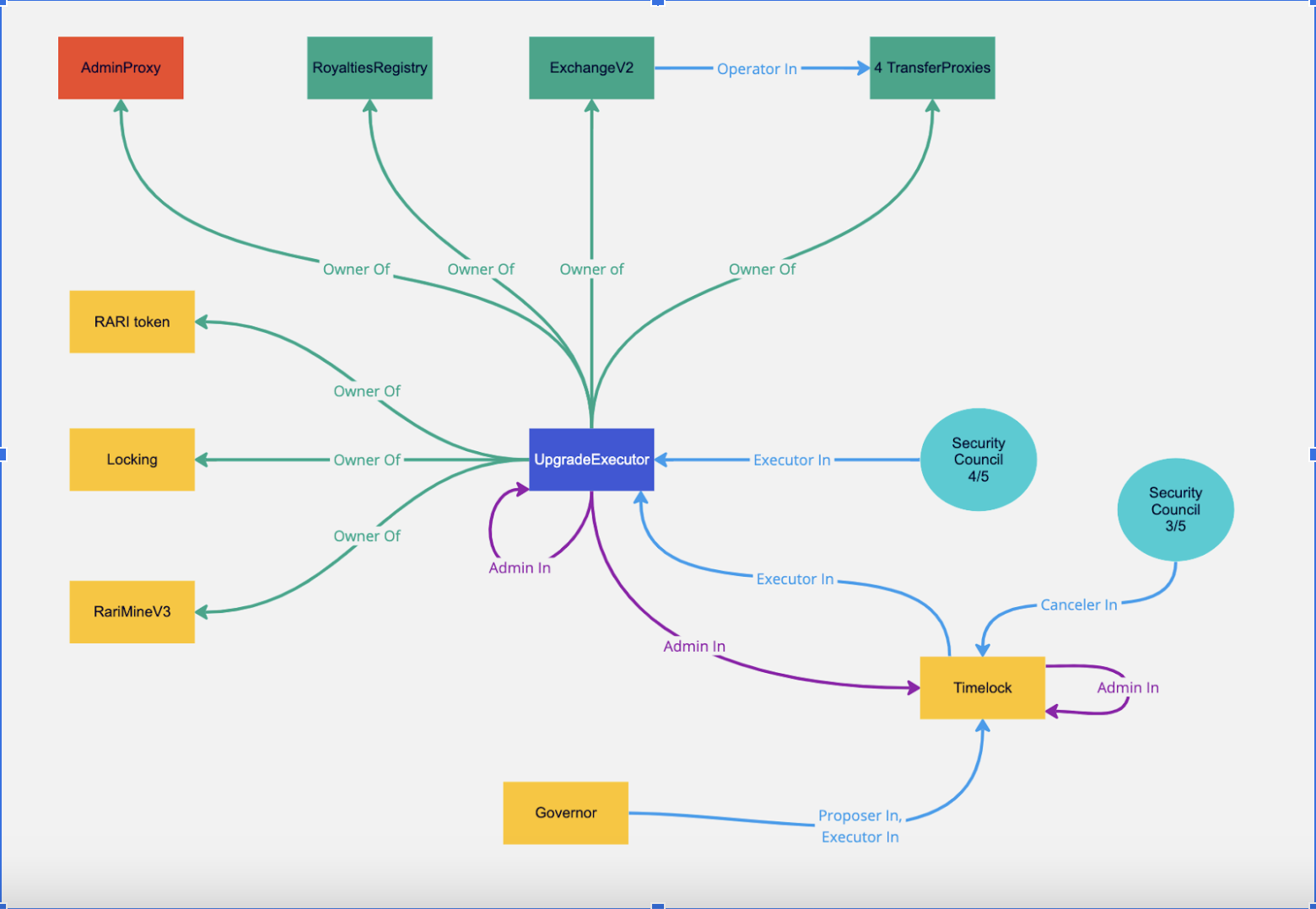
[<u>This diagram</u>](https://forum.rari.foundation/t/rrc-14-continuation-of-rarible-protocol-transfer-to-community/1811/9) shows every contract/wallet which is used in DAO-related contracts. Also, the diagram shows every role and dependencies between contracts/wallets.
UpgradeExecutor will be the owner or admin in the shown contracts. This will allow to control these contracts using 2 addresses:
* Security Council multisig (4/5)
* Timelock contract (which executes proposals)
UpgradeExecutor will be able to execute arbitrary actions on all contracts. This will be implemented using Action Contracts which will be deployed prior to doing action. DAO will be able to review Action Contracts before execution
UpgradeExecutor has an Executor role. Executors can execute arbitrary actions. Only 2 addresses will have an Executor role: Security Council multisig (4/5 threshold) and Timelock contract. Thus, there are only 2 ways to perform ownership-related actions on DAO-related contracts: by making and executing a proposal or by a 4/5 vote of the Security Council.
<u>2. DAO commitment to not exceed protocol fees beyond a certain threshold</u>
By approving this RRC, the DAO commits to keeping any future protocol feel at a reasonable level in order not to impede the protocol's adoption and to continue providing a stable environment for applications built with it. This reasonable transaction fee shall not exceed 0.5%.
<u>3. Expansion of the Security Council to 5 seats granting of emergency upgrade powers</u>
RRC 11 established a 3-seat Security Council that, in Phase 1 was permitted to exercise veto power over proposals that would be malicious or exploitative to the DAO. The proposal included a plan to expand the Security Council's powers to include emergency upgrades in Phase 2.
Phase 2 commences with the Exchange contracts bundle ownership transfer, as this poses the need for a failsafe mechanism for scenarios such as emergency actions in critical security scenarios (e.g. hack or serious bug) or minor routine maintenance on the contracts. With this increased remit of powers, the Security Council shall be expanded to 5 seats.
Specifics:
* Veto function will be performed with a 3/5 majority vote
* Multisig address: 0xd35ec9F67Aa082Ae666be1716C79291f1f6e4E0a
* Upgrade function will be performed with 4/5 majority vote:
* Multisig address:0xa5e4514145463385aEF763Fc8161CB42b92c74f2
* The first three members will continue serving on the Security Council until their term is up
* The additional two proposed members are:
1. Jafett Sandi, current delegate of the RARI DAO and core member of the Push protocol
* Hardware wallet address: 0x636e1f9A9Cb926a69441DcE54Aa9e490CFe6D4D6
2. Eugene Nacu, current CTO of Rarible
* Hardware wallet address:0x978EBcd18c5A0d829C061566AA84227e9618C1A4
### **Steps to Implement**
The solution is ready to implement upon proposal passing.
Budget: 10,000 USD for security audit.
# Test proposal 2
This is a second test proposal for the Security Council to veto to ensure the proper functioning of its powers. The community does not need to vote on this proposal; the Foundation team will vote on this test.
If you have any questions, please contact the Foundation team.
# Test Proposal
This is a test proposal for the Security Council to veto to ensure the proper functioning of its powers.
The community does not need to vote on this proposal; the Foundation team will vote on this test.
If you have any questions, please contact the Foundation team.
# RRC-11 [Revised]: On-chain protocol governance and security council
## Abstract
This RRC-11 proposes to establish a process by which the RARI DAO will be able to propose, vote on, and execute updates and changes to the Rarible Protocol’s core contracts directly on-chain via self-executing actions. This RRC-11 also proposes to implement a committee consisting of a DAO-appointed 3-member multi-sig (“Security Council”), which will have the ability to perform emergency and non-emergency actions such as urgent upgrades, minor, routine maintenance to the Rarible Protocol, and stoping DAO hack attempts.
## Motivation
As part of the path to a more decentralized Rarible Protocol, the power to govern the Rarible Protocol contracts should be within the hands of the RARI DAO, which currently has direct on-chain governance authority over the RARI DAO treasury and is on the path to governing the Rarible Protocol. As such, there is a need for a mechanism to prevent governance attacks in which an attacker acquires voting power through legitimate means (e.g. buying tokens on the open market) but uses that to manipulate votes to their own benefit - e.i. exploiting the DAO’s treasury or the Protocol via skewing governance or introducing Protocol vulnerabilities. The DAO needs a body with emergency veto and upgrade powers that will be able to step in to protect the DAO and its interests.
## Rationale
By growing the robustness of the RARI DAO governance and mitigating governance attack risks, the DAO will be able to fully adopt the Rarible Protocol and engage in activities to grow the Protocol’s ecosystem by onboarding new communities and expanding NFT use cases.
## Key Terms
N/A
## Specifications
**Current RARI DAO Governance:**
The RRC Process as laid out in “Specifications” section of RRC-0 shall apply to Rarible Protocol core contract updates and changes.
*Phase 1: RRC Idea*
-- An RRC Idea must be submitted as a post in the Forum, where it should gather feedback for a period of 7 days
*Phase 2: RRC Draft*
-- After Phase 1, the RRC Idea author must generate an RRC Draft with the required fields as laid out in RRC-0.
*Phase 3: Live RRC*
-- Once an RRC Draft is ready, the RRC author (provided that they have at least 5,000 veRARI) must post it as a Live Draft on Tally, where it will undergo a 5 day voting period.
-- The Live RRC must reach the quorum requirement dictated in RRC-0, and voting options are “in favor” and “against”. A Live RRC which meets the quorum requirement and receives more votes cast “in favor” than cast “against”, it shall be deemed an Accepted RRC.
*Phase 4: Cooldown Period*
-- An Accepted RRC undergoes a 2-day Cooldown Period, **during which the Security Council and the Board of the RARI Foundation may each reject such Accepted RRC*** if it would:
1. Directly conflict with a proposal that is currently up for vote;
2. Directly conflict with another proposal approved by the RARI DAO;
3.Not include the required proposal terms as detailed in Phase 2 of the RRC Process;
4. Compromise the Board’s fiduciary duties as they are owed to the RARI Foundation;
5. Be in violation of the RARI Foundation’s bylaws or articles, any statutory requirements of Cayman Islands laws or the laws or regulations of any other applicable jurisdiction;
6. Cause harm (including reputational harm) to the RARI Foundation (as determined in the Board’s sole discretion); and/or
7. Cause the RARI Foundation to be in breach of any contracts, agreements or any other arrangements.
-- * This RRC-11 is proposing this update to Phase 4 of the RRC Process – that is, the Security Council as well as the director of the RARI Foundation, has the ability to reject an Accepted RRC during a Cooldown Period.
*Phase 5: Implementation*
**Proposed Security Council:**
1. This RRC-11 establishes a 3-member Security Council.
-- In Phase 1 (immediately), the Security Council will be able to reject an Accepted RRC during the Cooldown Period should the proposal be malicious or exploitative to the DAO.
-- In Phase 2 (after a period of 3 months), the Security Council will also be able to perform emergency actions in critical security scenarios (e.g., a hack, serious bugs, etc.) as well as perform minor routine maintenance of the Protocol contacts.
-- After each action, the Security Council will publish a detailed report with the rationale for their actions and outline of the implementation details within a reasonable timeframe.
2. The initial members of the Security Council are nominated by the RARI Foundation and will serve a term of 12 months.
-- Campbell Law, current Director of the Foundation; wallet address: 0xd9C3EeD65968443F8587Bb068e6530A48dB5d177
-- Andrei Taraschuck, current delegate; wallet address: 0x25Ad94C7768108666BfDB6742aB66b109CA82946
-- StableLab, professional delegates, represented by Mattew Stein; wallet address: Stablelab.eth
3. The Safe multisig wallet the Security Council will use to perform its function is: 0xd35ec9F67Aa082Ae666be1716C79291f1f6e4E0a
4. Appointment and Removal
-- The members of the Security Council will serve a term of 12 months. The future members of the council may be appointed via the RRC process or via an on-chain election process if the community decides to establish on-chain elections with a stand-alone proposal.
-- The members of the Security Council must act upon the direction of the director of the RARI Foundation as well as the RARI token-holders pursuant to the RRC. Failure to act in accordance with directions from either the director of the RARI Foundation or the RRC Process constitutes a reason for an ad hoc removal of Security Council members. Such removal shall follow the RRC Process, and one member of the Security Council must remain in place.
-- The number of members on the Security Council may also be expanded or reduced pursuant to the RRC Process, provided that (i) there must be at least 1 member on the Security Council and (ii) at least 1 member of the Security Council must be a director of the RARI Foundation.
5. Compensation
Security Council members are entitled to compensation of 2,000 USDC per month.
## Steps to Implement
Phase 1:
Implement Security Council’s veto power in the Timelock contract: 0x6552C8fb228f7776Fc0e4056AA217c139D4baDa1
Phase 2:
Encode Security Council’s upgrade powers to all governance contracts:
Governor: 0x6552C8fb228f7776Fc0e4056AA217c139D4baDa1
Token: 0x096Bd9a7a2e703670088C05035e23c7a9F428496
Timelock: 0x7e9c956e3EFA81Ace71905Ff0dAEf1A71f42CBC5
Encode Security Council’s upgrade powers to Protocol contracts along with implementing DAO governance over the Protocol.
## Timeline
Phase 1: immediately
Phase 2: after 3 months of the first Security Council in place
## Overall Cost
72,000 for the first year. Cost for the first 6 months was approved as part of the Rari Foundation’s H2 ‘23 operational budget.
# RRC-11: On-chain Protocol Governance and Security Council
**Abstract**
This RRC-11 proposes to establish a process by which the RARI DAO will be able to propose, vote on and execute updates and changes to the Rarible Protocol’s core contracts directly on-chain via self-executing actions. This RRC-11 also proposes to implement a committee consisting of a DAO-appointed 3-member multi-sig (“Security Council”) which will have the ability to perform emergency upgrades, as well as minor, routine maintenance, to the Rarible Protocol.
**Motivation**
As part of the path to a more decentralized Rarible Protocol, the power to govern the Rarible Protocol contracts should be within the hands of the RARI DAO, which currently has direct on-chain governance authority over the RARI DAO treasury.
**Rationale**
By growing the robustness of the RARI DAO governance, the DAO will be able to fully adopt the Rarible Protocol and grow its ecosystem by onboarding new communities and expanding NFT use cases.
**Key Terms**
N/A
**Specifications**
***RARI DAO Governance:* **
The RRC Process as laid out in “Specifications” section of RRC-0 shall apply to Rarible Protocol core contract updates and changes.
1. Phase 1: RRC Idea
a. An RRC Idea must be submitted as a post in the Forum, where it should gather feedback for a period of 7 days
2. Phase 2: RRC Draft
a. After Phase 1, the RRC Idea author must generate an RRC Draft with the required fields as laid out in RRC-0.
3. Phase 3: Live RRC
a. Once an RRC Draft is ready, the RRC author (provided that they have at least 5,000 veRARI) must post it as a Live Draft on Tally, where it will undergo a 5 day voting period.
b. The Live RRC must reach the quorum requirement dictated in RRC-0, and voting options are “in favor” and “against”. A Live RRC which meets the quorum requirement and receives more votes cast “in favor” than cast “against”, it shall be deemed an Accepted RRC.
4. Phase 4: Cooldown Period
a. An Accepted RRC undergoes a 2-day Cooldown Period, during which the Security Council and the Board of the RARI Foundation may each reject such Accepted RRC* if it would:
- Directly conflict with a proposal that is currently up for vote;
- Directly conflict with another proposal approved by the RARI DAO;
- Not include the required proposal terms as detailed in Phase 2 of the RRC Process;
- Compromise the Board’s fiduciary duties as they are owed to the RARI Foundation;
- Be in violation of the RARI Foundation’s bylaws or articles, any statutory requirements of Cayman Islands laws or the laws or regulations of any other applicable jurisdiction;
- Cause harm (including reputational harm) to the RARI Foundation (as determined in the Board’s sole discretion); and/or
- Cause the RARI Foundation to be in breach of any contracts, agreements or any other arrangements.
b. * This RRC-11 is proposing this update to Phase 4 of the RRC Process – that is, the Security Council as well as the director of the RARI Foundation, has the ability to reject an Accepted RRC during a Cooldown Period.
5. Phase 5: Implementation
***Security Council:* **
1. This RRC-11 establishes a 3-member Security Council, which will be able to reject an Accepted RRC during a Cooldown Period, but also perform emergency actions in critical security scenarios (e.g., a hack, serious bugs, etc.).
2. The initial members of the Security Council are as follows:
- Campbell Law; wallet address: 0xd9C3EeD65968443F8587Bb068e6530A48dB5d177
- Andrei Taraschuck; wallet address: 0x25Ad94C7768108666BfDB6742aB66b109CA82946
- StableLab; wallet address: Stablelab.eth
- The multisig wallet the Security Council will use to perform veto or upgrade function is: 0xd35ec9F67Aa082Ae666be1716C79291f1f6e4E0a
3. Appointment and Removal
- The members of the Security Council may be appointed and removed during a yearly review or at any time, pursuant to the RRC Process.
- The members of the Security Council must act upon the direction of the director of the RARI Foundation as well as the RARI token-holders pursuant to the RRC Process. [Failure to act in accordance with directions from either the director of the RARI Foundation or the RRC Process may result in suspension of ].
- The number of members on the Security Council may also be expanded or reduced pursuant to the RRC Process, provided that (i) there must be at least 1 member on the Security Council and (ii) at least 1 member of the Security Council must be a director of the RARI Foundation.
- Security Council members are entitled to compensation of 2,000 USDC per month if requested.
**Steps to Implement**
1. Update the RARI Foundation’s governing documents to refer to the Security Council and its authorities
2. Update the RARI DAO’s governor contract to add the Security Council’s powers, exercisable during the Cooldown Period
**Timeline**
Solution ready for implementation.
**Overall Cost**
72,000 for the first year. Cost to be approved as part of the Rari Foundation’s operational budget.
# RRC-10: H2 2023 RARI Foundation Operational Budget
**Abstract**
This document proposes to allocate funds for the Rari Foundation operational budget for H2 2023 (6 months) in the amount of 611,800 USDC. This budget will ensure the continuity of the Rari Foundation team and operations and reflects the focus areas as identified by the community.
**Motivation**
The Rari Foundation represents the Rari DAO in the world. As such, it sustains operational costs that allow the Foundation to function and to facilitate the DAO in reaching the goal of Building a decentralized NFT infrastructure that will power future NFT use cases. The operational budget will allow the Foundation to source legal services, compensate key contributors, and promote Rari DAO’s mission in order to drive the adoption of the Rarible Protocol. The assumption is that Rari DAO will be working with the most skilled and professional contractors on the market, and it is necessary for the Foundation’s success to be able to offer compensation in stable coins or fiat money instead of $RARI in order to be competitive.
**Rationale**
The Rari DAO identified key goals to be focusing on in the short, mid, and long term. A dedicated team is required to deliver on these goals and to ensure the continuity of operations. The budget will enable the core team to facilitate the DAO in growing and maturing to the point of being able to take over the Rarible Protocol’s governance while laying the groundwork for growing Rarible Protocol’s ecosystem growth.
**Key Terms**
N/A
**Specifications**
The H2 operational budget reflects growing DAO needs: Improved governance (paid security council positions, a professional delegate) Increased marketing demands (website redesign resources, more DAO/RF initiatives = more needs for promotional support, RF presence at industry events) Improved compensation (pool for contributors rewards, $RARI vesting for the Foundation team)
*Budget overview: *
see image 
*Specifics*:
1. Foundation salaries
- The Foundation team includes Head of Strategy (Jana Bertram), Community Lead (Fumbles), Project Management Lead (Fumbles), Marketing Lead (Xenia Vyazemskaya), Engineering Lead (Cristian Covalli), Business Development Lead (to be hired), and Accountant (to be hired).
- The Foundation team headcount is 4 FT and 2 PT contributors.
- Freelance copy and design resources are intended for website redesign, branding update, and creation of promotional materials.
2. DAO compensation
- Contributor rewards are intended to compensate DAO community contributors in delivering on asks identified by the Foundation and DAO. E.g. content writing, events organizing, research, and business development.
- Professional delegate services are compensation to StableLab, who commit to active voting participation, setting a leading example of how a delegate in RARI DAO should act, collaboratively aid proposal creation, contribute to community calls.
- Security council seats are compensated at 2,000 USD per month per seat. The council consists of 3 members.
3. Vendor fees
- Legal fees are incurred for legal counsel in the Cayman Islands and in the United States. The legal councils prepare contracts, review core proposals and advise the Director of the Foundation, the Foundation team and the DAO on any potential legal risks or implications.
- Administration fees cover the Director of the Foundation and the Supervisor of the Foundation, both roles that are required for the set up of the Foundation under the Cayman law. The Director is ultimately responsible for the management and operation of the Foundation, in particular, approving and entering into contractual agreements on behalf of the Rari Foundation.
4. Marketing
- The Foundation is mapping H2 2023 marketing activities and foresees costs related to sponsorship, promotions, and gas reimbursements. Tentative plans foresee ETH Global NY and Devconnect in Istanbul.
- Production costs related to print material, video, and or merchandise produced for presence at events and conferences.
- The travel budget covers travel fare, accommodation and local expenses for conferences or events outside of city of residence.
5. Contingency
- Legal contingency is intended for an instance where the legal council would need to significantly increase their hours e.g. in case of an unexpected urgent legal matter.
- Miscellaneous covers small expenses such as office supplies, subscriptions and event tickets.
*Notes*:
1. The Director of the Foundation is responsible for the budget. They may opt to delegate day-to-day budget management tasks to the Foundation team.
2. Budget spending shall be monitored by the Foundation’s appointed accountant.
3. Periodic budget spending reports shall be shared with the community quarterly, no later than 30 days after the end of the quarter. The community may request budget updates at any point. In such event, the Foundation shall present the budget status no later than in 15 working days.
4. If there are unspent funds at the end of the budget cycle, the Foundation may propose to keep the amount in an operational reserve. Otherwise, it shall be returned to DAO’s treasury within 90 days of the budget cycle’s end.
5. The Foundation team shall respect the budget allocations as specified in the subtotals. It is understood that variations may occur. However, transfers between the budget groups should not exceed 30%. Budget reallocations larger than 30% will require DAO approval.
6. Should $RARI price deviate from the USDC conversation rate at the date of the proposal submission (1 $RARI = 1.06 USDC), the Foundation shall either submit an additional proposal to request funds to cover the exchange loss or refund the excess funds to the Treasury.
7. Any spending exceeding the budgeted amount shall be approved by token holders separately.
8. Contributors (Team) are to be paid once a month in USDC unless otherwise agreed in their contracts.
9. Legal and Administrative costs are to be paid upon receiving invoices from the Foundation service providers as per engagement letters or agreements with such entities.
*Payments disbursement:*
1. Contributors (Team) are to be paid once a month in USDC unless otherwise agreed in their contracts.
2. Legal and Administrative costs are to be paid upon receiving invoices from the Foundation service providers as per engagement letters or agreements with such entities.
**Steps to implement**
Upon the budget approval, the full corresponding $RARI amount will be transferred to the Foundation’s operational wallet (0x2a83d2891Ef3df6967E3C2e9b69cCc7aD029736B), the Foundation will convert it to USDC to reduce the exchange rate fluctuation risk and the exchanged amount wil be stored on the operational wallet 0x2a83d2891Ef3df6967E3C2e9b69cCc7aD029736B. The Foundation may opt to halt conversion to USDC, should the exchange rate start falling below the desired conversion rate, and resume when the desired rate is met or if a conversion must be made in order to meet Foundation’s payment obligations. Payments within the approved budget in accordance with signed contracts are to be made by the Foundation leadership, who will be responsible for the budget.
# RRC-9: Delegate Launchpad Proposal
**Abstract**
This document proposes a Rari DAO delegate launchpad program, which is designed to attract new delegates and boost DAO participation with the ultimate goal of advancing the mission of building a decentralized NFT infrastructure that powers future NFT use cases.
The delegate launchpad program consists of the Rari Foundation delegating a fixed amount of veRARI for a fixed amount of time as long as applicable delegates met the required criteria and maintained an active DAO status for the duration of the delegation.
The suggested mechanism is based on ideas proposed by the community during strategic workshops held on May 18 and 25 and related feedback.
**Motivation**
The Rari DAO is the governing body of the Rari Foundation, which was established to help grow the NFT ecosystem with the Rarible protocol, uncovering new NFT use cases and broadening the horizon of the NFT technology application. As such, we believe the Rari DAO community can benefit from inviting new members with relevant skills and experiences who can engage in the discourse of decentralizing the NFT infrastructure and help us get there. By empowering these new members with temporary delegations, we fast-track their active DAO participation and cultivate a vibrant community.
This program will be a pilot from which we will learn and improve on future initiatives designed to grow DAO participation. We’re targeting to onboard 15 new delegates through this program during summer 2023.
**Rationale**
The current DAO participation is low - both in terms of voting and discourse and in terms of proposal submissions. We’re seeking ways to jumpstart the DAO activity to get more traction on proposals and community discourse.
The Rari Foundation has just rolled out delegation incentives (as part of Delegation Week), which produced moderate results. We need to look beyond delegation gas reduction. The delegate launchpad program will enable us to screen qualified applicants for the kind of skills, experience, and motivation the DAO can benefit from in the long run and, at the same time, elevate the new delegates within their communities.
**Key Terms**
*$RARI* - the official token ticker of the ERC-20 token that governs Rarible Protocol ecosystem
*veRARI* - the locked $RARI that can be used for governance: voting and proposals submission
*Lock Period* - the time during which locked $RARI remains unavailable for transacting or trading
*Delegation* - The act of loaning veRARIi tokens, obtained by locking $RARI, to someone who will represent your interests in governance and voting on chain.
*Delegate* - A party that has the ability to vote on Rari governance proposals. Could be a veRARI token holder or someone to whom other $RARI token holders have delegated their veRARI and voting power.
*Rari DAO* - A decentralized autonomous organization committed to building the future of NFT infrastructure & NFT use cases. The DAO oversees the treasury and is on the path to govern the Rari protocol.
*Rari Foundation* - The legal entity of the Rari DAO, and an organization that facilitates the DAO and ensures compliant disposal of the DAO Treasury.
**Specifications**
***1. Program recipients' eligibility criteria***
We’re seeking to attract applicants from the following professional areas and with the following areas of contribution:
a. DAO Governance experts
- reasons to join
1. Thought leadership creds
2. Resume building
- areas of contribution
1. DAO processes, tools, and participation incentives
2. Grants framework
b. NFT & De-fi thought leaders
- reasons to join
1. Developing capabilities in the NFT-Fi space and building industry recognition/prestige
2. Token rewards
- areas of contribution
1. DAO participation incentives
2. Protocol adoption incentives
c. NFT & De-fi thought leaders
- reasons to join
1. Shaping the protocol
2. Access to grants and DAO decision-makers
- areas of contribution
1. Onboarding new communities to the Protocol
2. Protocol expansion and adoption via ambassadorship and partnerships
During the application period, applicants must submit their application outlining their qualifications, motivation, area of DAO contribution, Tally profile, socials, and wallet address or ENS. They must also acknowledge the conditions and terms of the delegation. The Rari Foundation team shall review all the applications and, together with the community, select the final 15 recipients and 5 top choices for a waitlist.
***2. Conditions of delegation***
The Rari Foundation will delegate 2,000 veRARI to up to 15 delegates that meet the above criteria and have applied within the application period.
This program lasts for 6 months in total. During the first three months, the delegated amount will remain to be the total 2,000 veRARI, unless the recipient breaches the terms outlined below. During the second three months, the amount of delegated veRARI will linearly decrease to 0. If the program recipients wish to maintain their delegate status, they can use this period to gather support and delegations from the DAO community. The Rari Foundation will elevate these delegates via owned channels in order to support them in their efforts to gain community support and delegations.
***3. Terms of delegation***
The program recipients need to demonstrate a track of DAO participation: vote on at least 60% of proposals (in any given 30-day period), provide a rationale in the DAO’s discussion forum on voting decisions, and be, within reason, responsive to the community. If these criteria are not met or if the delegate demonstrates behavior at odds with the DAOs code of conduct*, the foundation can revoke the delegation at any given moment.
* The Rari DAO’s core values are Respect, Integrity, Accountability, Innovation.
There is no exploitative behavior allowed at any time. Exploitative behavior can mean attempting to exploit an individual community member, seeking to exploit the DAO itself, or seeking to exploit the treasury. There is also no form of harassment tolerated anywhere throughout the Rari DAO. Any expression of racism, sexism, xenophobia, or other derogatory prejudice & intolerance is not welcome here.
In case the delegation is revoked, the Rari Foundation shall delegate to a candidate in the first position on the waitlist.
**Program budget**
The total program budget is 30,000 veRARI, which translates to 90,000 $RARI locked for a period of 6 months (6 months lock with 3 months slope to support the delegation mechanism as outlined above). We propose this budget is allocated from the Rari Foundation’s Treasury and remains in Rari Foundation’s management until revoked in order for the Foundation to have the ability to deploy the program again, upon alignment with the community.
**Timeline**
As soon as the proposal is approved and executed, the Rari Foundation can promote the program and launch the enrollment period. Tentative schedule:
w/o June 19 proposal voting & execution
w/o June 19 + 26 promotion and program amplification
w/o June 26 - w/o July 10 enrollment period
w/o July 17 candidate selection
w/o July 24 selected delegate onboarding
w/o July 31 delegation & program kick off
**Steps to implement**
1. Funds distribution: From Treasury to the Contract. Contract to Rari Foundation’s wallet.
2. Locking $RARI: 6 months lock where cliff = slope = 3 months.
3. Note: Having this kind of lock configuration of $RARI to veRARI, the ratio will be 33%. Therefore, to achieve 2000 veRARI, 6k $RARI should be locked (per delegate).
4. Delegating funds to the addresses of the selected candidates.
5. Report to the community on the status of delegations.
6. Weekly monitoring of delegate activities to ensure adherence to terms.
7. End of program report and learnings for future editions.