# Add sDOLA/reUSD onlyBoost LP Market to FiRM
# **Proposal to Add sDOLA/reUSD LP Market to FiRM**
Forum Post: https://forum.inverse.finance/t/add-sdola-reusd-lp-market-to-firm/680
## **Summary**
This proposal seeks to add the sDOLA/reUSD Curve LP, deposited via onlyBoost and Yearn, as a collateral market on FiRM.
This market was originally proposed in May 2025 but was ultimately paused following DAO discussion. At the time, the primary concern was not the strategic case for the integration, but Resupply's limited operational history. The view was that the protocol should be given additional time to demonstrate its stability and behaviour before FiRM took on exposure.
More than 15 months have now passed since that discussion, and Resupply has developed considerably. Alongside the additional protocol history, recent integrations between Inverse, Curve and Resupply have materially strengthened the business case for this market.
We believe now is the appropriate time to revisit the integration.
## **Background**
Resupply is a stablecoin and lending protocol built by contributors from the Convex and Yearn ecosystems. Users can deposit yield-bearing lending positions as collateral and borrow reUSD against them, allowing the underlying assets to continue earning yield while unlocking additional capital efficiency.
Resupply launched in March 2025 and has now been live in production for approximately 17 months.
The sDOLA/reUSD FiRM market was [first proposed shortly after Resupply's launch](https://forum.inverse.finance/t/add-sdola-reusd-convex-lp-market-to-firm/563). While the business case received support, the DAO ultimately preferred to allow the protocol more time to mature before proceeding. The proposal was therefore paused in May 2025 with the intention of revisiting it once Resupply had established a longer track record.
Shortly afterwards, in June 2025, Resupply suffered an exploit involving a newly deployed lending market, resulting in approximately 10m reUSD of bad debt. The incident reinforced the value of the DAO's cautious approach at the time. Resupply subsequently completed its bad-debt recovery process and has now operated for more than a year since the incident.
As a result, the DAO now has substantially more information and operational history on which to assess the protocol than was available during the original discussion.
## **Market Business Case**
The business case for this integration has strengthened considerably following the launch of the new sDOLA/crvUSD LlamaLend V2 market.
Resupply has integrated the crvUSD lending side of this market into its protocol, allowing users to deposit crvUSD into the sDOLA LlamaLend V2 market and use the resulting lending position as collateral to borrow reUSD.
This creates a particularly strong alignment between Inverse, Resupply and Curve.
The relationship can form a positive liquidity flywheel:
1. **FiRM enables leverage on the sDOLA/reUSD LP**
Allowing the LP to be used as FiRM collateral gives depositors access to fixed-rate DOLA borrowing and enables leveraged LP strategies. This should increase demand for the LP and make the incentives directed towards it more capital efficient.
2. **Greater LP demand deepens reUSD liquidity**
Additional sDOLA/reUSD liquidity provides reUSD with a deeper liquidity venue and improves its ability to maintain its peg. The Resupply and Convex ecosystems can further support this liquidity through incentives.
3. **Deeper reUSD liquidity enables Resupply to scale**
Stronger reUSD liquidity allows Resupply to support additional borrowing and leverage across its own markets.
4. **Resupply can direct additional capital into the sDOLA LlamaLend V2 market**
Resupply now accepts the crvUSD lending position from the sDOLA/crvUSD LlamaLend V2 market as collateral. Growth in Resupply therefore has the potential to drive additional crvUSD deposits into the market, increasing available liquidity for sDOLA borrowers and allowing the market to scale.
5. **A larger sDOLA market ultimately benefits Inverse**
Greater capacity within the sDOLA LlamaLend market increases the usefulness and potential scale of sDOLA, creating additional demand for DOLA and strengthening sDOLA's position throughout the Curve ecosystem.
The result is a highly synergistic structure where liquidity and borrowing activity can reinforce each other across FiRM, Resupply and LlamaLend.
## **Strategic Alignment**
There is also significant strategic alignment between the teams involved.
Inverse has longstanding relationships with contributors across Convex, Resupply and Yearn, with these teams having collaborated across liquidity, incentives, treasury management and product integrations for several years.
Resupply has consistently demonstrated an interest in growing integrations involving sDOLA. More recently, Resupply's decision to support the new sDOLA LlamaLend V2 market further increases the direct economic alignment between the protocols.
Adding the LP to FiRM provides another mechanism through which all parties can coordinate incentives and capital to grow the same underlying markets rather than competing for liquidity independently.
## **Market Parameters**
Market parameters proposed in accordance with [risk assessment and recommendations from the RWG](https://forum.inverse.finance/t/add-sdola-reusd-lp-market-to-firm/680/2).
* Collateral Factor: 85%
* Liquidation Factor: 100%
* Liquidation Incentive: 5%
* Minimum debt: 3,000 DOLA
For the onlyBoost Market: 0xf9287c29Cb888F4834B7D2757a833D509e7f9D9A
* Supply Ceiling: 1,500,000 DOLA
* Daily Borrow Limit: 350,000 DOLA
For the Yearn market: 0x1fD4985cdd57bDb1eD646B10B7952fCD58946916
* Supply Ceiling: 500,000 DOLA
* Daily Borrow Limit: 150,000 DOLA
# Reduce the Virtual Auction Minimum Bad Debt Repayment and Begin Treasury INV Buybacks
# Reduce the Virtual Auction Minimum Bad Debt Repayment and Begin Treasury INV Buybacks
Forum Post: https://forum.inverse.finance/t/reduce-the-virtual-auction-minimum-bad-debt-repayment-and-begin-treasury-inv-buybacks/640
## Summary
This proposal seeks to reduce the `minRepayBps` of the Virtual Auction to 0% from 20%, and to start a new auction that sells DBR for INV, accumulating INV in the Treasury via rate-limited DBR issuance. This is in response to the current state of the crypto markets, which are both squeezing margins in the core lending business and leading to significant price declines in many volatile assets, including the INV governance token.
## Background
* The virtual auction [launched in early 2024](https://www.inverse.finance/governance/proposals/mills/164), with 100% of proceeds initially being directed to DOLA bad debt repayment
* In January 2025, the [SaleHandler was updated](https://www.inverse.finance/governance/proposals/mills/263) to introduce a governance-controlled `minRepayBps` and a live `repayBps` adjustable by the TWG beneficiary between `minRepayBps` and 100%
* DBR Auction v2 infrastructure allows for governance to create new DBR for assets without needing new customized code
## Motivation
### Virtual Auction
The current 20% minimum repayment requirement makes the core lending business unsustainable during poor market periods, requiring incentives to be subsidized by other revenue sources (such as veNFTs). Reducing the minimum to 0%, gives the TWG flexibility to dynamically adjust the level of repayment used, based on current margins and market conditions. This ensures a more sustainable business at all times, thereby protecting the DAO’s runway during weaker market periods.
### INV Buybacks
With current market conditions pushing the INV governance token to its all-time low in USD at the time of writing, it represents a good opportunity for the DAO to begin price-sensitive DCA buybacks using the DBR Auction v2 infrastructure. The INV bought will be stored in the DAO Treasury and can be utilized by governance in the future.
## INV Auction Parameters
The proposed operator is the Treasury Working Group multisig, which will manage the DBR rate allocated to the auction, in conjunction with DBR issuance budget elsewhere, and also INVs USD price.
* Starting DBR Reserve \= 500,000
* Starting INV Reserve \= 1,250
* Min DBR rate per year \= 0
* Max DBR rate per year \= 50,000,000 (note: this is the ceiling, the expected initial rate will be lower)
## On-Chain Actions
* Set `minRepayBps` on VA Sales Handler to 0
* Grant DBR minting rights to INV Auction
* Set the max DBR rate per year to 50,000,000
https://x.com/0xCryptoHarryYearn DAO Yearn BORGhttps://beige-just-flyingfish-108.mypinata.cloud/ipfs/bafybeielghb5zxyll5mnvukj65oebpulkww2zadklacwo26gkrtbzzvda4
setReplenismentIncentiveBps(uint256)setReplenismentIncentiveBps(uint256)# Reduce the DBR Replenishment Incentive [1/2]
# Proposal to Reduce the Replenishment Incentive
Forum Post: https://forum.inverse.finance/t/reduce-the-dbr-replenishment-incentive/625
## TL;DR
* Reduce `replenishmentIncentiveBps` on FiRM markets from 5000 → 1000 (50% → 10%).
* Borrowers still pay the same replenishment cost; we only change how it’s split between replenisher vs DAO.
* The DAO Treasury’s share of replenishment revenue goes from 50% → 90%.
## Background
When a user has a DBR deficit, anyone can call `forceReplenish` on the market:
* The user incurs a replenishment cost in DOLA (added to their debt).
* A share of that cost, controlled by `replenishmentIncentiveBps`, is paid to the caller as `replenisherReward`.
* The DAO Treasury effectively captures the rest via the market/lender setup.
In the Market contract, this is:
`uint replenisherReward = replenishmentCost * replenishmentIncentiveBps / 10000;`
FiRM launched with replenishmentIncentiveBps \= 5000 (50%) to bootstrap keepers and make sure deficits are cleared quickly.
## Motivation
1\. Keeper ecosystem is already competitive
After almost three years live, FiRM is fully integrated into multiple bots and keeper stacks:
* Replenishments are already highly competitive on larger positions.
* The original 50% incentive has done its job as a bootstrap parameter.
We no longer need to give away half the revenue to maintain healthy replenishment activity.
2\. Treasury is overpaying for the same outcome
The borrower always pays 100% of the replenishment cost as new DOLA debt. This proposal only changes the split:
* Before: 50% to caller, 50% to DAO
* After: 10% to caller, 90% to DAO
3\. 10% is still enough to keep things running
We don’t want to push incentives so low that:
* Small deficits remain unreplenished for a long time, or
* Gas economics no longer make sense for callers.
At 10%:
* Larger deficits still pay a meaningful absolute reward.
* Existing bots already monitor FiRM, so infra cost is largely sunk.
* If we ever observe persistent unreplenished deficits or degraded behavior, governance can revisit the parameter.
## On-Chain Actions
For all active FiRM markets (of which there are 28 currently, so this will be split into 2 on-chain proposals, of 14 markets each), defined as markets that:
* have `totalDebt > 100 DOLA`, or
* have `borrowPaused == false`,
perform:
* `setReplenismentIncentiveBps(1000)`
This sets `replenishmentIncentiveBps` to 10% on those markets, shifting replenishment revenue to 90% DAO / 10% caller without changing DBR pricing, liquidations, or user-facing mechanics.
# Migrate DBR Helpers to New TriDBR Pool
# Proposal to Migrate DBR Helpers to New TriDBR Pool
Forum Post: https://forum.inverse.finance/t/migrate-dbr-helpers-to-new-tridbr-pool/627
## TL;DR
* FiRM helper contracts (ALE, PendlePTHelper, DbrHelper) currently route via the old TriDBR pool.
* Liquidity is migrating to the new TriDBR pool, so we’re upgrading helpers to use it.
* This proposal:
* Enables the new helper contracts,
* Executes a one-shot migrator to copy configuration from the old ALE,
* Then disables the legacy helpers.
* No changes to market parameters or user positions, this is purely a routing / infra upgrade.
## Background
To improve the FiRM UX, we use several helper contracts that abstract common flows such as:
* Buying/selling DBR
* Leveraging and deleveraging positions (ALE)
* Interacting with Pendle PT markets
Today, these helpers have hard-coded routing that assumes DBR–DOLA–INV liquidity is in the [old TriDBR](https://etherscan.io/address/0xc7de47b9ca2fc753d6a2f167d8b3e19c6d18b19a) Curve pool. As liquidity is being migrated to the [new TriDBR](https://etherscan.io/address/0x66da369fc5dbba0774da70546bd20f2b242cd34d) pool, the existing helpers would increasingly route through a shallow / deprecated pool, degrading execution and UX. To avoid this, we deploy updated helpers that integrate with the new pool:
## Objective
Update FiRM infra so that:
* All helper flows (ALE, DBR selling, Pendle PT helper flows) use the new TriDBR pool.
* Governance retains ownership/control of the new helper contracts.
* Legacy helpers are cleanly disabled to avoid confusion or mis-routing.
This proposal only:
1. Enables the new ALE contract on the borrow controller,
2. Executes a migration contract that:
* Claims pending gov on the new helpers,
* Copies ALE market configuration from the old ALE,
* Re-approves FiRM markets on the new DbrHelper,
3. Transfers governance back to DAO gov,
4. Disallows the old helpers.
No FiRM market parameters, user escrows, or DBR logic are changed.
## New Contracts:
* ALE: [0x39D167Fe676EFC3be49bE874a37349A5D89f9058](https://etherscan.io/address/0x39d167fe676efc3be49be874a37349a5d89f9058#code)
* PendlePTHelper: [0x719C47071bea36fD2b2287bBe6efa872A594Fb78](https://etherscan.io/address/0x719c47071bea36fd2b2287bbe6efa872a594fb78#code)
* DbrHelper: [0x3363Ad5780316Fd5180Bb9F34297B533fb9cB335](https://etherscan.io/address/0x3363ad5780316fd5180bb9f34297b533fb9cb335#code)
* Migration Contract: [0x043646A09FA89a1d8f48788008E70299BB269855](https://etherscan.io/address/0x043646a09fa89a1d8f48788008e70299bb269855#code)
The Migration contract:
* Reads the current ALE market configuration from the legacy ALE,
* Sets the equivalent markets on the new ALE,
* Calls approveMarket on the new DbrHelper for the same set of markets,
* Handles pending gov for both new ALE and new DbrHelper.
## On-Chain Actions
The governance proposal will perform the following actions:
1. Enable new helpers on the borrow controller
* Allow the new ALE contract to borrow / operate as helpers on FiRM (same permissions as the legacy helpers).
2. Execute the migrator
* Call `migrate()` on the migration contract
* This:
* Claims pending gov on the new ALE and DbrHelper,
* Copies ALE markets from the old ALE to the new ALE,
* Calls `approveMarket` for all relevant FiRM markets on the new DbrHelper,
* Sets pending gov of both contracts back to DAO governance.
3. Accept governance on new helpers
* Governance (GOV) accepts ownership / gov role on:
* ALEV2
* DbrHelper
4. Disable legacy helpers
* Remove / disallow the following legacy helper contracts from the borrow controller:
* Old ALE
* Old Curve Helper
# Authorize Limited Leverage for use by the TWG
# **Authorize the TWG to use limited leverage and hedging in stablecoin portfolio management**
Forum Post: https://forum.inverse.finance/t/authorize-limited-leverage-for-use-by-the-twg/618
## **TL;DR**
* **What:** Permit TWG to deploy low-risk, USD-stablecoin-only leverage and hedges to improve risk-adjusted returns and reduce protocol balance-sheet risk.
* **Why:** Increase sustainable yield, hedge protocol exposures (e.g., collateral/borrow side risk), and harvest DOLA volatility in a peg-supportive way.
* **How:** Strict guardrails on exposure, LTV, liquidation buffers, per-asset/protocol limits, transparent reporting, and an emergency pause.
* **Scope:** On-chain only; FiRM, Curve Lend, Aave v3, Morpho Blue, FraxLend, Fluid and Pendle primitives to start. Start with conservative caps; broaden only via DAO ratification.
---
## **Background**
The TWG has managed Inverse’s treasury and liquidity for \~4 years, growing assets from just under \~$2m (INV-heavy) to \>$17m with significantly more diversified holdings. To date, stablecoin reserves have been deployed conservatively (seeding liquidity, earning modest yield). This proposal expands the toolkit to include measured leverage and hedging exclusively within USD-stable markets to enhance returns and reduce risk on the DAO’s balance sheet.
---
## **Objectives (in order of priority)**
1. **Principal safety & peg stability** (DOLA first, everything else second).
2. **Balance-sheet risk reduction** (hedge material protocol exposures).
3. **Stable, defensible yield** (net of borrow costs, fees, and slippage).
4. **Transparency & repeatability** (clear playbooks, controls, and reporting).
---
## **Scope of Strategies**
All strategies are **USD-stable oriented** (collateral, debt, and instruments):
* Leveraged carry / basis: borrow one stable to long a yield-bearing stable, stable LP, or Pendle PTs to lock in net positive carry.
* Hedging: short specific stables where the DAO is long (e.g., collateral on FiRM or treasury assets) to reduce tail risk without forced user unwinds.
* DOLA volatility harvesting (peg-supportive): buy DOLA below band and (optionally) borrow-and-sell small sizes near/above band, with strict limits and circuit breakers (details below).
**Allowed venues (initial):**
* **Debt/credit:** FiRM, Curve Lend, Aave v3, FraxLend, Fluid, Morpho Blue (stable-vs-stable markets).
* **Yield legs:** yield-bearing stables, stable LPs (Curve), Pendle PTs (fixed-income style).
* **Execution:** on-chain DEXes and routers.
Any additions require DAO ratification.
**Explicit exclusions (initial):** perps/centralized margin, non-USD assets, under-audited new primitives.
---
## **Risk Guardrails & Definitions**
**Portfolio sizing**
* Max Net Exposure in leveraged strategies: ≤ 20% of Stable Reserve NAV.
**Concentration**
* Per-protocol cap: ≤ 10% of Stable Reserve NAV (except FiRM)
* Per-asset (unhedged long) cap: ≤ 10% of Stable Reserve NAV (except DOLA, which can be longed without a cap).
**Borrow-side risk**
* Min liquidation buffer: ≥ 4% to liquidation price when a market-based price oracle is used.
* Min liquidation buffer: ≥ 1% to liquidation price when a hard-coded price feed is used (such as PTs on FiRM).
**Ops & controls**
* **On-chain custody:** TWG controlled multisig only (no CEX custody).
* **Emergency pause:** any TWG signer \+ RWG may pause new position entries for a protocol/asset and start an unwind of existing position with rationale shared within 24 hours
---
## **DOLA Policy: Peg-Supportive Volatility Harvest**
**Intent:** Allow the DAO to capture some of the volatility that traders currently capture without harming the peg.
**Definitions**
* **Longs:** When DOLA is below target peg, long sDOLA by using it as collateral, borrowing other stables, and using to buy more sDOLA collateral
* **Shorts:** Use FiRM to borrow DOLA, and sell or add to liquidity (if using a DOLA LP collateral), effectively creating a short position
**Constraints**
* No new net shorting while FiRM incidents are active
**Rationale:** This policy is counter-cyclical on dips (supports the peg) and light-touch, opportunistic near peg (never large enough to create sell pressure). It lets the DAO internalize some spread PnL while remaining peg-positive.
---
## **Hedging Example (crvUSD)**
* The DAO currently has material crvUSD exposure via FiRM debt and treasury. On yield-basis launch (new code), RWG requested temporary exposure reduction.
* Action pattern: open a crvUSD short via long sDOLA funded with crvUSD debt (Curve Lend) or equivalent stable-vs-stable venue.
* Payoff: if crvUSD wobbles (or suffers an incident) while FiRM takes losses, the short profits help offset protocol-side losses. If crvUSD is fine, carry cost is bounded and the hedge can be scaled down.
* Should the TWG realize profit from a short position while experiencing losses elsewhere, said profit shall be allocated to cover losses in the following prioritized order: Treasury losses, DOLA backing losses, and junior tranche losses. Any remaining profit thereafter will be deposited into the treasury.
---
## **Reporting & Transparency**
* **Isolated Multsig:** In order to make tracking positions easier to follow and account for, an isolated multisig will be used for levered positions, at the address: [0x6dB248100cF4908429AB671F33D105311ED7fEF8](https://app.safe.global/home?safe=eth:0x6dB248100cF4908429AB671F33D105311ED7fEF8)
* **Quarterly report:** PnL will be included in the stable reserve line item of the soon-to-be-live quarterly DAO financial reports produced by the TWG
* **PnL treatment:**
* Realized yield net of borrow, fees, and incentives.
* Unrealized mark-to-market by pricing providers (UIs, oracles, Coingecko, debank).
* Points/airdrops: valued at 0 until liquid; disclosed separately.
* **Incidents:** immediate post-mortem.
---
**On-Chain Actions**
The TWG multisig requires higher token allowances to the DAO Treasury to execute routine capital allocations (deposits/withdrawals) efficiently. These approvals do not authorize discretionary spending; they simply permit repeated transfers of the same token without resetting allowances. For example, moving 250,000 DOLA out and back four times requires a 1,000,000 allowance. The current TWG DOLA allowance is 739,090; this proposal increases it to 2,000,000 to support ongoing treasury management, such as what has been discussed in the above proposal.
addMarket(address)# Add DOLA/wstUSR Convex LP Market to FiRM
Forum Link: https://forum.inverse.finance/t/add-dola-wstusr-convex-lp-market-to-firm/606
## Summary
This proposal adds the DOLA/wstUSR Curve LP token (LPT) as a collateral option on FiRM. The new market mirrors the risk framework of the existing DOLA/USR LP markets while directing part of aggregate exposure to the yield-bearing wstUSR leg. To keep total USR-related exposure unchanged, we propose reducing the aggregate DOLA/USR LP ceilings to $25m and setting the DOLA/wstUSR LP ceiling to $25m, preserving a combined $50m limit across USR-family LPs as previously approved and expanded by governance.
Why now: the DOLA/wstUSR LP accrues the staking yield from stUSR via wstUSR, which should be structurally more sustainable for the DAO versus points-only flows. While the current Resolv incentives award a lower multiplier to DOLA/wstUSR versus DOLA/USR (e.g., 20× vs. 30×), the embedded stUSR yield helps offset that difference over time.
## Background
* The DAO previously approved the DOLA/USR Convex LP market on FiRM and later raised its ceilings (Convex + Yearn variants) with an aggregate cap of $50m
* This proposal keeps the same overall USR-related exposure while introducing the yield-bearing wstUSR variant as an alternative collateral market
## Motivation
* Sustainability: wstUSR wraps stUSR, which accrues protocol yield; LPing DOLA against wstUSR lets borrowers capture that yield path while borrowing fixed-rate DOLA on FiRM.
* No net risk expansion: we reallocate ceilings from DOLA/USR to DOLA/wstUSR 1:1 (see “Ceilings & Reallocation”) instead of increasing aggregate exposure.
## Ceilings & Reallocation
This proposal will uphold the [previously authorized $50 million total cap](https://forum.inverse.finance/t/raise-dola-usr-lp-firm-market-ceilings/589) across USR-family LPs. The current DOLA/USR LP limits will be scaled down proportionally from the existing split (Convex $40 million, Yearn $10 million) to convex $20 million and Yearn $5 million. The new DOLA/wstUSR LP limits will mirror this, with convex receiving $20 million and Yearn receiving $5 million.
### Risk & Oracle (unchanged approach)
* Collateral profile: Stable-to-stable Curve LP with DOLA and wstUSR; wstUSR unwraps to stUSR, accruing yield against USR units.
* Oracle methodology: Mirror the approved DOLA/USR LP oracle approach using a conservative LP valuation (Curve virtual price and Chainlink USR/USD price feed) via the deployed custom token price feed adapter used for USR-family LPs.
* Liquidations: Same liquidation factor/incentive and settlement paths as DOLA/USR LP markets.
* Governance & operational considerations: This does not add a new issuer exposure beyond USR/stUSR; it redistributes ceilings toward the yield-bearing wrapper. Prior USR collateral risk assessment and monitoring continue to apply.
## Parameters (match DOLA/USR LP settings)
We propose to inherit the existing DOLA/USR LP market parameters, which have already been vetted by governance, with a temporary increase to the daily borrow limit in order to facilitate a more seamless migration for users (this will be adjusted back down to 2m after the migration has mostly been complete):
* Collateral Factor (CF): 90%
* Liquidation Factor (LF): 100%
* Liquidation Incentive (LI): 5%
* Daily Borrow Limit (BorrowController): 5,000,000 DOLA (temporarily at this level whilst users are migrating from the DOLA/USR market to this one)
* Minimum Debt: 3,000 DOLA
* Oracle stalenessThreshold: 86,460 (≈ 24h)
These values match the approved template previously used for the DOLA/USR Convex LP market. [(Inverse Finance Forum)](https://forum.inverse.finance/t/proposal-to-add-dola-usr-convex-lp-market-to-firm/546)
## On-Chain Actions
* Add DOLA/wstUSR LP Convex Market to DBR Contract
*Set borrowController of Market to FiRM BorrowController
* Set Market Supply Ceiling to 20,000,000 DOLA
* Set Daily Limit in BorrowController to 5,000,000 DOLA
* Set Collateral Factor to 90%
* Set Liquidation Factor to 100%
* Set Liquidation Incentive to 5%
* Approve DOLA/wstUSR LP Convex Market on the DBR Helper
* Set Minimum Debt Amount in BorrowController to 3,000 DOLA
* Set stalenessThreshold for DOLA/wstUSR Convex LP market to 86460 (24 hours)
* Set FiRM Oracle Price Feed for DOLA/wstUSR Convex LP to the deployed custom tokenPriceFeed contract
* Add DOLA/wstUSR LP Convex Market to ALE
* Add DOLA/wstUSR LP Convex Market to CurveDolaLPHelper
* Reduce DOLA/USR LP Convex market ceiling to 20,000,000
# Onboard PT-USDe-27NOV25 Market to FiRM
# Add PT-USDe-27NOV25 Market to FiRM
Forum Post: https://forum.inverse.finance/t/onboard-pt-usde-27nov25-to-firm/599
## Summary
This proposal seeks to integrate the PT-USDe-27NOV25 token from Pendle as a collateral asset on FiRM, Inverse Finance’s fixed-rate lending protocol. Like the PT-sUSDe markets, this is a Principal Token representing the right to receive 1 USDe upon maturity, this time on November 27, 2025.
## Background
Pendle Finance is a yield-trading platform that tokenizes yield-bearing assets into two components:
- **Principal Tokens (PTs):** redeemable for the underlying asset at maturity;
- **Yield Tokens (YTs):** which accrue the asset’s yield until expiry.
## Price Feed
Similarly to the previously onboarded Pendle PT markets, we intend to use a discount to NAV price feed. This feed accounts for the zero-coupon nature of the PT by applying a fixed discount rate to par value that exponentially converges to $1 as maturity nears. Only two main parameters, discount rate and time (block #) of maturity, must be configured. Importantly, by setting a conservative discount rate, the protocol intentionally underprices the PT relative to potential market optimism, which is safer from a protocol risk perspective.
## Business Case
Pendle PT markets for USDe and sUSDe have proven a massive success on FiRM, since it allows users to lock in a fixed yield against a fixed borrow rate. This success has been demonstrated with over $20m in debt between the USDe and sUSDe September PT markets currently. Onboarding the November PT allows users to roll over to the later maturity if they wish, seamlessly.
## Parameters
Please see RWG parameter recommendations [here](https://forum.inverse.finance/t/onboard-pt-usde-27nov25-to-firm/599/2), which have been accepted for this proposal.
# Extend DOLA Payroll Allowance
# Extend the DOLA Payroll Allowance
Forum Post: https://forum.inverse.finance/t/extend-dola-payroll-allowance/578
## Summary
Authorize an additional 175,500 DOLA allowance for the contributor-payroll contract so that all active contributors can continue to receive compensation for the next 30 days while Nour's DAO restructuring is finalized.
## Context and Problem
* **Seasonal payroll model** – The DAO traditionally funds contributor payments in fixed “seasons” (e.g., S3 → S4).
* **Pause directive** – At Nour’s request, working-group heads paused the transition to Season 4 pending a broader restructuring plan.
* **Result** – The dedicated DOLA allowance on the payroll contract has now depleted, halting payouts entirely.
Contributors deliver ongoing work that underpins core protocol operations, risk management, and development. It is crucial to continue compensation as it otherwise risks talent loss and operational disruption.
## Extension Calculation
* Unclaimed payroll (expected at time of proposal going live) = 55,000 DOLA
* Monthly Payroll = 120,500
* Allowance required = 120,500 + 55,000 = 175,500 DOLA
## On-Chain Actions
* Set DOLA allowance of the payroll contract to 175,500 DOLA
# Adjust sDOLA Auction and DSA Parameters
# Adjust sDOLA Auction and DSA Parameters
Forum Post: https://forum.inverse.finance/t/adjust-sdola-auction-and-dsa-parameters-2/575
## Summary
This proposal refines the economic parameters that govern the DOLA Savings Account (DSA) and the sDOLA–DBR XY-K auction. The goal is to:
* capture a healthier spread for the DAO now that sDOLA has found clear product–market fit (PMF);
* give the DSA headroom to scale into new opportunities;
* deepen the auction just enough to increase sDOLA APY and arbitrage efficiency without crowding out open-market DBR trading.
## Background
Since launching in [February 2024](https://forum.inverse.finance/t/launch-dsa-and-sdola/361), sDOLA and the DSA have returned >$764 k to depositors. TVL has grown to >$33 m, consistently placing sDOLA among the highest-yielding stablecoins on Ethereum.
sDOLA utility spans four pillars:
1. Yield Holders
- sDOLA is now consistently one of the highest yield-bearing stablecoins. This has attracted an increasing number of wallets that hold sDOLA purely for its raw yield.
2. Curve Pools
- Stableswap-ng pools handle sDOLA yield, fully returning it to liquidity providers. This makes sDOLA a compelling stablecoin for other issuers to pair with due to its constant yield. Current pairings include:
- [sDOLA/scrvUSD](https://www.curve.finance/dex/ethereum/pools/factory-stable-ng-297/deposit/): ~$3.84M TVL
- [sDOLA/alUSD](https://www.curve.finance/dex/ethereum/pools/factory-stable-ng-320/deposit/): ~$3.95M TVL
- [sDOLA/reUSD](https://www.curve.finance/dex/ethereum/pools/factory-stable-ng-413/deposit/): ~$3.41M TVL
3. Lending Markets
- sDOLA as collateral in lending markets allows users to leverage the spread between sDOLA yield and borrowing costs. It also enables leveraging DOLA during depegs for potential profits upon repegging. Key metrics:
- Curve Lend (Market [1](https://www.curve.finance/lend/ethereum/markets/one-way-market-30/create/) and [2](https://www.curve.finance/lend/ethereum/markets/one-way-market-17/create/)): ~$24.95M sDOLA collateral with ~$23.87M crvUSD borrowed
4. Yield Trading
- sDOLA is used as a yield trading instrument, allowing users to take long (via fixing) or short positions on the yield
- [Spectra](https://app.spectra.finance/pools/eth:0x69ba1b7dba7eb3b7a73f4e35fd04a27ad06c55fe): ~$1.2M TVL
- [Pendle](https://app.pendle.finance/trade/pools/0xe6723992ec43aa6011457bbbed7d6cd7db1407b6/zap/in?chain=ethereum): ~$0.7M TVL
sDOLA benefits the DAO by driving DOLA purchases from the open market. This creates equivalent lending capacity, which, when utilized, results in more DBR burn than DBR issuance spent.
---
## Proposed Adjustments
### 1. DSA Parameters
Max DBR per DOLA per Year
- Current: 0.95
- Proposed: 0.95 (unchanged)
- Rationale: In order to help promote the initial growth of sDOLA, the DAO opted for an extremely thin margin on sDOLA earnings. In order to continue the current growth momentum of sDOLA, we are not proposing to increase the current margin for the DAO. It should be noted that this will need to be done eventually, in order to allow for sustainable growth.
Max Yearly Reward Budget
- Current: 30M DBR/year
- Proposed: 60M DBR/year
- Rationale: Doubling the yearly reward budget ensures sDOLA has sufficient room to scale into emerging opportunities at the proposed max DBR rate, fully capitalizing on its potential.
### 2. sDOLA Auction
Objective:
The recent influx of sDOLA deposits presents an opportunity to deepen the auction while maintaining profitable arbitrage opportunities for participants. A deeper auction tightens the spread between the auction sell price and the DBR market price, reducing gas cost barriers and increasing sDOLA APY.
Recommended Actions:
1. Increase dbrReserve to ~1.2M DBR:
- Gradually allocate 800K DBR into the sDOLA contract over 7 days post-proposal approval, via the TWG. This staggered approach aligns with the K value ramp-up, ensuring arbitrage profitability remains stable.
2. Increase K Value:
- Current: 1.26E+46
- Proposed: 1.12E+47
- Rationale: Deepening the auction balances sDOLA APY stability while ensuring the open market remains the primary venue for DBR trading. Excessive depth could cause prolonged revenue dips if DBR prices fall sharply, so maintaining moderation is crucial.
---
## Yield and DAO-Profit Impact
Assumes current DSA deposits = 34,223,692 DOLA
The first entry is showing the current as-is stats for DSA (no changes)
|maxYearly RewardBudget|maxRewardPer DolaMantissa|Yearly DBR distributed|DBR per DOLA (annualized)|DSA APR|Annualized DAO Profit $|
| --- | --- | --- | --- | --- | --- |
|30,000,000|0.95|30,000,000|0.877|6.79%|$327,336|
|60,000,000|0.95|32,512,507|0.95|7.36%|$132,617|
|60,000,000|0.9|30,801,323|0.90|6.98%|$265,234|
|60,000,000|0.85|29,090,138|0.85|6.59%|$397,850|
|60,000,000|0.8|27,378,954|0.80|6.20%|$530,467|
The scenarios make it clear that the proposal compresses the DAO’s annual-profit margin. That trade-off is deliberate: richer incentives keep sDOLA among the top-yield stablecoins, supercharging TVL growth and network effects. Once that growth plateau is reached, the DAO retains full flexibility to widen the margin and restore a higher profit share.
## sDOLA Auction Impact
After the 7 days ramp of the k value, the auction depth will be increased by roughly 3x from where it is prior to the proposal. On trades, this has the following impact:
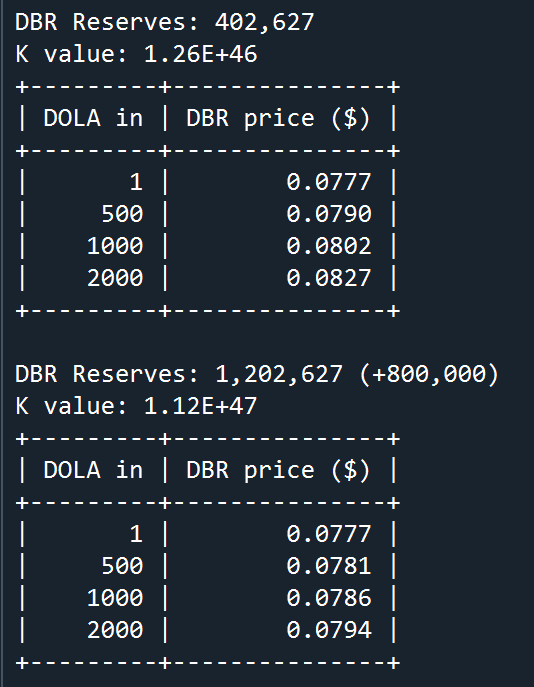
Net effect: arbitrageurs clear more DBR per transaction at spreads much closer to the spot market, so (a) gas cost per $1000 arb falls, and (b) sDOLA APY nudges higher because the reserve empties more slowly.
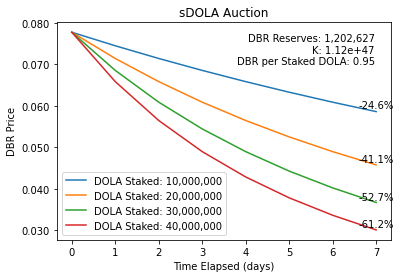
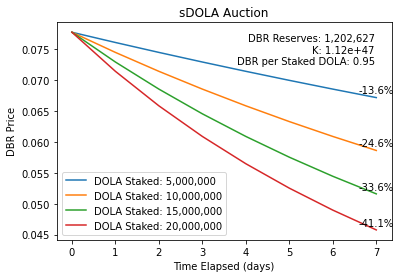
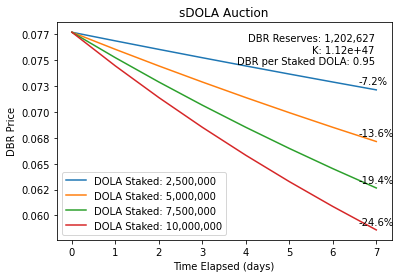
When increasing the depth of the auction, there are 2 main considerations:
* The time taken for the auction price to catch up to the market price after a large price decrease
* The auction price fall speed if sDOLA’s TVL falls significantly from today
The downside of having an auction that is too deep, is the yield of sDOLA being more volatile, which potentially, for some weeks to be extremely low if either of the above happens. It is easier for the DAO to deepen the auction than it is to reduce the depth, as doing this requires many DBRs being sold on the market as K ramps down.
Please see the following graphs demonstrating the rate of price decrease of the auction under the new parameters:
## Conclusion
By doubling the DSA reward ceiling and modestly deepening the sDOLA auction, we lift APY, preserve market-leading yield, and give the protocol room to grow. The trade-off is a temporary, controlled squeeze on DAO profit today for a larger, more sustainable revenue base tomorrow.
—
## On Chain Actions
* setMaxYearlyRewardBudget to 60m
* setTargetK to 1.12E+47
setBorrowController(address)# [7/7] Update to Pectra-Compliant FiRM Borrow Controller
Forum Link: https://forum.inverse.finance/t/update-to-pectra-compliant-firm-borrow-controller/547
### Summary
This proposal seeks to update the FiRM Borrow Controller across all active markets to a newly-deployed, Pectra-compliant version, addressing security risks introduced by [EIP-7702](https://github.com/ethereum/EIPs/blob/master/EIPS/eip-7702.md#self-sponsoring-allowing-txorigin-to-set-code). The upgrade ensures continued protection against flash loan exploits, reentrancy, and atomic transaction manipulations, while maintaining all previously implemented risk controls such as the rolling 24-hour borrow limit and daily borrow caps.
### Background
The borrow controller in FiRM plays a crucial role in risk management, ensuring that borrowing transactions comply with security measures such as:
* **Minimum Debt Amount**: Protecting the protocol from griefing by enforcing a minimum market debt allowed to be carried per user.
* **Smart Contract Verification**: Restricting borrowing from unauthorized smart contracts to mitigate risk.
* **Rolling 24-Hour Borrow Limit**: Preventing exploitative behaviors related to fixed-time resets.
* **Staleness Threshold**: Addressing stale oracle data exploits by preventing borrowing when price feeds have not updated within a governance-defined timeframe.
However, with the first phase of the Pectra hard fork scheduled for mid-March 2025, [Ethereum's EIP-7702](https://mixbytes.io/blog/the-prague-electra-pectra-hardfork-explained) introduces the ability for EOAs (externally owned accounts) to delegate execution to smart contracts, effectively bypassing FiRM’s existing protections against flash loans and reentrancy attacks.
To mitigate these risks, the new borrow controller enforces a stricter validation, combining `tx.origin == msg.sender` with `msg.sender.code.length == 0` to ensure that the caller is not a delegated smart contract. In doing so, it ensures full compatibility with the Pectra hard fork, maintaining security without sacrificing user experience.
The new borrow controller has been rigorously tested on the Prague EVM and reviewed by 3rd parties, both of which confirm it correctly blocks unauthorized delegated transactions while maintaining expected protocol functionality.
### Implementation Plan
This proposal will standardize the borrow controller across all active markets, eliminating existing discrepancies and bringing the rolling 24-hour borrow limit to all markets. All previously whitelisted addresses as well as market-specific daily borrow limits, staleness thresholds, and min debts will need to be set. As such with 33 live markets, this will require over 100 on-chain actions. As each proposal is limited to 20 on-chain actions, this will be spread out across 7 proposals.
This is Proposal # 7 of 7 and will apply to the following...
### On-Chain Actions
1. Set the Borrow Controller and Inherit All Existing Borrow Parameters for the following FiRM Markets:
-yv-crvUSD/DOLA, COMP, deUSD/DOLA, sUSDS/DOLA, sUSDe/DOLA
# Proposal to Add DOLA/deUSD Yearn LP Market to FiRM
Forum Link: https://forum.inverse.finance/t/proposal-to-add-dola-deusd-yearn-lp-market-to-firm/535
### Summary
This proposal aims to integrate the DOLA/deUSD Liquidity Pool Token (LPT) from Curve Finance as a collateral option on FiRM, Inverse Finance’s fixed-rate lending protocol. The DOLA/deUSD LP offers unique advantages due to its stable composition and points or “potions” program, providing a unique opportunity for capital efficient lending by offering stable liquidity positions that include DOLA as collateral. We plan to deploy two distinct markets; one that adheres to the convex strategy and a market which, utilizing the same underlying LPT, aligns with Yearn’s autocompound strategy. This proposal pertains to the Yearn-aligned deUSD/DOLA LP market on FiRM.
### Background
deUSD is a yield-bearing, ETH-hedged stablecoin developed by Elixir Labs, partially backed by stETH and T-Bills through MakerDAO’s USDS. Its delta-neutral design and Over Collateralization Fund (OCF) seek to maintain a robust $1 peg even in adverse funding conditions. When paired with DOLA in a Yearn vault, the resulting LP benefits from both incentives and Yearn’s auto-compounding strategies, delivering a low-volatility, yield-bearing position.
By leveraging the DOLA/deUSD LP as collateral, FiRM offers its users the opportunity to capitalize on stable liquidity positions while bolstering our ecosystem’s efficiency and DOLA liquidity depth. Providing stable liquidity positions that include DOLA as collateral allows for cost-efficient lending on behalf of Inverse Finance. Typically, borrowers sell DOLA to buy other assets, impacting DOLA liquidity. Conversely, a borrower collateralizing with a DOLA LP position is likely to add the other stablecoin/s to the liquidity pool initially to obtain the LPT. They may then loop the borrowed DOLA into the LP position repeatedly to increase their reward, benefiting DOLA liquidity as it does not remove other stablecoins. This results in a 150% improvement in lending capital efficiency, as only 1 DOLA needs to be contracted by our AMM Feds for each DOLA added to the liquidity position, compared to 2.5 DOLAs for each DOLA sold.
### Risk Assessment
[Complete Risk Assessment – deUSD Collaterals on FiRM](https://docs.google.com/document/d/1M0kYgqUwRPkX4AZsYmdiCOwhcqr9hCEdThX5JT8g4Is/edit?usp=sharing)
Key points from the assessment include:
1. **Governance**: Elixir Labs currently manages deUSD minting under a delegated proof-of-stake (DPoS) framework. While the protocol aims for decentralized governance by transitioning upgrade controls and treasury parameters to ELX token holders, whitelisted “authorized participants” currently retain exclusive mint/redeem permissions. Until permissionless minting is fully implemented, governance decisions rest partly with Elixir Labs’ multisig structures, meaning users must trust the team’s operational integrity and future roadmap commitments.
2. **Security**: Elixir’s main deUSD and staking (sdeUSD) contracts have been audited by Trail of Bits and Quantstamp, with no significant unresolved issues. Nevertheless, partial reliance on off-exchange storage (OES) for hedging activities introduce potential attack vectors. Ongoing Immunefi bug bounty programs aim to reinforce the protocol’s security, but users should remain aware of custodial dependencies.
3. **Regulatory Risks**: As a synthetic stablecoin mixing delta-neutral crypto strategies and T-Bill–backed collateral, deUSD may face scrutiny in jurisdictions regulating stablecoins or asset tokenization. Additionally, the reliance on off-exchange custodians (e.g., Fireblocks) introduces potential compliance obligations that could evolve rapidly. Regulatory actions targeting stablecoin issuance, derivatives trading, or RWA tokenization could impede deUSD’s minting/redemption processes or hamper cross-border liquidity.
4. **Collateral & Liquidity**: deUSD’s on-chain liquidity is primarily sourced from Curve pools and partnerships (e.g., DOLA–deUSD LP), but large positions often rely on off-chain whitelisting to mint or redeem without slippage. Sufficient market depth and transparent OCF metrics are critical to maintaining stable liquidity profiles.
5. **Competitive Edge**: deUSD distinguishes itself through its blend of delta-neutral crypto yields and real-world T-Bill integration, offering an alternative to purely crypto-backed stablecoins. Securitize-based RWAs (e.g., BlackRock BUIDL) bring further institutional exposure.
6. **Oracle & Price Feeds**: FiRM will implement a pessimistic LP token oracle for accurate valuation of the DOLA/deUSD LP. This process uses Chainlink price feeds for deUSD and the virtual price from the Curve pool’s smart contract and ensures a conservative and reliable estimate of the LP token's USD value. Real-time monitoring will further support price accuracy and integrity.
7. **Liquidation Mechanisms**: The liquidation factor and incentive are optimized to encourage active liquidator participation. Arbitrage opportunities with other DOLA or deUSD LPs will ensure that large liquidations do not lead to a liquidation cascade. The liquidation process will pull vault tokens, convert them to LP tokens, and then allow liquidators to realize value through balanced withdrawals, ensuring efficient liquidation routes.
Continuous monitoring of the DOLA/deUSD LP’s performance, yields, and liquidity conditions will be maintained by the RWG. Should any material changes or newly identified risks emerge, parameter adjustments or additional mitigations will be proposed via governance.
### On-Chain Actions
1. Add DOLA/deUSD LP Yearn Market to DBR Contract
2. Set borrowController of Market to FiRM BorrowController
3. Set Market Supply Ceiling to 10,000,000 DOLA
4. Set Daily Limit in BorrowController to 2,000,000 DOLA
5. Set Collateral Factor to 90%
6. Set Liquidation Factor to 100%
7. Set Liquidation Incentive to 5%
8. Approve DOLA/deUSD LP Yearn Market on the DBR Helper
9. Set Minimum Debt Amount in BorrowController to 3,000 DOLA
10. Set stalenessThreshold for DOLA/deUSD Yearn LP market to 86460 (24 hours)
11. Set FiRM Oracle Price Feed for DOLA/deUSD Yearn LP to the deployed custom tokenPriceFeed contract
12. Add DOLA/deUSD LP Yearn Market to ALE
13. Add DOLA/deUSD LP Yearn Market to CurveDolaLPHelper
# Update the INV Price Feed
# Update the INV Price Feed
Forum Post: https://forum.inverse.finance/t/update-the-inv-price-feed/531
## Background
The INV price feed, utilized on FiRM and Frontier, has been driven by the Curve EMA feed from the [TricryptoINV pool](https://curve.fi/#/ethereum/pools/factory-tricrypto-3/deposit), a Curve pool with INV<>WETH<>USDC.
## Objective
The Treasury Working Group (TWG) proposes transitioning the INV price feed to a new Curve [twocrypto-ng](https://docs.curve.fi/cryptoswap-exchange/twocrypto-ng/overview/) pool (I[NV<>WETH](https://curve.fi/#/ethereum/pools/factory-twocrypto-101/deposit)). This pool introduces several improvements over the TricryptoINV pool, including enhanced gas efficiency. The exchange_received function eliminates redundant token transfers during swaps, making multi-token swaps through aggregators significantly more cost-effective.
The new price feed is deployed at: [0x54F1E4EB93c5b5F4C12776c96e08a49A9928FE84](https://etherscan.io/address/0x54f1e4eb93c5b5f4c12776c96e08a49a9928fe84#readContract)
## Migration
To ensure a secure and seamless migration, the TWG will carefully manage the transition of INV protocol-owned liquidity (POL) between the TricryptoINV and twocrypto-ng pools.
Key steps include:
* The new pool has already been seeded with $340k TVL, enabling efficient arbitrage to maintain accurate pricing near fair market value.
* Upon approval of this proposal, the TWG will further increase liquidity in the twocrypto-ng pool while maintaining sufficient TVL in the TricryptoINV pool to prevent price manipulation risks.
* After successful execution of the migration, all remaining POL will be moved to the new pool, and the old TricryptoINV pool will be sunset.
## Implementation Notes
The TWG has already secured a [Curve DAO vote](https://gov.curve.fi/t/proposal-to-add-inv-weth-to-the-gauge-controller/10426) to add a gauge for the twocrypto-ng pool, enabling immediate incentivization to attract additional liquidity.
## Conclusion
This transition will enhance the efficiency of INV trading and improve the reliability of the INV price feed, aligning with the DAO's goals of optimizing its infrastructure. The TWG recommends the DAO approve this proposal to ensure a timely and secure migration.
On-Chain Actions
* Set the INV price feed on FiRM oracle to the new INV feed
* Set the INV price feed on Frontier oracle ot the new INV feed
* Set the INV price feed on the sINV exchange rate feed to the new INV feed
* Set the staleness on the borrow controller to 3660
# Update FiRM Borrow Controller for the PT-sUSDe-27MAR25 and LP Markets (1/2)
# Update FiRM Borrow Controller for the PT-sUSDe-27MAR25 and LP Markets
Forum Post: https://forum.inverse.finance/t/update-firm-borrow-controller-for-the-pt-susde-27mar25-and-lp-markets/505
### Summary
This proposal aims to update the borrow controller for the PT-sUSDe-27MAR25 market and DOLA LP markest on FiRM to implement an improved method of handling the daily borrow limit. The changes will introduce a rolling 24-hour limit, replacing the current system, which resets the borrow limit at midnight (00:00 UTC).
### Background
The borrow controller in FiRM serves as a gatekeeper for borrowing transactions, determining if users are permitted to borrow based on the following criteria:
* **Market Daily Borrow Limit**: Verifies that the requested borrow amount does not exceed the remaining daily borrow limit for the market.
* **Smart Contract Verification**: Checks whether the borrowing address is a smart contract and, if so, ensures it is on the whitelist.
The daily borrow limit is a key risk management feature designed to:
* Mitigate potential DAO losses in the event of an exploit
* Limit the financial gain for would-be exploiters
Currently, the daily borrow limit resets entirely at midnight (00:00 UTC), leading to the following drawbacks:
* **Double Borrowing Exploitability**: A borrower can execute a transaction just before midnight and another immediately after, effectively doubling the daily limit in a short period.
* **Non-Linear Competition**: In competitive markets like PT-sUSDe, borrowers who act first after midnight can consume the entire limit, leaving no capacity for others.
To address these issues, we propose shifting to a rolling 24-hour borrow limit. This updated mechanism will replenish borrowing capacity incrementally with each passing second, rather than resetting at a fixed time.
### Implementation
The new borrow controller logic has been rigorously tested and deployed in[ production](https://basescan.org/address/0x9a4b2f3669cc3e415fce39e32bd57bb5dfd64e16) by [Grace protocol](https://github.com/GraceProtocol/grace-protocol/blob/5083e630d60d0ea6b9a28c139d2babb77bcce506/src/BorrowController.sol#L51) for over 6 months. By adapting this proven system for FiRM, we can enhance risk management while maintaining operational consistency. The updated borrow controller has undergone thorough internal and external reviews to ensure its reliability and security.
This proposal focuses initially on the PT-sUSDe-27MAR25 and LP markets, which have the highest demand and urgency for improvement. Once validated, the changes will be incrementally rolled out to the remaining FiRM markets.
### On-Chain Actions
* setBorrowController of the PT-sUSDe-27MAR25 FiRM Market to the new borrow controller
* setBorrowController of the various LP FiRM Markets to the new borrow controller
* Add the new borrow controller as a FiRM minter
* Whitelist the ALE smart contract
* Whitelist user [0x495886947EAce9788360F46be55c758f92Ecd074](https://forum.inverse.finance/t/whitelist-0x4958-multisig-user-on-firm/494)
* Whitelist user [0x496a3Fc15209350487F7136b7c3c163F9204eE70](https://forum.inverse.finance/t/whitelist-safe-multisig-user-on-firm/489)
* Whitelist user [0x0591926d5d3b9cc48ae6efb8db68025ddc3adfa5](https://forum.inverse.finance/t/whitelist-temple-dao-treasury-address-on-firm/481)
* Whitelist DBR helper: [0x0aBb47c564296D34B0F5B068361985f507fe123c](https://forum.inverse.finance/t/proposal-to-whitelist-updated-curvehelper-contract-for-tridbr-lp/316)
* Set the daily borrow limit, minimum debt, and staleness threshold of the various markets to as they are on the old borrow controller
# Treasury Working Group - Season 3
Forum Post: https://forum.inverse.finance/t/treasury-working-group-season-3/502
## 1. Summary
Proposal for Inverse Finance DAO to cover operations of the Treasury Working Group (TWG) in Season 2, running from November 1st to April 30th, 2025.
## 2. TWG @ Inverse Finance
The core responsibility of the TWG is to enable efficient management of the DAO’s treasury funds. Due to the DAO’s on-chain governance system lagging by 5 days (3-day proposal vote time and 2-day timelock if successful), there is a need for the TWG to have direct access to the Treasury, and to act nimbly to deal with general operations as they arise. Such actions involve ongoing management and incentivization strategies for DOLA, as well as leveraging partnerships with partnered protocols to assist in deploying effective liquidity management strategies. On top of this, TWG also supports economic modeling and management accounting to help inform decision-making and strategy across various other working groups.
### 2.1 Season 2 Lookback
The Season 2 period was highly successful for the TWG, with some key metrics achieved:
* $797,844 profit realized to the DAO Treasury via the uitlization of voting power and AMM Feds
* Net 0 INV inflation achieved for all DAO liquidity operations since mid October
* Stablecoin runway maintained, implementing the [new bad debt and runway strategic approach](https://forum.inverse.finance/t/treasury-financial-review-03-2024-snapshot/396/2)
* DOLA stable liquidity TVL reaching an all time high of $210m
* Solidifying DOLA as the 2nd largest stablecoin on Base, only behind USDC, building significant brand equity
* No DOLA depegs (over 3% off 1 USD)
* Not missed incentivization rounds
* Expansion of DOLA partners, working closely with Anzem (USDz) and Overnight (USD+)
### 2.2 TWG Goals
The north star for Season 3 remains the reduction in DOLA bad debt. Significant progress against bad debt was made during season 2, with $1,531,544 of DOLA bad debt repaid since May 2024. The TWG will continue to optimize operations to prioritize further progress against DOLA bad debt. WG goals include:
* Continued management of DOLA, INV and DBR liquidity on DEXs at the highest possible efficiency, allowing debt on FiRM to continue to scale up
* Test new and upcoming venues for liquidity incentivization and accumulating of voting power (such as veNFTs)
* Executing on new liquidity partnerships for DOLA
* Continued and high quality financial and operational management within the DAO
### 2.3 Responsibilities
* Liquidity incentivization/managmeent for all INV pairs (3 currently), DOLA pairs (14 currently), sDOLA pairs (cross-chain), and DBR pairs (1 currently)
* Weekly or biweekly voting of the DAO’s voting power (Curve, Balancer, Bunni, Aerodrome, Velodrome, Thena, and Ramses) towards relevant gauges (either supporting liquidity or profit-seeking)
* Management of revenue from AMM Feds, with over $7.1m during Season 2
* Gas reimbursement for all (approved) DAO-related transactions, including contract deployments and production testing
* Represent the DAO and lead relationships with the various protocols partnered with from a liquidity perspective
* Lead on financially related decisions internally, providing key assistance to the Fed Chair, Policy Committee and more
* Proactively drive and propose new strategic opportunities for the DAO, such as new collaterals on FiRM and new products
* Facilitation of OTC swaps
* Repayment of both DOLA and non-DOLA bad debt
* Management of the Treasury’s assets, such as liquidity positions
### 2.4 Projects
The majority of work done within the TWG is weekly BAU, as well as dealing with ad-hoc incidents and requests as they happen. However, a few planned areas of focus are:
* Complete new strategic approach to Etheruem mainnet DOLA liquidity, luanching and supporting multiple new pools and offboarding current ones
* Continued support (such as incentivizing lenders) of markets that allow for borrowing against sDOLA, with current options on FraxLend and Curve Lend
* Further improvement to the DAO’s stablecoin runway (expressed in # of months), increasing operational resilience and ability to weather market downturns
* Redesign of contributor INV grant project
* Support sDOLA and sINV liquidity on L2s once launched
* Support AWG and PWG to improve transparency of Treasury operations on the Transparency Portal
* Set up on-chain automation bots, with a focus on minimizing ETH gas cost
* Lead the set up of a leverage DBR market, enabling for specualtors to take both leveraged long and short positions on the DBR token
* Set up a derivative market (including seeding liquidity via the TWG) for sDOLA, giving users the ability to fix the yield, such as via Spectra Finace or Pendle
### 2.5 Success Metrics
While many of the success metrics are heavily influenced heavily by factors external to the TWG, broadly, success can be measured by:
* Keep the DAO’s stablecoin runway above 12 months ([current runway is 14.8 months](https://forum.inverse.finance/t/treasury-financial-review-10-2024-snapshot/501))
* Keep DOLA in the top 5 stablecoins on Base (currently ranked #2, behind USDC, via [DefiLlama](https://defillama.com/stablecoins/Base)) via utilizatioin of the TWG grown veAERO position (current market value of AERO locked within: ~$12m)
* Number of weeks of large depeg (3%+) from 1 USD of DOLA stablecoin: Less than 4
* Number of missed bribes or votes in the weekly or biweekly epochs: Target is 0
* Cost per DOLA in circulating supply: Have it less than the current DBR price for the majority of the season
* At least $1m in DOLA bad debt repaid
### 2.6 Decision-making Power
* Approved access to the DAO Treasury in order to carry out the roles listed above
* fundingCommittee role on the DOLA payroll contract: gives power to add or remove recipients on the contract. This has only been used a few times historically: when a contributor quit (recipient removed), when a contributor wanted to change the address they received DOLA payroll to (recipient removed and new recipient added), and a couple of recipients removed who could not be fit onto [proposal 80](https://www.inverse.finance/governance/proposals/mills/80) due to action limit
### 2.7 SecOps Responsibilities
* Financial analysis and input to help inform spending decisions related to SecOps (audits, bug bounty etc)
## Budget
The TWG seeks to operate as lean and efficient as possible, as demonstrated by utilizing 0 of the flexible budget approved in Season 2.
### 1. Contributors
No contributor compensation changes are requested within the TWG.
|Name|FTE|Band|Pro-rata Monthly Salary|Total for Season 3|
| --- | --- | --- | --- | --- |
|cryptoharry|1.0|A|14,500|87,000|
cryptoharry [WGL]
Cryptoharry is a longstanding user and contributor at Inverse Finance DAO, with first contributions dating back to [September 2021](https://discord.com/channels/790157548845924352/790157548845924359/892065600770281523). After identifying pressing needs relating to both treasury and liquidity management within the DAO, cryptoharry spearheaded the creation of the Treasury Working Group in [March 2022](https://www.inverse.finance/governance/proposals/mills/10). Under his guidance and leadership, the DAO Treasury has increased its USD-denominated value 800% (Feb 2022 - November 2024), whilst managing over $9.1m in bad debt (DOLA and non-DOLA) repaid. Beyond leading the TWG, cryptoharry’s expertise is utilized in many other areas of the DAO.
### 2. Ad hoc & Tooling
600 DOLA budget requested for the set up and maintenance of on-chain automation solutions, such as bots for updating oracles, updating the exchange rates for sINV and sDOLA cross-chain, and other general DAO requirements.
This allowance will not be requested on-chain in this proposal given the already very large DOLA allowance for Treasury management.
### 3. Flexible Budget
None requested.
### 4. Summary
In summary, the TWG requests the following budget for the 6 months of Season 3:
||S3 DOLA Allowance|S3 INV Allowance|
| --- | --- | --- |
|Contributor Payroll|87,000|0|
|Ad Hoc & Tooling|600|0|
|Flexible Budget|0|0|
|Total|87,600|0|
# Proposal to add PT-sUSDe-MAR272025 Market to FiRM
Forum Link: https://forum.inverse.finance/t/proposal-to-add-pt-susde-mar272025-market-to-firm/483
## Summary
This proposal seeks to integrate the PT-sUSDe-MAR272025 token as a collateral asset on FiRM, Inverse Finance's fixed-rate lending protocol. PT-sUSDe-MAR272025 is a Principal Token representing the right to receive 1 USDe upon maturity on March 27, 2025. By adding this asset to FiRM, we aim to enhance the platform's offerings, attract sophisticated users, and capitalize on the fixed-yield opportunities presented by Pendle Finance's yield tokenization mechanisms.
## Background
Pendle Finance provides a platform for tokenizing yield-bearing assets through standardized wrappers called Standardized Yield (SY) tokens, adhering to EIP-5115. These SY tokens represent yield-bearing tokens in a standardized ERC-20 format, allowing users to deposit and redeem various supported tokens while ensuring a 1:1 backing with the underlying yield-bearing assets. Pendle enables the splitting of SY tokens into two separate components:
* Principal Token (PT): Representing the right to reclaim the principal amount of the underlying asset at maturity.
* Yield Token (YT): Entitling holders to the yield generated by the principal up to a specified expiry date.
PTs and YTs are minted and burned together before expiry, ensuring that for every PT, there is a corresponding YT. After the expiry date, yield accrual stops, and PTs and YTs can be redeemed independently. This system allows users to trade and speculate on future yields or lock in fixed interest rates.
Integrating PT-sUSDe-MAR272025 as collateral aims to leverage the fixed-yield opportunity provided by Pendle Finance and the fixed-rate borrowing capabilities of FiRM. This integration is particularly attractive for strategies like the carry trade, where users can lock in yield differentials between borrowing and lending rates. The sUSDe PT token offers a fixed yield due to its nature as a zero-coupon bond maturing at par value. FiRM's fixed-rate lending complements this by allowing users to lock in borrowing costs, making it ideal for carry trade strategies. Additionally, the sUSDe PT token inherently prices in Pendle's 30x sats multiplier providing an even more attractive proposition for users seeking higher yields.
## Risk Assessment
[Complete Risk Assessment - sUSDe PT Collateral on FiRM](https://docs.google.com/document/d/15fpdoJSHqZQGnHy_-85_VaC70Mbeu7o9k2YqRfrQQys/edit?usp=sharing)
The RWG conducted a risk assessment (linked above) which explored the integration of sUSDe PTs as collateral on FiRM. This assessment combines both quantitative and qualitative analysis, covering governance, security, liquidity, and competitive factors, and considering the unique characteristics of Pendle PTs, USDe, and the broader market context. These are summarized below:
* **Security**: Pendle Finance has undergone multiple security audits by reputable firms such as ChainSecurity and Spearbit in 2024, with identified issues promptly addressed and resolved. Recent audits uncovered high and medium severity issues, all of which have been patched. Pendle operates an active bug bounty program on Immunefi with rewards up to $250,000, emphasizing their commitment to security. Additionally, PT contracts are immutable with no owner, reducing the risk of unauthorized modifications and enhancing the overall security posture.
* **Regulatory Risks**: Regulatory risks stem from potential actions targeting stablecoins like USDe, which could impact its stability and operations. Ethena's ability to blacklist addresses under specific legal circumstances introduces compliance mechanisms but may raise concerns about decentralization and user autonomy. Changes in regulatory frameworks or enforcement actions could affect USDe's peg to the US dollar, influencing the collateral's reliability and potentially impacting the value and usability of sUSDe PT tokens within the protocol.
* **Collateral & Liquidity**: PT-sUSDe-27MAR2025 has substantial liquidity, with over $60MM in TVL on Pendle's AMM and significant sUSDe liquidity across various pools totaling over $46MM. Liquidity is supported through underlying yield from sUSDe, PT yield from appreciation towards par value at maturity, and Pendle LP incentives.
* **Competitive Edge**: Integrating PT-sUSDe-MAR272025 as collateral on FiRM offers several competitive advantages. By offering competitive borrowing terms and fixed rates, FiRM can attract sophisticated users executing carry trade strategies. The fixed-rate lending capabilities of FiRM complement the fixed-yield nature of the PT token, providing a compelling proposition for users seeking predictable returns.
* **Oracle and Price Feed**: The proposed oracle mechanism utilizes a $1 fixed-price feed for PT-sUSDe-27MAR2025, simplifying reasoning about collateral factors and reducing complexity. A guardian-controlled oracle switch behind an 18-hour timelock will handle extreme market conditions, allowing the protocol to respond to events like a USDe depeg by switching to a live price feed. However unlikely the event of USDe depeg, the FiRM sUSDe PT market will remain agile with the ability to override the markets collateral price feed with the following options: Primary - $1 Hardcoded (Expected integration for the full vesting of the sUSDe PT); Pre-Maturity - sUSDe Chainlink USD feed divided USDe:sUSDe exchange rate (Emergency price feed solution with 18 hour time lock for critical Ethena failure); Maturity - USDe Chainlink USD feed (After Maturity price feed for 1:1 value of sUSDe PT and USDe). The Policy multisig is proposed to act as the oracle guardian, following procedures to safeguard the protocol and its users by activating the backup feed when predefined conditions are met.
* **Liquidations**: Liquidating PT-sUSDe-27MAR2025 collateral presents challenges due to limited liquidity and the exotic nature of PTs. Liquidators can utilize Pendle's AMM to trade PTs but may face price slippage and market impact, especially when disposing of large amounts. To mitigate these issues, liquidators might hold PTs until maturity to redeem at full value, liquidate incrementally to minimize market disruption, or engage institutional buyers who have a vested interest in acquiring PTs and may offer better liquidity options, ensuring efficient and effective liquidation processes. The liquidation incentive is set at 5% to compensate liquidators for the costs and risks associated with seizing and selling the PT collateral.
#### FiRM Fed Supply Ceiling
In order to accommodate the additional DOLA expansions to the new market, the global supply ceiling on the FiRM Fed will be increased to 120m from 100m.
## On-Chain Actions
To implement this proposal, the following on-chain actions are required:
* Add PT-sUSDe-MAR272025 Market to DBR contract
* Set borrowController of Market to FiRM BorrowController
* Set market supply ceiling to 20,000,000 DOLA
* Set daily limit in BorrowController to 2,000,000 DOLA
* Set Collateral Factor to 87%
* Set Liquidation Factor to 100%
* Set Liquidation Incentive to 5%
* Approve PT-sUSDe-MAR272025 market on the DBR Helper
* Set Minimum Debt Amount in BorrowController to 3,000 DOLA
* Set stalenessThreshold for PT-sUSDe-MAR272025 market to 86460
* Set FiRM Oracle price feed for PT-sUSDe-MAR272025 to the deployed FeedSwitch
* Set supply ceiling on the FiRM Fed to 120,000,000 DOLA
# 2024 Q3 TWG Allowance Refresh
# 2024 Q3 TWG Allowance Refresh
Forum Post: https://forum.inverse.finance/t/2024-q3-twg-allowance-refresh/435
## Summary
The Treasury Working Group (TWG) at Inverse Finance seeks to refresh its various allowances for Q3 2024 to continue effective liquidity incentivization management and facilitate strategic management of the DAO Treasury.
## Background
The TWG has been instrumental in maintaining robust liquidity for DOLA, sDOLA, INV, and DBR, which is crucial for the stability and growth of Inverse Finance. Our strategies have successfully managed liquidity across multiple chains and protocols, contributing to the continued adoption and success of FiRM, our fixed-rate lending protocol. Challenges such as DOLA bad debt continue to necessitate careful and strategic liquidity management. Since [proposal #166](https://www.inverse.finance/governance/proposals/mills/166), the latest TWG allowance refreshes, the DAO has repaid 1.14m DOLA bad debt.
## Liquidity Management
As of Q3 2024, DOLA continues to exhibit a [close (soft) peg and deep liquidity](https://www.inverse.finance/transparency/liquidity), thanks to our active liquidity management strategies. Ongoing incentivization to liquidity providers is required to sustain and enhance this. The INV token plays a pivotal role in these operations, not only for DOLA but also for other strategic assets within our ecosystem, including DBR.
### Success in Reducing INV Spend
Throughout 2024, the efficiency of incentivization spending per DOLA in circulation has dramatically improved. This is measured by comparing the net INV spend from the Treasury each epoch against the circulating supply of DOLA. Improvements have been driven by various factors managed via the TWG, including:
* Growth in treasury balance sheet assets that provide liquidity incentives (such as veNFTs)
* Reducing the APR that liquidity providers are willing to accept to provide liquidity
* Using revenues from AMM Feds to subsidize future incentives (rather than realizing them as profit to the Treasury)
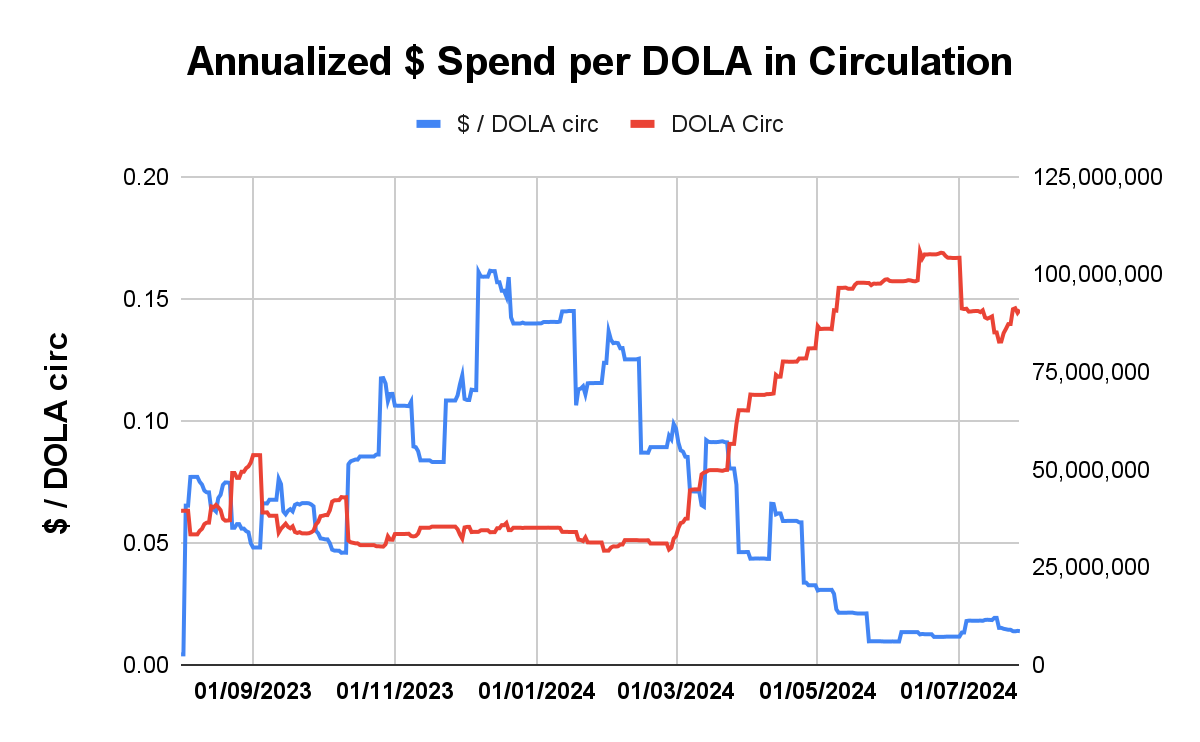
The chart above shows data for the net treasury spend per DOLA in circulation and DOLA circulating supply over the past year. Towards the end of 2023, DOLA suffered increased downward volatility, leading to a far worsened cost to incentivize liquidity among the pools. With focused incentives targeting ecosystems that both achieved higher than market vote incentive efficiency and scale, from 2024, the cost per DOLA in circulation was continually reduced. At the start of March, DOLA started achieving upward pressure on the peg, allowing AMM Feds to start rapidly expanding the supply. This was largely triggered by the extremely large price appreciation of AERO, where the TWG had been building a large veAERO position, and so was able to take full advantage. In the present day, the DAO maintains significant AMM Fed liquidity over various ecosystems, given the large DOLA circulating supply; this, along with the DAO’s large portfolio of emission-controlling tokens and NFTs is allowing for significant subsidization of DOLA liquidity incentives.
This has led to a significant reduction in INV inflation, which allowed the [2024 Q1 INV mint](https://www.inverse.finance/governance/proposals/mills/168) to last far beyond the year's first quarter.
## Utilizing sDOLA
With a growing stablecoin balance held in the Treasury, the TWG utilizes a portion by providing liquidity to DOLA pools (and farming the rewards). Currently, large amounts of DOLA (1.13 million) sit idle in the Treasury. The TWG seeks authorization to deploy idle DOLA into sDOLA, held in the DAO Treasury. This acts as a partial revenue share of the FiRM protocol to the DAO Treasury, allowing for the growth of stablecoin reserves, which can be utilized for operational expenses (opex), capital expenditures (capex), and bad debt repayments. The TWG will likely deploy Treasury DOLA into sDOLA when DBR policy is not contractionary (deflationary). The TWG will actively manage the Treasury's DOLA balance to ensure sufficient liquidity is available for short-term financial commitments.
Additionally, this should increase DOLA within sDOLA significantly, allowing for additional depth to be added to the sDOLA Auction in a subsequent proposal that will allow it to be profitably arbed with less of a spread to the market price of DBR.
## Proposal Ask for TWG Allowance Refresh
Given the ongoing needs and strategies outlined above, the TWG Proposes the following allowances to be granted:
* Refresh the INV allowance to 22,000, ensuring uninterrupted liquidity management as well as facilitation of smaller OTC swaps
* Provide sDOLA allowance of 4,000,000, allowing for constant management of sDOLA held within the Treasury (meaning it can be frequently pulled in and out)
* Refresh DOLA allowance to 4,000,000
* Refresh CRV allowance to 10,000,000, allowing access to AMM Fed rewards, utilized primarily for liquidity incentivization
* Refresh CVX allowance to 500,000
* Refresh Aura allowance to 1,000,000
* Refresh BAL allowance to 500,000
Additionally, as part of the [S2 initiation proposal](https://www.inverse.finance/governance/proposals/mills/182), the on-chain action to provide the payroll contract with a DOLA allowance of 800,000 was missed. This action will be added to this proposal to ensure that DOLA payroll can continue uninterrupted throughout the season.
## Use of Allowances
* INV is primarily used for liquidity incentives, however, on occasion will be used to add to AMM liquidity pools (forming POL), or facilitate smaller-sized OTC swaps (using all the proceeds to repay DOLA bad debt)
* sDOLA allowance will be used to pull and unwrap sDOLA into DOLA and return to the DAO Treasury when it is needed (WG OpEx and repaying DOLA bad debt), but may also be pulled to deposit into sDOLA liquidity strategies (such as sDOLA/DOLA). The 4m request is large and round, this is due to the unpredictable nature of the management, with large allowances quickly being depleted on every action
* DOLA’s allowance is to allow three actions: adding DOLA into a yield strategy (such as DOLA/FraxPyusd) to either earn a return for the DAO or seed an initial position, to wrap into sDOLA, and to repay DOLA bad debt. The 4m request is large and round to allow uninterrupted management of the Treasury’s DOLA balance over the coming months.
* CRV’s allowance allows the TWG to pull CRV from the Treasury, earned by the DOLA/FraxPyusd Fed and the Convex Fed (DOLA/FraxBP). This CRV is primarily used to recycle rounds into additional liquidity incentives but may also be sold to DOLA to realize profit to the Treasury or locked into sdCRV. The TWG is considering increasing the DAO’s sdCRV position (currently 542,860 sdCRV) to increase the DAO’s voting power in the curve ecosystem (permanently reducing the need for INV spend). The 10m allowance is large and round, and will likely last longer than Q3; this is to avoid full depletion of the allowance too soon, potentially disrupting the DAO’s liquidity incentivization strategy
* The CVX allowance is primarily used for vote incentives, but the TWG continues to monitor the utility of locking to vlCVX
* The BAL allowance is primarily used for vote incentives but may be locked to sdBAL. Whilst no near-term plans for using this BAL to lock to sdBAL, the TWG is monitoring the development of Balancer V3 in case it presents more opportunity with an increased vote weight
* The AURA allowance is used primarily for vote incentives. The DAO controls 106k vlAURA, and there are currently no intentions to increase this.
# Treasury Working Group - S2 Proposal
# Treasury Working Group - Season 2 Proposal
Forum Post: https://forum.inverse.finance/t/treasury-working-group-s2-proposal/413
# 1. Summary
Proposal for Inverse Finance DAO to cover operations of the Treasury Working Group (TWG) in Season 2, running from May 1st to November 31st, 2024.
# 2. TWG @ Inverse Finance
The core responsibility of the TWG is to enable efficient management of the DAO’s treasury funds. Due to the DAO’s on-chain governance system lagging by 5 days (3-day proposal vote time and 2-day timelock if successful), there is a need for the TWG to have direct access to the Treasury, and to act nimbly to deal with general operations as they arise. Such actions involve ongoing management, incentivization, and bribing strategies for DOLA, as well as leveraging partnerships with partnered protocols to assist in deploying effective liquidity management strategies. On top of this, TWG also supports economic modeling and management accounting to help inform decision-making and strategy across various other working groups.
### 2.1 TWG Goals
The north star for Season 2 remains the reduction in DOLA bad debt. Significant progress against bad debt was made during season 1, with $1,782,130 of DOLA bad debt repaid since October 2023. The TWG will continue to optimize operations to prioritize further progress against DOLA bad debt. WG goals include:
* Continued management of DOLA, INV and DBR liquidity on DEXs at the highest possible efficiency, allowing debt on FiRM to continue to scale up
* Test new and upcoming venues for liquidity incentivization and accumulating of voting power (such as veNFTs)
* Executing on new liquidity partnerships for DOLA
* Continued and high quality financial and operational management within the DAO
### 2.2 Responsibilities
* Liquidity incentivization for all INV pairs (2 currently), DOLA pairs (14 currently), sDOLA pairs (2 currently), and DBR pairs (1 currently)
* Weekly or biweekly voting of the DAO’s voting power (Curve, Balancer, Bunni, Aerodrome, Velodrome, Thena, and Ramses) towards relevant gauges (either supporting liquidity or profit-seeking)
* Management of revenue from AMM Feds, with over $4.4m during Season 1
* Gas reimbursement for all (approved) DAO-related transactions, including contract deployments and production testing
* Represent the DAO and lead relationships with the various protocols partnered with from a liquidity perspective
* Lead on financially related decisions internally, providing key assistance to the Fed Chair, Policy Committee and more
* Proactively drive and propose new strategic opportunities for the DAO, such as new collaterals on FiRM and new products
* Facilitation of OTC swaps
* Repayment of both DOLA and non-DOLA bad debt
* Management of the Treasury’s assets, such as liquidity positions
### 2.3 Projects
The majority of work done within the TWG is weekly BAU, as well as dealing with ad-hoc incidents and requests as they happen. However, a few planned areas of focus are:
* Management of liquidity for sDOLA on new chains, as well as creation of new organic demand for sDOLA (without the DAO needing to pay any additional excess on top of the the intrinsic DBR yield via DSA)
* Expand DOLAs presence via liquidity on new L2s
* Enable borrowing against sDOLA (and potentially DBR) as collateral on lending protocols such as Curve’s Llama Lend
* Increase the operational resilience of the DAO via strengthening the stablecoin runway (expressed in # of months)
* Further the redesign of Contributor INV grants
* Scale use and liquidity for sINV once launched
* Work with AWG and PWG to improve live reporting of Treasury operations on the Transparency portal
### 2.4 Success Metrics
While many of the success metrics are heavily influenced heavily by factors external to the TWG, broadly, success can be measured by:
* Keep the DAO’s stablecoin runway above 12 months ([12.0 months of stablecoin runway achieved by the end of March 2024](https://forum.inverse.finance/t/treasury-financial-review-03-2024-snapshot/396))
* Keep DOLA in the top 5 stablecoins on Base (currently ranked #2, behind USDC, via [DefiLlama](https://defillama.com/stablecoins/Base)), and grow DOLA into a top 5 stablecoin on Optimism (currently ranked #8 via [Defillama](https://defillama.com/stablecoins/Optimism))
* Number of weeks of large depeg (3%+) from 1 USD of DOLA stablecoin: Less than 4
* Number of missed bribes or votes in the weekly or biweekly epochs: Target is 0
* Cost per DOLA in circulating supply: Have it less than the current DBR price for the majority of the season
### 2.5 Decision-making Power
* Approved access to the DAO Treasury in order to carry out the roles listed above
* fundingCommittee role on the DOLA payroll contract: gives power to add or remove recipients on the contract. This has only been used a few times historically: when a contributor quit (recipient removed), when a contributor wanted to change the address they received DOLA payroll to (recipient removed and new recipient added), and a couple of recipients removed who could not be fit onto [proposal 80](https://www.inverse.finance/governance/proposals/mills/80) due to action limit
### 2.6 SecOps Responsibilities
* Financial analysis to help inform spending decisions related to SecOps (audits, bug bounty etc)
# 3. Budget
The TWG seeks to operate as lean and efficient as possible, as demonstrated by utilizing 0 of the flexible budget approved in Season 1.
### 3.1 Contributors
No contributor compensation changes are requested within the TWG.
|Name|FTE|Band|Pro-rata Monthly Salary|Total for Season 2|
| --- | --- | --- | --- | --- |
|cryptoharry|1.0|A|14,500|87,000|
cryptoharry [WGL]
Cryptoharry is a longstanding user and contributor at Inverse Finance DAO, with first contributions dating back to [September 2021](https://discord.com/channels/790157548845924352/790157548845924359/892065600770281523). After identifying pressing needs relating to both treasury and liquidity management within the DAO, cryptoharry spearheaded the creation of the Treasury Working Group in [March 2022](https://www.inverse.finance/governance/proposals/mills/10). Under his guidance and leadership, the DAO Treasury has increased its USD-denominated value 1,128% (Feb 2022 - March 2024), whilst managing over $7.3m in bad debt (DOLA and non-DOLA) repaid. Beyond leading the TWG, cryptoharry’s expertise is utilized in practically all other areas of the DAO.
### 3.2 Ad hoc & Tooling
None requested.
### 3.3 Flexible Budget
None requested.
### 3.4 Summary
In summary, the TWG requests the following budget for the 6 months of Season 2:
||S2 DOLA Allowance|S2 INV Allowance|
| --- | --- | --- |
|Contributor Payroll|87,000|0|
|Ad Hoc & Tooling|0|0|
|Flexible Budget|0|0|
|Total|87,000|0|
# Increase Max Rate on Virtual xy=k DBR Auction
# Increase Max Rate on Virtual xy=k DBR Auction
Forum post: https://forum.inverse.finance/t/increase-max-rate-on-virtual-xy-k-dbr-auction/383
### Summary
This proposal seeks to increase the maximum DBR rate per year that the Fed Chair can set for the virtual xy=k DBR auction. The current maximum is 5m/year, and this proposal seeks to increase this rate to 20m/year.
### Background
The virtual xy=k DBR auction, [launched in January](https://www.inverse.finance/governance/proposals/mills/164), is a contract that continuously sells DBR for DOLA, with the DOLA proceeds being used to pay down DOLA bad debt. Since the auction's first organic sale on Feb 3rd, it has raised over 170k DOLA from DBR sales. As the DBR burn rate on FiRM scales up, it is possible to scale up the issuance of DBR too, which is currently done via the streaming to INV stakers, the sDOLA auction and the virtual xy=k DBR auction.
### Objective
Over the past couple of months, the virtual xy=k DBR auction has proved to be a great success. The current DBR rate per year is at the DAO-set maximum for most of the time, at 5m/year. The current 5m/year rate, based on the current DBR market price, is expected to raise around $1.04m/year. The new proposed maximum of 20m/year would be expected to contribute in excess of $4m/year towards DOLA bad debt repayment if the DBR price stays the same throughout the year. Check out the [transparency portal](https://www.inverse.finance/transparency/bad-debts) for an up-to-date view of progress in repaying bad debt.
We do not expect the Fed Chair to utilize the Max Rate immediately, as debt on FiRM needs to scale further before this is possible. However, as debt on FiRM is currently growing very quickly, with 3.5m growth over the past three weeks, we are proposing this large max rate so the Fed Chair can more easily accommodate larger burn rates.
### Auction Parameter Changes
An analysis is ongoing to optimize the auction parameters while operating with a higher DBR rate. It is likely that the auction depth can be increased to increase the DAO's efficiency (increase the price of DBR sold). Once the analysis has been completed, a subsequent proposal with the adjustments laid out will be put on the forum.
### On-Chain Action
* Set maxDbrRatePerYear to 20m
# Launch DSA and sDOLA
# Launch DSA and sDOLA
Forum Post: https://forum.inverse.finance/t/launch-dsa-and-sdola/361
## Summary
This proposal seeks to introduce and launch the DOLA Savings Account (DSA) and the sDOLA product within the Inverse Finance DAO. The DSA offers an innovative platform for users to stake DOLA stablecoin and earn DBR tokens as yield, enhancing the utility of the DOLA ecosystem. The sDOLA product, built atop DSA, features an auto-compounding mechanism, elevating the value proposition of DOLA for long-term holders.
## Background
The DeFi landscape is rapidly evolving, with an increasing emphasis on stablecoin utility and efficiency; with strong growth in yield-bearing stablecoins such as sDAI, and sFRAX. The DOLA stablecoin, a pivotal element of Inverse Finance DAO’s ecosystem, stands to gain significant utility and liquidity through the introduction of DSA and sDOLA. These products are designed to increase the demand to hold DOLA at significantly better unit economics than is currently possible, providing greater sustainability and stability to the DOLA ecosystem.
## Implementation
### DOLA Savings Account (DSA)
The DSA smart contract allows users to stake their DOLA stablecoin and earn DBR. While the main use of the DSA is expected to be via sDOLA, we anticipate that users who believe DBR is currently underpriced will utilize the DSA, as well as other protocol integrations.
Governance sets a max yearly reward budget in DBR terms, with an operator (the Fed Chair) able to set the yearly budget in DBR terms between 0 and the governance set max. Governance will also set a max DBR per DOLA per year, allowing for the unit economics to be managed. This design allows for the DAO to set the upper limit for yield, whilst allowing the market to find the correct yield at or below this max.
For example, if the yearly budget was set to 5,000,000, and the max DBR per DOLA per year was set to 1:
|DOLA Staked|DBR per DOLA per Year|Yearly DBR Spend Rate|
| --- | --- | --- |
|2,500,000|1.0|2,500,000|
|5,000,000|1.0|5,000,000|
|7,500,000|0.67|5,000,000|
|10,000,000|0.5|5,000,000|
This table demonstrates how the system scales the DBR rewards in response to the amount of DOLA staked, ensuring the annual reward budget is adhered to, while dynamically adjusting the reward rate per DOLA to maintain economic equilibrium.
### sDOLA
sDOLA is a yield-bearing version of the DOLA stablecoin, powered as an auto-compounding ERC-4626 vault of DSA. The auto-compounding is driven by a DBR auction, which is very similar to the [Virtual xy=k DBR Auction](https://www.inverse.finance/dbr/auction) launched earlier [this month in this proposal](https://forum.inverse.finance/t/launch-virtual-xy-k-dbr-auction/359). The auction permissionlessly allows anyone to buy DBR using DOLA, with the price of DBR (per DOLA) continuously reducing every second until a DBR purchase is made at which point the price will increase. As with the virtual xy=k DBR auction, it is expected that MEV bots will be the main driver of the auction, completing arbitrage transactions between it and the [TriDBR pool on Curve](https://curve.fi/#/ethereum/pools/factory-tricrypto-18/swap) as soon as it becomes profitable. sDOLA’s yield is driven entirely by borrowers on FiRM, making the source of yield fully decentralized and auditable.
The main difference between the DBR auction used by sDOLA and the Virtual DBR Auction, is in sDOLA’s case the DBR reserves are not virtual. For sDOLA, the DBR reserves are the sum of the DBR balance within sDOLA and the unclaimed DBR for sDOLA in the DSA. To ensure a functional and responsive auction market, it's vital for the DAO to seed sDOLA with an initial DBR allocation. Without this, the starting price of DBR would be prohibitively high, delaying its alignment with market rates. sDOLA operates on a weekly revenue cycle, resetting every Thursday at 00:00 UTC. The DOLA accumulated from the auction during each cycle is then distributed continuously to sDOLA holders pro-rata in the subsequent cycle.
Beyond offering a mechanism for holding yield-bearing DOLA, sDOLA is poised to play a broader role in DeFi. Its integration is anticipated across various protocols, including as collateral in lending markets and in decentralized AMM liquidity pools, among other applications.
## DOLA Demand and Impact on FiRM
When the DBR reward rate for DOLA in DSA is set at or below 1 per year, it is anticipated that most usage of sDOLA (and by extension, DSA) will be fueled by capital external to FiRM. These users are expected to purchase DOLA from the market and deposit it into sDOLA, rather than using borrowed DOLA from FiRM. Although, certain sDOLA integrations may offer higher yields, making it appealing for FiRM borrowers to participate as well.
This influx of external capital into DOLA, driven by sDOLA's attractive yield opportunities, will positively influence DOLA’s market liquidity and price stability due to the increased demand for holding DOLA. Consequently, this increases the lending capacity on the FiRM. It's projected that there will be a direct correlation between the amount deposited into DSA/sDOLA and the increase in FiRM’s lending capacity, with a minimum ratio of 1:1.
For instance, if sDOLA receives 2 million in deposits, this would likely correspond to 2 million DOLA being purchased in the market. This same amount (2 million DOLA) could then be loaned out through FiRM, potentially leading to an equivalent volume of market sells. However, in scenarios where FiRM borrowers choose to retain their DOLA for activities like yield farming, the lending capacity could be further amplified. In such cases, up to 5 million DOLA could be lent out on FiRM, supported by the initial 2 million sDOLA deposits.
## Impact on Alternative DBR Issuance Methods
The introduction of sDOLA, similar to the Virtual xy=k DBR Auction, will result in the creation and sale of new DBRs in the market. To maintain balance, it’s essential to counterbalance this with a corresponding reduction in DBR issuance to INV stakers. However, this strategy is expected to ultimately lead to an overall increase in DBR distribution available for INV stakers.
For instance, let's consider a scenario where 5 million DOLA is deposited into DSA, earning DBR at a rate of 0.8 per year. This equates to an annual DBR expenditure of 4 million. As a result, the DBR streaming rate to INV stakers would be decreased by this 4 million. Yet, this action is projected to enhance FiRM’s lending capacity by an additional 5 million DOLA. If this capacity is fully utilized, it would lead to an extra 5 million DBR being burnt annually. Assuming this burnt amount is entirely allocated to INV stakers, it would effectively result in a net increase of 1 million DBR per year in the streaming rate to INV stakers.
## sDOLA Seed
To initiate the functioning of sDOLA's auction and enable the distribution of rewards (with APR starting at 0% in the initial revenue epoch), it is essential to seed sDOLA with initial capital. To address this, the Treasury will inject 400,000 DOLA into sDOLA through the Treasury Working Group (TWG). This method is chosen to mitigate potential issues like frontrunning, which can be more significant in ERC4626 vaults with low TVL.
It’s important to note that the Treasury’s contribution to sDOLA, while crucial for initial seeding, does not increase DOLA demand in the same way as external deposits, since the DOLA used is already held in the Treasury and not newly purchased. Therefore, as external capital begins to flow into sDOLA, the TWG will progressively convert the Treasury's initial seed back into DOLA, maintaining the intended dynamics of sDOLA's market interaction.
## Parameter Considerations
#### Max DBR per DOLA per Year (DSA)
The maximum DBR reward rate per DOLA per year is crucial for INV stakers' profitability. A rate below 1 is profitable, a rate of 1 is neutral, and a rate above 1 leads to a loss. Generally, this rate is expected to be at or below 1 for profitability. However, during times of DOLA peg weakness or increased cost per DOLA in circulation (outside sDOLA costs), a temporary higher rate may be set to stimulate sDOLA demand, offering a more cost-effective option than rates in AMM liquidity pools. We propose launching at a max rate of 0.99 DBR per DOLA per year to maximize sDOLA yield which is important at the start, while ensuring profitability for INV stakers.
#### Max DBR per Year Budget
It is important that the DBR budget going to DOLA stakers does not exceed the burn rate on FiRM. This shouldn’t be a problem since additional deposits into sDOLA are expected to increase lending on FiRM, which leads to a burn rate increase; however, if borrowing demand on FiRM drops off while sDOLA demand remains high, it could be possible. We propose to launch with a max DBR per year budget of 10m at the start.
#### Considerations for sDOLA Auction
When setting the target K value and initial DBR seed in the sDOLA auction, it’s essential to strike a balance that optimizes trade execution and minimizes arbitrage profit. This decision is pivotal as it directly influences the auction’s efficiency and functionality. The following considerations are recommended for determining the optimal depth:
* Optimal Trade Execution: The reserves should be sized to facilitate efficient trade execution. This approach aims to align the realized price with the prevailing market rate in the TriDBR pool as closely as possible, maximizing returns for sDOLA holders. When the depth is insufficient, a significant price disparity for profitable arbitrage might arise, especially after a sizable market DBR purchase that rapidly elevates the market price.
* Minimizing Arbitrage Profits: The depth should be calibrated to ensure arbitrage opportunities are limited primarily to covering transaction costs and a nominal profit margin. Overly generous arbitrage opportunities, resulting from excessive depth, could lead to disproportionate profits to arb bots following significant market movements, which are lossy to sDOLA holders.
* Controlled Price Reduction Dynamics: It's essential to carefully monitor and adjust the rate of DBR price reduction in the auction. Too rapid a decrease can create large price differences between the auction and market prices, especially during high network congestion leading to increased gas costs. However, ensuring a minimum of one auction purchase every 7 days is important to avoid periods of zero yield.
#### K Value and DBR Seed
Initially, our focus is on setting the right DBR reserve depth through the DBR seed, with the K value derived from this and the targeted DBR auction price. Our considerations are:
* Ensuring at least one arbitrage auction buy every 7 days.
* Maximizing sDOLA holder profit by increasing auction depth, reducing the spread needed for profitable arbitrage.
* Historical DBR data from the TriDBR pool (20th December - 29th January) was used for backtesting, which reflects the current pool depth.
Our simulations with a $40 gas hurdle and 400k DOLA staked in sDOLA (minimum expected amount due to the Treasury DOLA seed) indicate an optimal initial DBR seed of 50k for launch.
[(See graph/visualization in the forum post)](https://forum.inverse.finance/t/launch-dsa-and-sdola/361)
The 50k DBR seed demonstrates reliability in providing profitable arbitrage auction buys at least every 7 days, even with rapid market DBR price decline (which in the case of Jan 2nd - Jan 18th was the result of an INV sell-off, impacting DBR price via the TriDBR pool which contains INV).
To better understand the effect of auction depth, here is what 100k DBR looks like in the same simulation:
[(See graph/visualization in the forum post)](https://forum.inverse.finance/t/launch-dsa-and-sdola/361)
In this scenario, the auction depth prevents the price from adjusting quickly enough to trigger profitable arbitrage opportunities during price declines, leading to a couple weeks without yield flowing to sDOLA holders.
The initial auction price is set at 0.13 DOLA per DBR, corresponding to a K value of 3.25e+44. This pricing strategy is intended to encourage early auction buys, facilitating immediate yield generation for sDOLA holders. This is what the price chart looks like over 7 days when interrupted (DBR price when using 1 DOLA to purchase with):
[(See graph/visualization in the forum post)](https://forum.inverse.finance/t/launch-dsa-and-sdola/361)
*Data analysis and visualization carried out in python*
#### Need for Adjustments to Auction Depth
During the deep dive analysis into dbrReserve and the K value, it became clear that as sDOLA deposits scale up, auction depth can be increased significantly to achieve much greater yield to sDOLA holders while ensuring buys occurring least every 7 days. Not doing so reduces the efficiency of the auction, reducing APR to sDOLA holders. For example, this is how the launch depth responds to higher levels of DOLA being staked:
[(See graph/visualization in the forum post)](https://forum.inverse.finance/t/launch-dsa-and-sdola/361)
This rapid price decline at a low auction depth risks significant spreads to open up between the auction and market price during periods of higher gas costs.
However, if the depth is increased appropriately then the performance will significantly improve. For example, analysis from the backtest demonstrated that the optimal auction parameters when the there’s ~2m DOLA staked is 400,000e+18 dbrReserve and K value of 1.93e+46:
[(See graph/visualization in the forum post)](https://forum.inverse.finance/t/launch-dsa-and-sdola/361)
#### The Operator Role
Due to this, it is prudent to create an optional operator role for controlling the targetK rather than have it solely be a gov controlled parameter. Adjustments to targetK gradually take effect over 7 days, so also putting this behind a minimum 5-day timelock (governance proposal time) would potentially mean adjustments to improve auction efficiency are already out of date when they take effect (roughly 2 weeks later).
The operator role is currently inactive (assigned to the burn address), but can be activated by governance in a future proposal if deemed necessary. Until then, the DAO will handle any adjustments within on-chain proposals.
## Deployed Contracts
* Dola Savings Account (DSA): [0xE5f24791E273Cb96A1f8E5B67Bc2397F0AD9B8B4](https://etherscan.io/address/0xE5f24791E273Cb96A1f8E5B67Bc2397F0AD9B8B4#code)
* sDOLA: [0xb45ad160634c528Cc3D2926d9807104FA3157305](https://etherscan.io/address/0xb45ad160634c528cc3d2926d9807104fa3157305#code)
* sDOLA Helper: [0x5C1F6a62CC587e135280CbD59520Def551bB3C97](https://etherscan.io/address/0x5c1f6a62cc587e135280cbd59520def551bb3c97#code)
## On-Chain Actions
* Add DSA as a DBR minter
* Set max DBR per DOLA per year to 0.99
* Set max DBR per year budget to 10,000,000
* Send 50,000 DBR to sDOLA
* Approve 400,000 additional DOLA to TWG (current allowance = 2,303,500, so approve 2,703,500
* Approve 405,000 sDOLA to TWG (margin of safety)
# Update INV Market Price Feed
# Proposal to Update the Price Feed Used by FiRM’s INV Market
Forum Post: https://forum.inverse.finance/t/update-inv-market-price-feed/354
## Summary
Update the price feed used by the INV FiRM market.
## Motivation
Update the price feed used by the INV FiRM market, with the new feed including an additional fallback logic and fixing a small bug in the previous implementation of the USD/USDC Chainlink Feed.
## On-Chain Action
* Set feed of the INV market to the newly deployed feed
# Treasury Working Group - Season 1 Proposal
Authors: @cryptoharry
Reviewers: @edo
Forum post: https://forum.inverse.finance/t/treasury-working-group-season-1-proposal/317
1. ## Summary
Proposal for Inverse Finance DAO to cover operations of Treasury Working Group (TWG) in Season 1, running from October 1st, 2023 to March 1st, 2024. .
2. ## TWG @ Inverse Finance
The core responsibility of the TWG is to enable efficient management of the DAO’s treasury funds. With access to the Treasury directly by the DAO’s on-chain governance system lagging by 5 days (3-day proposal vote time and 2-day timelock if successful), there is a need for the TWG to act nimbly to deal with general operations as they arise. Such actions involve the ongoing management, incentivization, and bribing strategies for DOLA, as well as leveraging partnerships with partnered protocols to assist in deploying effective liquidity management strategies. On top of this, TWG also supports economic modelling and management accounting to help inform decision-making and strategy across various other working groups.
2.1 WG Goals
* Continued management of DOLA and INV liquidity on DEXs at the highest possible efficiency, ensuring FiRM is able to scale
* Continued seeking out the most optimal venue to place vote incentives for liquidity, exploring opportunities for OTC/private deals (at better than market rates, or avoiding 3rd party fees)
* New liquidity partnerships for DOLA
* Facilitation of OTC swaps with the INV or DBR token when possible, using all received funds to help retire DOLA bad debt
* General finance and operational management within the DAO (ETH gas reimbursements, etc)
2.2 Responsibilities
* Liquidity incentivization (“bribes”) for each of the 2 INV pairs and 12 DOLA pairs (DOLA pairs constantly growing across many partnered protocols and new L2s) and DBR pairs
* Directing the DAO’s voting power (sdBAL, sdCRV, vlAURA, veTHE, veVELO, veRAM, veCHR, veAERO) towards relevant gauges, either to collect revenue or direct rewards to DOLA or INV liquidity pools
* Management of revenue from AMM Feds
* Gas reimbursements to all DAO-related transactions, including contract deployments and prod testing
* Relationship management and business development with the various protocols we have or intend to partner with
* Direct assistance (modelling, transaction building etc) to the Fed Chair and Policy Committee
* Internal and external financial reporting or assisting other parties with financial reporting of the DAO treasury
* Drive and propose various new strategic opportunities for the DAO to consider (new FiRM collaterals etc)
* Facilitation of OTC transactions and trades
* Repayment of both DOLA and non-DOLA bad debt
* Cross-chain arbitrage for DOLA when significant deviations in price
2.3 Projects
While the majority of TWG’s work is BAU, or dealing with ad-hoc incidents and requests as they happen, a few planned projects to be undertaken are:
* Explore the building out of DOLA liquidity on Polygon’s POS chain via new partnerships
* Explore the various options available to build out DOLA liquidity on Base chain, with a particular focus on strengthening and utilizing existing partnerships
* Help rebuild partnerships on BNB Chain, with an emphasis on growing the DAO’s veTHE voting power
* Scale up DOLA/crvUSD liquidity TVL, strengthening the partnership with Curve, Convex and the community around those protocols
* Progressing projects that will reduce the INV cost per DOLA in circulation: Zero coupon INV bonds, DOLA liquidity positions as FiRM collateral, new or increased partnerships with other stablecoin protocols
2.4 Success Metrics
While many of the success metrics are influenced heavily by factors external to the TWG (DAO votes, general market sentiment, token price), broadly, success can be measured by TWG:
* Bring the DAO’s stablecoin runway back to 12 month or more: current runway has fallen to 9.4 months, with proposed sec-op spending expected to reduce this further to 8.7 months
* Value of DOLA liquidity on Base (highly dependent on incentive efficiency). Target is 5m
* Ranking of DOLA as a top 5 decentralized stablecoin on Base
* Number of weekly epoch of serious depeg from 1 USD of DOLA stablecoin (1 cent or more). Target is 0.
* Number of missed bribes or votes in the weekly or biweekly epochs. Target is 0.
* $INV cost per DOLA in circulating supply. Target is to continually reduce this
2.5 Decision-making power
* Approved access to the DAO Treasury in order to carry out the roles listed above
* fundingCommittee role on the DOLA payroll contract: gives power to add or remove recipients on the contract. This has only been used a few times historically: when a contributor quit (recipient removed), when a contributor wanted to change the address they received DOLA payroll to (recipient removed and new recipient added), and a couple recipients removed who could not be fit onto [proposal 80](https://www.inverse.finance/governance/proposals/mills/80) due to action limit
2.6 SecOps Responsibilities
* Financial analysis to help inform spend decisions related to SecOps (audits, bug bounty etc)
# Budget
In Season 1, Contributors agreed to move to a standard compensation banding system. You can view the full compensation bands [here](https://docs.google.com/spreadsheets/d/1nl2MdD_3V-6LjjScDCaEmfTzxo4AHRvzddmrfHOgsuY/edit#gid=0).
1. ## Contributors
Contributors will be active within TWG, to be paid as follows.
|Name|FTE|Band|Pro-rata Monthly Salary|Total for Season 1|
| --- | --- | --- | --- | --- |
|cryptoharry|1.0|A|14,500|87,000|
cryptoharry [WGL]
As a long-standing user of Inverse Finance DAO products, cryptoharry began his involvement by enhancing sections of the official Docs in [September 2021](https://discord.com/channels/790157548845924352/790157548845924359/892065600770281523). Identifying the pressing needs related to treasury and liquidity management of the DAO, he initiated and spearheaded the [Treasury Working Group in March 2022](https://www.inverse.finance/governance/proposals/mills/10). Under his guidance, the DAO Treasury, excluding DBR & INV, saw an impressive growth of 110%, currently at $5.25m. This was achieved despite the challenges of a turbulent crypto market and the execution of [$4.7m in bad debt repayments](https://www.inverse.finance/transparency/bad-debts). Beyond leading the TWG, cryptoharry's expertise spans pivotal roles in business strategy, business development, as well as smart contract code and logic review.
2. ## Ad hoc & Tooling
None requested.
3. ## Flexible Budget
Treasury Working Group requests a flexible budget as follows to cover unforeseen expenditure that arises during the Season.
|Additional flexible budget in $DOLA|34,500|
| --- | --- |
|Additional flexible budget in $INV|450|
We’re proposing a flexible $DOLA budget of 28,500, which corresponds to 0.5 FTE (expected FTE will be between 0.25 and 0.5) at Band C for the potential recruitment of a part-time contributor to the TWG. While we are fully aware of the existing financial constraints on the DAO Treasury, we will only proceed with this onboarding if savings are found elsewhere or if there's an improvement in the stablecoin runway. An additional allocation of 6,000 $DOLA and 450 $INV is included and meant to cover expenses and grants associated with third parties engaged by the TWG.
4. ## Summary
In summary TWG requested the following budget for the 6 months of Season 1.
||S1 $DOLA allowance|S1 $INV allowance|
| --- | --- | --- |
|Contributors|87,000|0|
|Ad Hoc & Tooling|0|0|
|Flexible Budget|34,500|450|
|Total|121,500|450|
The TWG maintains large DOLA and INV allowances to the Treasury’s funds in order to complete day-to-day management, so the 34,500 $DOLA and 450 $INV will be added in addition to these.
* Current DOLA allowance = 2,550,000
* Requested DOLA allowance = 2,550,000 + 34,500 = 2,584,500
* Current INV allowance = 37,950
* Requested INV allowance = 37,950 + 450 = 38,400
# Add stakedCVX Market to FiRM
Forum Post: https://forum.inverse.finance/t/add-stakedcvx-market-to-firm/312
## Summary
This proposal seeks to add stakedCVX as collateral on FiRM. Using the Personal Collateral Escrow design, CVX will earn cvxCRV yield through the Convex staking mechanism.
## Background
Convex Finance is a platform that aims to simplify both farming for liquidity providers and locking of the native token for platforms such as Curve, Frax and Prisma Finance. We have already worked closely with Convex, by offering collaterals such as cvxCRV and cvxFXS as collaterals on FiRM.
To first introduce CVX, the majority of holders will do 1 of 3 actions, which are: locking, staking, or providing liquidity.
* Locking: CVX can be locked to vlCVX for 16 weeks, giving the user voting power. This is used for voting on CRV governance and gauge votes. Significant income can be earned from vote incentives paid to vlCVX users
* Staking: CVX can be staked in order to share a portion of CRV platform fees. This CRV is locked to cvxCRV and distributed. Stakers have instant access to their token, but do not have any voting power
* Liquidity providers: CVX holders can add to the main liquidity pools in order to be paid incentives as well as trading fees, the main pool is CVX/ETH on Curve
On Convex Finance, a 17% fee is taken from all CRV earned by LPs on Convex (currently $1.76bn of LPs deposited via Convex), of which 4.5% goes to CVX stakers as cvxCRV. Staking CVX has never been too lucrative, with vlCVX lockers having their CVX “staked” as well, significantly diluting the cvxCRV rewards.
However, [there is currently a proposal live in Convex governance](https://vote.convexfinance.com/#/proposal/0xfb67c271af4e898b8a8a6008b25501b300c3038d0d63e3b8ccbebe36717c5170) to set vlCVX lockers staking allocation to 0% (from 100%); this will mean that while the total cvxCRV reward amount stays the same, it is completely distributed to stakers. The expectation is that the APR for staking CVX will immediately increase to ~85% once this proposal passes if all things remain constant (CVX price, cvxCRV price, CRV earn rate, amount of CVX staked)
## Implementation
The market collateral will be the CVX asset, with staking (unstaking) logic built into deposits (withdrawals). Rewards will accrue as a claimable asset, rather than being autocompounded.
## Market Opportunity
CVX is an asset that has had very little exposure to leverage in its history, this is because the APR vote incentives (that are only received when locked) have been so high (average ~30%), that it makes little sense to not be locked. However, after this change, due to the significantly improved APR to stakers, borrowing against CVX now makes a lot more sense, provided it is staked. Due to the PCE design, there is a huge opportunity to integrate stakedCVX as collateral before any other lending markets are able to. First-mover advantage could be significant here due to:
* Bigger opportunities for co-marketing and community awareness being the first to integrate
* CVX holders who have wanted leverage for a long time will be eager to jump at the opportunity
* CVX is currently trading at its 1-year low - there could be people willing to bet big that the price will turn around (especially with this change), and doing so via spot leverage
* Another great yield-generating collateral option that borrowers will likely be happy to pay high DBR prices for (at least while FiRM is the only lending market with the integration)
## Risk Assessment
The RWG analysis for CVX can be found [here](https://docs.google.com/document/d/1uxSmgSJ_xaSJ-I_4-radRWN8YFHK08DTVQhx8nH8e88), which assigns a score of 6.96/10
**Parameter recommendations: shown as on-chain actions
## Conclusion
Adding stakedCVX as collateral further strengthens Inverse Finance’s ties with both the community and team at Convex Finance. Being the first mover to provide stakedCVX as a collateral option is compelling, especially with the APR to stakers expected to be so high initially (this will take time to decrease due to most users needing to wait for their current vlCVX to unlock, which takes up to 16 weeks).
## On-Chain Actions
* Add CVX Market to DBR
* Set the borrowController of the CVX Market
* Set the CVX Feed to the FiRM Oracle
* Set CVX Market Supply Ceiling to 2,000,000 DOLA
* Set Initial Fed Supply to 500,000 DOLA
* Set CVX Market Daily Borrow Limit to 250,000 DOLA
* Set Firm Global Supply Ceiling to 44,000,000 DOLA
* Set CVX Market Collateral Factor to 70%
* Set CVX Market Liquidation Factor to 50%
* Set CVX Market Liquidation Incentive to 10%
* Set Staleness Threshold of CVX market to 86460
# Launch AeroFed on Base
Forum post: https://forum.inverse.finance/t/launch-aero-fed-on-base/297
# Summary
This proposal aims to launch the Aero Fed, an AMM DOLA Fed that will be connected to the newly launched DOLA/USDC pool on Aerodrome, on the Base chain. This fed-deployed liquidity will be earning rewards in the AERO token.
# Background
In October 2022, in [proposal 68](https://www.inverse.finance/governance/proposals/mills/68) the Inverse Finance DAO launched the Velo Fed on the Optimism chain. This went on to be a huge success for the DAO, with the Velo Fed driving deep liquidity on the Optimism chain, facilitating the TWG to build one of the largest veVELO positions that gives significant power to control future VELO emissions, and over $357k stablecoin revenue brought directly back Inverse Treasury.
Base is an L2 built on OP Stack in collaboration with Optimism by Coinbase. It is incubating inside of Coinbase, leveraging the last decade of experience building crypto products. It enables very low-cost transaction costs for users, similar to other L2 chains.
On 28th August 2023, the Velodrome team launched Aerodrome (a fork of Velodrome v2) on Base (a fork of Optimism). This launch has been hugely successful with $183m of TVL deposited as liquidity to the protocol so far. As one of the largest veVELO holders, the Inverse Finance TWG was granted one of the largest veAERO NFTs at launch (3.2m veAERO, worth ~$1.19m at August month end). This vote weight was used 100% on DOLA/USDC, with $4.5m depth already built up.
# Objective
This proposal seeks to launch the Aero Fed on Base. In order to do this, a BaseNetworkFed contract on Ethereum will need to be given DOLA minting rights in order to supply it as liquidity in Aerodrome. The goal of this fed is to establish extremely deep DOLA liquidity on Base while also growing a sustainable veNFT position to incentivize liquidity in the future at a low cost to INV holders. This will lay the path for a potential deployment of FiRM on Base in the future. The code being used for BaseFed and AeroFarmer is very similar to what is currently in use for OptiFed and Velo Farmer.
# Risk Assessment
RWG assessment for the Aero Fed can be found [here.](https://docs.google.com/document/d/1F6MtJ9_4z8-nZvwPD08hf6TKQWu4pQpEo0uOUDPzFbM/preview)
# Relevant Contracts:
- BaseNetworkFed: Mainnet : 0x24a3c49e5cd8786498e9051f5be7d6e86b263c8b
- AeroFedMessenger: Mainnet : 0xf090f285b6eaeb7e22487029b42a9ae59224056f
- AeroFed: Base : 0x2457937668a345305FE08736F407Fba3F39cbF2f
- Base Fed Chair: Base : 0x7FD13dD8d653F32Bd5E2B6bAbb4978507960A0dA
For Velo Fed comparison:
- OptiFed: Mainnet : 0xfEd533e0Ec584D6FF40281a7850c4621D258b43d
- Velo Farmer: Optimism : 0x8Bbd036d018657E454F679E7C4726F7a8ECE2773
# On-Chain Actions
- Set BaseNetworkFed as DOLA minter
- Set AeroFed base address in BaseNetworkFed
- Set AeroFed base address in the AeroFedMessenger
# Update Frontier INV Price Feed
Forum Post: https://forum.inverse.finance/t/update-frontier-inv-price-feed/300
## Summary
Update the price feed the Frontier oracle uses for valuing the INV token.
## Background
Historically, the only price feed used for the INV token was a Uniswap v2 TWAP oracle, originally using the INV/WETH pair on Sushiswap and then being [migrated](https://www.inverse.finance/governance/proposals/mills/54) to the INV/WETH pair on Uniswap v2. As painfully discovered in the April 2nd exploit, this TWAP feed was not manipulation-resistant and so a manually adjustable [price ceiling was added](https://www.inverse.finance/governance/proposals/mills/47) to the oracle to reduce the ability for an attacker to manipulate the price upwards.
In 2023, the Curve team released new pools that have built-in EMA oracles, which are widely viewed as manipulation-resistant. Tests have shown that at a 10-min EMA, the maximum the price oracle can be manipulated is 4% if an attacker takes over 3 consecutive blocks. These oracles have been audited and battle-tested now for some time, currently already in use by 3 FiRM markets: cvxFXS, cvxCRV and st-yCRV. The new INV price feeds is utilizing this new on-chain EMA oracle, reading directly from the new [TricryptoINV pool](https://curve.fi/#/ethereum/pools/factory-tricrypto-3/deposit). This feed reads the INV price in USDC (provided by the pool), then converts this into a USD price by utilizing the USDC chainlink price feed.
## Objective
Currently, the INV/WETH pool on Uniswap v2 has $359k of liquidity, with 98.5% of this being provided by the Inverse DAO. The TricryptoINV pool has $602k of liquidity, with 20.3% provided by the TWG. There are currently live debt positions against INV on Frontier, which is why the Uniswap v2 liquidity has been maintained.
After execution of this proposal, the TWG will begin migration 100% of DAO-held liquidity from INV/WETH on Uniswap v2 to the new TricryptoINV pool, winding down INV liquidity on Uniswap v2. Once liquidity is fully migrated, it will be possible for for the final parameter analysis to be conducted that is needed to enable borrowing against INV collateral on FiRM.
New InvPriceFeed: [0xC54Ca0a605D5DA34baC77f43efb55519fC53E78e](https://etherscan.io/address/0xc54ca0a605d5da34bac77f43efb55519fc53e78e#readContract)
## On-Chain Action:
* Set INV’s Frontier Market Price Feed Source to 0xC54Ca0a605D5DA34baC77f43efb55519fC53E78e
# Treasury Working Group DOLA Allowance Refresh
# Treasury Working Group DOLA Allowance Refresh
Forum links: https://forum.inverse.finance/t/treasury-working-group-dola-allowance-refresh/262
## Summary
Refresh the Treasury Working Group’s DOLA allowance so that bad debt repayments can continue, as well as treasury stablecoin management and liquidity rebalancing.
## Background
Throughout 2023, the main of the TWG DOLA allowance has been for the repayment of bad debt associated with Inverse Finance DAO, such as DOLA bad debt. This proposal seeks to authorize the Inverse Finance TWG multisig with the necessary permissions to facilitate the final repayment of the recovered funds stemming from the Euler exploit and the continued bad debt repayment using DAO revenues. The funds related to the Euler incident have been secured via the coordinated recovery efforts led by Balancer and will be utilized, together with the remnant recovered funds, to pay down DOLA bad debt.
#### History of the Euler Incident
(relevant transactions hyperlinked)
* [March 13th](https://twitter.com/InverseFinance/status/1635280206171885572) - 863,157.88 DOLA bad debt accrued to the AuraEuler AMM Fed as a result of a ~$200m exploit of Euler.
* March 29th - 21,864 Aura and 6,330 BAL rewards that had been farmed by the AuraEuler Fed [harvested](https://etherscan.io/tx/0xe8eb25cc20cdea91e3bac1ba37ac181d5682692e16a2377f5830a7f9bd0ebc82) after rewards stopped. Swapped into [110,847.77 DOLA](https://etherscan.io/tx/0x06d04f206662f9ccb679c97fb90697a8887379eb252b5c258b87927de0e8cd16) and sent to the [Inverse Finance treasury](https://etherscan.io/tx/0x70ad412f9937d0b25f0fcb9205d48536a4f4f81ea8efa5d576d28790f7a49d6c).
* April 19th - 248 ETH, 114,771 DAI and 8,846 USDC [recovered from Euler](https://etherscan.io/tx/0x25c5bf99a8ff83c227244e07845ae67c128293a17635bb0ff4b7081fb0123fb2). Swapped into 615,166.38 DOLA ([tx 1](https://etherscan.io/tx/0xbf211a9a71eccb11dca988522dcc98cafb033e4f91efe9b0ac789337d08ec0f5), [tx 2](https://etherscan.io/tx/0xdf3e41176ed56eba00e52bb6de6884fe4b5804b27f636bf5918fbed86799ed7b)), and sent to the [Inverse Finance treasury](https://etherscan.io/tx/0x1e9d75e4fc125b4e8616c307f26f3e98244f05ccc904425f6262480a3fc373b2).
* June 8th - After the unpausing of all Euler pools on Balancer, the Fed Chair is able to rescue the remaining amount of DOLA left in the DOLA/bb-e-USD pool, amounting to [8,405.43 DOLA](https://etherscan.io/tx/0x3acba2f813d4bc07224e117dbc102fa3c37098a3227a33ba99e42a89dc6f1476).
* June 14th - Through a specialised arbitrage, Balancer are able to rescue remaining DAI and USDC in the Euler boosted pools. Inverse is sent their share of this, being 152,911 DAI and 146,838 DOLA. This is swapped into 301,266.05 DOLA and sent to the [Inverse Finance treasury](https://etherscan.io/tx/0xdc3f6c66d01ce0ea1a14f05faaf4bbffd2b2a64263c8fb7b0abd8a4e90cbf488).
This has resulted in 1,027,280.20 DOLA recovered and held by the Inverse Finance Treasury, and the final AuraEuler bad debt standing at 854,752.43 DOLA. 100% of this bad debt will be paid down using the recovered funds, and the surplus 172,527.77 DOLA will be used to pay down DOLA bad debt from Frontier exploits.
## Overview
The current TWG DOLA allowance to the Inverse Finance Treasury is ~806k, which is not enough to deal with bad debt repayments outlined in the near and medium term future. This proposal seeks to request this DOLA allowance is refreshed to 5m DOLA in order to deal with future DOLA bad debt repayments. As well as this, the TWG will conduct liquidity rebalancing across multiple blockchains. There are times where DOLA’s price on other blockchains is not inline with Ethereum, but there is not incentive enough for 3rd party cross chain arbitrage due to reasons such as challenge period delays. In these circumstances, the TWG will be able to conduct these arbitrages, helping generate a profit for the DAO and alignthe peg of DOLA across blockchains.
## On-Chain Action
* Grant the TWG a DOLA allowance of 5,000,000
# Extend Governance Proposer Whitelist
# Extend Governance Proposer Whitelist
Forum post: https://forum.inverse.finance/t/extend-governance-proposer-whitelist/252
## Background
Right now, governance participants with greater than or equal to 1900 INV voting power can submit on-chain proposals, known as the proposal threshold. This helps filter out spam and low-quality proposals from being pushed forward.
To get around the proposal threshold, governance has a proposer whitelist system that allows anyone on that list to submit on-chain proposals (even without any voting power). Adding more people to the whitelist has been discussed before as a way to get more people involved in Governance who have the knowledge to put forward high-quality proposals but not the voting power.
## Overview
The criteria for being included on the proposal whitelist is:
* Is a core member
* Is a member of at least one Inverse Multisig (PC, TWG, GWG, AWG, PWG, etc.)
* Has at least a minimum knowledge of Inverse’s smart contracts
Based on these criteria, we recommend that the following new addresses are added to the whitelist:
* 0xMT (PWG) - 0x9F3614afb3Df9f899caDBFfaA05c6C908059F726
* CryptoHarry’s DAO gas wallet (TWG) - 0xEC092c15e8D5A48a77Cde36827F8e228CE39471a
## On-Chain Actions
* Update proposer whitelist to add 0x9F3614afb3Df9f899caDBFfaA05c6C908059F726
* Update proposer whitelist to add 0xEC092c15e8D5A48a77Cde36827F8e228CE39471a
# Launch Temporary Aura Fed
# Proposal to Launch Temporary Aura Fed
Forum Post: https://forum.inverse.finance/t/launch-temporary-aura-fed/254
## Background
On May 30th, we were informed by the Aura team that they were undergoing a process of optimization, which necessitated the migration of certain Aura pools. The current DOLA/USDC pool is in the list of affected pools, with a scheduled migration date of June 12th. More details can be found in [this post on the Aura forum](https://forum.aura.finance/t/aip-29-finish-migration-of-aura-pools-to-optimize-integrations-enact-aip-26/476).
## Overview
Inverse Finance DAO currently operates an AMM Fed, known as the Aura Fed, in the DOLA/USDC Balancer pool. The most recent version of this Fed was [launched February 3rd](https://www.inverse.finance/governance/proposals/mills/86), and allows the Fed Chair to deploy DOLAs into the pool while farming rewards. The current Aura Fed is pointing towards the Aura pool that will discontinue receiving rewards from June 12th as part of the migration. Therefore a new Aura Fed is needed in order to receive rewards from the updated Aura pool.
Separately, the PWG has led the development of a new codebase for AMM Feds, which will allow the deployment of new feds to happen more seamlessly than presently. This new codebase, which was intended to be rolled out with the Aura Fed, is currently under review. As the comprehensive code review process is still ongoing, this proposal will initiate a provisional Aura Fed, to ensure a continuous reward stream. This interim Aura Fed is based on the same codebase as the existing Aura Fed, with minor modifications, and therefore does not require aa thorough code review process.
Despite the anticipated short lifespan of this provisional Aura Fed, it is a vital step for the DAO to maintain the present DOLA liquidity strategy. A subsequent proposal concerning the adoption of the new codebase for the Aura Fed will be presented in due course. Please review the codebase changes between the current Aura Fed and the proposed temporary Aura Fed [here](https://etherscan.io/contractdiffchecker?a1=0x5C16aE212f8d721FAb74164d1039d4514b11DB54&a2=0x1CD24E3FBae88BECbaFED4b8Cda765D1e6e3BC03).
## On-Chain Action
* Add Temporary Aura Fed as DOLA minter
# Extend TWG Allowance for r3gen Consultancy
# Proposal to extend TWG Allowance for r3gen Consultancy
Forum: https://forum.inverse.finance/t/extend-twg-allowance-for-r3gen-consultancy/251
## Background
Following the provisions of [Proposal 92](https://www.inverse.finance/governance/proposals/mills/92), r3gen consultancy has been diligently offering its expertise to Inverse Finance DAO for the previous quarter (March, April, and May). Significant progress has been made, notably in areas such as legal discovery, FP&A work on budgeting and the impending launch of Season 1. For a glimpse into the value delivered so far, such as the DAO’s financial status report, consider reviewing these posts on the Inverse Finance forum:
* [Season 1 launch | temperature check](https://forum.inverse.finance/t/season-1-launch-temperature-check/219/1)
* [Inverse Finance - Financial Status @ 31st March 2023](https://forum.inverse.finance/t/inverse-finance-financial-status-31st-march-2023/229)
## Overview
This proposal seeks to extend r3gen's consultancy services for an additional two-month period (June and July). This extension will facilitate the continuation of critical ongoing projects, including the legal discovery sessions, strategy development and the launch of Season 1. r3gen is committed to maintaining the initial conditions set out in Proposal 92 at a fee of $3200 USDC and $5450 INV on a monthly basis.
As part of the ongoing discovery surrounding legal incorporation options, an additional one-off payment of $3190 USDC is required to facilitate discovery with a legal partner to allow for a thorough exploration of the options available. This will ultimately enable the community to make an informed decision on how they want to proceed.
Given this:
* USDC fee for 2 months: 6400 USDC
* USDC fee for legal discovery: 3190 USDC
* (Upper) Approximate INV fee for 2 months: 350 INV
* Existing TWG USDC Allowance: 4,613,200 USDC
* Existing TWG INV Allowance: 12,355 INV
The requested allowance will be the sum of the current allowance and the impending fees.
## On-Chain Actions
In order to actualize this proposal, the following on-chain actions are required:
* Grant TWG allowance of 4,622,790 USDC
* Grant TWG allowance of 12,705 INV
# Increase maxLossWithdraw and Decommission Aura Euler Fed
# Proposal to Increase maxLossWithdraw and Decommission Aura Euler Fed
Forum post: https://forum.inverse.finance/t/increase-maxlosswithdraw-and-decommission-aura-euler-fed/253
## Background
On March 13th, the Euler protocol was flash loan attacked, which resulted in a loss of over $195M. Despite the swift actions taken by DAO contributors, which mitigated the overall loss considerably, approximately 863K DOLA remained vulnerable due to exposure through the Aura Euler Fed (specifically, within the DOLA/bb-e-USD pool on Balancer). Post-event recovery efforts have been successful, with a significant majority of funds recouped from the offender and redirected to the impacted parties, including the Inverse Finance DAO, which is projected to recuperate beyond the initial ~863k of accrued bad debt.
## Overview
In the wake of these events, a residual 8,408 DOLA remains within the DOLA/bb-e-USD pool on Balancer. Once operations resume post the stipulated 'unpause' date of June 8th, there lies an opportunity for the DAO to reclaim this remaining DOLA through a high-slippage fed contraction. To effectively execute this strategy, a modification in the maxLossWithdraw parameter is crucial, requiring an escalation from the existing 5% limit to 100%.
This proposal represents a highly specialized scenario where a substantial slippage contraction can be beneficially exploited by the DAO. To substantiate the viability of this approach, Proof-of-Concept (POC) simulations have been developed and executed, suggesting 8405 of the 8408 DOLA can be rescued if prompt action is taken.
In addition to increasing the maxLossWithdraw, this proposal seeks to remove the Aura Euler Fed as a DOLA minter. Due to the current state of the pool, there is no reason why fresh new DOLA being minted into the pool would benefit the DAO, so this proposal will disable this.
## On-Chain Actions
* Set maxLossWithdraw on Aura Euler Fed to 10,000 bps (100%).
* Remove Aura Euler Fed as a DOLA minter
# Issue new DBRs via streaming to INV stakers on FiRM
# Proposal to Begin Issuance of new DBR Tokens
Forum post: https://forum.inverse.finance/t/proposal-to-begin-issuance-of-new-dbr-tokens/227
## Summary
This proposal aims to begin the issuance of DBR tokens via streaming to INV depositors in FiRM.
## Background
On December 16th, 2022, [Inverse Finance DAO launched FiRM](https://www.inverse.finance/governance/proposals/mills/74), the fixed-rate interest market for borrowing DOLA. On the same day the [DAO also launched the DBR,](https://www.inverse.finance/governance/proposals/mills/75) an ERC20 token that represents your right to borrow DOLA on FiRM. 1 DBR is required to borrow 1 DOLA for 1 year, meaning 0.00274 DBR is burnt from a borrowers balance per day per DOLA they’ve borrowed on FiRM. For example, a user who has borrowed 1,000 DOLA will have 2.74 DBR burnt daily (the “burn” happens continuously in the DBR smart contracts memory, rather than once a day!).
A total supply of 4,646,000 DBR was minted at launch and distributed in the following way:
Airdrop - 1,096,000 DBR (566,000 of which still remains unclaimed)
On-chain liquidity - 1,550,000
Future OTC Swap allowance - 2,000,000
No DBR OTC swaps have been carried out since this proposal, however, an additional 420,000 DBR has been put towards on-chain liquidity. The initial swap rate of DBR was 1 DBR to 0.040 DOLA, and due to the constrained supply and usage of FiRM, this has risen to a current swap rate of 1 DBR to 0.050 DOLA as of April 5th 2023, a 25% increase.
## Motivation
In order for DOLA borrowing to ramp up on FiRM, the issuance of new DBR into supply is necessary to meet the demand to borrow DOLA. A higher market swap rate for DBR results in a costlier DOLA borrowing transaction. This causes increased friction in the acquisition of new DOLA borrowers and impacts product adoption.
Having new DBR entering circulation will allow the market to readjust more efficiently to an equilibrium that maximizes borrowing of DOLA on FiRM. This will make FiRM more appealing for new and existing users and support the growth and success of Inverse Finance.
### Proposed changes
This proposal, if passed, will formalize the DAO’s decision to use streaming to INV depositors on FiRM as the method of new DBR issuance. DBR will become claimable to INV stakers on FiRM, increasing every block proportionally to the number of INV a user has staked relative to the total amount of INV staked. For example, if a wallet owns 1.5% of all INV staked, then it will receive 1.5% of new DBR issuance via streaming.
INV stakers who are streamed DBR are likely to do the following:
* Use the DBR to fund new or existing DOLA borrow positions on FiRM
* Swap the DBR tokens on the market for another crypto token, such as DOLA
* Hold the DBR, waiting to do one of the following above
This is expected to contribute to a more efficient DBR market.
* When the swap rate of DBR is high (when considering DOLA borrowing costs), INV stakers are likely to swap their streamed DBR for other crypto tokens, reducing the market swap rate.
* When the DBR market swap rate is low (when considering DOLA borrowing costs), INV stakers are more likely to use the DBR to borrow DOLA (or hold for the future), meaning the new DBR hitting the market will be constrained, likely leading to an increase in DBR swap rate as new borrowers open positions on FiRM.
## INV Escrow Market
A FiRM market for the INV token will need to be launched in order for DBR streaming to begin. At launch, borrowing will be disabled, meaning INV cannot be used as collateral to open new loan positions. Once a suitable price feed has been developed a DAO vote may add in this additional functionality.
The INV Escrow market will function as follows:
* INV deposits will be automatically staked to the xINV market on Frontier, meaning the depositor receives INV staking rewards as usual
* Depositors will retain control over the governance voting power of their INV and the ability to delegate the power as they wish via an on-chain transaction
* Only the depositor will be able to claim any DBR rewards accrued to them
## DBR Distributor
The DBR distributor controls the distribution of DBR to INV depositors on FiRM. It operates with the following rules:
* A minimum and maximum reward rate is set and controlled by governance
* The current reward rate is controlled by the operator, which is a role given by governance. The operator can only set a reward rate that is within the min and max parameters set by governance
* The reward rate is the rate of new DBR being issued per second, globally. For example, a reward rate of 1.0 is equivalent to 1 DBR per second, 60 DBR per minute, 3600 DBR per hour, 86,400 DBR per day or 31,536,000 DBR issued per year. The issuance is split among all INV currently deposited on FiRM
* When a user claims DBR, the exact amount is minted to their wallet, adding to the circulating supply of DBR
#### DBR rewardRate
It is important for governance to appropriately set the min and max DBR reward rate to allow for safe, efficient management by the operator. Governance can also set the current DBR reward rate via adjusting the min and max allowed rate to the same value. This proposal aims to set the operator to the Fed Chair multisig, a 2 of 7 multisig with representation from Risk, Treasury, Product, Growth and Analytics working groups [formed in May 2022](https://www.inverse.finance/governance/proposals/mills/31).
The initial parameters will be set on launch:
* minRewardRate = 0
* maxRewardRate = 0.3171 (10m DBR per year rate)
* Starting rewardRate = 0.1268 (4m DBR per year)
Management of the DBR rewardRate can be simplified by looking at the current amount of DOLA lent out on FiRM and determining whether this quantity should either be maintained, increased or decreased.
* If the current policy is to maintain the amount of DOLA lent out on FiRM, the yearly DBR reward rate should be set roughly to the amount of DOLA lent out. This means that the circulating supply of DBR will be kept at roughly level, with DBR being burnt from supply at roughly the same rate new DBR is issued. For example, if 5m DOLA is lent out on FiRM and this level wants to be maintained, a DBR reward rate of 0.1585 should be set (5m DBR issued per year).
* If the current policy is to expand the amount of DOLA lent out on FiRM from its current level, the yearly DBR reward rate should be set to the target for DOLA. For example, if 5m DOLA is lent out on FiRM currently, but the target is 8m, then the DBR reward rate should be set to 0.2537 (8m DBR issued per year). This will result in more DBR issued than burnt, leading to an expanding supply that should allow for the expansion of DOLA borrowing for the reasons outlined above. In instances where the goal is to expand DOLA borrowing at a rapid rate, the DBR reward rate should be set higher than the DOLA target, and reduced when nearing that target.
* If the current policy is to reduce/contract the amount of DOLA lent out on FiRM, then the DBR reward rate should be set to less than the current quantity of DOLA lent out. The best level is to set the DBR reward rate to the new target for DOLA lent out on FiRM, or lower to increase the speed of the supply contraction.
It should be noted that DOLA borrowing can ramp up a lot faster than it can ramp back down due to the design of FiRM.
## On-Chain Actions
* Make DBR distributor a DBR minter
* Set the rewardRate = 0.1268 (4m DBR per year)
* Set the minRewardRate to 0
* Set the maxRewardRate to 0.3171 (10m DBR per year)
* Add the Market to the DBR contract
* Add frontier INV feed to oracle
* Pause borrows on new Market
# Proposal to Update Helper Contract (Auto-Buy DBR)
Forum Link: https://forum.inverse.finance/t/proposal-to-update-helper-contract-auto-buy-dbr/231
**Summary:**
This proposal aims to whitelist the new Curve-based helper contract and update the FiRM UI to point users towards the DOLA-DBR LP on Curve and away from the DOLA-DBR LP on Balancer. In doing so, users will be able to seamlessly buy and sell DBR with better rates and lower slippage directly from the FiRM UI. The contract tied to the old Balancer pool will remain whitelisted in the eventuality the UI is updated to point towards it once more.
**Background:**
Proposal [#089](https://www.inverse.finance/governance/proposals/mills/89) introduced a helper contract for FiRM users to buy and sell DBR when opening, managing, and closing their positions without needing to use external websites. However, the proposal relied on Balancer as the platform to buy and sell DBR. Since then, a new DOLA-DBR LP has been launched on Curve. This LP stands to provide a better trading experience for FiRM users, making use of CurveV2’s pricing algorithm, and the possibility of having a gauge whitelisted, all of which will lead to lower trade slippages. Once/If this proposal is voted through, the TWG, which has been actively managing the Inverse Finance treasury since its inception, will transfer PoL from Balancer to the DOLA-DBR LP on Curve.
**Motivation:**
Curve v2, launched in August 2021, introduced several key improvements over the original version of the protocol; one of them being the introduction of a new pricing algorithm that provides tighter spreads and lower slippage for traders. This new algorithm was designed to be more capital-efficient than the original, which means that users can trade larger volumes with lower price impact. In addition to the new pricing algorithm, Curve v2 introduced a new "liquidity gauge" feature, which allows liquidity providers to earn additional tokens as a reward for providing liquidity to the protocol and consequently improves the trading experience for all users. Lastly, Curve v2 also includes several other technical improvements that make the protocol more efficient and cost-effective, including reduced gas costs due to improvements to the protocol's smart contract infrastructure.
The TWG is working towards having the Curve DAO whitelist a gauge for the DOLA-DBR LP. This process involves drafting a proposal, socializing it on Curve Finance’s forum and ultimately a voting process via Curve Governance. If a Curve gauge is whitelisted for the DOLA-DBR pool, Inverse would make use of accumulated veCRV voting power to incentivize LPs to provide liquidity to the pool. This will result in a deeper LP, which will ultimately make for better trading rates and accommodate for larger swaps from FiRM users.
**Conclusion:**
By updating the FiRM helper contract to use the new DOLA-DBR LP on Curve, FiRM users will be able to buy and sell DBR more efficiently and with better rates. This change will improve the overall user experience and will help bring about the next wave of users to FiRM.
**On-chain actions:**
* Whitelist the new Curve-based DOLA-DBR LP helper contract in the FiRM borrow controller
# Treasury Working Group INV Allowance Refresh
# Treasury Working Group INV Allowance Refresh
Forum post: https://forum.inverse.finance/t/treasury-working-group-inv-allowance-refresh/226
## Summary
Refresh the Treasury Working Group’s INV allowance so the management of liquidity incentivization can continue undisrupted along with the facilitation of OTC swaps.
## Background
Liquidity for both the DOLA and INV token needs to be incentivized to attract depositors beyond the protocol-owned liquidity. While the DAO has built up a sizeable portfolio of emission-controlling tokens (Aura, sdCRV, sdBAL, veVELO, veTHE, veRAM, etc), there is still the need for INV spend to supplement the incentivization and in some cases, increase revenue via AMM Fed utilization.
Liquidity incentivization is particularly expensive for Inverse Finance DAO due to the existence of ~10M DOLA bad debt. In order for DOLA to maintain its USD peg, the DOLA bad debt in its entirety needs to be incentivized in AMMs while also incentivizing the other side of the pairing. When the cost of DOLA liquidity is high, this becomes a very expensive operation and highlights why reducing the DOLA bad debt is a high priority within the DAO.
As a reminder, the majority of INV token emissions go towards INV Stakers (dilution protection), DOLA liquidity incentivisation (managed by TWG) and bonding (managed by the Policy Committee).
Motivation
During the last couple of months, DOLA went through various stress tests, namely the USDC depeg and Euler Finance incident. Despite this, DOLA maintains it’s peg, has expanded to new chains (BNB Chain, Arbitrum, and Polygon), and holds deep liquidity across numerous LPs on various protocols, spreading risk.
Since mid-February, the TWG’s liquidity strategy shifted in order to start bringing additional profits to the DAO, utilizing the DAO’s AMM Fed product to take advantage of profitable bribe economies (>$1 in rewards from $1 bribe). The DAO profits through a portion of rewards being sold to stablecoins (used for covering DOLA opex and bad debt repayments), and another portion being locked as emission-controlling tokens (giving future income and reduced reliance on INV token). While bribe efficiencies are high, this is seen as more beneficial use of INV spend than ramping up DOLA bonds to the previous levels seen in 2022. 117,227 DOLA in February and 183,097 DOLA in March was realized as profit to the DAO via implementing this new strategy.
Below is a liquidity snapshot for DOLA and INV, taken Apr 7th, 17:00 UTC. For up-to-date figures, refer to the liquidity page on our transparency portal [here](https://www.inverse.finance/transparency/liquidity).
DOLA Liquidity
|Total TVL:|$82,395,215|
| --- | --- |
|Avg. DOLA weight|54.94%|
|Pairing Depth|$37,127,686|
|DOLA Balance|$45,267,529|
|Protocol Owned|$36,129,762|
|Avg APY|18.36%|
INV Liquidity
|Total TVL:|$1,624,267|
| --- | --- |
|Avg. INV weight|50.11%|
|Pairing Depth|$810,306|
|INV Balance|$813,961|
|Protocol Owned|$1,128,818|
|Avg APY|78.94%|
In order to continue this positive momentum, the Treasury Working Group requires an INV allowance refresh so that the management of liquidity incentivization can continue undisrupted.
## Year-to-Date Results
The table below summarizes INV spent in 2023 to maintain DAO operations. It is not meant as a guarantee for INV token's rate of emission for the future. However, the TWG is committed to maintain the liquidity management policy of reducing reliance on new INV emissions in the long term. This is achieved by both reducing DOLA bad debt, and increasing the DAO’s Treasury holdings of emission-controlling tokens.
|Month|Liquidity Expense|Bond Expense|Contributor Expense|Other Expense|
| --- | --- | --- | --- | --- |
|January|2730 INV|940 INV|574 INV|0 INV|
|February|2074 INV|1052 INV|508 INV|25 INV|
|March|5287 INV|1006 INV|698 INV|0 INV|
Notes:
January and February were marked by an overall reduction in INV inflation through the new liquidity strategy all whilst significantly increasing DOLA TVL. DOLA supply hit a new all-time high, and the Policy Committee was able to reduce the INV rewards going to INV stakers down to 29.62% APR while still maintaining full dilution protection.
March brought about a large increase in liquidity expense (incentivization) after both the USDC depeg and Euler incident. The USDC depeg led to also a temporary DOLA depeg whilst waiting for [Proposal 96](https://www.inverse.finance/governance/proposals/mills/96) to execute; this led to DOLA liquidity becoming more expensive for the DAO to incentivize, due to the increased risk premium. This has happened numerous times before with other “black swan” type events in crypto, and we slowly have to earn back trust in DOLA which reduces the cost to incentivize liquidity. In the meanwhile, INV staking APR was increased and now sits at 68.15%, quantifying this period of increased spend.
## Conclusion
The TWG requests 14,000 INV to continue the current liquidity incentivization program and facilitate any potential future OTC swaps.
## On-Chain Actions
* Set TWG INV allowance to 14,000
# Proposal to use anDOLA reserve to pay down DOLA bad debt
# Proposal to Utilize DOLA Reserves from Frontier's DOLA Market for Accurate Accounting of DOLA Bad Debt
Forum: https://forum.inverse.finance/t/proposal-to-use-andola-reserve-to-pay-down-dola-bad-debt/221
## Summary
This proposal seeks to use the DOLA reserves available in Frontier's DOLA market to pay down the DOLA borrow balance of 0xeA0c959BBb7476DDD6cD4204bDee82b790AA1562, which is currently classified as DOLA bad debt. This account’s bad debt accrued as a result of the April 2nd price manipulation incident. This action is primarily an accounting move to provide a more accurate representation of the real DOLA bad debt figure.
## Background
The [Inverse Finance DAO Treasury](https://etherscan.io/address/0x926df14a23be491164dcf93f4c468a50ef659d5b) is a crucial component of the Inverse Finance ecosystem, as it serves to support the financial stability and growth of the protocol. The [anDOLA smart contract](https://etherscan.io/address/0x7Fcb7DAC61eE35b3D4a51117A7c58D53f0a8a670) currently holds a substantial amount of DOLA reserves in Frontier's DOLA market. You can find a summary of these reserves on our transparency dashboard: https://www.inverse.finance/transparency/treasury. The vast majority (~96%)of the DOLA reserves have accumulated from interest against the current DOLA bad debt positions, rather than from healthy loans.
## Motivation
To provide a more accurate representation of the real DOLA bad debt figure, I propose the following steps:
1. Pull the 105k DOLA from reserves from Frontier's DOLA market (anDOLA smart contract) to the DAO Treasury.
2. Use the 105k DOLA reserves to pay down part of the DOLA borrow balance of 0xeA0c959BBb7476DDD6cD4204bDee82b790AA1562, reducing the DOLA bad debt figure
## Benefits
Implementing this proposal will offer several benefits:
* Adjusting the DOLA bad debt figure through this accounting move will provide a more accurate representation of the financial health of the Inverse Finance ecosystem, particularly the DOLA stablecoin.
* By making the real DOLA bad debt figure more transparent, it helps restore trust and confidence among our users and the wider DeFi community.
This proposal presents a clear plan to accurately represent the real DOLA bad debt figure through an accounting move. By taking these steps, we will not only improve the transparency of our ecosystem but also demonstrate our commitment to maintaining a robust and well-managed platform. I urge the community to support this proposal and welcome any feedback or suggestions to improve upon it.
## On-Chain Actions
* reduceReserve’s of the anDOLA Frontier market, by 105,000
* Give 105,000 DOLA allowance to the anDOLA smart contract
* repayBorrowBehalf 105,000 DOLA of the account: 0xeA0c959BBb7476DDD6cD4204bDee82b790AA1562
# Proposal to Increase maxDiscount on Bad Debt Repayer Contract
# Proposal to Increase maxDiscount on Bad Debt Repayer Contract
Forum: https://forum.inverse.finance/t/proposal-to-increase-maxdiscount-on-bad-debt-repayer-contract/217
## Background
On the 9th of September, 2022, [Proposal 57 was executed](https://www.inverse.finance/governance/proposals/mills/57) to launch the Debt Repayer and Converter contracts that provided a novel and fair option for users holding bad debt stemming from the April 2nd price manipulation incident to recover liquid assets.
To date, the Debt Repayer contract has distributed the following to users (for insolvent anTokens):
47.44 wETH
3.33 WBTC
1.15 YFI
In doing this, the user-held bad debt has been reduced by:
94.18 ETH (~$163k)
7.07 WBTC (~$182k)
2.22 YFI (~$21k)
Today, the current maximum discount set on the Debt Repayer is 55%. In order to accelerate the reduction in bad debt, this proposal increases the discount to 80% while preserving the current zero discount reserve threshold at 15%.
## Motivation
The purpose of the Debt Repayer is to allow a more market-based repayment approach while speeding up the time taken for total repayment of user-held bad debt for the DAO. The contract is designed to allow participants willing to accept the largest discount on their anToken to withdraw first. This means that if deployed with the correct parameters, there should only ever be 1 participant willing to accept the current discount.
The first few months of usage showed us that multiple users would compete to accept the discounts (between 50-55%). This suggests that the starting discount of 55% was above what the market would bear. Further evidence of this is debt holders who have reached out in private to DAO contributors, offering to negotiate private OTC swaps of anTokens for even larger discounts (up to 75%). Based on this data, the TWG recommends that the max discount be increased to 80%. It is believed that starting at a discount of 80% will more accurately reflect demand.
For a quick summary of how the contract works ([please see proposal 57 for greater detail](https://www.inverse.finance/governance/proposals/mills/57)):
* The contract tracks current outstanding debt for each token (ETH, WBTC, YFI), as remainingDebt.
* The current balance of WETH/WBTC/YFI stored in the repayment contract is tracked, as reserves.
* A reserve ratio is calculated, by (reserves/remainingDebt) for each asset
* The discount is what the user accepts when swapping their anToken for the underlying asset
* At 0% reserve ratio, the discount = maxDiscount, which after this proposal will be 80%
* At zeroDiscountReserveThreshold (15% reserve ratio currently), the discount is 0%
Hypothetical situation for the ETH market:
* remainingDebt = 1,000 ETH
* If the balance of the contract is 0 ETH
* Reserve ratio = 0 / 1,000 = 0%
* Discount = maxDiscount
* Discount = 80%
* If the ETH balance of the contract is 10 ETH:
* Reserve ratio = 10 / 1,000 = 1%
* Discount = [maxDiscount - (maxDiscount / (zeroDiscountReserveThreshold / reserve ratio))]
* Discount = [80% - (80% / (15% / 1%))] = 74.67%
* If the ETH balance of the contract is 90 ETH
* Reserve ratio = 90 / 1,000 = 9%
* Discount = [maxDiscount - (maxDiscount / (zeroDiscountReserveThreshold / reserve ratio))]
* Discount = [80% - (80% / (15% / 9%))] = 32%
## On Chain Action
* Set newMaxDiscount to 80%
# Proposal to Upgrade Velo Fed L2 Messenger
# Proposal to Update Velo Fed L2 Messenger
Forum: https://forum.inverse.finance/t/proposal-to-upgrade-velo-fed-l2-messenger/216
## Background
The Velo Fed was [launched on October 18th 2022](https://www.inverse.finance/governance/proposals/mills/68), allowing the DAO to supply liquidity directly to the DOLA-USDC pool on Velodrome (Optimism). This product has allowed for rapid growth of DOLA in the Optimism ecosystem, where DOLA is currently the #5 stablecoin by TVL.
## Summary
As the Velo fed is deployed on a different blockchain (Optimistic Ethereum) to Inverse Finance DAO’s on-chain governance (Ethereum mainnet), a messenger contract is used for sending actions from governance to the Velo Fed. This ensures that INV governance retains control over the parameters of the Fed, as it does with all Fed’s based on Ethereum.
An issue related to access controls was recently identified within the current Velo Fed’s messenger implementation. This prevents the guardian (currently assigned to RWG) from being able to adjust certain maxLoss parameters. This proposal updates the Velo Fed’s messenger to a newly deployed implementation with this issue resolved.
## On-Chain Actions
* Set the pending gov of Velo fed to the new messenger contract
* Claim gov on Velo fed
# Proposal to Grant TWG Allowance for r3gen Consultancy
# Proposal to Grant TWG Allowance for r3gen Consultancy
Forum post: https://forum.inverse.finance/t/proposal-to-grant-twg-allowance-for-r3gen-consultancy/193
## Background
Since the start of 2023, Inverse Finance DAO has been pursuing avenues to raise additional capital to accelerate the repayment of DOLA bad debt currently in the system. In order to support this effort the TWG is requesting an additional allowance in order to contract r3gen consulting services.
## Overview
r3gen’s expertise will assist Inverse Finance’s Treasury and Analytics working groups in further development of the in-house FP&A function to better communicate the story of Inverse’s finances, particularly to non-crypto-centric funds and VC’s.
Activities that r3gen may partake include
* FinOps review and uplift
* Guidance on web3 accounting best practices
* Training of Inverse Finance in-house bookkeeping resources
* Design and structure of FP&A function
* Provision of reporting template (i.e. investor report) and support with reporting best practices and template
* Advisory support with capital raise
The team at r3gen has a wide range of varied experience within web3, including work at Gitcoin and Aave. See more about the team on their [website here](https://www.r3gen.finance/). This relationship has been brokered by patb, having worked with the team at r3gen previously whilst at Index Coop.
## Finances
r3gen will provide 0.5 FTE to Inverse Finance DAO in order to carry out the consulting services. This will cost a fee of $3200 USDC and $5450 INV per month. Paid using the 5 day moving average at time of payment, with payment made at the end of each month’s delivery (50% initial upfront payment for first month made to commence the start of the working relationship).
This agreement has no set term and is renewed on a monthly basis provided the TWG (on behalf of Inverse Finance) remain satisfied with the work being carried out.
In order to facilitate the payment, the TWG requests an allowance increase that facilitates 3 months of USDC fee and ~3 months of INV fee to r3gen. As the INV amount sent to r3gen is dependent on INV market price at the time, the exact amount cannot be accurately determined at this point.
Given this:
3 month USDC fee: 9600 USDC
~3 month INV fee: 330 INV
Current TWG USDC Allowance: 4,960,000 USDC
Current TWG INV Allowance: 10,010
Requested allowance = current allowance + fee
## On-Chain Actions:
Grant TWG allowance of 4,969,600 USDC
Grant TWG allowance of 10,340 INV
# Launch AuraEuler Fed to support new DOLA-bb-e-USD LP on Balancer
Forum Link: https://forum.inverse.finance/t/launch-auraeuler-fed-to-support-new-dola-bb-e-usd-lp-on-balancer/201
**Overview**
This proposal intends to launch a second Aura Fed, dubbed AuraEuler Fed, meant to support the new DOLA/bb-e-USD LP on Balancer. By doing so, Inverse can build up the liquidity of this new LP, and further develop DOLA on the Balancer/Aura ecosystem.
**Background**
On [January 6th](https://twitter.com/Balancer/status/1611363559685898247), Balancer labs identified a critical issue with their bb-a-USD product that could not be thwarted using their emergency DAO. As a preemptive measure, Inverse Finance deprecated the DOLA/bb-a-USD LP. At the time the LP had over $8.7M TVL, but thanks to the Fed Chair’s swift actions, the pool shrunk to ~$150k in little over 48 hours after the announcement. No Inverse DAO funds or user funds were lost. Pools previously paired with bbaUSD are transitioning to use bb-e-USD (Balancer Euler Boosted USD) as Balancer awaits the coming migration of bbaUSD to use Aave V3, which is expected in the next few weeks. Emissions for these new LPs, including the new DOLA-bb-e-USD LP, began on [February 16th](https://twitter.com/Balancer/status/1626235762399391745).
**Motivation**
Prior to the bb-a-USD vulnerability, the Aura Fed was scaling successfully with over $8M TVL completely sustained by fed profits recycled back around into bribes for the pool. This flywheel proved to be a powerful tool to secure DOLA liquidity depth for the DAO. To continue the success of this system and while we awaited a resolve, the TWG, in close collaboration with the RWG, opted to seek a whitelist for a new DOLA/USDC gauge on the [Balancer forum](https://forum.balancer.fi/t/bip-148-enable-dola-usdc-stableswap-gauge-on-ethereum/4245). The request passed through [Balancer’s governance](https://snapshot.org/#/balancer.eth/proposal/0xe1ed24d442c5346ed344ab9a520419857b75e2c0aba815165c308d597ad02c21) successfully, with over 4.6M veBAL voting in support for the gauge whitelist, and as of Inverse governance [proposal #86](https://www.inverse.finance/governance/proposals/mills/86), the original Aura Fed was redirected to point to the DOLA/USDC LP. This LP now sits at over $11M, and has been instrumental in once again bringing deep DOLA liquidity to Balancer.
As of [BIP-178](https://snapshot.org/#/balancer.eth/proposal/0x46754cfd060b8f02d236813a9bf7900b86a43cfc1f26595814817da78a678536), a new configuration addressing the potential issues related to Balancer's previous composable stable pools (v2) has been deployed.This pool uses is composed of three Euler linear pools and is called bb-e-USD. The underlying tokens are USDC, DAI, and USDT. These are wrapped through Euler's market to earn LPs additional yield. Euler is a [heavily audited]((https://docs.euler.finance/security/audits)) and battle-tested protocol and we have confidence in assuming this added risk in pairing DOLA with the bb-e-USD product. At this stage, we are ready to launch the AuraEuler Fed meant to support this new LP.
These two DOLA stable LPs on Balancer are expected to be a staple liquidity source and peg controller for DOLA, and we are excited to continue bribing and operating a second Fed on the Balancer platform.
**On-Chain Actions**
* Launch AuraEuler Fed pointed towards a new DOLA/bb-e-USD pool, assigning minting rights to the Fed Chair multisig
# Proposal To redirect AURA Fed to new DOLA/USDC LP
Forum Link: https://forum.inverse.finance/t/proposal-to-redirect-aura-fed-to-new-dola-usdc-lp/186
## Background
On [January 6th,](https://twitter.com/Balancer/status/1611363559685898247) Balancer labs identified a critical issue with their bb-a-USD product that could not be thwarted using their emergency DAO. As a preemptive measure, Inverse Finance deprecated the DOLA/bb-a-USD LP. At the time the LP had over $8.7M TVL, but thanks to the Fed Chair’s swift actions, the pool shrunk to ~$150k in little over 48 hours after the announcement. No Inverse DAO funds or user funds were lost. As a result of the vulnerability and deprecation of the LP, Balancer no longer has a DOLA stable LP.
## Motivation
*So where does that leave Inverse Finance and the AURA fed?*
Prior to this vulnerability the AURA Fed was scaling massively with over 8M TVL completely sustained by fed profits recycled back around into bribes for the pool. This flywheel proved to be a powerful tool to secure DOLA liquidity depth for the DAO.
To continue the success of this system, the TWG, in close collaboration with the RWG, opted to seek a whitelist for new DOLA/USDC gauge on the [Balancer forum](https://forum.balancer.fi/t/enable-dola-usdc-stableswap-gauge-on-ethereum/4245). The request recently passed through[ Balancer’s governance](https://snapshot.org/#/balancer.eth/proposal/0xe1ed24d442c5346ed344ab9a520419857b75e2c0aba815165c308d597ad02c21) successfully, with over 4.6M veBAL voting in support for the gauge whitelist.
This governance proposal aims to accomplish two things:
* Deprecate and remove minting rights to the current AURA fed attached to the deprecated DOLA/bb-a-USD LP.
* Launch a new AURA fed pointed towards a new DOLA/USDC pool, assigning minting rights to the Fed Chair multisig
* Replicate the various maxLosses used on the old Aura fed, some of which were recently adjusted in [proposal 79](https://www.inverse.finance/governance/proposals/mills/79)
The DOLA/USDC LP is expected to be a staple liquidity source and peg controller for DOLA, and we are excited to once again bribe and operate a Fed on the Balancer platform.
# Change DWF Labs OTC Swap Wallet
# Summary
As disclosed in [Proposal 84](https://www.inverse.finance/governance/proposals/mills/84), an agreement with DWF labs to OTC swap 1,000,000 USDC for INV tokens at a 15% discount is underway. DWF Labs has informed Inverse DAO that they wish to use a different wallet to carry out the discounts than previously whitelisted on the proposal. This proposal will disabled the original wallet from the contract's whitelist, replacing it with the new wallet.
Old wallet: 0xD4B69e8D62C880E9DD55d419d5E07435C3538342
New wallet requested: 0x834FF5670A72EAa0166c5E494f9c80F0E77F6551
# On-Chain Actions
* Toggle allowWhitelist to false for 0xD4B69e8D62C880E9DD55d419d5E07435C3538342
* Toggle allowWhitelist to true for 0x834FF5670A72EAa0166c5E494f9c80F0E77F6551
# Treasury Working Group Allowance Refresh
## Summary
As part of our reinstatement of the [Convex Fed](https://www.inverse.finance/governance/proposals/mills/79) and our continued efforts to reduce [INV emissions](https://www.inverse.finance/governance/proposals/mills/78), the TWG is requesting an allowance refresh for the following tokens: $CRV, $CRX, $INV, $USDC.
## CRV and CVX
Our recent [TWG allowance refresh](https://www.inverse.finance/governance/proposals/mills/73) approved allowance of 100,000 $CRV and 10,000 $CVX. The allowances for these tokens have been quickly depleted due to the reinstatement and rapid scaling of the Convex Fed. These emissions tokens, once harvested by the TWG, are recycled into bribes in the Curve ecosystem to secure DOLA TVL activating a flywheel for the DAO. This strategy of recycling CRV and CVX allows us to cut back INV token emissions and restore value to the governance token. In order to accommodate a growing Convex Fed for the coming months, we ask allowances be refreshed to 1,000,000 $CRV and 100,000 $CVX.
## INV
TWG requests a replenishment INV allowance of 12,000 $INV, as currently only ~3,890 $INV allowance remains. Although $INV expenditure has been reduced according to terms set forward in [Proposal #78](https://www.inverse.finance/governance/proposals/mills/78), $DOLA liquidity is still dependent on $INV token bribes as we work towards our goal of reducing and ultimately eliminating $INV emissions. It should be noted that during crypto black swan events (FTX demise, for example), the rate of INV spend conducted by the TWG often has to rise temporarily in order to ensure DOLA's peg (and reputation) is protected. The TWG continues to adapt and seek the most capital efficient use of $INV for securing $DOLA liquidity depth. Most recently the TWG has found success with Convex Votium, Stakedao Votemarket, Paladin Warden, Redacted Hidden Hand and continues to seek new more capital efficient systems.
## USDC
TWG requests an allowance of $USDC to store these assets in the Inverse Finance Treasury. Currently, over 700k $USDC Tokens sit in the TWG wallet, which have been deployed in various strategies throughout H2 2022. During periods of increased risk (or lowered returns), the preference is to hold the funds in cash rather than putting them to work; however, the current USDC allowance would mean that if stored in the treasury the TGW would not be able to pull it out again for management when opportunities arise. This allowance allows therefore gives the TWG the flexibility to pull and manage this $USDC freely while securing it in the Treasury when not in use. TWG is requesting an allowance of 5,000,000 $USDC for this purpose. Although allowances seem high, as outlined in previous allowance proposals moving these funds in and out of the treasury a few times burns up much of this allowance.
## Allowance Request Actions
TWG is requesting the following allowances to continue to manage and grow DOLA liquidity:
* Approve allowance of 0 $CRV to the TWG Multisig (needed for the next approval to work)
* Approve allowance of 1,000,000 $CRV to the TWG Multisig
* Approve allowance of 100,000 $CVX to the TWG Multisig
* Approve allowance of 12,000 $INV to the TWG Multisig
* Approve allowance of 5,000,000 $USDC to the TWG Multisig
Forum post (old version): https://forum.inverse.finance/t/treasury-working-group-q1-allowance-refresh/184
# Proposal to Upgrade Convex Fed and Adjust Velo & Aura Fed
Forum Link: https://forum.inverse.finance/t/proposal-to-upgrade-convex-fed-and-adjust-velo-aura-fed/182
**Convex Fed Upgrade**
This proposal aims to redeploy Convex Fed, with new logic that allows the smart contract to deal with any “bad debt” in the accounts resulting from slippage on expansions and contractions. Currently, after fully contracting (burning all supplied DOLA) the Fed, if dolaSupply is greater than 0, this will permanently be seen as “bad debt” in the accounts. This can be resolved by sending the DOLA amount to the contract balance; however, presently dealing with the dolaSupply accounting issue is not possible. The upgraded contract includes logic that allows the DAO to send DOLAs to the Fed in this situation, and have it be burnt from supply meaning it’s officially deducted from dolaSupply in the Feds accounts. This upgrade does not improve security or carry any additional risks; it simply allows for cleaner on-chain accounting. To execute, DOLA minting rights will be removed from the current Convex Fed v2 and given to the new Convex Fed v3. Then liquidity in the DOLA-FraxBP will be migrated over from one Fed to the other in a way that aims to minimize negative slippage experience by Convex Fed v2 (to reduce the unsolvable accounting issue).
**Aura & Convex Fed maxLossExpansionBps Adjustment**
In order to give greater flexibility to the Fed Chair on AMM Fed liquidity management, it is proposed that the maxLossExpansionBps be increased from 10 bps to 13 bps. The current parameter setting has hindered the Fed Chair’s ability to make small targeted strategic expansions and has ultimately cost the DAO additional revenues. A minor increase of 3 bps will address this and unlock more beneficial options for the DAO.
**Velo Fed maxSlippageBpsDolaToUsdc Adjustment**
In order to allow for the DAO to ramp up Fed presence on Velodrome’s DOLA-USDC pool, an increase to the maxSlippageBpsDolaToUsdc is required to allow for DOLA to be swapped to USDC on Ethereum before being bridged to Optimism. Currently, maxSlippageBpsDolaToUsdc is set to 25 bps, which commonly means executing the swap is impossible. This severely limits the ability to ramp the Velo Fed, as Velodrome requires LP deposits to be in both tokens (DOLA and USDC) in the current balance of the pool. Ramping the Velo Fed allows for the DAO’s bribe to the DOLA-USDC pool to be matched with increasing incentives by the Velodrome team, while also farming VELO rewards which are reinvested to DOLA liquidity operations. In order to achieve this, access to the far deeper Ethereum L1 liquidity is required. Increasing the maxSlippageBpsDolaToUsdc to 35 bps will allow for this.
**On-Chain Actions**
* Remove Convex Fed v2 as a DOLA minter
* Add Convex Fed v3 as a DOLA minter
* Increase Aura Fed v2 maxLossExpansionBps to 13 bps
* Increase Convex Fed v3 maxLossExpansionBps to 13 bps
* Increase Velo Fed maxSlippageBpsDolaToUsdc to 35 bps
# Proposal to relaunch Aura Fed
# Proposal to relaunch Aura Fed
Forum Post: https://forum.inverse.finance/t/proposal-to-relaunch-aura-fed/178
## Background and Summary
The Aura Fed was originally launched via a proposal that was executed on November 7th 2022. To date, this Fed has operated profitably, with $1.8MM deployed to the DOLA-bb-a-USD pool on Aura, currently earning AURA/BAL rewards at an APR of 24.35%, equivalent to $8.4k per week. For more details on Aura Fed v1, including deployment parameters, please review Proposal 71, [linked here](https://www.inverse.finance/governance/proposals/mills/71).
Aura has recently announced it will need to migrate all vault contracts to new ones to deal with a non-critical bug, and in doing so will be deprecating current vaults, including our DOLA/bb-a-USD vault. Note: The LP on Balancer is unaffected. Due to migration by the Aura team, our Fed liquidity will soon stop earning rewards.
This proposal aims to redeploy the Aura Fed, pointing at the new rewards contract, so it can start earning AURA/BAL rewards. The new Aura Fed will need to be given DOLA minting rights in order to do this. The v1 Aura Fed will be fully contracted as part of the liquidity migration, and DOLA minting rights will be removed as it is no longer needed.
We have taken this opportunity to add an additional security upgrade to the AURA Fed. A privileged role (adjustable by gov) to adjust maxLossWithdrawBps will be given to the RWG Multisig via the guardian role. Along with gov, the RWG Multisig will therefore be able to make changes to the maxLoss parameter. This means in situations where decisive action to contract the new Aura Fed needs to be taken quickly, the RWG can step in to adjust the current maxLossWithdrawBps if set too low, and in doing so can bypass the 5-day delay of gov intervention.
On-Chain Actions:
* Add AURA Fed v2 as a DOLA minter
* Remove AURA Fed v1 as a DOLA minter