# Grow3dge Accelerator: Strategic Support for Rari Foundation and DAO Growth
### Author
Kara Howard
### Abstract
This proposal is submitted to support the Rari Foundation and DAO in driving more market awareness, adoption, and revenue. It requests funding for their participation in SI\<3>’s Grow3dge Accelerator. Grow3dge is a 10-week growth-focused program running from August 7 – October 9, designed to help projects launch public-facing campaigns and programs and deepen their impact across their parent ecosystems.
Grow3dge offers each participant structured pathways to learn, collaborate, and grow alongside 22 womxn educators and operators from organizations like Uniswap, Zerion, Adobe, Stellar, Ledger, Serotonin, Dune analytics, and many more.
### Motivation
This proposal directly supports the Rari Foundation’s strategic goals to:
* Foster ecosystem-wide visibility for projects building on or around Rarible
* Convert strategic partnerships into measurable marketplace activity
* Improve RARI token awareness and deepen governance participation via delegated staking
### Rationale
This initiative delivers high-leverage impact in these core areas:
* Rari Foundation and 3 of its delegates will receive 10 weeks of education and support from industry leaders in the Grow3dge Accelerator
* Capacity building: Rari Foundation and DAO will leave with frameworks, playbooks, and connections that directly support their long-term adoption goals
* Governance alignment: Participants are encouraged to explore staking RARI and delegating, increasing DAO engagement from committed ecosystem partners.
### Clarification
While the Grow3dge Accelerator features experienced educators, their role here is less about traditional instruction and more about acting as high-trust connectors within their ecosystems. The projects participating in the accelerator are already in our network, which creates a natural opportunity to deepen those relationships.
Through their involvement, we aim to open the door for organizations like Uniswap, Unlock Protocol, Zerion, Ledger and more to engage closely with RARI DAO; potentially by participating in governance and onboarding as Delegates. Doing so would require them to stake $2K worth of RARI, which directly aligns their communities with ours and helps grow participation from respected orgs across Web3.
Rather than ending with education alone, this approach plants seeds for long-term alignment, reputation, and reach for the DAO.
### Specifications
Grow3dge Program Details (Live sessions meeting once per week on Thursdays at from 9-10 am MST):
[<img height="388" width="690" alt="IndustryEducators" src="https://forum.rari.foundation/uploads/default/optimized/2X/8/80235b2d131690598ad3ef92edbe9236c9a687fb_2_690x388.jpeg" />IndustryEducators1920×1080 156 KB](https://forum.rari.foundation/uploads/default/original/2X/8/80235b2d131690598ad3ef92edbe9236c9a687fb.jpeg "IndustryEducators")
1. ‘Preparing Your Metrics for Success’ with Web3 Marketing Lead at Dune Analytics, and Senior Growth Analytics Manager at Serotonin
2. ‘Designing & Developing Accessibly’ with Design Lead and CTO from SI\<3>
3. ‘Incentivizing Learning with Certifications and Rewards’ with Lead DAO Steward from Unlock Protocol and Product Manager at Huddle01
4. ‘Global Education 3.0’ with Founders of Women Biz LATAM, BitQueens Africa and Women of Web3
5. ‘Adoption For All’ – with Ecosystem Lead at Moonbeam and Director of Growth and Engagement at Adobe Express
6. ‘Preparing for Scale’ with Head of Marketing from Uniswap and Business Development Lead at Zerion
7. ‘Creating Lasting Partnerships’ with Head of Partnerships at Ledger and Co-Founder of BD in Web3
8. ‘Immersive & AI-Supported Education’ with Director of Research and Education at Blockchain Research Institute, Founder of Friends with Holograms, and Co-Founder of Reliabl AI
9. ‘Bringing Web3 Into Real-World Impact’ with Ecosystem Lead at Stellar and Project Manager at Metagov
10. ‘Know Your Cybersecurity & Privacy’ with Founder of Peace Keepers and CEO at Hacken
Each participating organization in the accelerator receives:
* Access to all ten modules of training
* Access to our private Telegram accelerator channel with all educators and participants, fostering networking throughout the 10 weeks
* Growth and Education 3.0 Playbook
* Learning AI agent support
* Certification for participation
### 
Steps to Implement
* Onboard into Grow3dge Accelerator and Telegram channel for cohort participants
Facilitated by SI\<3>
Deadline: August 5
* Participate in Live Sessions & Collaborative Learning
All participants actively engage in weekly programming
Timeline: August 7 – October 9
### 
Timeline
* Aug 5 – Pre-program onboarding
* Aug 7 – Oct 9 – Accelerator runs
### 
Overall Cost
* $2,000 USD in RARI
### 
About SI\<3>
[SI\<3>](https://si3.space/) is an ecosystem of communities, professionals, and protocols focused on fostering education and collaborative growth in the emerging on-chain economy.
[**Kara Howard, Co-Founder & Ecosystem Growth Lead**](https://www.linkedin.com/in/decentralizing/)
Kara Howard has been a womxn-in-emerging tech community builder and growth marketer for over twelve years. Her first role in women in tech leadership was as the LA Chapter Lead of the Vinetta Project, focused on connecting women founders with women investors. Kara previously worked on Wall Street in Equity Research and as a financial analyst, and holds an MBA from NYU. Kara is now bringing her career experience in emerging technology, finance, womxn-in-tech community building, partnerships and marketing together as she leads SI\<3>, an education-driven ecosystem of emerging tech organizations and communities.
[**Jelena Gjorgev, Co-Founder & CTO**](https://www.linkedin.com/in/1nf3rn0/)
Jelena is a seasoned full-stack developer and educator deeply involved in blockchain and Web3 technologies. With extensive experience in software development, she actively participates in academia as a university lecturer and mentor. Jelena’s work emphasizes the integration of cutting-edge technologies with practical applications, aiming to foster inclusive and equitable digital solutions. Her role as a technical advisor highlights her expertise and commitment to advancing the field through both educational endeavors and strategic development.
Previous Partnership Testimonials:
[Granting Access Virtual Event](https://www.linkedin.com/events/7223830368930402304/comments/):
“The Granting Access event was well-attended and successfully executed, with clear evidence of deliverables. The focus on onboarding under-represented groups is seen as a positive step that could drive significant impact for Arbitrum.”
Si Her Unlock Value Workshops:
“Unlock Protocol DAO and SI\<3> have transformed workshops into a joyful celebration of kindness and enthusiasm, fostering a vibrant and dedicated community that embraces blockchain-based events and membership creation.”
Push Chain
“Push x SI\<3> Ecosystem’s partnership has been impressive, driving awareness and hundreds of new adopters to the protocol.”
# RRC-46: Q2 2025 RARI DAO Delegate Incentive Program Report
Authors: Jaris James
### Abstract
This proposal requests approval for the disbursement of Q2 2025 rewards under the RRC-40 Delegate Incentive Program. The program aims to reward RARI DAO delegates for active onchain participation, rationale posting, and proposal authorship. This proposal includes a transparent point-based breakdown of qualifying delegates, final payout calculations in RARI based on the spot price at disbursal time, and allocation of the admin fee for managing the program.
Eligibility Criteria:
To qualify for rewards in Q2 2025 under the RRC-40 Delegate Incentive Program, delegates were required to meet the following conditions:
1. Minimum Voting Participation:
Delegates must have voted on at least 5 out of 7 proposals this quarter. This satisfies the 60% minimum voting participation requirement set in [RRC-40 1](https://www.tally.xyz/gov/rari-foundation/proposal/3874438786813020549794705861329749287839663276746267532960042286532672481876).
2. Voting Power Requirement (Amended):
Per RRC-40, delegates must have at least 2,000 veRARI delegated to them on Ethereum Mainnet. However, to account for the dual-governance model introduced with Rari Chain, this requirement has been amended to also include delegates with at least 2,000 RARI voting power on Rari Chain.
Mainnet Snapshot:[ Tally – RARI Foundation
](https://www.tally.xyz/gov/rari-foundation/delegates)Rari Chain Snapshot:[ Tally – RARI DAO
](https://www.tally.xyz/gov/rari-dao/delegates)
3. Active Delegate Thread:
Delegates must maintain an active Delegate Thread on the RARI DAO governance forum, posting rationale for each vote during the quarter. Forum activity was reviewed to confirm compliance.
4. Not already paid for delegate services by Foundation
### Motivation
The Delegate Incentive Program was launched to ensure the sustainability and quality of RARI DAO governance. It rewards delegates who demonstrate consistent voting behavior, provide rationale, and contribute to shaping the DAO’s future. This payout proposal ensures trust in the program and incentivizes meaningful participation.
### Rationale
The program aligns with RARI DAO’s goals by reinforcing transparency, decentralization, and consistent engagement. The incentive structure encourages thoughtful governance participation and empowers delegates to contribute long-term. Publishing a clear rewards breakdown also strengthens community trust in how governance rewards are administered.
### Key Terms
* veRARI: Voting-escrowed RARI
* RRC-40: The passed proposal establishing the Delegate Incentive Program
* Rationale: Delegate explanation of vote posted on the forum
* Point System: Scoring method that determines payouts
### Specifications
* Program Admin: daospace
* Pricing Mechanism: Spot price of $RARI at time of disbursal
* Reward System: Based on onchain voting, rationale writing, and proposal authorship
* Admin Fee: $500/month in RARI
### Point System Overview
Rewards were distributed based on a total of 1,692 points earned across all eligible delegates. The Q2 reward pool is $30,000 in RARI, making the price per point:
$17.73 per point
(Rounded to the nearest cent)
### Steps to Implement
Publish the Q2 report and proposal to the forum
Open a 5-day review period for community feedback
Submit proposal to Tally for DAO vote
Upon passing, disburse RARI to eligible wallets
### Timeline
* July 1, 2025: Payment Proposal published on forum
* July 7, 2025: Submit the Payout proposal on Rari V1 Tally on mainnet after the 5 day review on forum.
### Overall Cost
* Q2 Delegate Rewards Pool: $30,000 in RARI
* Admin Fee (daospace): $1,500 in RARI
TOTAL COST: $31,500 in RARI
### Full Report & Payout Breakdown
(Final dollar payouts were rounded up or down to the nearest dollar for cleaner disbursement amounts)
\============================================================
Delegate: [@Jaf](https://forum.rari.foundation/u/jaf)
Wallet: 0xca85c622d4c61047f96e352cb919695486a193e6
Votes: 7
[Proposals Voted On (V1):](https://www.tally.xyz/gov/rari-foundation/delegate/mrjaf.eth)
[Proposals Voted On (V2):
1](https://www.tally.xyz/gov/rari-dao/delegate/mrjaf.eth)
RRC 41: Response to RRC 39 - Proposed Mechanics of Secondary Fee Collection
RRC-42: Q1 2025 RARI DAO Delegate Incentive Program Report
\[RRC-43] Rari Staking Incentives Program
RRC-44: Response to Current Crypto Markets & DAO Strategic Workshop
Test Poposal DAO v2 - 1
Test proposal DAO v2 - 2 (Security Council veto test)
\[RRC-45] Fund Phase 1 of RARI Staking Rewards
[Rationales (RRC‑41, RRC-42, RRC-43, RRC-44, Test 1, Test 2, RRC-45):](https://forum.rari.foundation/t/jaf-delegate-thread/2290/3)
→ Voter Points : 100
→ Rationale Points: 100
→ Proposal Author Bonus: 150
→ Total Points : 350
Payout: $6,206 in RARI
\============================================================
Delegate: jarisjames
Wallet: 0xb04e6891e584f2884ad2ee90b6545ba44f843c4a
Votes: 7
[Proposals Voted On (V1):](https://www.tally.xyz/gov/rari-foundation/delegate/daospace.eth)
[Proposals Voted On (V2):](https://www.tally.xyz/gov/rari-dao/delegate/daospace.eth)
RRC 41: Response to RRC 39 - Proposed Mechanics of Secondary Fee Collection
RRC-42: Q1 2025 RARI DAO Delegate Incentive Program Report
\[RRC-43] Rari Staking Incentives Program
RRC-44: Response to Current Crypto Markets & DAO Strategic Workshop
Test Poposal DAO v2 - 1
Test proposal DAO v2 - 2 (Security Council veto test)
\[RRC-45] Fund Phase 1 of RARI Staking Rewards
[Rationales (RRC‑41, RRC-42, RRC-43, RRC-44, Test 1, Test 2, RRC-45):](https://forum.rari.foundation/t/jaris-james-delegate-thread/2299/3)
→ Voter Points: 100
→ Rationale Points: 100
→ Total Points: 200
Payout: $3,546 in RARI
\============================================================
Delegate: [@bitblondy](https://forum.rari.foundation/u/bitblondy)
Wallet: 0x4d32d90d6535bd4e7eabaa27ee72932cb214bbfa
Votes: 7
[Proposals Voted On (V1):
](https://www.tally.xyz/gov/rari-foundation/delegate/bitblondy-gov.eth)[Proposals Voted On (V2):](https://www.tally.xyz/gov/rari-dao/delegate/bitblondy-gov.eth)
RRC 41: Response to RRC 39 - Proposed Mechanics of Secondary Fee Collection
RRC-42: Q1 2025 RARI DAO Delegate Incentive Program Report
\[RRC-43] Rari Staking Incentives Program
RRC-44: Response to Current Crypto Markets & DAO Strategic Workshop
Test Poposal DAO v2 - 1
Test proposal DAO v2 - 2 (Security Council veto test)
\[RRC-45] Fund Phase 1 of RARI Staking Rewards
[Rationales (RRC‑41, RRC-42, RRC-43, RRC-44, Test 1, Test 2, RRC-45):](https://forum.rari.foundation/t/bitblondy-delegate-thread/2280/3)
→ Voter Points: 100
→ Rationale Points: 100
→ Total Points: 200
Payout: $3,546 in RARI
\============================================================
Delegate: [@Firefly808](https://forum.rari.foundation/u/firefly808)
Wallet: 0xbe3f82034778fbf474060f7d4a032f592559ab4d
Votes: 7
[Proposals Voted On (V1):
](https://www.tally.xyz/gov/rari-foundation/delegate/firefly808.eth)[Proposals Voted On (V2):](https://www.tally.xyz/gov/rari-dao/delegate/firefly808.eth)
RRC 41: Response to RRC 39 - Proposed Mechanics of Secondary Fee Collection
RRC-42: Q1 2025 RARI DAO Delegate Incentive Program Report
\[RRC-43] Rari Staking Incentives Program
RRC-44: Response to Current Crypto Markets & DAO Strategic Workshop
Test Poposal DAO v2 - 1
Test proposal DAO v2 - 2 (Security Council veto test)
\[RRC-45] Fund Phase 1 of RARI Staking Rewards
[Rationales (RRC‑41, RRC-42, RRC-43, RRC-44, Test 1, Test 2, RRC-45)::](https://forum.rari.foundation/t/firefly808-delegate-thread/2308/2)
→ Voter Points: 100
→ Rationale Points: 100
→ Total Points: 200
Payout: $3,546 in RARI
\============================================================
Delegate: [@forexus](https://forum.rari.foundation/u/forexus)
Wallet: 0xd8936e602e38dfee5d6466865068b94b1943debf
Votes: 7
[Proposals Voted On (V1):
](https://www.tally.xyz/gov/rari-foundation/delegate/forexus.eth)[Proposals Voted On (V2):](https://www.tally.xyz/gov/rari-dao/delegate/forexus.eth)
RRC 41: Response to RRC 39 - Proposed Mechanics of Secondary Fee Collection
RRC-42: Q1 2025 RARI DAO Delegate Incentive Program Report
\[RRC-43] Rari Staking Incentives Program
RRC-44: Response to Current Crypto Markets & DAO Strategic Workshop
Test Poposal DAO v2 - 1
Test proposal DAO v2 - 2 (Security Council veto test)
\[RRC-45] Fund Phase 1 of RARI Staking Rewards
[Rationales (RRC‑41, RRC-42, RRC-43, RRC-44, Test 1, Test 2, RRC-45):](https://forum.rari.foundation/t/forexus-delegate-thread/2283/2)
→ Voter Points : 100
→ Rationale Points: 100
→ Total Points : 200
Payout: $3,546 in RARI
\============================================================
Delegate: [@PGov](https://forum.rari.foundation/u/pgov)
Wallet: 0x3fb19771947072629c8eee7995a2ef23b72d4c8a
Votes: 7
[Proposals Voted On (V1):
](https://www.tally.xyz/gov/rari-foundation/delegate/pgov.eth)[Proposals Voted On (V2):](https://www.tally.xyz/gov/rari-dao/delegate/pgov.eth)
RRC 41: Response to RRC 39 - Proposed Mechanics of Secondary Fee Collection
RRC-42: Q1 2025 RARI DAO Delegate Incentive Program Report
\[RRC-43] Rari Staking Incentives Program
RRC-44: Response to Current Crypto Markets & DAO Strategic Workshop
Test Poposal DAO v2 - 1
Test proposal DAO v2 - 2 (Security Council veto test)
\[RRC-45] Fund Phase 1 of RARI Staking Rewards
[Rationales (RRC‑41, RRC-42, RRC-43, RRC-44, Test 1, Test 2, RRC-45):](https://forum.rari.foundation/t/pgov-delegate-thread/2287/3)
→ Voter Points : 100
→ Rationale Points: 100
→ Total Points : 200
Payout: $3,546 in RARI
\============================================================
Delegate: [@Sixty](https://forum.rari.foundation/u/sixty)
Wallet: 0xc2971fe806ce4438da09e21fc7be7fb121cf7e13
Votes: 7
[Proposals Voted On (V1):
](https://www.tally.xyz/gov/rari-foundation/delegate/sixtykeys.eth)[Proposals Voted On (V2):](https://www.tally.xyz/gov/rari-dao/delegate/sixtykeys.eth)
RRC 41: Response to RRC 39 - Proposed Mechanics of Secondary Fee Collection
RRC-42: Q1 2025 RARI DAO Delegate Incentive Program Report
\[RRC-43] Rari Staking Incentives Program
RRC-44: Response to Current Crypto Markets & DAO Strategic Workshop
Test Poposal DAO v2 - 1
Test proposal DAO v2 - 2 (Security Council veto test)
\[RRC-45] Fund Phase 1 of RARI Staking Rewards
[Rationales (RRC‑41, RRC-42, RRC-43, RRC-44, Test 1, Test 2, RRC-45):](https://forum.rari.foundation/t/sixty-delegate-thread/2292/3)
→ Voter Points: 100
→ Rationale Points: 100
→ Total Points: 200
Payout: $3,546 in RARI
\============================================================
Delegate: [@coffee-crusher](https://forum.rari.foundation/u/coffee-crusher)
Wallet: 0x6a39677F216D8Ea21BE5F95798Cd23d0c454E818
Votes: 5
[Proposals Voted On (V1):
](https://www.tally.xyz/gov/rari-foundation/delegate/0x836dd1fb00dcd93b4ce205aac02173f01192b916)[Proposals Voted On (V2):](https://www.tally.xyz/gov/rari-dao/delegate/0x6a39677f216d8ea21be5f95798cd23d0c454e818)
RRC 41: Response to RRC 39 - Proposed Mechanics of Secondary Fee Collection
RRC-42: Q1 2025 RARI DAO Delegate Incentive Program Report
\[RRC-43] Rari Staking Incentives Program
RRC-44: Response to Current Crypto Markets & DAO Strategic Workshop
\[RRC-45] Fund Phase 1 of RARI Staking Rewards
[Rationales (RRC‑41, RRC-42, RRC-43, RRC-44, RRC-45):](https://forum.rari.foundation/t/coffee-crusher-delegate-thread/2288/3)
→ Voter Points: 71 (5/7 = 0.71)
→ Rationale Points: 71 (5/7 = 0.71)
→ Total Points: 142
Payout: $2,518 in RARI
\============================================================
Admin Fee: 1,500 USD in RARI (500 USD/Month)
Daospace wallet: 0xd3EDA7aB6Ed6a1836EAB644D86E7f76ABAd75172
II# OIP #4 Delegate Compensation and Delegate Reputation Score Integration (stOBOL)
Status: `Final`
Proposal Type: `Contract upgrade`
# Abstract
This proposal introduces two upgrades to enhance the governance system for stOBOL:
1. **Delegate compensation mechanism**: A reward system that distributes rewards to active delegates from a dedicated pool, separate from the staking rewards.
2. **Delegate Reputation Score (DRS) integration**: A lightweight activity tracking and reputation layer, enabling transparency and accountability in delegate performance. Staking rewards for token holders and delegates can depend on delegating to an “active delegate” as determined by DRS.
This proposal - originally posted May 14, 2025 - has been updated to reflect community feedback. It lays the foundation for a system that can evolve in the future.
# Motivation
The Obol Collective is committed to building a governance system that rewards *active contribution* over passive token holding. To realize this vision, Tally proposes to align incentives around meaningful participation in governance.
This proposal introduces two key upgrades to Obol’s staking and delegation flow: **delegate compensation** and **Delegate Reputation Score (DRS) integration**. Together, these mechanisms ensure that rewards flow toward the individuals and behaviours that sustain and improve the protocol.
* **Delegates** are rewarded for active participation—such as voting and protocol stewardship—through a separate compensation pool.
* **Token holders** earn staking rewards by participating directly or by delegating to proven, active delegates as measured by the DRS.
The goal is to introduce an integrated, high-integrity incentive structure that:
* Makes Obol’s governance more robust by rewarding verifiable contributions,
* Encourages long-term commitment by linking rewards to activity,
* Aligns token holder incentives with the protocol’s success,
* Establishes transparent reputationnal signals to help delegates stand out and voters make informed choices.
Whether or not we’re currently seeing participation problems, the core principle remains: **no one should have to work for free, especially not long-term**. Yes, the TGE moment creates short-term energy. But adrenaline fades, and when it does, clear structures matter.
The long-term vision is to gradually increase the value we place on delegate work over time. This proposal is framed as a **first version**, designed to pilot the system with 10% of rewards allocated to delegates. That balance may change in future governance cycles.
In the future, we expect delegate rewards to come from the same pool as staking rewards, with a fixed % redirected toward governance participation. For this initial period with an already live staking rewards pool, a separate reward pool helps isolate and test the mechanism.
We also acknowledge feedback that current delegate participation is healthy and that there’s no major problem to solve right now. That’s precisely why it’s a good time to build the right structure, before scaling issues emerge.
Some of the largest DAOs are now dedicating enormous resources to retroactively solve participation challenges. Obol has the opportunity to **build that foundation upfront**, leveraging lessons from those who came before.
This proposal is **modular by design** and can be improved in future iterations.
# Specifications
## Delegate compensation mechanism
We propose implementing a reward mechanism where a dedicated pool of rewards is distributed to **active delegates**.
* **165,000 OBOL tokens** from a separate delegate reward pool (not the staking pool), to be distributed over 6 months (or until when the current reward pool will empty).
* Rewards distributed **proportional to the square root of voting power**, to reduce the risk of centralization and create a flatter reward curve.
* In future phases, rewards may be weighted directly by DRS.
### **Linear vs √Power Rewards**
Here would be a simplified example of the rewards distribution: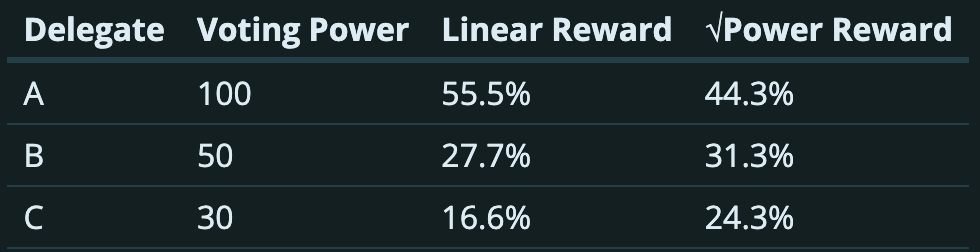This curve **flattens the advantage** of large delegates and better rewards smaller but engaged participants.
### Goals
* Reward active participation in governance
* Reward token holders for delegating to active delegates. Alternatively, token holders can earn rewards by participating directly.
* Support long-term commitment to Obol governance.
### How it works
Obol would upgrade the existing staking system to add new requirements:
* Stakers would only be eligible for rewards if they’re delegated to an “active” delegate
* “Active” would be defined as having a minimum DRS.
* Obol Association will align with DRS Provider on how to calculate a delegate’s DRS. A first (subject to modification) calculation model is outlined below.
* 165,000 OBOL tokens (equivalent to 10% of the global staking rewards pool for the first 6 months of staking) from a separate delegate reward pool (independent of staking rewards) would be distributed to active delegates, proportional to their voting power.
## DRS Integration
As part of this initiative, the Obol Collective is currently evaluating multiple potential scoring system providers, including but not limited to [Karma](https://www.karmahq.xyz/) and [Curia](https://www.curialab.xyz/). While both offer viable approaches to delegate reputation scoring, their integration timelines, oracle compatibility, and infrastructure readiness may vary. DRS will use a single oracle implementation per cycle. Karma and Curia have confirmed compatibility with Tally and can operate off the same version-controlled logic.
*To ensure implementation proceeds smoothly post-approval, this proposal grants the Obol Association, in collaboration with Tally, the authority to select the most technically viable and aligned provider for the first deployment of the Delegate Reputation Score.*
This flexibility allows the Collective to:
* Launch the scoring system without delays,
* Maintain compatibility with Tally’s staking and governance UI,
* Optionally rotate or expand to additional providers in future phases, based on performance and community feedback.
* Regardless of the initial provider selected, the DRS calculation logic will remain **publicly auditable**, version-controlled, and subject to future governance updates
### Delegate Reputation Score (DRS)
DRS defines who is eligible to receive rewards and ensures that rewards go to delegates who are consistently participating. It is calculated as a **moving average over the past 63 days (equivalent to three voting cycles)**, designed to reflect **recent contributions** rather than reputational inertia. Because DRS is based on a rolling 63-day window, scores naturally decay when delegates stop participating, ensuring that rewards reflect current, not historical, legitimacy.
To ensure transparency and fairness, the DRS will be based on a composite of measurable governance activities, with the following simplified structure inspired by existing systems like Curia and Karma:
**DRS Formula:**
DRS = (Voting Participation Score × 0.40)
	 `+` (Voting Impact Score × 0.10)
	 `+` (Voting Timeliness Score × 0.15)
	 `+` (Rationale Submission Score × 0.15)
	 `+` (Forum Score × 0.20)
*Each metric is normalized on a 0–100 scale and contributes to the total Delegate Reputation Score (DRS) according to its weight. These definitions are adapted from Curia’s scoring model and may evolve based on community feedback.*
**Classification:**
* **Active**: Maintains over 65% DRS over the past 63 days (≈3 governance cycles)
* **Inactive**: Below 65% DRS
* **Ghost**: Has voting power delegated but has not voted at all
If necessary, the Association may update the DRS formula during this pilot phase, based on informal community consultation.
In the future, this formula is subject to change and can be updated through an OIP or by a working group appointed by the association through an OIP if judged necessary.
**Possible future improvements include:**
* Backup Delegations: allowing delegates to nominate fallback delegates while away, subject to DRS constraints.
* Delegator Diversity and Engagement Caps: to further mitigate whale dominance.
**Score Components:**
* **Voting Participation Score (40% weight)***We merged **Number of Votes** and **Participation Rate** into a single Voting Participation Score to avoid over-counting similar behaviors and to streamline the formula. This ensures we reward consistent, eligible participation without overweighting sheer voting volume.*
* **What it is**: A combined metric that captures both how frequently a delegate votes and how engaged they are relative to the number of proposals they were eligible to vote on. It replaces and simplifies the separate “Number of Votes” and “Participation Rate” scores into a single, more intuitive component.
* **How it works**:
* Each delegate’s voting frequency is calculated as a percentage of all proposals they were eligible to vote on within the rolling 63-day window. This raw participation percentage (e.g., voting on 8 out of 10 proposals yields a score of 80) is used directly as the Voting Participation Score.
* **Why it matters**: Raw vote counts can over-reward large or early delegates. Participation rate alone doesn’t capture effort in contexts where proposal volume varies. This unified score reflects a delegate’s sustained commitment to governance without overemphasizing raw numbers or diluting quality signals.
* **Voting Impact Score (10% weight)**
* **What it is**: Measures **how much influence** a delegate had in the votes they participated in.
* **How it works**: For each proposal, it calculates the share of voting power a delegate used compared to the total votes cast. Then it averages that across all proposals and normalizes to 0–100.
* **Why it matters**: This score distinguishes delegates who cast high-weight, meaningful votes from those with little impact, helping highlight influential decision-makers.
* **Voting Timeliness Score (15% weight)**
* **What it is**: Time-decay model that rewards delegates who vote early, reflecting their proactive engagement. This method balances the encouragement of timely participation with fairness to all delegates.
* **How it works**:
* Votes cast within the first 48 hours receive a score of 100. After 48 hours, the score decays linearly to 0 by the end of the voting period. For example, in a 5-day (120-hour) voting window, the score decreases by approximately 1.39 points per hour after the initial 48 hours. This approach maintains transparency and avoids complexity introduced by additional bonus layers.
* **Why it matters**: Rewards **early and proactive** governance participation. Discourages last-minute or opportunistic voting.
* **Rationale Submission Score (15% weight)**
* **What is is**: A new scoring component within the Delegate Reputation Score (DRS) that rewards delegates for submitting written rationales on the Forum explaining their votes. This reinforces transparency and supports informed delegation decisions.
* **How it works**:
* Delegates receive points based on the timeliness of their rationale submissions:
### Rationale Submission Timing-bonus options
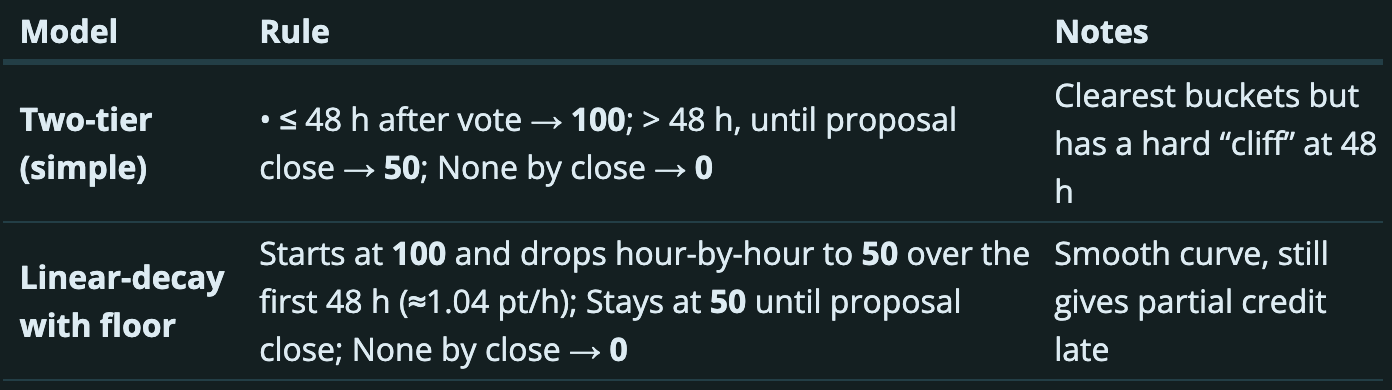
Raw points from either model already sit on a 0–100 scale, ready to plug into the 15 % weight. 
#### **Standardizing the rationale format**
Delegates shall follow this template when posting voting rationale:
`Vote: For / Against / Abstain`
`Rationale: <concise reasoning here>`
* **Why it matters**: Providing voting rationales is a governance best practice. It helps token holders understand the thinking behind a vote, increases trust, and reinforces a culture of accountability. This scoring mechanism encourages consistency without introducing heavy evaluation processes, with quality assessment to be considered in future iterations.
* **Forum Score (20% weight)**
* **What it is:** Measures off-chain engagement in the governance forum (posts, comments, discussions).
* **How it works**: Derived from multiple signals like number of proposal discussions joined, topics started, likes received, and reading activity. Normalized and simplified for the MVP.
* **Why it matters**: Delegates who contribute in the forum often shape decisions early and improve proposal quality. This score rewards those who help make governance deliberative, not just performative.
### Integration details
* Smart contract changes required to enable Oracle listener.
* DRS Oracle will score and flag “active” delegates based on voting and proposal participation.
* Tally will handle coordination and UI updates to integrate DRS into delegate profiles.
## User interface
* **Tally will add support for delegate compensation to the UI**
* Tokenholders would be able to see delegates’ DRS scores and eligibility statuses when staking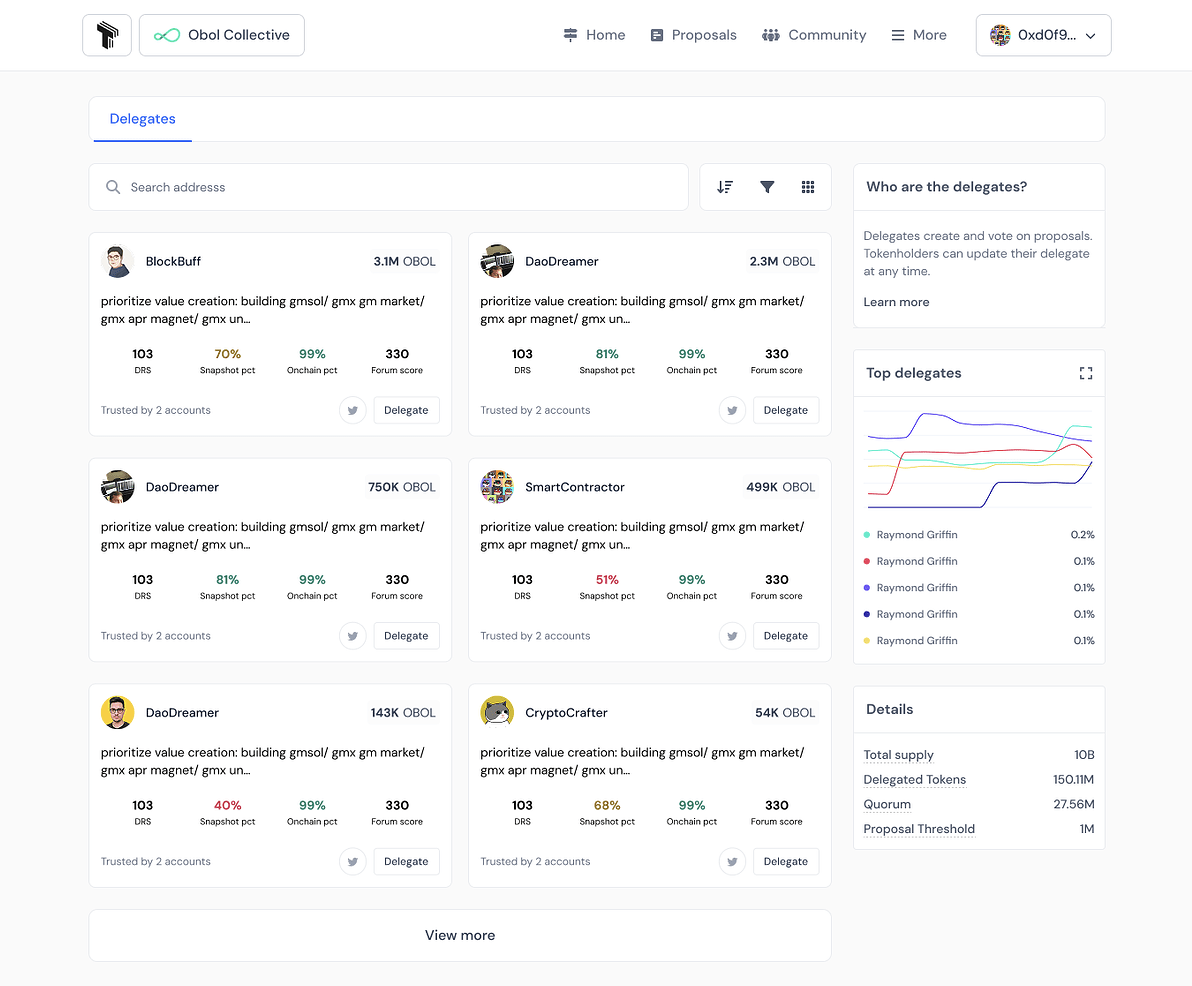
<!---->
* Delegates would be able to see and claim their accrued rewards from their profile page
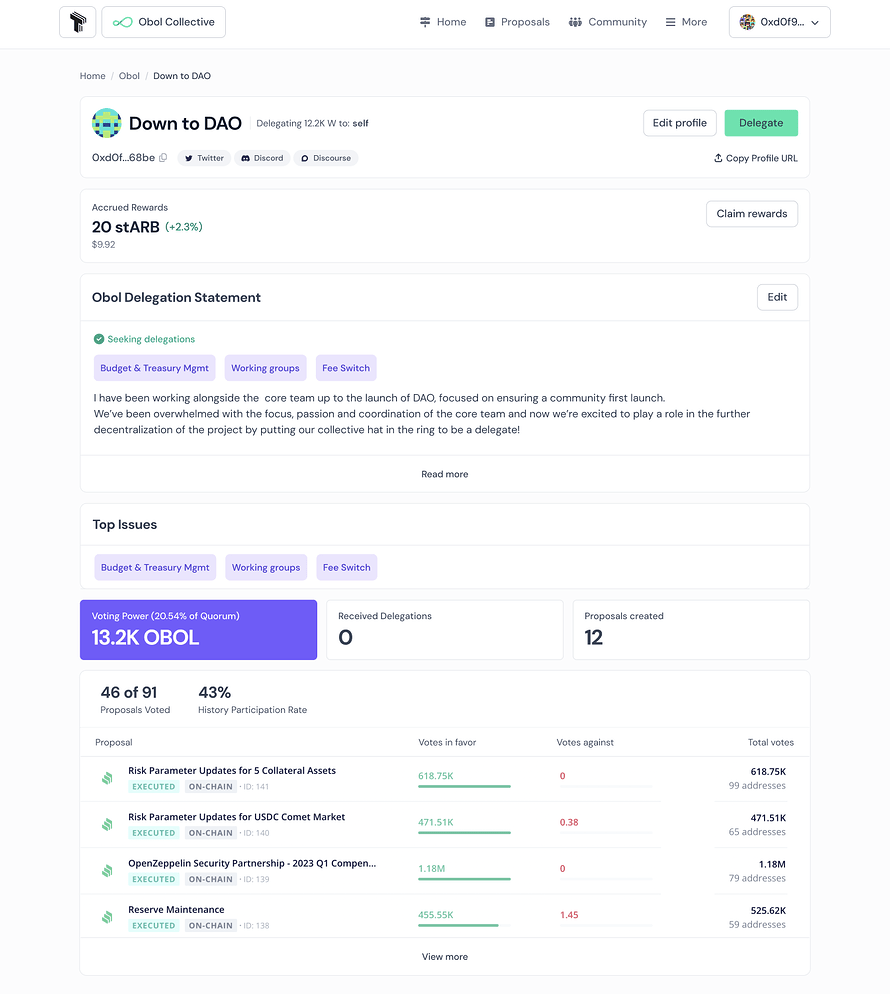
* These features would be live at both [vote.obol.org/stake](http://vote.obol.org/stake) and tally.xyz/gov/obol/stake
* **Eligibility requirements**:
* Must be deemed “active” by DRS Oracle (details below).
### Technical scope
* Implement a new [earning power calculator](https://github.com/withtally/staker/tree/main/src/calculators) smart contract that sends rewards to active delegates
* Front-end UI components
* Show eligibility and DRS when delegating
* Let delegates see and claim their rewards
* Dependency, not included in scope: Obol to set up DRS Oracle
* Dependency, not included in scope: DRS Oracle to put scores on-chain
## Forum Integration of DRS
In addition to incorporating DRS into staking and delegation flows, the Obol Collective is exploring ways to extend DRS visibility into the governance forum. This would allow delegates to link their forum accounts to their on-chain identities and display their DRS alongside posts and comments.
This feature would serve two purposes:
* Help delegates verify their identity across platforms, increasing trust in discussion.
* Allow token holders to better contextualise forum participation with transparent reputation signals.
This integration is currently under technical review. If confirmed, it could be implemented either by Tally or funded through a small standalone grant, similar to the below proposed Telegram alert feature. A future update will provide details if this path is pursued.
## UI and Notification Features
* Tally will **replace the Top Delegates leaderboard with a DRS-based version**, rather than sorting by raw voting power.
* Curia, Karma, and others may build complementary interfaces that enrich DRS displays drawing on both on-chain metrics and forum-based engagement data
* We are exploring a **Telegram notification bot** that alerts token holders when their delegate falls below the DRS threshold — making delegation more transparent and responsive. This feature could be built by Tally or developed separately through a small grant. This feature would help build trust in delegation by reducing the perceived risk of picking the ‘wrong’ delegate.
## Review Cycle and Governance Flexibility
**This proposal is structured as a pilot with a defined review window:**
* The 165,000 OBOL pool will be distributed over 6-month, until the current reward pool is empty.
* Afterward, the DAO will:
* Re-evaluate the efficacy of the system
* Assess participation trends and feedback
* assess whether the model improves legitimacy and delegation confidence
* Consider improvements or expansion
**Future changes and improvements may include:**
* Adjust the reward percentage
* Merge rewards into the staking pool
* Update the DRS formula (e.g: DRS-weighted)
* Incorporate a notification system
* Peer-review-based assessment mechanism of the rationale submissions (as part of DRS)
* Forum integration of DRS
* Incorporating delegator diversity or engagement-weighted caps may be explored to further decentralise influence
## Cost
Total: $65,000
* Delegate compensation implementation:
* Smart contract development: $35,000
* Smart contract audit: $20,000 — estimated; if additional audit funding is needed, Tally will submit a follow-up request
* Frontend development and QA: $10,000
* Including DRS integration
While initial reward pool value is lower than implementation cost, the tooling is reusable across future cycles and proposals.
*A note on cost:*
While Obol is the first DAO to adopt this combination of staking rewards and DRS-based delegate incentives, it’s not necessarily bearing the full cost long-term.
* This implementation requires custom development tailored to Obol’s needs. That includes specific design, oracle integration, and UI work.
* The oracle for DRS is per-DAO — each new DAO that adopts staking + DRS will need its own feed integration, which is not directly reusable from Obol’s implementation.
* Each DAO has different requirements, and Obol’s solution is custom-built on a shared foundation ([Tally staking contracts](https://github.com/withtally/staker)). This is typical for early integrations of a new product line, where the core system is extensible but tailored components are needed per implementation.
## Action Plan
* May 14 - May 21: Post proposal on forum for feedback, get approval from 4 top-100 delegates
* May 22 - June 28: Submit proposal on Tally for on-chain voting
* May 29: Tally to begin technical development. During this time, Tally will also get to final alignment with Obol Association on (a) delegate reward pool specs and (2) definition of an “active delegate” by DRS.
* June 25: Begin audit for contracts
* July 16: Launch delegate compensation mechanism and DRS integration.
## Conclusion
This is a measured first step toward building a governance system where effort, not only stake, drives long-term influence.
It’s also an opportunity to test legitimacy and transparency while retaining flexibility to evolve. Delegates, token holders, and contributors will shape the next version together.
### Disclaimer
*This proposal should not be relied on as legal, tax, or investment advice. Any projections included here are based on our best estimates and presented for informational purposes only.*
# RRC-43: RARI DAO Delegate Incentive Program
## **Abstract:**
Following the approval of [RRC-30 3](https://www.tally.xyz/gov/rari-foundation/proposal/85102068202527969889208024703113668965813715410446115075088330064807449302588), Rari DAO began transitioning the $RARI token and governance to the Arbitrum ecosystem. The community has already approved the implementation of [RARI staking](https://forum.rari.foundation/t/enable-rari-staking/2073) to enhance the governance and security of the RARI protocol.
This proposal specifically seeks approval for:
1. Initial funding budget of 60,000 $RARI from the DAO treasury for staking incentives.
2. A twelve-month staking incentives program to be launched on Rari Chain.
3. Continuous tracking and monthly reporting to optimize the program rewards.
Implementing these staking incentives together with the already-approved staking mechanism will maximize its impact on the DAO’s governance participation and token value.
## Motivation:
The Rari DAO is undergoing a significant transition from the Ethereum mainnet to Rari Chain. This migration is a critical milestone for the DAO’s evolution, aimed at improving governance efficiency, reducing transaction costs, and enhancing the scalability of the protocol. However, the success of this migration depends heavily on user participation and the seamless integration of existing governance mechanisms into the new environment.
The current governance model relies on Rari tokens locked in veRari contracts on Ethereum mainnet. For the migration to Rari Chain to be effective, these staked tokens must be unstaked, bridged, and delegated on Rari Chain. Without sufficient incentives, users may hesitate to migrate their tokens - especially early on. While mainnet utility isn’t lost, since tokens can be wrapped and used for governance after the upgrade, incentives will still be key to drive early staking and adoption of the new RARI L2 token standard.
Two of Rari DAO’s most important goals are to improve governance participation and increase the utility of the $RARI token, both of which are significantly advanced by the introduction of RARI governance staking, developed by Tally. In this contract, $RARI stakers that delegate their voting power to an eligible delegate will receive staking rewards. Adding staking rewards will further motivate token holders to migrate and contribute to governance, ensuring stronger alignment with the DAO’s overall objectives and enhancing the utility of the $RARI token by providing tangible benefits to participants.
## Rationale:
This proposal establishes a fixed-term (twelve-month) incentives program to jumpstart governance participation. To incentivize early bridging and staking, the incentives will be scheduled in three phases (see specification) with diminishing rewards over time plus a one-time bridging Quests for early users. The initial goal is to attract a similar amount of $RARI as currently sits into the ve-contract in Ethereum, ~300,000 $RARI, to the governance staking contract in Rari Chain.
The staking mechanism supports both direct voter participation and the option for token holders to delegate their voting power to active community members, creating multiple pathways for governance engagement while still earning rewards.
The long-term vision is for staking incentives to be sustainably funded from the DAO’s revenue streams. After this initial period concludes, a new proposal will be required to continue the staking rewards program, ideally transitioning to the self-sustaining model derived from DAO revenue.
The progress of the program will be tracked and reported monthly by StableLab. Reports will be posted in the forum for the DAO to discuss, along with recommendations on next steps.
KPIs to track include the following (more can be added in the future):
* Number of delegated RARI tokens.
* Number of wallets staked.
* Numbers of delegates receiving delegation.
* Unique proposal voters.
## Key Terms:
* RARI token: RARI DAO governance token
* RARI DAO: body governing the Rarible Protocol and RARI chain
* Arbitrum ecosystem: Arbitrum One and RARI chain L3
## Specification
### Staking Rewards Mechanics:
In the governance staking contract, rewards are distributed proportionally to the amount of $RARI staked. We calculated the amount of $RARI to allocate for rewards based on an APR estimation for 300,000 $RARI migrating and delegating to Rari Chain:
* Target APR: An attractive yield of 25% (Phase 1), 15% (Phase 2) and 10% (Phase 3) annualized return to attract stakers, balancing the risk of holding $RARI on Rari Chain against typical crypto yields (e.g., 3-3.3% for ETH staking, 4.5% for Sky’s USDS).
### Reward Calculations:
As each Phase lasts 4 months, to estimate the amount of Rari to yield each target APR we must calculate:
$RARI incentives = 300,000 (Staked $RARI estimation) \* Target APR \* 4 months (Phase duration) / 12 months (annualized returns)
Therefore,
* Phase 1 (months 1-4): 25,000 $RARI.
* Phase 2 (months 5-8): 15,000 $RARI.
* Phase 3 (months 9-12): 10,000 $RARI.
Additionally, 10,000 $RARI will be allocated to Quests for bridging into Rari Chain to kickstart Phase 1.
## Steps to Implement
Upon successful approval of this proposal on Tally, 60,000 $RARI will be sent to the Foundation’s SAFE on mainnet (**0x2a83d2891Ef3df6967E3C2e9b69cCc7aD029736B)**.
Then, Rari Foundation will bridge the funds to Rari Chain and deposit them into the DAO Treasury at **0x83CBaF64b94D1eDfeDd468b23234DeCf2AecDD8b.**
The Governance Staking contract will then be given permission to allocate funds as staking rewards based on the outlined reward structure, through a DAO-approved proposal on RARI Chain (more details on governance staking [here 1](https://docs.tally.xyz/tally-features/staking/stgov-lst)).
## Overall Cost:
Overall costs: 60,000 $RARI
* 10,000 $RARI for Superboard bridging Quests.
* 50,000 $RARI for staking rewards.
# RRC-43: RARI DAO Delegate Incentive Program
## **Abstract:**
Following the approval of [RRC-30 3](https://www.tally.xyz/gov/rari-foundation/proposal/85102068202527969889208024703113668965813715410446115075088330064807449302588), Rari DAO began transitioning the $RARI token and governance to the Arbitrum ecosystem. The community has already approved the implementation of [RARI staking](https://forum.rari.foundation/t/enable-rari-staking/2073) to enhance the governance and security of the RARI protocol.
This proposal specifically seeks approval for:
1. Initial funding budget of 60,000 $RARI from the DAO treasury for staking incentives.
2. A twelve-month staking incentives program to be launched on Rari Chain.
3. Continuous tracking and monthly reporting to optimize the program rewards.
Implementing these staking incentives together with the already-approved staking mechanism will maximize its impact on the DAO’s governance participation and token value.
## Motivation:
The Rari DAO is undergoing a significant transition from the Ethereum mainnet to Rari Chain. This migration is a critical milestone for the DAO’s evolution, aimed at improving governance efficiency, reducing transaction costs, and enhancing the scalability of the protocol. However, the success of this migration depends heavily on user participation and the seamless integration of existing governance mechanisms into the new environment.
The current governance model relies on Rari tokens locked in veRari contracts on Ethereum mainnet. For the migration to Rari Chain to be effective, these staked tokens must be unstaked, bridged, and delegated on Rari Chain. Without sufficient incentives, users may hesitate to migrate their tokens - especially early on. While mainnet utility isn’t lost, since tokens can be wrapped and used for governance after the upgrade, incentives will still be key to drive early staking and adoption of the new RARI L2 token standard.
Two of Rari DAO’s most important goals are to improve governance participation and increase the utility of the $RARI token, both of which are significantly advanced by the introduction of RARI governance staking, developed by Tally. In this contract, $RARI stakers that delegate their voting power to an eligible delegate will receive staking rewards. Adding staking rewards will further motivate token holders to migrate and contribute to governance, ensuring stronger alignment with the DAO’s overall objectives and enhancing the utility of the $RARI token by providing tangible benefits to participants.
## Rationale:
This proposal establishes a fixed-term (twelve-month) incentives program to jumpstart governance participation. To incentivize early bridging and staking, the incentives will be scheduled in three phases (see specification) with diminishing rewards over time plus a one-time bridging Quests for early users. The initial goal is to attract a similar amount of $RARI as currently sits into the ve-contract in Ethereum, ~300,000 $RARI, to the governance staking contract in Rari Chain.
The staking mechanism supports both direct voter participation and the option for token holders to delegate their voting power to active community members, creating multiple pathways for governance engagement while still earning rewards.
The long-term vision is for staking incentives to be sustainably funded from the DAO’s revenue streams. After this initial period concludes, a new proposal will be required to continue the staking rewards program, ideally transitioning to the self-sustaining model derived from DAO revenue.
The progress of the program will be tracked and reported monthly by StableLab. Reports will be posted in the forum for the DAO to discuss, along with recommendations on next steps.
KPIs to track include the following (more can be added in the future):
* Number of delegated RARI tokens.
* Number of wallets staked.
* Numbers of delegates receiving delegation.
* Unique proposal voters.
## Key Terms:
* RARI token: RARI DAO governance token
* RARI DAO: body governing the Rarible Protocol and RARI chain
* Arbitrum ecosystem: Arbitrum One and RARI chain L3
## Specification
### Staking Rewards Mechanics:
In the governance staking contract, rewards are distributed proportionally to the amount of $RARI staked. We calculated the amount of $RARI to allocate for rewards based on an APR estimation for 300,000 $RARI migrating and delegating to Rari Chain:
* Target APR: An attractive yield of 25% (Phase 1), 15% (Phase 2) and 10% (Phase 3) annualized return to attract stakers, balancing the risk of holding $RARI on Rari Chain against typical crypto yields (e.g., 3-3.3% for ETH staking, 4.5% for Sky’s USDS).
### Reward Calculations:
As each Phase lasts 4 months, to estimate the amount of Rari to yield each target APR we must calculate:
$RARI incentives = 300,000 (Staked $RARI estimation) \* Target APR \* 4 months (Phase duration) / 12 months (annualized returns)
Therefore,
* Phase 1 (months 1-4): 25,000 $RARI.
* Phase 2 (months 5-8): 15,000 $RARI.
* Phase 3 (months 9-12): 10,000 $RARI.
Additionally, 10,000 $RARI will be allocated to Quests for bridging into Rari Chain to kickstart Phase 1.
## Steps to Implement
Upon successful approval of this proposal on Tally, 60,000 $RARI will be sent to the Foundation’s SAFE on mainnet (**0x2a83d2891Ef3df6967E3C2e9b69cCc7aD029736B)**.
Then, Rari Foundation will bridge the funds to Rari Chain and deposit them into the DAO Treasury at **0x83CBaF64b94D1eDfeDd468b23234DeCf2AecDD8b.**
The Governance Staking contract will then be given permission to allocate funds as staking rewards based on the outlined reward structure, through a DAO-approved proposal on RARI Chain (more details on governance staking [here 1](https://docs.tally.xyz/tally-features/staking/stgov-lst)).
## Overall Cost:
Overall costs: 60,000 $RARI
* 10,000 $RARI for Superboard bridging Quests.
* 50,000 $RARI for staking rewards.
As members of the Governance Working Group that shaped this CoC, StableLab supports its implementation. This document sets the grounds for a respectful and fair governance ecosystem for Rari.
# RRC-34: Enable RARI Staking
## Abstract
RARI governance is undergoing an upgrade via [turning on protocol fees (RRC 28) 4](https://www.tally.xyz/gov/rari-foundation/proposal/64443561092723928501818567121519051108693422626070463342810224372241233243885) and via [the token upgrade (RRC 30) 1](https://www.tally.xyz/gov/rari-foundation/proposal/85102068202527969889208024703113668965813715410446115075088330064807449302588). We believe turning on staking should be a third component of this governance upgrade.
We propose to unlock RARI utility and improve the governance and security of the RARI protocol by implementing RARI staking, without yet turning on fee distribution to token holders. Through RARI staking, token holders who delegate to active governance participants will be able to capture value. The proposal will also implement a liquid staked RARI token (stRARI) on Rari Chain via the [Tally Protocol](https://tally.mirror.xyz/Drw-uvqhUnJLRxg32sV-sqKZ785-AO85FBaCYeXqxhA) that enables any future rewards to auto-compound, is (re)stakeable, and is compatible with DeFi. Separately, we will work with the RARI DAO to decide how to fund rewards and how to split rewards between token holders and delegates.
## Motivation
Motivation to enable staking for RARI DAO is two-fold: (1) improve governance participation and (2) improve security of RARI DAO.
### Enable staking to improve governance participation
RARI token utility is low and as a result, the RARI token is struggling to accrue value.
* Governance power is the only source of fundamental demand for RARI, while there are multiple sources of new supply (unlocks, treasury spending, etc.).
* The ability to restake RARI or use it on DeFi is not compatible with governance. Voting power breaks when RARI is deposited into smart contracts.
Right now, ~12.4% of RARI (that which does not belong to “Holders” on the below graph) is being used in the onchain ecosystem, meaning it cannot be used in governance. This robs the DAO of voting power that can be used to reach quorum and protect against malicious attacks.
[<img height="314" width="690" alt="Screenshot 2024-09-06 at 5.28.54 PM" src="https://forum.rari.foundation/uploads/default/optimized/1X/6418e51c9ebd0578af4f7f3849220351244a6e0a_2_690x314.png" />Screenshot 2024-09-06 at 5.28.54 PM1412×644 71.1 KB](https://forum.rari.foundation/uploads/default/original/1X/6418e51c9ebd0578af4f7f3849220351244a6e0a.png "Screenshot 2024-09-06 at 5.28.54 PM")
*From* [*CoinMarketCap*](https://coinmarketcap.com/currencies/rarible/#Analytics)
The RARI token is struggling as a governance mechanism. The veRARI token model deterred participation because it adds complexity and commitment, discouraging those who may not want to lock up their tokens. Without staking, the DAO is also disallows RARI token holders that want to use these tokens in DeFi from voting.
With the recent move from veRARI to RARI for governance voting, RARI DAO is looking to incentivise active governance participation. Delegation has tripled since DAO launch in 2020, especially with the help of the [Delegate Launchpad Proposal (RRC 9)](https://www.tally.xyz/gov/rari-foundation/proposal/4998212454959764411677761814601920941258702940035724218302264365950572124990), but more tokens have not been used in voting.
### Enable staking to improve security of RARI DAO
The strongest defense against attacks on a decentralized system is active governance participation and a broad, engaged delegate base. Staking plays a crucial role in achieving this by incentivizing users to commit their tokens and participate in governance. By turning on staking rewards and tying them to active participation in governance (via delegation to oneself or to someone else), the system can foster a more resilient and well-distributed decision-making process, which enhances overall security and stability within the DAO.
The RARI DAO treasury currently holds 4.67 million $RARI (worth over $7.19 million USD) from its initial allocation and will continue to generate revenue through the [new fee structure 4](https://www.tally.xyz/gov/rari-foundation/proposal/64443561092723928501818567121519051108693422626070463342810224372241233243885). The DAO has the flexibility to decide how to use this revenue, with one suggestion being to allocate a portion for staking rewards. Separate from this current proposal, the DAO could consider setting aside a dedicated pool to enhance these rewards and incentivise early participation since staking rewards may be low initially.
As a result, it is becoming economically attractive for a malicious actor to launch a governance attack on the DAO treasury. The potential profit of attacking the DAO treasury is increasing as more RARI accumulates in the treasury, while the cost of attacking the DAO through purchasing RARI for its voting power is not increasing proportionally to defend against attacks. A more developed version of this dynamic exists in the ENS which is actively fighting off governance attacks (documented [here](https://discuss.ens.domains/t/temp-check-enable-cancel-role-on-the-dao/19090/10)) and in Compound, which fell victim to this type of attack recently (documented [here](https://thedefiant.io/news/defi/compound-governance-attack-reveals-inherent-vulnerabilities-of-daos)). Had Compound enabled staking, which could have redistributed voting power to the DAO, it would not have been economically worth attacking the DAO because the increased cost of acquiring enough voting power through staking would have outweighed the potential rewards of the attack. Staking would have created a more robust defense by tying voting power to economic commitment, making it much more expensive and difficult for a malicious actor to gain control over governance decisions.
RARI Staking unlocks utility and aligns governance by creating a mechanism to stream future rewards from DAO-generated sources like protocol fees, token inflation, and treasury diversification to token holders who are delegated to an active governance participant. RARI Staking makes RARI usable in restaking and DeFi by returning voting power locked in contracts to the DAO.
## Specifications and Steps to Implement
### System architecture
RARI Staking enables RARI utility in Rari Chain while allowing the DAO to retain governance power. It includes a few modular components that come together to power the system. 
**RARI Staking via the Tally governance staking system**
* Has the power to distribute fees proportionally to token holders who have delegated voting power to an active governance participant.
**The DAO**
* Has the power to turn on fee distribution and send fees to RARI Staking
* Controls how voting power is distributed to delegates, including delegation strategies for unused voting power
**stRARI (Tally Protocol LST)**
* Auto-compounds potential rewards if they are turned on in the future
* Provides token holders a liquid position
* Returns voting power to the DAO when stRARI is deposited into restaking, DeFi, and centralized exchanges. The RARI DAO exclusively has the ability to determine how this voting power is distributed/redelegated via a governance proposal. The DAO will decide how to set up the initial redelegation logic for stRARI.
[<img height="500" width="521" alt="Screenshot 2024-09-06 at 5.32.51 PM" src="https://forum.rari.foundation/uploads/default/optimized/1X/4a911a145f4836cf1010a3d442b84039e67ff659_2_521x500.png" />Screenshot 2024-09-06 at 5.32.51 PM856×820 64.9 KB](https://forum.rari.foundation/uploads/default/original/1X/4a911a145f4836cf1010a3d442b84039e67ff659.png "Screenshot 2024-09-06 at 5.32.51 PM")
### Implementation details and eligibility for rewards
The Tally governance staking system builds on top of [Unistaker](https://github.com/uniswapfoundation/UniStaker). We will customize Unistaker for RARI’s [governance architecture](https://github.com/ArbitrumFoundation/governance/blob/main/docs/overview.md) and [fee collection mechanism](https://docs.arbitrum.foundation/fee-distribution) in Rari Chain. We will implement RARI Staking in such a way that it can accept arbitrary fee sources as rewards. We will also require that tokens be delegated to an active delegate.
We define an active delegate using Karma Score. The DAO will define the Karma Score requirement for being considered an active delegate. Karma Score is a combination of delegate’s Snapshot voting stats, onchain voting stats and their forum activity. To accurately calculate forum activity score, delegates are required to prove ownership of their forum handle by [signing a message](https://www.karmahq.xyz/dao/link/forum?dao=arbitrum) with their delegate address and posting on the forum. The current Karma score formula is below, which can be adjusted by the DAO going forward:
((100) \* ((Forum Activity Score \* 1) + (Off-chain Votes % \* 3) + (Onchain Votes % \* 5))) / (Sum of Weights times Max Score Setting \* 1)
Karma Score will be included in RARI staking via a smart contract that writes data onchain from the Karma API. We will include several guardrails to ensure that this aspect of the implementation is robust and decentralized:
* Users can verify Karma score calculations independently.
* The DAO will have the ability to block Karma Scores if it believes they are being calculated incorrectly.
* If Karma scores fail to arrive or the scores are blocked by the DAO, RARI Staking will distribute rewards to all stakers regardless of whether they are delegated to an active governance participant until the situation is resolved.
In the future, we believe it would make sense to integrate delegate incentives with RARI staking so that, instead of getting delegate incentive funds from the RARI treasury, they come directly from onchain revenue.
Tally will build RARI staking into our existing [RARI DAO platform](https://www.tally.xyz/gov/rari-foundation), so that users can easily stake and delegate in one place.
## Estimated Timeline
* Post proposal on forum for feedback: early September
* Post onchain proposal on Tally for funding: October
* Begin development: October
* Submit onchain proposal on Tally including full RARI Staking implementation: November
## Cost
Total funds requested: $110,000 USD in RARI token\*.
$100,000 USD in RARI of funding to cover the costs of development, including the following funding categories:
* $50,000 USD in RARI: Develop RARI Staking smart contracts
* Implement staking contracts
* Integrate RARI’s current and potential fee mechanisms
* Integrate Karma Score requirement
* Enable the DAO to block Karma Scores if it believes they are being calculated incorrectly
* $20,000 USD in RARI: Integrate RARI Staking into Tally.xyz
* $30,000 USD in RARI: Integrate Karma into RARI Staking
* Develop and deploy a smart contract to store key stats and Karma scores onchain
* Create a system to record stats onchain and store detailed delegate data off-chain (using Arweave or IPFS) for easy verification
* Continuously improve scoring algorithms to adapt to evolving RARI community needs
* Provide technical support to delegates experiencing issues with their statistics
* This is inclusive of a Karma integration valued at 15,000 USD/year.
\*$10,000 USD in RARI to buffer any potential price impact. Any remaining funds once $100,000 have been successfully sold into stablecoins will be returned to the treasury within 7 days of receiving the RARI tokens. 
### Disclaimer
This proposal should not be relied on as legal, tax, or investment advice. Any projections included here are based on our best estimates and presented for informational purposes only.