# RRC-56: Raise RARI DAO V1 Proposal Quorum
**Author:** Kaf / **Co-author:** Anna
## Abstract
This proposal amends [RRC-18 3](https://www.tally.xyz/gov/rari-foundation/proposal/92291942737638248510121968606930728418927478036113609984320383722147913463255?utm_source=chatgpt.com) by increasing the quorum of the legacy RARI DAO V1 Governor from 15% to 20% of the total voting power supply.
The proposed change is limited to the V1 Governor and does not modify the quorum parameters of the current or any future canonical RARI DAO governance architecture.
## Motivation
RRC-18 increased the V1 quorum from 10% to 15% to strengthen the minimum participation required for governance proposals.
Since then, the distribution of voting power and participation in V1 governance have continued to evolve. Under the current configuration, the 15% quorum represents a relatively low threshold for large voting positions to satisfy the minimum participation requirement.
Increasing the quorum to 20% would strengthen this requirement and encourage broader participation before a V1 proposal can be considered valid.
## Rationale
A 20% quorum represents a moderate increase from the existing 15% threshold.
The objective is to strengthen the resilience of V1 governance while avoiding an unnecessarily high quorum that could make legitimate governance activity more difficult.
Rather than defining a permanent quorum target for RARI DAO governance, this proposal makes a targeted adjustment to the existing V1 Governor. The parameter can be reassessed if voting power distribution or participation materially changes.
## Key Terms
Quorum: The minimum voting power that must participate in a governance proposal for the proposal to be considered valid.
RARI DAO V1: The legacy RARI DAO Governor contract governed through veRARI voting power.
## Specifications
The proposal modifies the quorum numerator of the RARI DAO V1 Governor.
Target contract:
0x6552C8fb228f7776Fc0e4056AA217c139D4baDa1
Function:
updateQuorumNumerator(uint256)
New quorum numerator:
20
The action changes the V1 quorum from 15% to 20%. No other governance parameters are modified.
## Steps to Implement
If approved through the RARI DAO governance process, the proposal will execute the following call on the V1 Governor:
updateQuorumNumerator(20)
Upon successful execution, the V1 quorum will be updated from 15% to 20%.
## Timeline
The RRC Draft will remain on the forum for at least seven days for community review and feedback.
Following the discussion period, the finalized proposal may be submitted onchain through Tally. If approved, the quorum update will take effect following successful execution through the standard governance process.
## Overall Cost
There is no additional cost to the DAO associated with this proposal beyond standard governance transaction costs.
# Unichain Co-Incentives Growth Management Plan
[<img height="345" width="690" alt="232" src="https://us1.discourse-cdn.com/flex016/uploads/uniswap1/optimized/2X/a/a674fe1bf594f1210d9ccf6d178f82ac7db18de0_2_690x345.jpeg" />2322048×1024 415 KB](https://us1.discourse-cdn.com/flex016/uploads/uniswap1/original/2X/a/a674fe1bf594f1210d9ccf6d178f82ac7db18de0.jpeg "232")
**Summary**
Following the passage of the Unichain-USDS Growth Management Plan on [Snapshot](https://snapshot.box/#/s:uniswapgovernance.eth/proposal/0x537a301c4c94c1ec0b972bab558e2e36b1fa1111f0cbc4d5a59b0465f505c9ab) that echoed Unichain as the pillar of Uniswap’s growth strategy, recent months have been dedicated to refining and updating the proposal for Uniswap DAO, based on feedback from various stakeholders.
When the proposal passed, Unichain held less than 20 million USDS; since then, we’ve seen strong growth to nearly 45 million USDS on Unichain. Our aim is to accelerate this growth through strategic deployment and secured incentives from the Spark ecosystem. We have opened up sUSDC as an additional avenue for growth as it utilizes the Sky ecosystem’s mechanism and contributes to the Sky ecosystem.
Additionally, we have raised the minimum KPIs to be more ambitious and implemented a self-imposed “No result, no reward” approach to promote fairness, collaboration, and success for Uniswap DAO.
**Motivation**
After a period of sharp growth, Unichain’s TVL has steadily declined from over $900 million USD TVL in July 2025 to nearly half that amount in early September. The introduction of USDS, sUSDS, and sUSDC creates opportunities for enhanced collaboration among DeFi protocols. Both sUSDS and sUSDC provide yield, funded by the Sky ecosystem. For example, if Unichain sUSDS TVL grows to $100 million, at the current 4.75% yield, this would cost Sky $4.75 million USD per year. sUSDS can be a crucial driver for Unichain’s DeFi ecosystem growth, offering a stable and scalable yield source.
Furthermore, we strongly believe Uniswap DAO should guide and decide on incentive distribution. The basis is once per three months (with reduced frequency following feedback to avoid overwhelming the governance process, but potentially more frequent in the future), the strategy will be suggested to Uniswap DAO, where they can vote via Snapshot to support the incentive distribution or not.
**Goal / Growth Strategy**
The strategy centers on coordinating with key protocols to expand the Unichain ecosystem, notably by utilizing Sky’s competitive base savings rate. With incentives from Uniswap DAO and relevant DeFi partners, this rate can be amplified further. While additional incentives are secured, partners have emphasized that Uniswap DAO’s support is essential.
1. **Focus on optimizing incentive programs**
All co-incentive programs will be data-driven to ensure effective growth. Co-incentives will be spent with strategic reasoning and analytical support. Program updates will be shared once per month to communicate with the community.
1. **Continuous improvement and optimization**
Beyond monthly program updates, we’ll refine the strategy in real time, allowing for continuous improvement and optimization. KPI-driven growth will enable ongoing adjustment of both partnership targets and co-incentives distribution to ensure maximum ROI on spending. We will provide the report regarding strategy and rebalancing weekly.
Currently, the planned methodology for pools and lending markets is an incentive redistribution framework that reallocates a portion of rewards from the bottom 25% performing pools to the top 25% performing pools. This systematic rebalancing attracts more users, increases TVL, and improves overall bottomline metrics by concentrating incentives where they generate maximum impact.
Instead of sending all reallocated rewards directly to the top-performing pools, up to 5% of the total value will be strategically reserved to seed emerging opportunities and strengthen smaller pools. No single test pool can receive more than 2% of the total value, ensuring diversification and controlled risk.
StableLab leverages its deep ecosystem knowledge and ongoing market analysis to identify where these allocations can have the highest long-term impact. By backing promising new pools or overlooked markets at the right moment, these rewards can spark meaningful growth and unlock outsized upside for the protocol. Over time, these allocations fold back into the regular rebalancing cycle, ensuring the system continuously adapts while compounding value across the broader ecosystem.
As with the offchain proposal, Unichain DAO retains the ability to reject any proposed distribution if deemed necessary.
**Budget and Duration**
As mentioned above, sUSDS and sUSDC provide yield funded by the Sky Ecosystem. For example, if sUSDS grows to $100 million, at the current yield rate of 4.75%, that would cost Sky $4.75 million USD per year. Contributions from various DeFi protocols would further grow Unichain, with Spark having committed to providing additional co-incentives.
We strongly believe the majority of the budget that Uniswap DAO provides should be tied to objective KPIs like USDS and sUSDS supply on Unichain, which is inherently tied to TVL.
The program will start with a budget of $1 million USD when the first Snapshot strategy vote passes after this onchain vote passes to kickstart the program. Therefore, only one-fourth of the budget will be fixed, and the remaining portion will be performance-based. The performance-based part will be paid when the agreed-upon KPIs are reached, and we request unlock by submitting on-chain proof.
In addition, 80% of the budget will be directly spent on co-incentives that focus on USDS and sUSDS growth to boost Unichain TVL and usage. For instance, additional yield for sUSDS to make sUSDS yield on Unichain more attractive, or an incentivized USDS and/or sUSDS pool such as UNI-USDS on Unichain.
The remaining 20% of the budget, would be used for operations and logistics–such as coordinating with partners and optimizing and reporting on the incentive program
**KPIs**
KPIs are intentionally set high to align with the DAO’s interests. Following growth in USDS, and to keep interests aligned and show our commitment, we have raised KPIs by three times (from $20 million to $60 million).
Out of the potential $3,000,000 USD incentive-based payment:
1. USDS and sUSDS / sUSDC combined supply reaches TVL above $60 million USD on Unichain
\- $1,000,000 USD unlock. 80% allocated to co-incentives.
1. USDS and sUSDS combined supply reaches TVL above $100 million USD on Unichain
\- Additional $1,000,000 USD unlock. 80% allocated to co-incentives.
1. USDS and sUSDS combined supply reaches TVL above $200 million USD on Unichain
\- Additional $1,000,000 USD unlock. 80% allocated to co-incentives.
**Additional Accountability and Alignment regarding KPIs**
1. We will provide monthly updates on co-incentive distribution relevant metrics, including:
\- 30 / 60 / 90-day TVL retention, with the goal of 60 % / 50 % / 40 % each of peak
-Net new liquidity provider addresses, with the goal of more than 1200 addresses by the end of the program
-Δ TVL / $ incentive (ROI), ≥ $12 TVL gain per $1 variable spend, measured 30 d after each unlock
1. The total payment will first go to UAC, the fixed payment will be disbursed at once in order to kickstart the co-incentive program.
2. Upon achieving a KPI, we will submit a request to UAC with supporting proof.
3. We will provide the report regarding strategy and rebalancing weekly.
# RRC-48: Rarible Creator Fund Program
**Abstract**
This proposal establishes the Rarible Creator Fund Program to incentivize high-value creators, brands, and projects to launch NFT drops on the Rarible FUN platform, driving revenue and ecosystem growth. The program requests $100,000 USD in RARI tokens to provide grants of $2,500–$20,000 per creator, brand, or project. Grant applications will be curated by a working group comprising two RARI Foundation delegates, one RARI Foundation team member and Rarible’s VP of Growth. The program proposes a 10% Rarible revenue-sharing model from Rarible FUN drops by funded creators/brands/projects, with proceeds directed to the RARI DAO treasury. The initiative will operate under RARI Foundation and DAO oversight to ensure transparency and alignment with community goals.
***
**Motivation**
The RARI Foundation and Rarible Protocol aim to foster a decentralized, creator-centric NFT ecosystem. Attracting high-value creators, brands, and projects to Rarible FUN is critical to driving revenue, user engagement, and ecosystem adoption. Currently, there is no structured program to incentivize such creators to launch on Rarible FUN. The Rarible Creator Fund Program addresses this gap by providing financial grants to curated creators, ensuring high-quality NFT drops that align with Rarible’s vision. The 10% Rarible revenue-sharing model will strengthen the RARI DAO treasury, supporting future community initiatives and ensuring long-term sustainability. This program aligns with the RARI Foundation’s mission to empower creators and enhance the Rari ecosystem.
***
**Specification**
The Rarible Creator Fund Program will operate as follows:
* **Funding Allocation**:
* Total Request: $110,000 USD in $RARI tokens, disbursed at the prevailing market rate to a multisig wallet administered by the Rari Foundation. This includes a $10,000 USD buffer.
* Grants of $2,500–$20,000 will be awarded from the $100,000 USD Rarible Creator Fund Program to 5–30 curated creators, brands, or projects launching NFT drops on Rarible FUN.
* **Curation Process**:
* A working group will review and select grant applicants, consisting of:
* One RARI Foundation team member leading the working group (Anna).
* Two RARI Foundation delegates (nominated via the RARI Foundation Forum).
* Rarible’s VP of Growth (Jonathan Colon)
* Selection criteria will include market influence, creative quality, alignment with Rarible’s brand, and potential to drive revenue on Rarible FUN. Criteria will be published on the RARI Foundation Forum for transparency and community feedback.
* **Revenue-Sharing Model**:
* 10% of Rarible revenue from Rarible FUN drops by Creator Fund participants will be directed to the RARI DAO treasury.
* Revenue will be tracked transparently via Rarible and reported quarterly to the DAO.
* **Execution Plan**:
* **Milestone 1 (Immediate - Months 1)**: Program Setup and Curation
* Form the working group and finalize selection criteria.
* Develop the application process and launch a marketing campaign to attract high-value creators.
* Host a community feedback session on the RARI Foundation Forum or Discord Server to refine criteria and process.
* **Milestone 2 (Months 1-5)**: Grant Disbursement and Drop Facilitation
* Disburse grants to 5–30 curated creators for NFT drops on Rarible FUN.
* Implement the 10% Rarible revenue-sharing model and transfer proceeds to the DAO treasury.
* Monitor and report initial drop performance to the DAO.
* **Milestone 3 (Months 6-12)**: Program Evaluation and Revenue Sharing
* Evaluate program impact against the defined KPIs (e.g., revenue generated, user engagement, trading activity, ecosystem growth, and drop success).
* Publish a final report with metrics and recommendations for future programs.
* **Governance and Oversight**:
* The working group will manage curation and grant disbursement, subject to RARI Foundation and DAO oversight.
* Quarterly reports will detail grant recipients, drop performance, and revenue shared, posted on the RARI Foundation Forum.
* Community feedback will be solicited via the Forum and Discord to ensure transparency and accountability.
***
**Key Performance Indicators (KPIs):**
The program's success will be measured against the following targets and metrics, evaluated quarterly and in the final report:
* Protocol Revenue Generated Through the Creator Fund: Target of at least $150,000 USD in total protocol revenue from funded NFT drops within the first 8 months, with at least 50% derived from the 10% revenue-sharing model to ensure the program achieves a positive return for the RARI DAO treasury.
* Revenue Generated per USD$ Spent: Target ROI of at least 1.5x, meaning $1.50 in protocol revenue generated for every $1 USD equivalent spent from the fund (calculated as total revenue from funded drops divided by total grants disbursed).
* User Engagement / Trading Activity: Target of at least 50,000 unique users interacting with funded NFT drops (e.g., views, bids, or purchases) and a minimum trading volume of $500,000 USD across all funded drops within the program period, measured via on-chain analytics and Rarible platform data.
* Ecosystem Growth: Target of at least 20% increase in active creators on Rarible FUN (measured by new creator accounts launching drops post-program launch) and a 15% growth in total NFT mints on the platform attributable to the program, tracked through ecosystem metrics like user acquisition rates and drop participation.
**Budget Breakdown**:
* Total: $110,000 USD in $RARI tokens sent to a multisig wallet administered by the RARI Foundation.
* $10,000 USD as a buffer for price fluctuations.
* 5-30 Grants ranging from $2,500 to $20,000 USD awarded to high profile creators/brands/projects
***
**Rationale**
The Rarible Creator Fund Program directly supports the RARI Foundation’s mission to empower creators and drive growth on Rarible FUN. By providing targeted grants, the program will attract high-value creators, increasing platform adoption and revenue. The 10% Rarible revenue-sharing model ensures a sustainable funding mechanism for the RARI DAO treasury, supporting future initiatives. The working group structure, combining Rarible expertise with RARI Foundation oversight, balances efficiency with decentralized governance. The milestone-based approach and transparent reporting align with RARI DAO’s preference for accountability, while community feedback ensures alignment with DAO priorities.
***
**Risks and Mitigations**
* **Risk**: Insufficient participation from high-value creators.
* **Mitigation**: Leverage Rarible’s network and a robust marketing campaign, with clear, community-vetted selection criteria to attract top-tier creators.
* **Risk**: Revenue-sharing model underperforms.
* **Mitigation**: Monitor drop performance in Milestone 2 and adjust grant sizes or curation criteria if needed, based on early results.
* **Risk**: Lack of transparency in creator curation.
* **Mitigation**: Publish selection criteria and grant recipient details on the RARI Foundation Forum, with quarterly updates and community feedback.
# Grow3dge Accelerator: Strategic Support for Rari Foundation and DAO Growth
### Author
Kara Howard
### Abstract
This proposal is submitted to support the Rari Foundation and DAO in driving more market awareness, adoption, and revenue. It requests funding for their participation in SI\<3>’s Grow3dge Accelerator. Grow3dge is a 10-week growth-focused program running from August 7 – October 9, designed to help projects launch public-facing campaigns and programs and deepen their impact across their parent ecosystems.
Grow3dge offers each participant structured pathways to learn, collaborate, and grow alongside 22 womxn educators and operators from organizations like Uniswap, Zerion, Adobe, Stellar, Ledger, Serotonin, Dune analytics, and many more.
### Motivation
This proposal directly supports the Rari Foundation’s strategic goals to:
* Foster ecosystem-wide visibility for projects building on or around Rarible
* Convert strategic partnerships into measurable marketplace activity
* Improve RARI token awareness and deepen governance participation via delegated staking
### Rationale
This initiative delivers high-leverage impact in these core areas:
* Rari Foundation and 3 of its delegates will receive 10 weeks of education and support from industry leaders in the Grow3dge Accelerator
* Capacity building: Rari Foundation and DAO will leave with frameworks, playbooks, and connections that directly support their long-term adoption goals
* Governance alignment: Participants are encouraged to explore staking RARI and delegating, increasing DAO engagement from committed ecosystem partners.
### Clarification
While the Grow3dge Accelerator features experienced educators, their role here is less about traditional instruction and more about acting as high-trust connectors within their ecosystems. The projects participating in the accelerator are already in our network, which creates a natural opportunity to deepen those relationships.
Through their involvement, we aim to open the door for organizations like Uniswap, Unlock Protocol, Zerion, Ledger and more to engage closely with RARI DAO; potentially by participating in governance and onboarding as Delegates. Doing so would require them to stake $2K worth of RARI, which directly aligns their communities with ours and helps grow participation from respected orgs across Web3.
Rather than ending with education alone, this approach plants seeds for long-term alignment, reputation, and reach for the DAO.
### Specifications
Grow3dge Program Details (Live sessions meeting once per week on Thursdays at from 9-10 am MST):
[<img height="388" width="690" alt="IndustryEducators" src="https://forum.rari.foundation/uploads/default/optimized/2X/8/80235b2d131690598ad3ef92edbe9236c9a687fb_2_690x388.jpeg" />IndustryEducators1920×1080 156 KB](https://forum.rari.foundation/uploads/default/original/2X/8/80235b2d131690598ad3ef92edbe9236c9a687fb.jpeg "IndustryEducators")
1. ‘Preparing Your Metrics for Success’ with Web3 Marketing Lead at Dune Analytics, and Senior Growth Analytics Manager at Serotonin
2. ‘Designing & Developing Accessibly’ with Design Lead and CTO from SI\<3>
3. ‘Incentivizing Learning with Certifications and Rewards’ with Lead DAO Steward from Unlock Protocol and Product Manager at Huddle01
4. ‘Global Education 3.0’ with Founders of Women Biz LATAM, BitQueens Africa and Women of Web3
5. ‘Adoption For All’ – with Ecosystem Lead at Moonbeam and Director of Growth and Engagement at Adobe Express
6. ‘Preparing for Scale’ with Head of Marketing from Uniswap and Business Development Lead at Zerion
7. ‘Creating Lasting Partnerships’ with Head of Partnerships at Ledger and Co-Founder of BD in Web3
8. ‘Immersive & AI-Supported Education’ with Director of Research and Education at Blockchain Research Institute, Founder of Friends with Holograms, and Co-Founder of Reliabl AI
9. ‘Bringing Web3 Into Real-World Impact’ with Ecosystem Lead at Stellar and Project Manager at Metagov
10. ‘Know Your Cybersecurity & Privacy’ with Founder of Peace Keepers and CEO at Hacken
Each participating organization in the accelerator receives:
* Access to all ten modules of training
* Access to our private Telegram accelerator channel with all educators and participants, fostering networking throughout the 10 weeks
* Growth and Education 3.0 Playbook
* Learning AI agent support
* Certification for participation
### 
Steps to Implement
* Onboard into Grow3dge Accelerator and Telegram channel for cohort participants
Facilitated by SI\<3>
Deadline: August 5
* Participate in Live Sessions & Collaborative Learning
All participants actively engage in weekly programming
Timeline: August 7 – October 9
### 
Timeline
* Aug 5 – Pre-program onboarding
* Aug 7 – Oct 9 – Accelerator runs
### 
Overall Cost
* $2,000 USD in RARI
### 
About SI\<3>
[SI\<3>](https://si3.space/) is an ecosystem of communities, professionals, and protocols focused on fostering education and collaborative growth in the emerging on-chain economy.
[**Kara Howard, Co-Founder & Ecosystem Growth Lead**](https://www.linkedin.com/in/decentralizing/)
Kara Howard has been a womxn-in-emerging tech community builder and growth marketer for over twelve years. Her first role in women in tech leadership was as the LA Chapter Lead of the Vinetta Project, focused on connecting women founders with women investors. Kara previously worked on Wall Street in Equity Research and as a financial analyst, and holds an MBA from NYU. Kara is now bringing her career experience in emerging technology, finance, womxn-in-tech community building, partnerships and marketing together as she leads SI\<3>, an education-driven ecosystem of emerging tech organizations and communities.
[**Jelena Gjorgev, Co-Founder & CTO**](https://www.linkedin.com/in/1nf3rn0/)
Jelena is a seasoned full-stack developer and educator deeply involved in blockchain and Web3 technologies. With extensive experience in software development, she actively participates in academia as a university lecturer and mentor. Jelena’s work emphasizes the integration of cutting-edge technologies with practical applications, aiming to foster inclusive and equitable digital solutions. Her role as a technical advisor highlights her expertise and commitment to advancing the field through both educational endeavors and strategic development.
Previous Partnership Testimonials:
[Granting Access Virtual Event](https://www.linkedin.com/events/7223830368930402304/comments/):
“The Granting Access event was well-attended and successfully executed, with clear evidence of deliverables. The focus on onboarding under-represented groups is seen as a positive step that could drive significant impact for Arbitrum.”
Si Her Unlock Value Workshops:
“Unlock Protocol DAO and SI\<3> have transformed workshops into a joyful celebration of kindness and enthusiasm, fostering a vibrant and dedicated community that embraces blockchain-based events and membership creation.”
Push Chain
“Push x SI\<3> Ecosystem’s partnership has been impressive, driving awareness and hundreds of new adopters to the protocol.”
# RRC-47: Q2 2025 Delegate Incentive Program Report (amendment)
Authors: [@jarisjames](https://forum.rari.foundation/u/jarisjames) (Founder of daospace), amendment [@jose\_stablelab](https://forum.rari.foundation/u/jose_stablelab) (StableLab)
## Abstract
This proposal requests approval for the disbursement of Q2 2025 rewards under the amended RRC-40 Delegate Incentive Program. The updated framework introduces a fixed-per-activity reward model that simplifies compensation and aligns incentives with the DAO’s current scale and participation goals. Delegates are rewarded for onchain voting, rationale posting, and proposal authorship, each capped at 500 RARI per category, with a maximum total of 1,500 RARI per delegate. This update also includes a revised eligibility model that reflects the DAO’s dual governance setup on Ethereum and Rari Chain, along with a detailed breakdown of qualifying participants and payout calculations.
## Motivation
The original Delegate Incentive Program was designed to enhance the quality and consistency of governance participation in RARI DAO. However, as governance activity on Rari Chain evolves, there is a need to adapt the incentive structure to remain aligned with the DAO’s scale, engagement, and financial sustainability.
This amendment introduces a clear, capped, and predictable reward model that supports fair compensation without overextending the DAO’s resources. The fixed model encourages broader participation by lowering entry barriers, while still promoting meaningful engagement through voting, rationale posting, and proposal authorship. The proposed structure also reflects community feedback around aligning compensation with governance workload, and aims to balance inclusivity with fiscal responsibility.
## Rationale
This revised incentive model supports RARI DAO’s core values of transparency, decentralization, and open participation. By replacing the previous point-based model with fixed-per-activity rewards, the DAO simplifies operations, offers greater predictability to delegates, and ensures proportional compensation without administrative overhead.
The cap of 1,500 RARI per delegate per quarter reinforces the vision of scaling the program horizontally rather than vertically, distributing incentives more broadly to attract new contributors rather than concentrating rewards among a few.
In contrast to larger DAOs with complex participation metrics (e.g., Arbitrum or MakerDAO), RARI DAO operates with a modest governance cadence and budget. Accordingly, this program is designed to be lightweight and accessible, with low thresholds for participation and a strong emphasis on inclusivity. The 2,000 RARI voting threshold is deliberately modest, opening the door to a wider and more diverse delegate set.
Finally, by tying rewards to core activities and maintaining clarity in how rewards are earned, the DAO increases accountability while incentivizing vigilant participation. In the broader context, this helps to mitigate governance risks and aligns the incentives of contributors with the long-term security and decentralization of Rari DAO.
## Specifications
### Eligibility Criteria
To qualify for rewards in Q2 2025 under the RRC-40 Delegate Incentive Program, delegates were required to meet the following conditions:
* Minimum Voting Participation: Delegates must have at least 60% voting participation requirement set in RRC-40.
* Voting Power Requirement (Amended): Delegates must have at least 2,000 veRARI delegated to them on Ethereum Mainnet. However, to account for the dual-governance model introduced with Rari Chain, this requirement has been amended to also include delegates with at least 2,000 RARI voting power on Rari Chain.
* Active Delegate Thread: Delegates must maintain an active Delegate Thread on the RARI DAO governance forum, posting rationale for each vote during the quarter. Forum activity was reviewed to confirm compliance.
* Updated Delegate Profile in Tally including Delegate name and description, expertise and skills and previous achievements.
* Not already paid for delegate services by Foundation.
### Reward structure (amended)
The RARI rewards are fixed per activity, and not dependent on a pooled points system. Each delegate’s payout is determined individually based on:
* Percentage of votes participated in
* Percentage of rationales submitted
* Number of proposals authored (capped at one 500 RARI reward per proposal, even with multiple authors)
This simple, transparent system ensures predictable, merit-based compensation for delegates while aligning with the DAO’s expectations for active participation.
#### 1. Onchain Voting Activity – 500 RARI
Delegates are expected to actively vote on all onchain proposals on the RARI DAO via Tally. Participation in 100% of onchain votes during the quarter earns a delegate 500 RARI. If a delegate misses any votes, the reward will be prorated based on the percentage of votes participated in, e.g., voting on 80% of proposals will yield 400 RARI.
This component ensures that delegates remain consistently engaged with DAO decision-making.
#### 2. Voting Rationales – 500 RARI
In addition to voting, delegates must maintain an active Delegate Thread on the RARI governance forum. After each vote, delegates should post a rationale within their thread (or link to a detailed comment left on the proposal’s forum thread) outlining:
* How they voted (For / Against / Abstain),
* Their reasoning for the vote,
* Any concerns or suggested improvements,
* Iteration ideas, even if they supported the proposal,
* Honest reflections if they lacked clarity on the topic.
Writing rationales for 100% of onchain votes in a quarter earns 500 RARI. Partial completion will be rewarded proportionally, e.g., rationales for 60% of votes will yield 300 RARI.
We encourage thoughtful, non-generic input. Rationales must reflect independent reasoning and constructive feedback.
#### 3. Proposal Authorship – 500 RARI
Delegates who take initiative to author proposals will receive additional rewards:
* 500 RARI for authoring a proposal that passes the onchain stage.
* If multiple co-authors exist, the reward will be split equally among contributors.
* Proposals that include built-in author compensation (e.g., grants, working group budgets) are not eligible for this reward.
The proposal should be beneficial and aligned with the DAO’s strategic goals and promote growth for the DAO and/or the Rari ecosystem.
## Key Terms
* veRARI: Voting-escrowed RARI
* RRC-40: The passed proposal establishing the Delegate Incentive Program
* Rationale: Delegate explanation of vote posted on the forum
* Point System: Scoring method that determines payouts
## Steps to Implement
* Publish the Q2 report and proposal to the forum
* 7-day review period for community feedback
* Submit proposal to Tally for DAO vote
* Upon passing, disburse RARI to eligible wallets
## Overall Cost
* Q2 Delegate Rewards Pool: 8,214 RARI
* Admin Fee (daospace): $1,500 in RARI
#### TOTAL COST: ~9,750 RARI
\============================================================
### Full Report & Payout Breakdown
Delegate: [@Jaf](https://forum.rari.foundation/u/jaf)
Wallet: 0xca85c622d4c61047f96e352cb919695486a193e6
Proposals Voted: 7 (100%)
Rationales: 7 (100%)
Proposal Author: 1 (Full authorship)
Total Rari: 1,500
\============================================================
Delegate: [@jarisjames](https://forum.rari.foundation/u/jarisjames)
Wallet: 0xb04e6891e584f2884ad2ee90b6545ba44f843c4a
Proposals Voted: 7 (100%)
Rationales: 7 (100%)
Proposal Author: 0
Payout: 1,000 RARI
\============================================================
Delegate: [@bitblondy](https://forum.rari.foundation/u/bitblondy)
Wallet: 0x4d32d90d6535bd4e7eabaa27ee72932cb214bbfa
Proposals Voted: 7 (100%)
Rationales: 7 (100%)
Proposal Author: 0
Payout: 1,000 RARI
\============================================================
Delegate: [@Firefly808](https://forum.rari.foundation/u/firefly808)
Wallet: 0xbe3f82034778fbf474060f7d4a032f592559ab4d
Proposals Voted: 7 (100%)
Rationales: 7 (100%)
Proposal Author: 0
Payout: 1,000 RARI
\============================================================
Delegate: [@forexus](https://forum.rari.foundation/u/forexus)
Wallet: 0xd8936e602e38dfee5d6466865068b94b1943debf
Proposals Voted: 7 (100%)
Rationales: 7 (100%)
Proposal Author: 0
Payout: 1,000 RARI
\============================================================
Delegate: [@PGov](https://forum.rari.foundation/u/pgov)
Wallet: 0x3fb19771947072629c8eee7995a2ef23b72d4c8a
Proposals Voted: 7 (100%)
Rationales: 7 (100%)
Proposal Author: 0
Payout: 1,000 RARI
\============================================================
Delegate: [@Sixty](https://forum.rari.foundation/u/sixty)
Wallet: 0xc2971fe806ce4438da09e21fc7be7fb121cf7e13
Proposals Voted: 7 (100%)
Rationales: 7 (100%)
Proposal Author: 0
Payout: 1,000 RARI
\============================================================
Delegate: [@coffee-crusher](https://forum.rari.foundation/u/coffee-crusher)
Wallet: 0x6a39677F216D8Ea21BE5F95798Cd23d0c454E818
Proposals Voted: 5 (71%)
Rationales: 5 (71%)
Proposal Author: 0
Payout: 714 RARI
\============================================================
Admin Fee: 1,500 USD in RARI (500 USD/Month)
Daospace wallet: 0xd3EDA7aB6Ed6a1836EAB644D86E7f76ABAd75172
# RRC-46: Q2 2025 RARI DAO Delegate Incentive Program Report
Authors: Jaris James
### Abstract
This proposal requests approval for the disbursement of Q2 2025 rewards under the RRC-40 Delegate Incentive Program. The program aims to reward RARI DAO delegates for active onchain participation, rationale posting, and proposal authorship. This proposal includes a transparent point-based breakdown of qualifying delegates, final payout calculations in RARI based on the spot price at disbursal time, and allocation of the admin fee for managing the program.
Eligibility Criteria:
To qualify for rewards in Q2 2025 under the RRC-40 Delegate Incentive Program, delegates were required to meet the following conditions:
1. Minimum Voting Participation:
Delegates must have voted on at least 5 out of 7 proposals this quarter. This satisfies the 60% minimum voting participation requirement set in [RRC-40 1](https://www.tally.xyz/gov/rari-foundation/proposal/3874438786813020549794705861329749287839663276746267532960042286532672481876).
2. Voting Power Requirement (Amended):
Per RRC-40, delegates must have at least 2,000 veRARI delegated to them on Ethereum Mainnet. However, to account for the dual-governance model introduced with Rari Chain, this requirement has been amended to also include delegates with at least 2,000 RARI voting power on Rari Chain.
Mainnet Snapshot:[ Tally – RARI Foundation
](https://www.tally.xyz/gov/rari-foundation/delegates)Rari Chain Snapshot:[ Tally – RARI DAO
](https://www.tally.xyz/gov/rari-dao/delegates)
3. Active Delegate Thread:
Delegates must maintain an active Delegate Thread on the RARI DAO governance forum, posting rationale for each vote during the quarter. Forum activity was reviewed to confirm compliance.
4. Not already paid for delegate services by Foundation
### Motivation
The Delegate Incentive Program was launched to ensure the sustainability and quality of RARI DAO governance. It rewards delegates who demonstrate consistent voting behavior, provide rationale, and contribute to shaping the DAO’s future. This payout proposal ensures trust in the program and incentivizes meaningful participation.
### Rationale
The program aligns with RARI DAO’s goals by reinforcing transparency, decentralization, and consistent engagement. The incentive structure encourages thoughtful governance participation and empowers delegates to contribute long-term. Publishing a clear rewards breakdown also strengthens community trust in how governance rewards are administered.
### Key Terms
* veRARI: Voting-escrowed RARI
* RRC-40: The passed proposal establishing the Delegate Incentive Program
* Rationale: Delegate explanation of vote posted on the forum
* Point System: Scoring method that determines payouts
### Specifications
* Program Admin: daospace
* Pricing Mechanism: Spot price of $RARI at time of disbursal
* Reward System: Based on onchain voting, rationale writing, and proposal authorship
* Admin Fee: $500/month in RARI
### Point System Overview
Rewards were distributed based on a total of 1,692 points earned across all eligible delegates. The Q2 reward pool is $30,000 in RARI, making the price per point:
$17.73 per point
(Rounded to the nearest cent)
### Steps to Implement
Publish the Q2 report and proposal to the forum
Open a 5-day review period for community feedback
Submit proposal to Tally for DAO vote
Upon passing, disburse RARI to eligible wallets
### Timeline
* July 1, 2025: Payment Proposal published on forum
* July 7, 2025: Submit the Payout proposal on Rari V1 Tally on mainnet after the 5 day review on forum.
### Overall Cost
* Q2 Delegate Rewards Pool: $30,000 in RARI
* Admin Fee (daospace): $1,500 in RARI
TOTAL COST: $31,500 in RARI
### Full Report & Payout Breakdown
(Final dollar payouts were rounded up or down to the nearest dollar for cleaner disbursement amounts)
\============================================================
Delegate: [@Jaf](https://forum.rari.foundation/u/jaf)
Wallet: 0xca85c622d4c61047f96e352cb919695486a193e6
Votes: 7
[Proposals Voted On (V1):](https://www.tally.xyz/gov/rari-foundation/delegate/mrjaf.eth)
[Proposals Voted On (V2):
1](https://www.tally.xyz/gov/rari-dao/delegate/mrjaf.eth)
RRC 41: Response to RRC 39 - Proposed Mechanics of Secondary Fee Collection
RRC-42: Q1 2025 RARI DAO Delegate Incentive Program Report
\[RRC-43] Rari Staking Incentives Program
RRC-44: Response to Current Crypto Markets & DAO Strategic Workshop
Test Poposal DAO v2 - 1
Test proposal DAO v2 - 2 (Security Council veto test)
\[RRC-45] Fund Phase 1 of RARI Staking Rewards
[Rationales (RRC‑41, RRC-42, RRC-43, RRC-44, Test 1, Test 2, RRC-45):](https://forum.rari.foundation/t/jaf-delegate-thread/2290/3)
→ Voter Points : 100
→ Rationale Points: 100
→ Proposal Author Bonus: 150
→ Total Points : 350
Payout: $6,206 in RARI
\============================================================
Delegate: jarisjames
Wallet: 0xb04e6891e584f2884ad2ee90b6545ba44f843c4a
Votes: 7
[Proposals Voted On (V1):](https://www.tally.xyz/gov/rari-foundation/delegate/daospace.eth)
[Proposals Voted On (V2):](https://www.tally.xyz/gov/rari-dao/delegate/daospace.eth)
RRC 41: Response to RRC 39 - Proposed Mechanics of Secondary Fee Collection
RRC-42: Q1 2025 RARI DAO Delegate Incentive Program Report
\[RRC-43] Rari Staking Incentives Program
RRC-44: Response to Current Crypto Markets & DAO Strategic Workshop
Test Poposal DAO v2 - 1
Test proposal DAO v2 - 2 (Security Council veto test)
\[RRC-45] Fund Phase 1 of RARI Staking Rewards
[Rationales (RRC‑41, RRC-42, RRC-43, RRC-44, Test 1, Test 2, RRC-45):](https://forum.rari.foundation/t/jaris-james-delegate-thread/2299/3)
→ Voter Points: 100
→ Rationale Points: 100
→ Total Points: 200
Payout: $3,546 in RARI
\============================================================
Delegate: [@bitblondy](https://forum.rari.foundation/u/bitblondy)
Wallet: 0x4d32d90d6535bd4e7eabaa27ee72932cb214bbfa
Votes: 7
[Proposals Voted On (V1):
](https://www.tally.xyz/gov/rari-foundation/delegate/bitblondy-gov.eth)[Proposals Voted On (V2):](https://www.tally.xyz/gov/rari-dao/delegate/bitblondy-gov.eth)
RRC 41: Response to RRC 39 - Proposed Mechanics of Secondary Fee Collection
RRC-42: Q1 2025 RARI DAO Delegate Incentive Program Report
\[RRC-43] Rari Staking Incentives Program
RRC-44: Response to Current Crypto Markets & DAO Strategic Workshop
Test Poposal DAO v2 - 1
Test proposal DAO v2 - 2 (Security Council veto test)
\[RRC-45] Fund Phase 1 of RARI Staking Rewards
[Rationales (RRC‑41, RRC-42, RRC-43, RRC-44, Test 1, Test 2, RRC-45):](https://forum.rari.foundation/t/bitblondy-delegate-thread/2280/3)
→ Voter Points: 100
→ Rationale Points: 100
→ Total Points: 200
Payout: $3,546 in RARI
\============================================================
Delegate: [@Firefly808](https://forum.rari.foundation/u/firefly808)
Wallet: 0xbe3f82034778fbf474060f7d4a032f592559ab4d
Votes: 7
[Proposals Voted On (V1):
](https://www.tally.xyz/gov/rari-foundation/delegate/firefly808.eth)[Proposals Voted On (V2):](https://www.tally.xyz/gov/rari-dao/delegate/firefly808.eth)
RRC 41: Response to RRC 39 - Proposed Mechanics of Secondary Fee Collection
RRC-42: Q1 2025 RARI DAO Delegate Incentive Program Report
\[RRC-43] Rari Staking Incentives Program
RRC-44: Response to Current Crypto Markets & DAO Strategic Workshop
Test Poposal DAO v2 - 1
Test proposal DAO v2 - 2 (Security Council veto test)
\[RRC-45] Fund Phase 1 of RARI Staking Rewards
[Rationales (RRC‑41, RRC-42, RRC-43, RRC-44, Test 1, Test 2, RRC-45)::](https://forum.rari.foundation/t/firefly808-delegate-thread/2308/2)
→ Voter Points: 100
→ Rationale Points: 100
→ Total Points: 200
Payout: $3,546 in RARI
\============================================================
Delegate: [@forexus](https://forum.rari.foundation/u/forexus)
Wallet: 0xd8936e602e38dfee5d6466865068b94b1943debf
Votes: 7
[Proposals Voted On (V1):
](https://www.tally.xyz/gov/rari-foundation/delegate/forexus.eth)[Proposals Voted On (V2):](https://www.tally.xyz/gov/rari-dao/delegate/forexus.eth)
RRC 41: Response to RRC 39 - Proposed Mechanics of Secondary Fee Collection
RRC-42: Q1 2025 RARI DAO Delegate Incentive Program Report
\[RRC-43] Rari Staking Incentives Program
RRC-44: Response to Current Crypto Markets & DAO Strategic Workshop
Test Poposal DAO v2 - 1
Test proposal DAO v2 - 2 (Security Council veto test)
\[RRC-45] Fund Phase 1 of RARI Staking Rewards
[Rationales (RRC‑41, RRC-42, RRC-43, RRC-44, Test 1, Test 2, RRC-45):](https://forum.rari.foundation/t/forexus-delegate-thread/2283/2)
→ Voter Points : 100
→ Rationale Points: 100
→ Total Points : 200
Payout: $3,546 in RARI
\============================================================
Delegate: [@PGov](https://forum.rari.foundation/u/pgov)
Wallet: 0x3fb19771947072629c8eee7995a2ef23b72d4c8a
Votes: 7
[Proposals Voted On (V1):
](https://www.tally.xyz/gov/rari-foundation/delegate/pgov.eth)[Proposals Voted On (V2):](https://www.tally.xyz/gov/rari-dao/delegate/pgov.eth)
RRC 41: Response to RRC 39 - Proposed Mechanics of Secondary Fee Collection
RRC-42: Q1 2025 RARI DAO Delegate Incentive Program Report
\[RRC-43] Rari Staking Incentives Program
RRC-44: Response to Current Crypto Markets & DAO Strategic Workshop
Test Poposal DAO v2 - 1
Test proposal DAO v2 - 2 (Security Council veto test)
\[RRC-45] Fund Phase 1 of RARI Staking Rewards
[Rationales (RRC‑41, RRC-42, RRC-43, RRC-44, Test 1, Test 2, RRC-45):](https://forum.rari.foundation/t/pgov-delegate-thread/2287/3)
→ Voter Points : 100
→ Rationale Points: 100
→ Total Points : 200
Payout: $3,546 in RARI
\============================================================
Delegate: [@Sixty](https://forum.rari.foundation/u/sixty)
Wallet: 0xc2971fe806ce4438da09e21fc7be7fb121cf7e13
Votes: 7
[Proposals Voted On (V1):
](https://www.tally.xyz/gov/rari-foundation/delegate/sixtykeys.eth)[Proposals Voted On (V2):](https://www.tally.xyz/gov/rari-dao/delegate/sixtykeys.eth)
RRC 41: Response to RRC 39 - Proposed Mechanics of Secondary Fee Collection
RRC-42: Q1 2025 RARI DAO Delegate Incentive Program Report
\[RRC-43] Rari Staking Incentives Program
RRC-44: Response to Current Crypto Markets & DAO Strategic Workshop
Test Poposal DAO v2 - 1
Test proposal DAO v2 - 2 (Security Council veto test)
\[RRC-45] Fund Phase 1 of RARI Staking Rewards
[Rationales (RRC‑41, RRC-42, RRC-43, RRC-44, Test 1, Test 2, RRC-45):](https://forum.rari.foundation/t/sixty-delegate-thread/2292/3)
→ Voter Points: 100
→ Rationale Points: 100
→ Total Points: 200
Payout: $3,546 in RARI
\============================================================
Delegate: [@coffee-crusher](https://forum.rari.foundation/u/coffee-crusher)
Wallet: 0x6a39677F216D8Ea21BE5F95798Cd23d0c454E818
Votes: 5
[Proposals Voted On (V1):
](https://www.tally.xyz/gov/rari-foundation/delegate/0x836dd1fb00dcd93b4ce205aac02173f01192b916)[Proposals Voted On (V2):](https://www.tally.xyz/gov/rari-dao/delegate/0x6a39677f216d8ea21be5f95798cd23d0c454e818)
RRC 41: Response to RRC 39 - Proposed Mechanics of Secondary Fee Collection
RRC-42: Q1 2025 RARI DAO Delegate Incentive Program Report
\[RRC-43] Rari Staking Incentives Program
RRC-44: Response to Current Crypto Markets & DAO Strategic Workshop
\[RRC-45] Fund Phase 1 of RARI Staking Rewards
[Rationales (RRC‑41, RRC-42, RRC-43, RRC-44, RRC-45):](https://forum.rari.foundation/t/coffee-crusher-delegate-thread/2288/3)
→ Voter Points: 71 (5/7 = 0.71)
→ Rationale Points: 71 (5/7 = 0.71)
→ Total Points: 142
Payout: $2,518 in RARI
\============================================================
Admin Fee: 1,500 USD in RARI (500 USD/Month)
Daospace wallet: 0xd3EDA7aB6Ed6a1836EAB644D86E7f76ABAd75172
II# OIP #4 Delegate Compensation and Delegate Reputation Score Integration (stOBOL)
Status: `Final`
Proposal Type: `Contract upgrade`
# Abstract
This proposal introduces two upgrades to enhance the governance system for stOBOL:
1. **Delegate compensation mechanism**: A reward system that distributes rewards to active delegates from a dedicated pool, separate from the staking rewards.
2. **Delegate Reputation Score (DRS) integration**: A lightweight activity tracking and reputation layer, enabling transparency and accountability in delegate performance. Staking rewards for token holders and delegates can depend on delegating to an “active delegate” as determined by DRS.
This proposal - originally posted May 14, 2025 - has been updated to reflect community feedback. It lays the foundation for a system that can evolve in the future.
# Motivation
The Obol Collective is committed to building a governance system that rewards *active contribution* over passive token holding. To realize this vision, Tally proposes to align incentives around meaningful participation in governance.
This proposal introduces two key upgrades to Obol’s staking and delegation flow: **delegate compensation** and **Delegate Reputation Score (DRS) integration**. Together, these mechanisms ensure that rewards flow toward the individuals and behaviours that sustain and improve the protocol.
* **Delegates** are rewarded for active participation—such as voting and protocol stewardship—through a separate compensation pool.
* **Token holders** earn staking rewards by participating directly or by delegating to proven, active delegates as measured by the DRS.
The goal is to introduce an integrated, high-integrity incentive structure that:
* Makes Obol’s governance more robust by rewarding verifiable contributions,
* Encourages long-term commitment by linking rewards to activity,
* Aligns token holder incentives with the protocol’s success,
* Establishes transparent reputationnal signals to help delegates stand out and voters make informed choices.
Whether or not we’re currently seeing participation problems, the core principle remains: **no one should have to work for free, especially not long-term**. Yes, the TGE moment creates short-term energy. But adrenaline fades, and when it does, clear structures matter.
The long-term vision is to gradually increase the value we place on delegate work over time. This proposal is framed as a **first version**, designed to pilot the system with 10% of rewards allocated to delegates. That balance may change in future governance cycles.
In the future, we expect delegate rewards to come from the same pool as staking rewards, with a fixed % redirected toward governance participation. For this initial period with an already live staking rewards pool, a separate reward pool helps isolate and test the mechanism.
We also acknowledge feedback that current delegate participation is healthy and that there’s no major problem to solve right now. That’s precisely why it’s a good time to build the right structure, before scaling issues emerge.
Some of the largest DAOs are now dedicating enormous resources to retroactively solve participation challenges. Obol has the opportunity to **build that foundation upfront**, leveraging lessons from those who came before.
This proposal is **modular by design** and can be improved in future iterations.
# Specifications
## Delegate compensation mechanism
We propose implementing a reward mechanism where a dedicated pool of rewards is distributed to **active delegates**.
* **165,000 OBOL tokens** from a separate delegate reward pool (not the staking pool), to be distributed over 6 months (or until when the current reward pool will empty).
* Rewards distributed **proportional to the square root of voting power**, to reduce the risk of centralization and create a flatter reward curve.
* In future phases, rewards may be weighted directly by DRS.
### **Linear vs √Power Rewards**
Here would be a simplified example of the rewards distribution: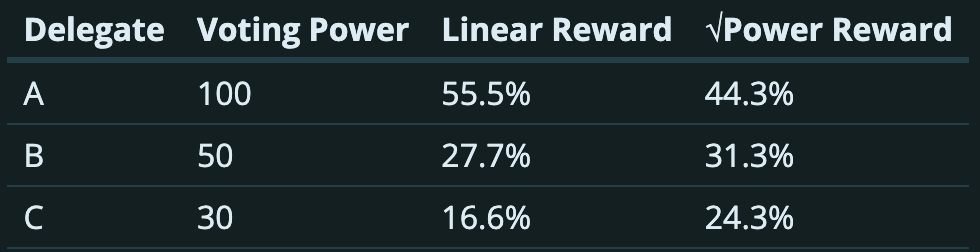This curve **flattens the advantage** of large delegates and better rewards smaller but engaged participants.
### Goals
* Reward active participation in governance
* Reward token holders for delegating to active delegates. Alternatively, token holders can earn rewards by participating directly.
* Support long-term commitment to Obol governance.
### How it works
Obol would upgrade the existing staking system to add new requirements:
* Stakers would only be eligible for rewards if they’re delegated to an “active” delegate
* “Active” would be defined as having a minimum DRS.
* Obol Association will align with DRS Provider on how to calculate a delegate’s DRS. A first (subject to modification) calculation model is outlined below.
* 165,000 OBOL tokens (equivalent to 10% of the global staking rewards pool for the first 6 months of staking) from a separate delegate reward pool (independent of staking rewards) would be distributed to active delegates, proportional to their voting power.
## DRS Integration
As part of this initiative, the Obol Collective is currently evaluating multiple potential scoring system providers, including but not limited to [Karma](https://www.karmahq.xyz/) and [Curia](https://www.curialab.xyz/). While both offer viable approaches to delegate reputation scoring, their integration timelines, oracle compatibility, and infrastructure readiness may vary. DRS will use a single oracle implementation per cycle. Karma and Curia have confirmed compatibility with Tally and can operate off the same version-controlled logic.
*To ensure implementation proceeds smoothly post-approval, this proposal grants the Obol Association, in collaboration with Tally, the authority to select the most technically viable and aligned provider for the first deployment of the Delegate Reputation Score.*
This flexibility allows the Collective to:
* Launch the scoring system without delays,
* Maintain compatibility with Tally’s staking and governance UI,
* Optionally rotate or expand to additional providers in future phases, based on performance and community feedback.
* Regardless of the initial provider selected, the DRS calculation logic will remain **publicly auditable**, version-controlled, and subject to future governance updates
### Delegate Reputation Score (DRS)
DRS defines who is eligible to receive rewards and ensures that rewards go to delegates who are consistently participating. It is calculated as a **moving average over the past 63 days (equivalent to three voting cycles)**, designed to reflect **recent contributions** rather than reputational inertia. Because DRS is based on a rolling 63-day window, scores naturally decay when delegates stop participating, ensuring that rewards reflect current, not historical, legitimacy.
To ensure transparency and fairness, the DRS will be based on a composite of measurable governance activities, with the following simplified structure inspired by existing systems like Curia and Karma:
**DRS Formula:**
DRS = (Voting Participation Score × 0.40)
	 `+` (Voting Impact Score × 0.10)
	 `+` (Voting Timeliness Score × 0.15)
	 `+` (Rationale Submission Score × 0.15)
	 `+` (Forum Score × 0.20)
*Each metric is normalized on a 0–100 scale and contributes to the total Delegate Reputation Score (DRS) according to its weight. These definitions are adapted from Curia’s scoring model and may evolve based on community feedback.*
**Classification:**
* **Active**: Maintains over 65% DRS over the past 63 days (≈3 governance cycles)
* **Inactive**: Below 65% DRS
* **Ghost**: Has voting power delegated but has not voted at all
If necessary, the Association may update the DRS formula during this pilot phase, based on informal community consultation.
In the future, this formula is subject to change and can be updated through an OIP or by a working group appointed by the association through an OIP if judged necessary.
**Possible future improvements include:**
* Backup Delegations: allowing delegates to nominate fallback delegates while away, subject to DRS constraints.
* Delegator Diversity and Engagement Caps: to further mitigate whale dominance.
**Score Components:**
* **Voting Participation Score (40% weight)***We merged **Number of Votes** and **Participation Rate** into a single Voting Participation Score to avoid over-counting similar behaviors and to streamline the formula. This ensures we reward consistent, eligible participation without overweighting sheer voting volume.*
* **What it is**: A combined metric that captures both how frequently a delegate votes and how engaged they are relative to the number of proposals they were eligible to vote on. It replaces and simplifies the separate “Number of Votes” and “Participation Rate” scores into a single, more intuitive component.
* **How it works**:
* Each delegate’s voting frequency is calculated as a percentage of all proposals they were eligible to vote on within the rolling 63-day window. This raw participation percentage (e.g., voting on 8 out of 10 proposals yields a score of 80) is used directly as the Voting Participation Score.
* **Why it matters**: Raw vote counts can over-reward large or early delegates. Participation rate alone doesn’t capture effort in contexts where proposal volume varies. This unified score reflects a delegate’s sustained commitment to governance without overemphasizing raw numbers or diluting quality signals.
* **Voting Impact Score (10% weight)**
* **What it is**: Measures **how much influence** a delegate had in the votes they participated in.
* **How it works**: For each proposal, it calculates the share of voting power a delegate used compared to the total votes cast. Then it averages that across all proposals and normalizes to 0–100.
* **Why it matters**: This score distinguishes delegates who cast high-weight, meaningful votes from those with little impact, helping highlight influential decision-makers.
* **Voting Timeliness Score (15% weight)**
* **What it is**: Time-decay model that rewards delegates who vote early, reflecting their proactive engagement. This method balances the encouragement of timely participation with fairness to all delegates.
* **How it works**:
* Votes cast within the first 48 hours receive a score of 100. After 48 hours, the score decays linearly to 0 by the end of the voting period. For example, in a 5-day (120-hour) voting window, the score decreases by approximately 1.39 points per hour after the initial 48 hours. This approach maintains transparency and avoids complexity introduced by additional bonus layers.
* **Why it matters**: Rewards **early and proactive** governance participation. Discourages last-minute or opportunistic voting.
* **Rationale Submission Score (15% weight)**
* **What is is**: A new scoring component within the Delegate Reputation Score (DRS) that rewards delegates for submitting written rationales on the Forum explaining their votes. This reinforces transparency and supports informed delegation decisions.
* **How it works**:
* Delegates receive points based on the timeliness of their rationale submissions:
### Rationale Submission Timing-bonus options
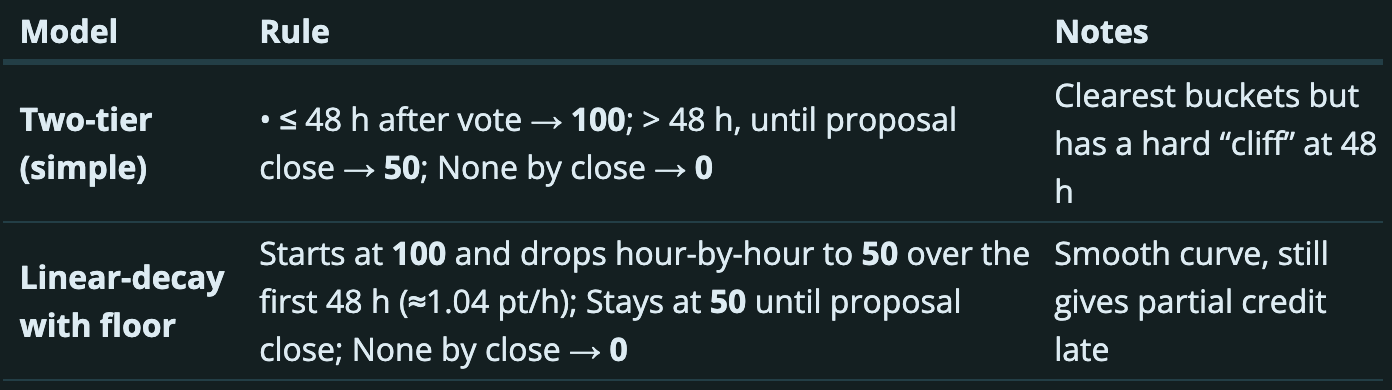
Raw points from either model already sit on a 0–100 scale, ready to plug into the 15 % weight. 
#### **Standardizing the rationale format**
Delegates shall follow this template when posting voting rationale:
`Vote: For / Against / Abstain`
`Rationale: <concise reasoning here>`
* **Why it matters**: Providing voting rationales is a governance best practice. It helps token holders understand the thinking behind a vote, increases trust, and reinforces a culture of accountability. This scoring mechanism encourages consistency without introducing heavy evaluation processes, with quality assessment to be considered in future iterations.
* **Forum Score (20% weight)**
* **What it is:** Measures off-chain engagement in the governance forum (posts, comments, discussions).
* **How it works**: Derived from multiple signals like number of proposal discussions joined, topics started, likes received, and reading activity. Normalized and simplified for the MVP.
* **Why it matters**: Delegates who contribute in the forum often shape decisions early and improve proposal quality. This score rewards those who help make governance deliberative, not just performative.
### Integration details
* Smart contract changes required to enable Oracle listener.
* DRS Oracle will score and flag “active” delegates based on voting and proposal participation.
* Tally will handle coordination and UI updates to integrate DRS into delegate profiles.
## User interface
* **Tally will add support for delegate compensation to the UI**
* Tokenholders would be able to see delegates’ DRS scores and eligibility statuses when staking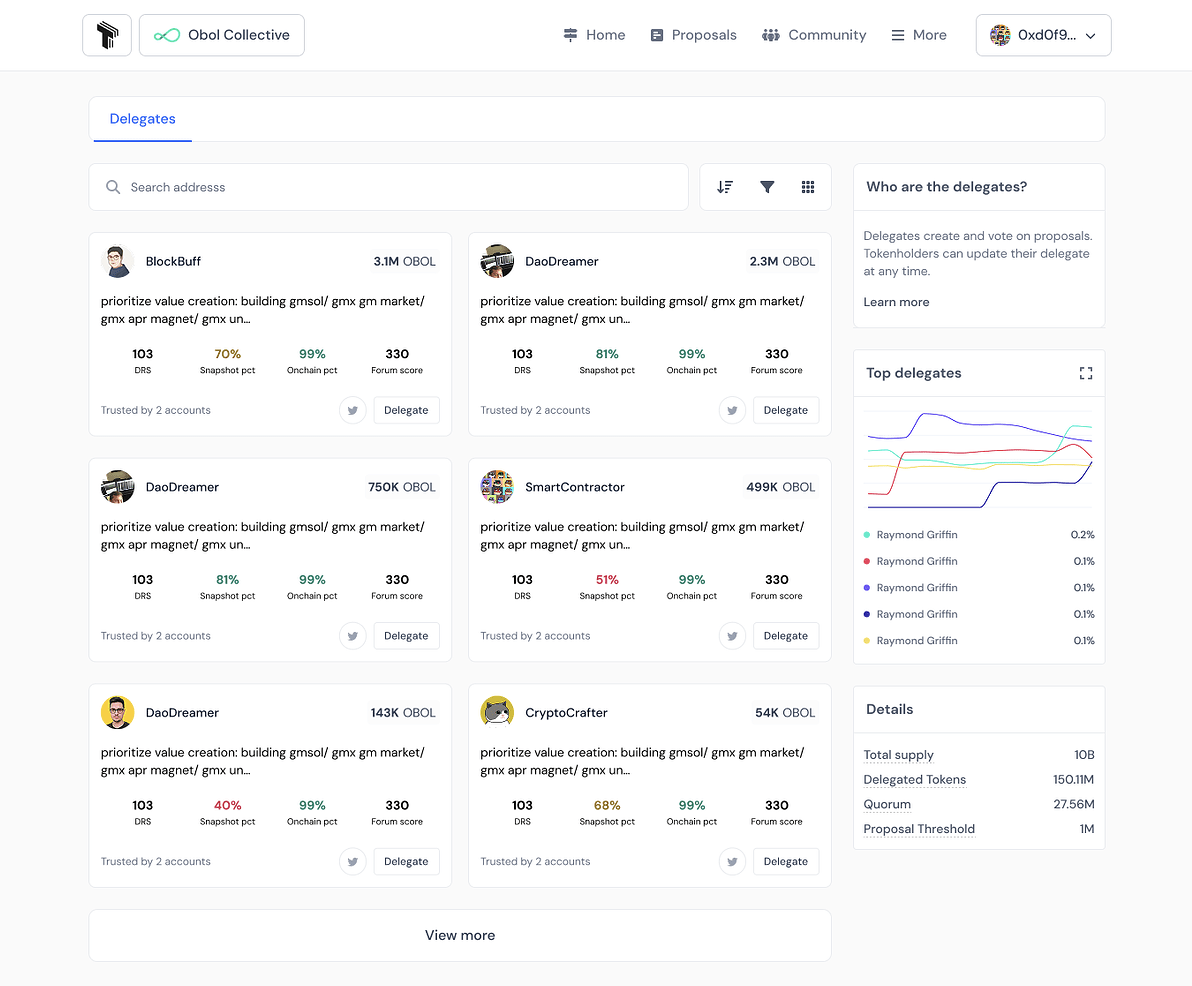
<!---->
* Delegates would be able to see and claim their accrued rewards from their profile page
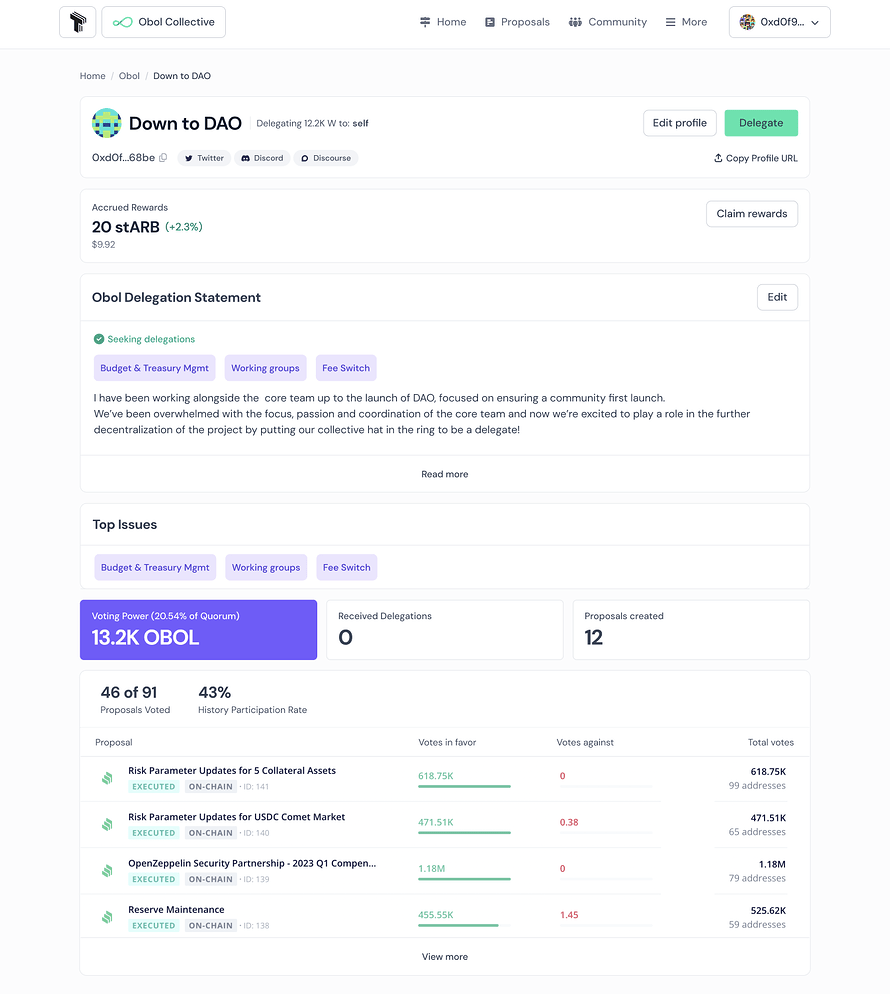
* These features would be live at both [vote.obol.org/stake](http://vote.obol.org/stake) and tally.xyz/gov/obol/stake
* **Eligibility requirements**:
* Must be deemed “active” by DRS Oracle (details below).
### Technical scope
* Implement a new [earning power calculator](https://github.com/withtally/staker/tree/main/src/calculators) smart contract that sends rewards to active delegates
* Front-end UI components
* Show eligibility and DRS when delegating
* Let delegates see and claim their rewards
* Dependency, not included in scope: Obol to set up DRS Oracle
* Dependency, not included in scope: DRS Oracle to put scores on-chain
## Forum Integration of DRS
In addition to incorporating DRS into staking and delegation flows, the Obol Collective is exploring ways to extend DRS visibility into the governance forum. This would allow delegates to link their forum accounts to their on-chain identities and display their DRS alongside posts and comments.
This feature would serve two purposes:
* Help delegates verify their identity across platforms, increasing trust in discussion.
* Allow token holders to better contextualise forum participation with transparent reputation signals.
This integration is currently under technical review. If confirmed, it could be implemented either by Tally or funded through a small standalone grant, similar to the below proposed Telegram alert feature. A future update will provide details if this path is pursued.
## UI and Notification Features
* Tally will **replace the Top Delegates leaderboard with a DRS-based version**, rather than sorting by raw voting power.
* Curia, Karma, and others may build complementary interfaces that enrich DRS displays drawing on both on-chain metrics and forum-based engagement data
* We are exploring a **Telegram notification bot** that alerts token holders when their delegate falls below the DRS threshold — making delegation more transparent and responsive. This feature could be built by Tally or developed separately through a small grant. This feature would help build trust in delegation by reducing the perceived risk of picking the ‘wrong’ delegate.
## Review Cycle and Governance Flexibility
**This proposal is structured as a pilot with a defined review window:**
* The 165,000 OBOL pool will be distributed over 6-month, until the current reward pool is empty.
* Afterward, the DAO will:
* Re-evaluate the efficacy of the system
* Assess participation trends and feedback
* assess whether the model improves legitimacy and delegation confidence
* Consider improvements or expansion
**Future changes and improvements may include:**
* Adjust the reward percentage
* Merge rewards into the staking pool
* Update the DRS formula (e.g: DRS-weighted)
* Incorporate a notification system
* Peer-review-based assessment mechanism of the rationale submissions (as part of DRS)
* Forum integration of DRS
* Incorporating delegator diversity or engagement-weighted caps may be explored to further decentralise influence
## Cost
Total: $65,000
* Delegate compensation implementation:
* Smart contract development: $35,000
* Smart contract audit: $20,000 — estimated; if additional audit funding is needed, Tally will submit a follow-up request
* Frontend development and QA: $10,000
* Including DRS integration
While initial reward pool value is lower than implementation cost, the tooling is reusable across future cycles and proposals.
*A note on cost:*
While Obol is the first DAO to adopt this combination of staking rewards and DRS-based delegate incentives, it’s not necessarily bearing the full cost long-term.
* This implementation requires custom development tailored to Obol’s needs. That includes specific design, oracle integration, and UI work.
* The oracle for DRS is per-DAO — each new DAO that adopts staking + DRS will need its own feed integration, which is not directly reusable from Obol’s implementation.
* Each DAO has different requirements, and Obol’s solution is custom-built on a shared foundation ([Tally staking contracts](https://github.com/withtally/staker)). This is typical for early integrations of a new product line, where the core system is extensible but tailored components are needed per implementation.
## Action Plan
* May 14 - May 21: Post proposal on forum for feedback, get approval from 4 top-100 delegates
* May 22 - June 28: Submit proposal on Tally for on-chain voting
* May 29: Tally to begin technical development. During this time, Tally will also get to final alignment with Obol Association on (a) delegate reward pool specs and (2) definition of an “active delegate” by DRS.
* June 25: Begin audit for contracts
* July 16: Launch delegate compensation mechanism and DRS integration.
## Conclusion
This is a measured first step toward building a governance system where effort, not only stake, drives long-term influence.
It’s also an opportunity to test legitimacy and transparency while retaining flexibility to evolve. Delegates, token holders, and contributors will shape the next version together.
### Disclaimer
*This proposal should not be relied on as legal, tax, or investment advice. Any projections included here are based on our best estimates and presented for informational purposes only.*
# [RRC-43] Rari Staking Incentives Program
## **Abstract:**
Following the approval of [RRC-30](https://www.tally.xyz/gov/rari-foundation/proposal/85102068202527969889208024703113668965813715410446115075088330064807449302588), Rari DAO began transitioning the $RARI token and governance to the Arbitrum ecosystem. The community has already approved the implementation of [RARI staking](https://forum.rari.foundation/t/enable-rari-staking/2073) to enhance the governance and security of the RARI protocol.
This proposal specifically seeks approval for:
1. Initial funding budget of 60,000 $RARI from the DAO treasury for staking incentives.
2. A twelve-month staking incentives program to be launched on Rari Chain.
3. Continuous tracking and monthly reporting to optimize the program rewards.
Implementing these staking incentives together with the already-approved staking mechanism will maximize its impact on the DAO’s governance participation and token value.
## Motivation:
The Rari DAO is undergoing a significant transition from the Ethereum mainnet to Rari Chain. This migration is a critical milestone for the DAO’s evolution, aimed at improving governance efficiency, reducing transaction costs, and enhancing the scalability of the protocol. However, the success of this migration depends heavily on user participation and the seamless integration of existing governance mechanisms into the new environment.
The current governance model relies on Rari tokens locked in veRari contracts on Ethereum mainnet. For the migration to Rari Chain to be effective, these staked tokens must be unstaked, bridged, and delegated on Rari Chain. Without sufficient incentives, users may hesitate to migrate their tokens - especially early on. While mainnet utility isn’t lost, since tokens can be wrapped and used for governance after the upgrade, incentives will still be key to drive early staking and adoption of the new RARI L2 token standard.
Two of Rari DAO’s most important goals are to improve governance participation and increase the utility of the $RARI token, both of which are significantly advanced by the introduction of RARI governance staking, developed by Tally. In this contract, $RARI stakers that delegate their voting power to an eligible delegate will receive staking rewards. Adding staking rewards will further motivate token holders to migrate and contribute to governance, ensuring stronger alignment with the DAO’s overall objectives and enhancing the utility of the $RARI token by providing tangible benefits to participants.
## Rationale:
This proposal establishes a fixed-term (twelve-month) incentives program to jumpstart governance participation. To incentivize early bridging and staking, the incentives will be scheduled in three phases (see specification) with diminishing rewards over time plus a one-time bridging Quests for early users. The initial goal is to attract a similar amount of $RARI as currently sits into the ve-contract in Ethereum, ~300,000 $RARI, to the governance staking contract in Rari Chain.
The staking mechanism supports both direct voter participation and the option for token holders to delegate their voting power to active community members, creating multiple pathways for governance engagement while still earning rewards.
The long-term vision is for staking incentives to be sustainably funded from the DAO’s revenue streams. After this initial period concludes, a new proposal will be required to continue the staking rewards program, ideally transitioning to the self-sustaining model derived from DAO revenue.
The progress of the program will be tracked and reported monthly by StableLab. Reports will be posted in the forum for the DAO to discuss, along with recommendations on next steps.
KPIs to track include the following (more can be added in the future):
* Number of delegated RARI tokens.
* Number of wallets staked.
* Numbers of delegates receiving delegation.
* Unique proposal voters.
## Key Terms:
* RARI token: RARI DAO governance token
* RARI DAO: body governing the Rarible Protocol and RARI chain
* Arbitrum ecosystem: Arbitrum One and RARI chain L3
## Specification
### Staking Rewards Mechanics:
In the governance staking contract, rewards are distributed proportionally to the amount of $RARI staked. We calculated the amount of $RARI to allocate for rewards based on an APR estimation for 300,000 $RARI migrating and delegating to Rari Chain:
* Target APR: An attractive yield of 25% (Phase 1), 15% (Phase 2) and 10% (Phase 3) annualized return to attract stakers, balancing the risk of holding $RARI on Rari Chain against typical crypto yields (e.g., 3-3.3% for ETH staking, 4.5% for Sky’s USDS).
### Reward Calculations:
As each Phase lasts 4 months, to estimate the amount of Rari to yield each target APR we must calculate:
$RARI incentives = 300,000 (Staked $RARI estimation) \* Target APR \* 4 months (Phase duration) / 12 months (annualized returns)
Therefore,
* Phase 1 (months 1-4): 25,000 $RARI.
* Phase 2 (months 5-8): 15,000 $RARI.
* Phase 3 (months 9-12): 10,000 $RARI.
Additionally, 10,000 $RARI will be allocated to Quests for bridging into Rari Chain to kickstart Phase 1.
## Steps to Implement
Upon successful approval of this proposal on Tally, 60,000 $RARI will be sent to the Foundation’s SAFE on mainnet (**0x2a83d2891Ef3df6967E3C2e9b69cCc7aD029736B)**.
Then, Rari Foundation will bridge the funds to Rari Chain and deposit them into the DAO Treasury at **0x83CBaF64b94D1eDfeDd468b23234DeCf2AecDD8b.**
The Governance Staking contract will then be given permission to allocate funds as staking rewards based on the outlined reward structure, through a DAO-approved proposal on RARI Chain (more details on governance staking [here 1](https://docs.tally.xyz/tally-features/staking/stgov-lst)).
## Overall Cost:
Overall costs: 60,000 $RARI
* 10,000 $RARI for Superboard bridging Quests.
* 50,000 $RARI for staking rewards.
# RRC-43: RARI DAO Delegate Incentive Program
## **Abstract:**
Following the approval of [RRC-30 3](https://www.tally.xyz/gov/rari-foundation/proposal/85102068202527969889208024703113668965813715410446115075088330064807449302588), Rari DAO began transitioning the $RARI token and governance to the Arbitrum ecosystem. The community has already approved the implementation of [RARI staking](https://forum.rari.foundation/t/enable-rari-staking/2073) to enhance the governance and security of the RARI protocol.
This proposal specifically seeks approval for:
1. Initial funding budget of 60,000 $RARI from the DAO treasury for staking incentives.
2. A twelve-month staking incentives program to be launched on Rari Chain.
3. Continuous tracking and monthly reporting to optimize the program rewards.
Implementing these staking incentives together with the already-approved staking mechanism will maximize its impact on the DAO’s governance participation and token value.
## Motivation:
The Rari DAO is undergoing a significant transition from the Ethereum mainnet to Rari Chain. This migration is a critical milestone for the DAO’s evolution, aimed at improving governance efficiency, reducing transaction costs, and enhancing the scalability of the protocol. However, the success of this migration depends heavily on user participation and the seamless integration of existing governance mechanisms into the new environment.
The current governance model relies on Rari tokens locked in veRari contracts on Ethereum mainnet. For the migration to Rari Chain to be effective, these staked tokens must be unstaked, bridged, and delegated on Rari Chain. Without sufficient incentives, users may hesitate to migrate their tokens - especially early on. While mainnet utility isn’t lost, since tokens can be wrapped and used for governance after the upgrade, incentives will still be key to drive early staking and adoption of the new RARI L2 token standard.
Two of Rari DAO’s most important goals are to improve governance participation and increase the utility of the $RARI token, both of which are significantly advanced by the introduction of RARI governance staking, developed by Tally. In this contract, $RARI stakers that delegate their voting power to an eligible delegate will receive staking rewards. Adding staking rewards will further motivate token holders to migrate and contribute to governance, ensuring stronger alignment with the DAO’s overall objectives and enhancing the utility of the $RARI token by providing tangible benefits to participants.
## Rationale:
This proposal establishes a fixed-term (twelve-month) incentives program to jumpstart governance participation. To incentivize early bridging and staking, the incentives will be scheduled in three phases (see specification) with diminishing rewards over time plus a one-time bridging Quests for early users. The initial goal is to attract a similar amount of $RARI as currently sits into the ve-contract in Ethereum, ~300,000 $RARI, to the governance staking contract in Rari Chain.
The staking mechanism supports both direct voter participation and the option for token holders to delegate their voting power to active community members, creating multiple pathways for governance engagement while still earning rewards.
The long-term vision is for staking incentives to be sustainably funded from the DAO’s revenue streams. After this initial period concludes, a new proposal will be required to continue the staking rewards program, ideally transitioning to the self-sustaining model derived from DAO revenue.
The progress of the program will be tracked and reported monthly by StableLab. Reports will be posted in the forum for the DAO to discuss, along with recommendations on next steps.
KPIs to track include the following (more can be added in the future):
* Number of delegated RARI tokens.
* Number of wallets staked.
* Numbers of delegates receiving delegation.
* Unique proposal voters.
## Key Terms:
* RARI token: RARI DAO governance token
* RARI DAO: body governing the Rarible Protocol and RARI chain
* Arbitrum ecosystem: Arbitrum One and RARI chain L3
## Specification
### Staking Rewards Mechanics:
In the governance staking contract, rewards are distributed proportionally to the amount of $RARI staked. We calculated the amount of $RARI to allocate for rewards based on an APR estimation for 300,000 $RARI migrating and delegating to Rari Chain:
* Target APR: An attractive yield of 25% (Phase 1), 15% (Phase 2) and 10% (Phase 3) annualized return to attract stakers, balancing the risk of holding $RARI on Rari Chain against typical crypto yields (e.g., 3-3.3% for ETH staking, 4.5% for Sky’s USDS).
### Reward Calculations:
As each Phase lasts 4 months, to estimate the amount of Rari to yield each target APR we must calculate:
$RARI incentives = 300,000 (Staked $RARI estimation) \* Target APR \* 4 months (Phase duration) / 12 months (annualized returns)
Therefore,
* Phase 1 (months 1-4): 25,000 $RARI.
* Phase 2 (months 5-8): 15,000 $RARI.
* Phase 3 (months 9-12): 10,000 $RARI.
Additionally, 10,000 $RARI will be allocated to Quests for bridging into Rari Chain to kickstart Phase 1.
## Steps to Implement
Upon successful approval of this proposal on Tally, 60,000 $RARI will be sent to the Foundation’s SAFE on mainnet (**0x2a83d2891Ef3df6967E3C2e9b69cCc7aD029736B)**.
Then, Rari Foundation will bridge the funds to Rari Chain and deposit them into the DAO Treasury at **0x83CBaF64b94D1eDfeDd468b23234DeCf2AecDD8b.**
The Governance Staking contract will then be given permission to allocate funds as staking rewards based on the outlined reward structure, through a DAO-approved proposal on RARI Chain (more details on governance staking [here 1](https://docs.tally.xyz/tally-features/staking/stgov-lst)).
## Overall Cost:
Overall costs: 60,000 $RARI
* 10,000 $RARI for Superboard bridging Quests.
* 50,000 $RARI for staking rewards.
# RRC-43: RARI DAO Delegate Incentive Program
## **Abstract:**
Following the approval of [RRC-30 3](https://www.tally.xyz/gov/rari-foundation/proposal/85102068202527969889208024703113668965813715410446115075088330064807449302588), Rari DAO began transitioning the $RARI token and governance to the Arbitrum ecosystem. The community has already approved the implementation of [RARI staking](https://forum.rari.foundation/t/enable-rari-staking/2073) to enhance the governance and security of the RARI protocol.
This proposal specifically seeks approval for:
1. Initial funding budget of 60,000 $RARI from the DAO treasury for staking incentives.
2. A twelve-month staking incentives program to be launched on Rari Chain.
3. Continuous tracking and monthly reporting to optimize the program rewards.
Implementing these staking incentives together with the already-approved staking mechanism will maximize its impact on the DAO’s governance participation and token value.
## Motivation:
The Rari DAO is undergoing a significant transition from the Ethereum mainnet to Rari Chain. This migration is a critical milestone for the DAO’s evolution, aimed at improving governance efficiency, reducing transaction costs, and enhancing the scalability of the protocol. However, the success of this migration depends heavily on user participation and the seamless integration of existing governance mechanisms into the new environment.
The current governance model relies on Rari tokens locked in veRari contracts on Ethereum mainnet. For the migration to Rari Chain to be effective, these staked tokens must be unstaked, bridged, and delegated on Rari Chain. Without sufficient incentives, users may hesitate to migrate their tokens - especially early on. While mainnet utility isn’t lost, since tokens can be wrapped and used for governance after the upgrade, incentives will still be key to drive early staking and adoption of the new RARI L2 token standard.
Two of Rari DAO’s most important goals are to improve governance participation and increase the utility of the $RARI token, both of which are significantly advanced by the introduction of RARI governance staking, developed by Tally. In this contract, $RARI stakers that delegate their voting power to an eligible delegate will receive staking rewards. Adding staking rewards will further motivate token holders to migrate and contribute to governance, ensuring stronger alignment with the DAO’s overall objectives and enhancing the utility of the $RARI token by providing tangible benefits to participants.
## Rationale:
This proposal establishes a fixed-term (twelve-month) incentives program to jumpstart governance participation. To incentivize early bridging and staking, the incentives will be scheduled in three phases (see specification) with diminishing rewards over time plus a one-time bridging Quests for early users. The initial goal is to attract a similar amount of $RARI as currently sits into the ve-contract in Ethereum, ~300,000 $RARI, to the governance staking contract in Rari Chain.
The staking mechanism supports both direct voter participation and the option for token holders to delegate their voting power to active community members, creating multiple pathways for governance engagement while still earning rewards.
The long-term vision is for staking incentives to be sustainably funded from the DAO’s revenue streams. After this initial period concludes, a new proposal will be required to continue the staking rewards program, ideally transitioning to the self-sustaining model derived from DAO revenue.
The progress of the program will be tracked and reported monthly by StableLab. Reports will be posted in the forum for the DAO to discuss, along with recommendations on next steps.
KPIs to track include the following (more can be added in the future):
* Number of delegated RARI tokens.
* Number of wallets staked.
* Numbers of delegates receiving delegation.
* Unique proposal voters.
## Key Terms:
* RARI token: RARI DAO governance token
* RARI DAO: body governing the Rarible Protocol and RARI chain
* Arbitrum ecosystem: Arbitrum One and RARI chain L3
## Specification
### Staking Rewards Mechanics:
In the governance staking contract, rewards are distributed proportionally to the amount of $RARI staked. We calculated the amount of $RARI to allocate for rewards based on an APR estimation for 300,000 $RARI migrating and delegating to Rari Chain:
* Target APR: An attractive yield of 25% (Phase 1), 15% (Phase 2) and 10% (Phase 3) annualized return to attract stakers, balancing the risk of holding $RARI on Rari Chain against typical crypto yields (e.g., 3-3.3% for ETH staking, 4.5% for Sky’s USDS).
### Reward Calculations:
As each Phase lasts 4 months, to estimate the amount of Rari to yield each target APR we must calculate:
$RARI incentives = 300,000 (Staked $RARI estimation) \* Target APR \* 4 months (Phase duration) / 12 months (annualized returns)
Therefore,
* Phase 1 (months 1-4): 25,000 $RARI.
* Phase 2 (months 5-8): 15,000 $RARI.
* Phase 3 (months 9-12): 10,000 $RARI.
Additionally, 10,000 $RARI will be allocated to Quests for bridging into Rari Chain to kickstart Phase 1.
## Steps to Implement
Upon successful approval of this proposal on Tally, 60,000 $RARI will be sent to the Foundation’s SAFE on mainnet (**0x2a83d2891Ef3df6967E3C2e9b69cCc7aD029736B)**.
Then, Rari Foundation will bridge the funds to Rari Chain and deposit them into the DAO Treasury at **0x83CBaF64b94D1eDfeDd468b23234DeCf2AecDD8b.**
The Governance Staking contract will then be given permission to allocate funds as staking rewards based on the outlined reward structure, through a DAO-approved proposal on RARI Chain (more details on governance staking [here 1](https://docs.tally.xyz/tally-features/staking/stgov-lst)).
## Overall Cost:
Overall costs: 60,000 $RARI
* 10,000 $RARI for Superboard bridging Quests.
* 50,000 $RARI for staking rewards.
"
# RRC-40: RARI DAO Delegate Incentive Program
**Authors:** @sixty, @bitblondy, @cr1st0f
# Abstract
The RARI DAO Delegate Incentive Program intends to enhance governance participation within RARI DAO by rewarding active and engaged delegates.
By aligning incentives with governance activity, the program aims to enhance decision-making, improve voter turnout, and strengthen the DAO’s long-term sustainability and security. The goal is to create a more resilient, secure, and effective governance framework that empowers the RARI ecosystem and drives the DAO’s continued growth.
# Motivation
Effective governance is vital to RARI DAO’s success. Currently, delegates who review proposals, participate in discussions, and vote on key decisions receive no direct rewards, risking disengagement, voter apathy, and over-reliance on a few committed individuals. To address this, we propose a Delegate Incentive Program that offers compensation and enhanced voting power. This program aims to encourage long-term participation, attract high-quality contributors, and align delegate interests with the RARI ecosystem.
Low participation rates and a small pool of active delegates reduce proactive contributions. An improved incentive program could attract experienced community members and skilled governance professionals, leading to better decision-making. While the Delegate Launchpad has drawn in new delegates, it does not reward ongoing engagement and forces active delegates to reapply for foundation delegations. Introducing continuous rewards will help build voting power and ensure long-term stability for the DAO.
Compensating delegates aligns with [best practices seen in other DAOs](https://docs.google.com/presentation/d/1tIbDpeqpCmDHtAL40G15AzjpvSIc_FpgO8L8Z2DQUUU/edit) (examples [1](https://gov.uniswap.org/t/uniswap-delegate-reward-initiative-cycle-3/25241), [2](https://forum.arbitrum.foundation/t/proposal-delegate-incentive-program-dip/26496), [3](https://forum.scroll.io/t/delegate-incentive-programs-daostar-research/470)), and it is generally accepted that delegate incentives drive stronger engagement, higher proposal quality, and a more decentralized decision-making process. By implementing this program, RARI DAO can build a more robust governance system, ensuring that those responsible for guiding the protocol’s future are both empowered and supported.
# Rationale
The RARI DAO Delegate Incentive Program directly aligns with the DAO’s mission to foster decentralized, transparent, and high-quality governance that drives sustainable ecosystem growth.
# Specification
## Budget ($31,500 per quarter)
* **$10,000** (in RARI) monthly, split amongst all the active delegates. RARI price will be the average price at the daily close for the month in question.
* **$500** (in RARI) monthly for administration. RARI price will be the average price at the daily close for the month in question.
## Frequency of Payment
### Quarterly
* An onchain proposal to reward delegates for their contributions will be shared at the end of each quarter.
* The reward system will be retroactive, starting January 1st, 2025, and will initially continue for 1 year when it will be reassessed.
## Eligibility Criteria
* At least 2,000 veRARI delegated ([38 delegates as of now](https://www.tally.xyz/gov/rari-foundation/proposals))
* 60% 90-day voting participation rate
* Active Delegate Thread
* Not already paid for delegate services by Foundation
## What Delegate Activities should be rewarded
Rewards will be distributed based on 3 criteria. We have chosen these criteria as we believe they fall in line with the expectations of any delegate in a DAO. For simplicity's sake, we have chosen to go with only 3 for now, intending to expand them if the community/delegates see fit.
### 1. Onchain voting activity - 100 Points
Onchain voting refers to voting activity on onchain proposals on the [RARI DAO Tally](https://www.tally.xyz/gov/rari-foundation/proposals). Participation in all votes for that quarter will result in a delegate receiving 100 Points. 100 Points is the maximum, and if a delegate misses certain votes, their points will be equivalent to the % of votes that they voted in.
Deducting points for missing votes will create an additional incentive for delegates to participate in every onchain vote, bolstering the strength of our governance process.
### 2. Active delegate thread - 100 Points
Each delegate should maintain an active delegate thread on the [RARI DAO governance forum](https://forum.rari.foundation/latest). A delegate thread is a post on the governance forum where a delegate introduces themselves and explains their governance philosophy and other relevant details about the delegate. The [DAOplomats delegate thread](https://forum.rari.foundation/t/daoplomats-delegate-thread/2157) here is a perfect example.
Delegates should reply within their delegate thread after each vote with reasoning as to why they voted the way they did. If the delegate previously left a ‘comment’ on the proposal’s forum post, they can reference this comment as their voting rationale in their thread.
A delegate’s comment on their rationale thread (or linked comment left on the proposal) should include:
* Clearly state if they voted **For**, **Against**, or **Abstained**
* Reasons for **Support** / **Opposition** of the proposal
* If they voted Against or had concerns, **suggest improvements**.
* If they voted For but see areas for iteration, **mention them**.
We encourage delegates to be genuine in their comments, including whether they might not have properly understood the proposal so we can work on adding more avenues for collective learning. Also, we encourage delegates to give well-thought-out responses and feedback rather than submitting *generic AI responses*. Complaints and/or concerns should also be presented with the aim of providing *constructive criticism*, such as solutions or alternatives for your complaint/concerns.
Points for maintaining an active delegate thread will be distributed only for voting rationale on onchain votes (Tally). Therefore, these points will be calculated as a percentage of total onchain votes for that quarter.
Delegate threads should be completed before the end of the quarter.
### 3. Proposal Creation - 150 Points / 200 Points
If a proposal is passed, a single author will receive 150 additional points. If there are multiple authors, they will split 200 points amongst themselves.
Proposals that already intend rewards toward the authors (e.g., receiving a grant or setting up a paid working group) shall not be additionally rewarded.
## Reward Distribution Methodology
At the end of the quarter, all points earned by delegates will be tallied up and summed together. This means all the points delegates earned will be added together. After adding all the points, we will divide the total points by the fixed reward pool for the quarter ($30,000). This will allow us to determine the price per point.
Once the price per point is determined for the quarter, rewards will be distributed in proportion to the points a delegate has earned for the quarter.
## How should we keep track of rewarded activities?
### Administration
**daospace** will handle the administration of the delegate incentive program by combining onchain and offchain data tracking to provide a clearer picture of delegate activity each month, with the aim to automate the process and provide real-time tracking.
### Review Period
DAO members will review the quarterly report for any inconsistencies and inaccuracies before an onchain proposal is posted; this is to ensure that delegate payouts are accurate and fair.
### KPIs
It is important to track KPIs for any incentive program. As there are two main components to the incentivization strategy, voting and passed proposals, it is proposed that these make up the KPIs for tracking the success of this proposal. The KPIs to be tracked and reported on are, therefore:
* Number of active voters.
* Average vote participation rate for active voters.
* Average $RARI voting on proposals.
* Number of proposals passed per quarter.
# Proposed Timeline
**1st January - 31st March, 2025** - Delegate Rewards period Q1
**First Week of April, 2025** - Delegate Rewards Report Q1 is shared on the forum for feedback
**Second Week of April, 2025** - Delegate Rewards Proposal Q1 is posted on Tally
# Overall Cost
The cost of this proposal is **$31,500 per quarter** with the proposed programme running for one year at a total cost to the DAO of **$126,000 per year**. The dollar conversion to RARI will use the average price over any time period being considered.
# RRC-39: Multichain Primary & Secondary Protocol Fees
[<img height="345" width="690" alt="image" src="https://forum.rari.foundation/uploads/default/optimized/1X/acf3ffc692f04807d32c87b1b64e09ba1539f29a_2_690x345.jpeg" />image3000×1500 1 MB](https://forum.rari.foundation/uploads/default/original/1X/acf3ffc692f04807d32c87b1b64e09ba1539f29a.jpeg "image")
Proposal author: StableLab 
Review and feedback: Rari Foundation
## Abstract
This proposal seeks to grant the Rari Foundation a mandate to collaborate with Rarible on implementing multichain protocol fee collection and designing a primary protocol fee structure for NFT mints. By doing so, the DAO aims to capture missed revenue from secondary trading across all supported chains and introduce a new, DAO-managed revenue stream for primary sales (mints).
***
## Motivation
After the implementation of [\[RRC-28\]](https://www.tally.xyz/gov/rari-foundation/proposal/64443561092723928501818567121519051108693422626070463342810224372241233243885), Rari DAO collects secondary fees in Ethereum mainnet. However, the existing Rari DAO setup does not yet have robust multichain fee collection mechanisms in place, causing the DAO to forgo potential revenue from additional secondary trading. Additionally, there is currently no DAO-controlled protocol fee for primary NFT mints, leaving an opportunity for Rarible (or other marketplaces) to collect fees unilaterally. Enabling multichain fee collection and introducing a primary fee will strengthen the DAO’s treasury and align Rari DAO’s longer-term mission of protocol sustainability and growth with the performance Rarible, the biggest app built on top of Rari Protocol.
To add some numbers, in 2024, Rarible primary sales totaled ~ $230,000, while secondary sales totaled north of $9.7M during the same period ([Rarible Dune dashboard 1](https://dune.com/sealaunch/rarible-ethereum-polygon)), of which only ~34% happened in Ethereum mainnet. Therefore, ~66% of secondary volume happened in sidechains and L2s.
[<img height="467" width="351" src="https://forum.rari.foundation/uploads/default/optimized/1X/e0abacbd837b7c2c58efb832b52279011848a95b_2_351x467.png" />958×1270 57.8 KB](https://forum.rari.foundation/uploads/default/original/1X/e0abacbd837b7c2c58efb832b52279011848a95b.png)
*(Top) Rarible total volume in the last year coloured by category (primary/secondary). (Bottom) Distribution of volume by chain in the last 180 days.*
***
## Rationale
**New sources of revenue**: Based on 2024 primary and secondary sales data, and with an estimate of a 0.5% protocol fee on both sales categories (as it is currently applied in Ethereum secondary sales), the DAO could be earning an additional ~$33,000 over 2025 if NFT volume projections remain constant.
**Alignment with Rari DAO’s Mission**: The DAO’s primary objective is to ensure sustainable growth and revenue streams that support ongoing development, innovation, and community engagement in the Rari ecosystem. Expanding fee collection to multiple chains and implementing a primary mint fee directly address this objective.
**Incentives alignment with Rarible**: By leveraging Rarible’s existing infrastructure and user base, the DAO can quickly tap into new revenue. This implies that DAO-led programs aimed at enhancing activity at Rarible will have a direct impact on DAO revenue, creating a synergy where both entities, Rarible and the Rari DAO, benefit from each other’s success.
***
## Key Terms
**Multichain Governance**: A governance model or system that spans multiple blockchain networks, enabling consistent decision-making across chains.
**Primary Protocol Fee**: A fee applied when an NFT is minted (as opposed to a secondary fee that applies when the NFT is traded on the secondary market).
**Secondary Protocol Fee**: A fee taken from NFT sales after the initial mint (e.g., resales on marketplaces).
***
## Specifications
**Multichain Fee Collection**
The Foundation will coordinate with Rarible to enable fee collection on all chains currently supported by Rarible. Fees will be routed to the DAO treasury or a designated DAO-controlled wallet.
**Primary Protocol Fee Design**
The Foundation will work with Rarible to negotiate and configure a new primary protocol fee. This fee will replace or supplement the existing “$2 minting fee” that currently goes solely to Rarible, ensuring the DAO captures a share of that revenue.
**Governance and Compliance**
Fees and fee structures will be implemented in accordance with relevant regulations and Rari DAO’s existing governance frameworks. Any changes or adjustments to fee percentages will require the DAO’s governance approval.
***
## Steps to Implement
1. DAO Approval of Foundation Mandate (This Proposal): Secure approval from Rari DAO token holders to empower the Foundation to proceed with negotiations and technical integration.
2. Technical & Legal Preparations: The Foundation will collaborate with Rarible’s technical team to establish robust smart contract changes for fee collection on each supported chain. It will also conduct any necessary legal review or documentation required for cross-chain fee collection.
3. Fee Structure Negotiations: The Foundation will propose a new primary protocol fee structure in collaboration with Rarible. The Foundation will bring proposed fee splits and structure back to the DAO for final approval.
4. Development & Deployment: Rarible, in collaboration with the Foundation, develops and implements updated smart contracts (or configurations) to collect both secondary and newly introduced primary fees. The Foundation oversees and tests the deployment process to ensure correct operation.
5. Monitoring & Optimization: Once implemented, the Foundation and Rarible will monitor fee generation, user feedback, and overall market impact. The DAO may introduce adjustments or optimizations via subsequent governance proposals if needed.
***
## Tentative timeline
Week 2-4:
* Rari Foundation coordinates with Rarible to scope out technical requirements.
* Initial design for multichain fee collection and primary fee structure completed.
* Legal documentation (if necessary) is drafted.
Week 6-8:
* Smart contract updates and testing.
* Deployment to test environments, community feedback collected.
Week 8-10:
* Final deployment to all supported chains (Ethereum, Polygon, etc.).
* Ongoing monitoring and optimization.
***
## Overall Cost
Estimated to be minimal compared to projected revenue gains. A final cost outline will be provided once the Foundation and Rarible agree on the technical scope.
# RRC-36 Rumble.exchange - DAO Support Proposal
## **Abstract**
Rumble.exchange, the first meme coin-focused DeFi platform on Rari Chain, is seeking 10,000 $RARI tokens to scale its platform. The funding will be milestone-based, supporting development, infrastructure, and marketing initiatives aimed at driving adoption, community engagement, and ecosystem growth.
***
## **Motivation**
The Rari Chain ecosystem can benefit from the rising popularity of meme coin markets, which are proven drivers of community growth and user engagement. As the first meme coin-focused Launchpad on Rari Chain, Rumble.exchange creates a unique opportunity to establish a thriving niche and attract new users to the ecosystem.
***
## **Rationale**
Supporting Rumble.exchange aligns with the Rari Foundation's mission to foster decentralized innovation and community-led growth. By providing a platform for meme coin trading and NFT integration, Rumble.exchange increases the utility of $RARI while introducing novel use cases and strengthening ecosystem diversity.
***
## **Key Terms (optional)**
* **Bonding Curve Mechanics**: A pricing mechanism where token prices dynamically adjust based on supply and demand.
* **Launchpad/Dex**: Decentralized Launchpad/Exchange enabling peer-to-peer trading without intermediaries.
***
***
## **Timeline**
Implementation of proposed initiatives will begin immediately upon proposal approval, with first progress report delivered within 30 days.
***
## **Specifications**
**Platform Features**
* Standalone Launchpad utilizing bonding curve mechanics for meme coin trading.
* Integration of NFT functionality for launching and trading meme NFTs.
* User-friendly front-end optimized for seamless trading experiences.
**Technical Infrastructure**
* Scalable back-end architecture with enhanced security and server management.
**Marketing and Community Initiatives**
* Twitter giveaways, trading competitions, and AMAs to grow the user base.
* Educational content, video tutorials, and platform documentation.
* Organic growth strategy focused on attracting genuine users and avoiding short-term reward farming.
***
## **Steps to Implement**
To ensure transparency and accountability, Rumble.exchange will provide:
* Monthly progress reports on development, infrastructure, and marketing.
* Transparent updates on fund utilization and milestone achievements.
* Community AMAs to discuss progress, address feedback, and align on goals.
**Phase 1: Initial Development and Launch (5,000 $RARI - 50%)**
* Enhance trading features, improve UI/UX, and integrate meme NFT functionality.
* Cover infrastructure costs (server and maintenance).
* Launch marketing campaigns, including community engagement events.
**Phase 2: 3-Month Milestone (2,500 $RARI - 25%)**
* Release new features based on user feedback and KPIs.
* Expand marketing initiatives and user acquisition efforts.
* KPIs: 50+ Daily Active Users, $30,000 Monthly Trading Volume, and 2,500+ social media followers.
**Phase 3: 6-Month Milestone (2,500 $RARI - 25%)**
* Scale platform operations, security enhancements, and infrastructure upgrades.
* Host competitions and community-driven events to drive continued growth.
* KPIs: 100+ Daily Active Users, $50,000 Monthly Trading Volume, and 5,000+ social media followers.
***
## **Timeline**
* **Phase 1:** Start immediately upon approval (1 month).
* **Phase 2:** Complete 3-month KPIs and milestone report.
* **Phase 3:** Complete 6-month KPIs and final milestone report.
***
## **Overall Cost**
Total Requested: **10,000 $RARI**
* Phase 1: 5,000 $RARI (50% upfront)
* Phase 2: 2,500 $RARI (25% at 3-month milestone)
* Phase 3: 2,500 $RARI (25% at 6-month milestone)
***
## **Multi-sig policies**
* Assuming a 3-member squad, the multi-sig will be structured as 2 out of 3:
**(Forexus, Firefly808, Sidney)**
* Multi-sig address: 0xa110922a5E981e1442f2D519373f94CCd74a4B93
* 50% of the total funding will be allocated upfront to Rumble, while the remaining 50% will be deposited into a multi-signature wallet. Funds in the wallet will only be released upon achieving specified milestones, with approval required from both **Firefly808** and **Forexus**.
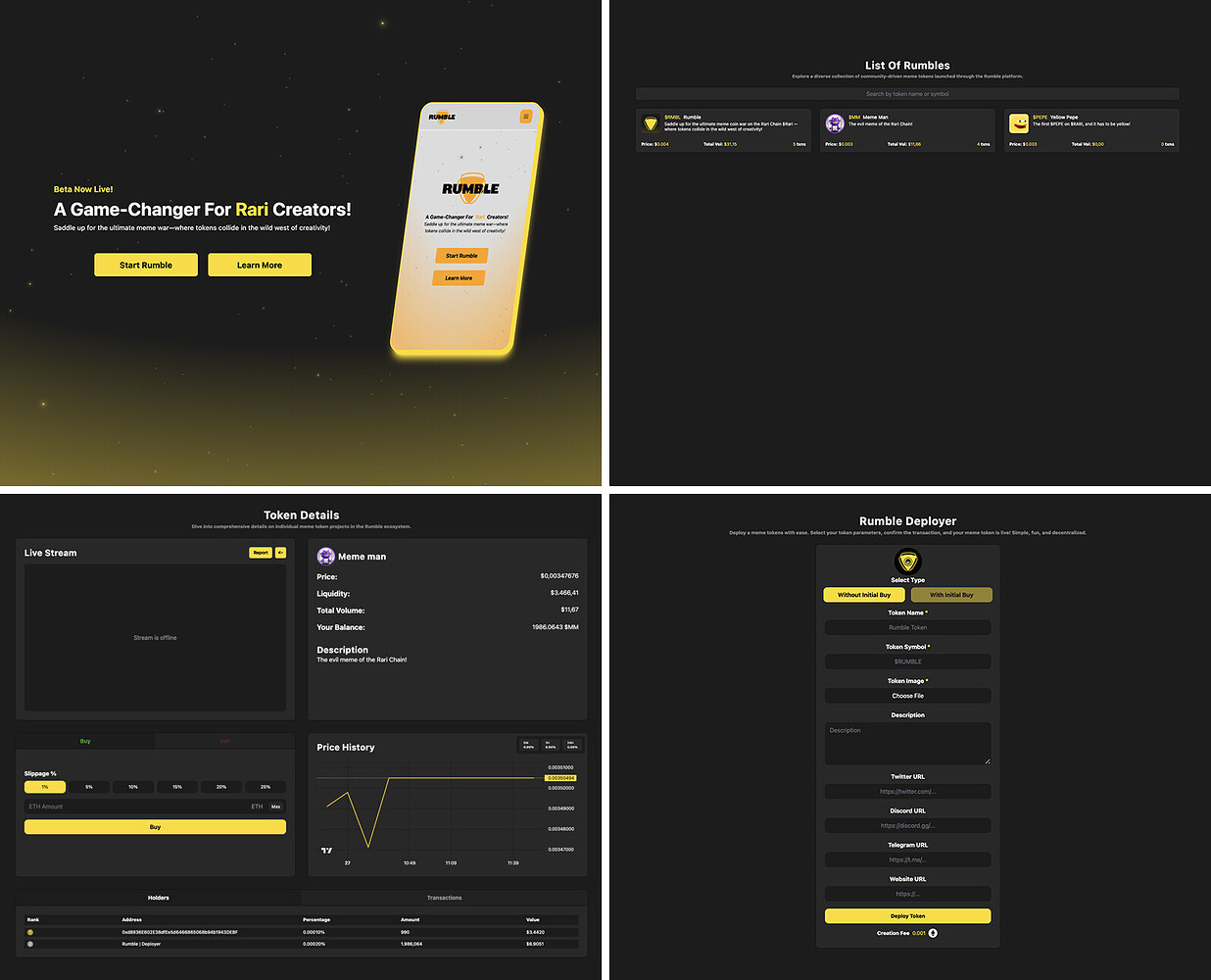
As members of the Governance Working Group that shaped this CoC, StableLab supports its implementation. This document sets the grounds for a respectful and fair governance ecosystem for Rari.
!B# [Updated] Forse Analytics for Uniswap Revitalization and Growth Program
**Simple Summary**
This proposal seeks to onboard Forse by StableLab as a data service provider, helping analyze the effectiveness of the Uniswap Revitalization and Growth Program. The offchain vote was [<u>passed</u>](https://snapshot.org/#/uniswapgovernance.eth/proposal/0xdf2d95ccfadebf141847b90e058f8fafb4f76d8ca2ec2a7351d93353187df560) in early August of this year, and for a month, we have discussed with various Uniswap DAO participants to incorporate their feedback. The onchain vote however didn’t hit the quorum by less than a million UNI. Therefore, we have incorporated further feedback received and will retry the onchain vote.
**Feedback Incorporated**
**1. Accountability and Completion Based**
The budget once the onchain vote passes will first go to the Uniswap Accountability Committee. Once the Committee confirms that the work has been completed, StableLab can claim the budget.
**2. Budget and Scope Changes**
Initially, the RFC requested $70,000 worth of UNI to analyze the impact of the Uniswap Revitalization and Growth Program for 3 blockchains chosen by the Uniswap DAO; this was expanded to 4 blockchains for offchain vote following the feedback. Following the feedback, the Analytics will cover 4 blockchains but at a reduced cost of $60,000, effectively reducing the cost by $10,000 and also increasing the number of blockchains covered compared to the original RFC.
**3. Preventing Redundancy**
There have been concerns that the work on Arbitrum especially might overlap with Gauntlet’s research on incentive programs on Arbitrum. We are in active talks with the Gauntlet team and will also ensure the work doesn’t overlap with Gauntlet’s domains.
**Motivation**
In February 2024, the Uniswap DAO introduced the Uniswap Revitalization and Growth Program, which incentivizes users to participate in current and new deployments of Uniswap on different networks within the L2 space. The initial onboarding packages of this program cost the Uniswap DAO at least $3.5M worth of assets.
We propose that Uniswap DAO engage with Forse, our DAO intelligence and analytics platform, to analyze the impact of the Uniswap Revitalization and Growth program and assess if the current approach drives real growth.
By assessing the impacts of the Revitalization and Growth Program, the Uniswap DAO will have valuable insights to improve further iterations of the program and/or other incentive programs. With this information, Uniswap DAO will be able to understand who are the most relevant user groups, their acquisition cost, and evaluate if the program itself was effective in influencing user behavior leading to increased stickiness of users, and therefore TVL and other top-level protocol metrics.
Recently, StableLab supported the Arbitrum DAO as the Program Manager for the [<u>Arbitrum Short-Term Incentives Program</u>](https://forum.arbitrum.foundation/t/long-term-incentives-pilot-program/20223), and we delivered a comprehensive [<u>analysis</u>](https://forum.arbitrum.foundation/t/stablelab-analyzing-stip-s-efficacy-and-ltipp-comparison/24777/) of the STIP to the Arbitrium DAO.
With Uniswap allocating over $3.5M worth of assets for the purpose of growing Uniswap’s market share, it is essential to ensure that the DAO analyses and reviews the impact of these incentives on an ongoing basis.
**What is Forse?**
[<u>Forse</u>](https://www.forse.io) is a data and intelligence platform built by StableLab helping DAOs analyze the impact of governance decisions in protocol growth, top-line metrics, and governance operations, including its cost and effort structures. [<u>StableLab</u>](https://www.stablelab.xyz/) is the leading provider of governance products and solutions for decentralized protocols. We work with various projects, from the ones just starting their journey to decentralization to the most prominent DeFi protocols.
We are currently working with:
Figure: Example of Onchain Impact Analaysis - Arb STIP Analysis
Figure: Example of User Segmentation Analysis - Arb STIP Analysis
This service provider engagement grants the Uniswap DAO access to the services of the entire StableLab team. Specifically, three StableLab team members will be the primary points of contact.
**Team**
**Christian Ziegler** is the CTO at StableLab. Previously, he worked as a researcher at the Technical University of Munich (TUM), where he wrote his doctoral thesis on DAOs. In 2018, he co-founded Blockcurators GmbH. Christian has several published scientific articles, including [a Taxonomy of DAOs;](https://mediatum.ub.tum.de/doc/1709396/document.pdf) [scoring methodologies for DAOs;](https://www.mdpi.com/1911-8074/16/7/330) [network analysis of DAOS; ](https://mediatum.ub.tum.de/doc/1742459/document.pdf)and [classification of DAO proposals using LLMs](https://arxiv.org/abs/2401.07059); among others.
**Johannes Loewe** is the Data Lead at StableLab, where he focuses on all stages of AI and ML development, from experimentation to deployment. Before joining StableLab, he was a Freelance AI & Blockchain Software Engineer. He also has experience with DAOs, being a founding member of PretzelDAO in Munich. He holds a Bachelor's degree from Radboud University in the Netherlands and a Master's degree in Machine Learning from NUI-Galway in Ireland.
**Marcos Miranda** is the Head of Product at StableLab. With over 5 years of experience in Product Management, focusing on Web3 and Analytics products, he is also experienced in building DeFi protocols, having previously worked for other protocols in the space.
**Methods**
* K-means with Euclidean distance for user groups based on transformed transactions
* Difference in Difference Analysis and Interrupted Time Series Analysis to separate the effect of the growth program from the effect of the market
* The remaining analysis using further advanced statistical analysis
**Specification**
By analyzing the impact of these incentives, Forse by StableLab hopes to identify the following:
* Impact quantification of the Uniswap Revitalization and Growth Program in top-line protocol metrics with the isolation of external factors influencing these metrics as far as permitted and reasonably possible.
* User segmentation and analysis based on archetypes of users to determine the types of users attracted through the incentive program.
* Post-incentive user retention, reactivation, and user acquisition cost metrics.
* Per-dollar value of incentives compared to other ways of incentivizing users (e.g. Airdrops, LP rewards, grants, ..).
* User Retention and activity patterns over the time of the Uniswap Revitalization and Growth Program.
To see Forse in action, explore our [<u>interactive dashboard</u>](https://dashboard.forse.io/main/arbitrum/grants_program/Short_Term_Incentives_Program) showcasing the Arbitrum Short-Term Incentives Program. This provides a great example of what our output could be for Uniswap’s Revitalization and Growth Program. Our **Deliverable** would be an interactive dashboard hosted on dashboard.forse.io on at least the metrics stated above.
**Budget Request**
The proposal requests $60,000 worth of UNI, which is 7,500 UNI (at the time of the updated proposal) to analyze the impact of the Uniswap Revitalization and Growth Program so far for 4 blockchains chosen by the Uniswap DAO, with 3 months of additional maintenance support and updates to analytics modules utilized in the live dashboard.
**Four Blockchains Among Chosen by the Uniswap DAO**
| Blockchains | TVL |
| ----------- | -------- |
| Arbitrum | $3.07b |
| Base | $2.68b |
| Scroll | $1.01b |
| Blast | $731.18m |
StableLab supports this proposal as it will add cutting-edge innovation to the Rari governance structure, increasing governance participation while incentivizing users to migrate and bridge RARI from the old contract in Ethereum to the new one in Rari Chain. The stRARI liquid token will also allow for composable uses for the token, creating potential synergies with further programs.
# RRC-34: Enable RARI Staking
## Abstract
RARI governance is undergoing an upgrade via [turning on protocol fees (RRC 28) 4](https://www.tally.xyz/gov/rari-foundation/proposal/64443561092723928501818567121519051108693422626070463342810224372241233243885) and via [the token upgrade (RRC 30) 1](https://www.tally.xyz/gov/rari-foundation/proposal/85102068202527969889208024703113668965813715410446115075088330064807449302588). We believe turning on staking should be a third component of this governance upgrade.
We propose to unlock RARI utility and improve the governance and security of the RARI protocol by implementing RARI staking, without yet turning on fee distribution to token holders. Through RARI staking, token holders who delegate to active governance participants will be able to capture value. The proposal will also implement a liquid staked RARI token (stRARI) on Rari Chain via the [Tally Protocol](https://tally.mirror.xyz/Drw-uvqhUnJLRxg32sV-sqKZ785-AO85FBaCYeXqxhA) that enables any future rewards to auto-compound, is (re)stakeable, and is compatible with DeFi. Separately, we will work with the RARI DAO to decide how to fund rewards and how to split rewards between token holders and delegates.
## Motivation
Motivation to enable staking for RARI DAO is two-fold: (1) improve governance participation and (2) improve security of RARI DAO.
### Enable staking to improve governance participation
RARI token utility is low and as a result, the RARI token is struggling to accrue value.
* Governance power is the only source of fundamental demand for RARI, while there are multiple sources of new supply (unlocks, treasury spending, etc.).
* The ability to restake RARI or use it on DeFi is not compatible with governance. Voting power breaks when RARI is deposited into smart contracts.
Right now, ~12.4% of RARI (that which does not belong to “Holders” on the below graph) is being used in the onchain ecosystem, meaning it cannot be used in governance. This robs the DAO of voting power that can be used to reach quorum and protect against malicious attacks.
[<img height="314" width="690" alt="Screenshot 2024-09-06 at 5.28.54 PM" src="https://forum.rari.foundation/uploads/default/optimized/1X/6418e51c9ebd0578af4f7f3849220351244a6e0a_2_690x314.png" />Screenshot 2024-09-06 at 5.28.54 PM1412×644 71.1 KB](https://forum.rari.foundation/uploads/default/original/1X/6418e51c9ebd0578af4f7f3849220351244a6e0a.png "Screenshot 2024-09-06 at 5.28.54 PM")
*From* [*CoinMarketCap*](https://coinmarketcap.com/currencies/rarible/#Analytics)
The RARI token is struggling as a governance mechanism. The veRARI token model deterred participation because it adds complexity and commitment, discouraging those who may not want to lock up their tokens. Without staking, the DAO is also disallows RARI token holders that want to use these tokens in DeFi from voting.
With the recent move from veRARI to RARI for governance voting, RARI DAO is looking to incentivise active governance participation. Delegation has tripled since DAO launch in 2020, especially with the help of the [Delegate Launchpad Proposal (RRC 9)](https://www.tally.xyz/gov/rari-foundation/proposal/4998212454959764411677761814601920941258702940035724218302264365950572124990), but more tokens have not been used in voting.
### Enable staking to improve security of RARI DAO
The strongest defense against attacks on a decentralized system is active governance participation and a broad, engaged delegate base. Staking plays a crucial role in achieving this by incentivizing users to commit their tokens and participate in governance. By turning on staking rewards and tying them to active participation in governance (via delegation to oneself or to someone else), the system can foster a more resilient and well-distributed decision-making process, which enhances overall security and stability within the DAO.
The RARI DAO treasury currently holds 4.67 million $RARI (worth over $7.19 million USD) from its initial allocation and will continue to generate revenue through the [new fee structure 4](https://www.tally.xyz/gov/rari-foundation/proposal/64443561092723928501818567121519051108693422626070463342810224372241233243885). The DAO has the flexibility to decide how to use this revenue, with one suggestion being to allocate a portion for staking rewards. Separate from this current proposal, the DAO could consider setting aside a dedicated pool to enhance these rewards and incentivise early participation since staking rewards may be low initially.
As a result, it is becoming economically attractive for a malicious actor to launch a governance attack on the DAO treasury. The potential profit of attacking the DAO treasury is increasing as more RARI accumulates in the treasury, while the cost of attacking the DAO through purchasing RARI for its voting power is not increasing proportionally to defend against attacks. A more developed version of this dynamic exists in the ENS which is actively fighting off governance attacks (documented [here](https://discuss.ens.domains/t/temp-check-enable-cancel-role-on-the-dao/19090/10)) and in Compound, which fell victim to this type of attack recently (documented [here](https://thedefiant.io/news/defi/compound-governance-attack-reveals-inherent-vulnerabilities-of-daos)). Had Compound enabled staking, which could have redistributed voting power to the DAO, it would not have been economically worth attacking the DAO because the increased cost of acquiring enough voting power through staking would have outweighed the potential rewards of the attack. Staking would have created a more robust defense by tying voting power to economic commitment, making it much more expensive and difficult for a malicious actor to gain control over governance decisions.
RARI Staking unlocks utility and aligns governance by creating a mechanism to stream future rewards from DAO-generated sources like protocol fees, token inflation, and treasury diversification to token holders who are delegated to an active governance participant. RARI Staking makes RARI usable in restaking and DeFi by returning voting power locked in contracts to the DAO.
## Specifications and Steps to Implement
### System architecture
RARI Staking enables RARI utility in Rari Chain while allowing the DAO to retain governance power. It includes a few modular components that come together to power the system. 
**RARI Staking via the Tally governance staking system**
* Has the power to distribute fees proportionally to token holders who have delegated voting power to an active governance participant.
**The DAO**
* Has the power to turn on fee distribution and send fees to RARI Staking
* Controls how voting power is distributed to delegates, including delegation strategies for unused voting power
**stRARI (Tally Protocol LST)**
* Auto-compounds potential rewards if they are turned on in the future
* Provides token holders a liquid position
* Returns voting power to the DAO when stRARI is deposited into restaking, DeFi, and centralized exchanges. The RARI DAO exclusively has the ability to determine how this voting power is distributed/redelegated via a governance proposal. The DAO will decide how to set up the initial redelegation logic for stRARI.
[<img height="500" width="521" alt="Screenshot 2024-09-06 at 5.32.51 PM" src="https://forum.rari.foundation/uploads/default/optimized/1X/4a911a145f4836cf1010a3d442b84039e67ff659_2_521x500.png" />Screenshot 2024-09-06 at 5.32.51 PM856×820 64.9 KB](https://forum.rari.foundation/uploads/default/original/1X/4a911a145f4836cf1010a3d442b84039e67ff659.png "Screenshot 2024-09-06 at 5.32.51 PM")
### Implementation details and eligibility for rewards
The Tally governance staking system builds on top of [Unistaker](https://github.com/uniswapfoundation/UniStaker). We will customize Unistaker for RARI’s [governance architecture](https://github.com/ArbitrumFoundation/governance/blob/main/docs/overview.md) and [fee collection mechanism](https://docs.arbitrum.foundation/fee-distribution) in Rari Chain. We will implement RARI Staking in such a way that it can accept arbitrary fee sources as rewards. We will also require that tokens be delegated to an active delegate.
We define an active delegate using Karma Score. The DAO will define the Karma Score requirement for being considered an active delegate. Karma Score is a combination of delegate’s Snapshot voting stats, onchain voting stats and their forum activity. To accurately calculate forum activity score, delegates are required to prove ownership of their forum handle by [signing a message](https://www.karmahq.xyz/dao/link/forum?dao=arbitrum) with their delegate address and posting on the forum. The current Karma score formula is below, which can be adjusted by the DAO going forward:
((100) \* ((Forum Activity Score \* 1) + (Off-chain Votes % \* 3) + (Onchain Votes % \* 5))) / (Sum of Weights times Max Score Setting \* 1)
Karma Score will be included in RARI staking via a smart contract that writes data onchain from the Karma API. We will include several guardrails to ensure that this aspect of the implementation is robust and decentralized:
* Users can verify Karma score calculations independently.
* The DAO will have the ability to block Karma Scores if it believes they are being calculated incorrectly.
* If Karma scores fail to arrive or the scores are blocked by the DAO, RARI Staking will distribute rewards to all stakers regardless of whether they are delegated to an active governance participant until the situation is resolved.
In the future, we believe it would make sense to integrate delegate incentives with RARI staking so that, instead of getting delegate incentive funds from the RARI treasury, they come directly from onchain revenue.
Tally will build RARI staking into our existing [RARI DAO platform](https://www.tally.xyz/gov/rari-foundation), so that users can easily stake and delegate in one place.
## Estimated Timeline
* Post proposal on forum for feedback: early September
* Post onchain proposal on Tally for funding: October
* Begin development: October
* Submit onchain proposal on Tally including full RARI Staking implementation: November
## Cost
Total funds requested: $110,000 USD in RARI token\*.
$100,000 USD in RARI of funding to cover the costs of development, including the following funding categories:
* $50,000 USD in RARI: Develop RARI Staking smart contracts
* Implement staking contracts
* Integrate RARI’s current and potential fee mechanisms
* Integrate Karma Score requirement
* Enable the DAO to block Karma Scores if it believes they are being calculated incorrectly
* $20,000 USD in RARI: Integrate RARI Staking into Tally.xyz
* $30,000 USD in RARI: Integrate Karma into RARI Staking
* Develop and deploy a smart contract to store key stats and Karma scores onchain
* Create a system to record stats onchain and store detailed delegate data off-chain (using Arweave or IPFS) for easy verification
* Continuously improve scoring algorithms to adapt to evolving RARI community needs
* Provide technical support to delegates experiencing issues with their statistics
* This is inclusive of a Karma integration valued at 15,000 USD/year.
\*$10,000 USD in RARI to buffer any potential price impact. Any remaining funds once $100,000 have been successfully sold into stablecoins will be returned to the treasury within 7 days of receiving the RARI tokens. 
### Disclaimer
This proposal should not be relied on as legal, tax, or investment advice. Any projections included here are based on our best estimates and presented for informational purposes only.
As a member of the current Security Council, StableLab would vote abstain on this proposal. However, since Quorum is unlikely to pass without our vote, we will vote For once all community concerns have been addressed and there is sufficient consensus about the proposal. We recognize the necessity and diligence of the existing Security Council and support the continuation of the council for the proposed 12-month term. However, we believe that the ultimate form of security lies in a strong governance participation and our stance is that over time, there should be a progressive shift from a security council structure to a more decentralized governance security model.
# Forse Analytics for Uniswap Revitalization and Growth Program

**Simple Summary**
This proposal seeks to onboard Forse by StableLab as a data service provider, helping analyze the effectiveness of the Uniswap Revitalization and Growth Program. The offchain vote was [passed](https://snapshot.org/#/uniswapgovernance.eth/proposal/0xdf2d95ccfadebf141847b90e058f8fafb4f76d8ca2ec2a7351d93353187df560) in early August of this year, and for a month, we have discussed with various Uniswap DAO participants to incorporate their feedback.
**Feedback Incorporated**
**1. Accountability and Completion Based**
-The budget once the onchain vote passes will first go to the Uniswap Accountability Committee. Once the Committee confirms that the work has been completed, StableLab can claim the budget. If a StableLab member is on the Committee, one will not interfere and leave the decision to other Committee members.
**2. Budget and Scope Changes**
-Initially, the RFC requested $70,000 worth of UNI to analyze the impact of the Uniswap Revitalization and Growth Program for 3 blockchains chosen by the Uniswap DAO, this was expanded to 4 blockchains for offchain vote following the feedback. However, there were more suggestions for reduced scope and lower budget. Thus, the Analytics will cover 3 blockchains but at a reduced cost of $60,000, effectively reducing the cost by $10,000 compared to the original proposal.
**3. Preventing Redundancy**
-There have been concerns that the work on Arbitrum especially might overlap with Gauntlet’s research on incentive programs on Arbitrum. We are in active talks with the Gauntlet team and will also ensure the work doesn’t overlap with Gauntlet’s domains.
**Motivation**
In February 2024, the Uniswap DAO introduced the Uniswap Revitalization and Growth Program, which incentivizes users to participate in current and new deployments of Uniswap on different networks within the L2 space. The initial onboarding packages of this program cost the Uniswap DAO at least $3.5M worth of assets.
We propose that Uniswap DAO engage with Forse, our DAO intelligence and analytics platform, to analyze the impact of the Uniswap Revitalization and Growth program and assess if the current approach drives real growth.
By assessing the impacts of the Revitalization and Growth Program, the Uniswap DAO will have valuable insights to improve further iterations of the Revitalization and Growth Program or other incentive programs. Armed with this information, Uniswap DAO will be able to understand what was the most relevant user groups, and their acquisition cost, and evaluate if the Revitalization and Growth program effectively modified user behavior and led to increased stickiness of users, and therefore TVL and other top-level protocol metrics.
Recently, StableLab supported the Arbitrum DAO as the Program Manager for the [Arbitrum Short-Term Incentives Program](https://forum.arbitrum.foundation/t/long-term-incentives-pilot-program/20223), and we delivered a comprehensive [analysis](https://forum.arbitrum.foundation/t/stablelab-analyzing-stip-s-efficacy-and-ltipp-comparison/24777/) of the STIP to the Arbitrium DAO.
With Uniswap allocating over $3.5M worth of assets for the purpose of growing Uniswap’s market share, it is essential to ensure that the DAO analyses and reviews the impact of these incentives on an ongoing basis.
**What is Forse?**
[Forse](https://www.forse.io) is a data and intelligence platform built by StableLab helping DAOs analyze the impact of governance decisions in protocol growth, top-line metrics, and governance operations, including its cost and effort structures. [StableLab](https://www.stablelab.xyz/) is the leading provider of governance products and solutions for decentralized protocols. We work with various projects, from the ones just starting their journey to decentralization to the most prominent DeFi protocols.


This service provider engagement grants the Uniswap DAO access to the services of the entire StableLab team. Specifically, three StableLab team members will be the primary points of contact.
**Team**
**Christian Ziegler** is the Tech Lead at StableLab. Previously, he worked as a researcher at the Technical University of Munich (TUM), where he wrote his doctoral thesis on DAOs. In 2018, he co-founded Blockcurators GmbH. Christian has several published scientific articles, including [a Taxonomy of DAOs;](https://mediatum.ub.tum.de/doc/1709396/document.pdf) [scoring methodologies for DAOs;](https://www.mdpi.com/1911-8074/16/7/330) [network analysis of DAOS; ](https://mediatum.ub.tum.de/doc/1742459/document.pdf)and [classification of DAO proposals using LLMs](https://arxiv.org/abs/2401.07059); among others.
**Johannes Loewe** is the Data Lead at StableLab, where he focuses on all stages of AI and ML development, from experimentation to deployment. Before joining StableLab, he was a Freelance AI & Blockchain Software Engineer. He also has experience with DAOs, being a founding member of PretzelDAO in Munich. He holds a Bachelor's degree from Radboud University in the Netherlands and a Master's degree in Machine Learning from NUI-Galway in Ireland.
**Marcos Miranda** is the Head of Product at StableLab. With over 5 years of experience in Product Management, focusing on Web3 and Analytics products, he is also experienced in building DeFi protocols, having previously worked for other protocols in the space.
**Specification**
By analyzing the impact of these incentives, Forse by StableLab hopes to identify the following:
* Impact quantification of the Uniswap Revitalization and Growth Program in top-line protocol metrics with the isolation of external factors influencing these metrics as far as permitted and reasonably possible.
* User segmentation and analysis based on archetypes of users to determine the types of users attracted through the incentive program.
* Post-incentive user retention, reactivation, and user acquisition cost metrics.
* Per-dollar value of incentives compared to other ways of incentivizing users (e.g. Airdrops, LP rewards, grants, ..).
* User Retention and activity patterns over the time of the Uniswap Revitalization and Growth Program.
To see Forse in action, explore our [interactive dashboard](https://dashboard.forse.io/main/arbitrum/grants_program/Short_Term_Incentives_Program) showcasing the Arbitrum Short-Term Incentives Program. This provides a great example of what our output could be for Uniswap’s Revitalization and Growth Program.
**Budget Request**
The proposal requests $60,000 worth of UNI, which is 8700 UNI to analyze the impact of the Uniswap Revitalization and Growth Program so far for 3 blockchains chosen by the Uniswap DAO, with 3 months of additional maintenance support and updates to analytics modules utilized in the live dashboard.
**Three Blockchains Among Chosen by the Uniswap DAO**
| Blockchains | TVL |
| ----------- | -------- |
| Arbitrum | $2.596b |
| Base | $1.35b |
| Blast | $838.46m |
Rewarding delegates for their contributions are crucial. However, we are also aware of comments for different style for cycle 3 and will be considering feedback on such.
# Uniswap Delegate Reward Initiative - Cycle 2
Uniswap Delegate Reward Initiative - Cycle 2
**Authors:** [@Doo\_StableLab](https://gov.uniswap.org/u/doo_stablelab) [@PGov](https://gov.uniswap.org/u/pgov) [@AranaDigital](https://gov.uniswap.org/u/aranadigital)
## Summary
This proposal outlines the Uniswap Delegate Reward Initiative - Cycle 2, a compensation program designed to improve participation quality and dedication among Uniswap delegates following the conclusion of Cycle 1.
## Background
In late February 2024, StableLab proposed the [Uniswap Delegate Reward Initiative 14](https://gov.uniswap.org/t/rfc-uniswap-delegate-reward/22909). After the GovSwap event in Denver, further research to plan and implement the Delegate Reward Initiative was highlighted, leading to the formation of the Uniswap Delegate Reward Working Group, composed of 8 members from different organizations. After extensive research for more than a month, the Working Group produced several findings, which can be found here: [https://gov.uniswap.org/t/findings-from-uniswap-delegate-reward-working-group/23702 7](https://gov.uniswap.org/t/findings-from-uniswap-delegate-reward-working-group/23702)
Incorporating these findings, the Uniswap Delegate Reward Initiative–Cycle 1 was [proposed 4](https://gov.uniswap.org/t/temp-check-uniswap-delegate-reward-3-months-cycle-1/23837) and [launched 2](https://www.tally.xyz/gov/uniswap/proposal/64) in June 2024.
## Success of Cycle 1
The 12 delegates that were selected under Cycle 1 maintained 100% voting participation rate for both offchain and onchain votes during this period. In addition, the Delegate Reward Initiative discussion attracted several new delegates.
New Delegate NameDelegate Join DateSEEDGovMay 2024CuriaJune 2024TanéJune 2024BobbayJuly 2024WhetstoneJuly 2024
## Learnings from Cycle 1
While Cycle 1 was simple and effective, there were several suggestions to have a tier system to incorporate different participation levels of delegates. In addition, various suggestions were shared on how to make a points system to determine the top delegate applicants more fair and objective.
## Cycle 2 Proposal Details
**Application Eligibility**
* There will be a week-long period for delegate candidates to submit their applications. Top 15 delegates will be determined based on points.
* Delegates from Cycle 1 must apply again for Cycle 2–they will not be automatically included.
* Delegates that have joined less than 3 months can also apply for the Initiative.
**Delegate Reward Eligibility**
Once delegates have passed the application process, they must fulfill the following requirements to be eligible for up to $6,000 USD worth of $UNI reward per month.
**Requirements**
1.Maintain 80% onchain and offchain voting participation for the past 3 months. Achieving this will provide $3,000 USD worth of $UNI
Additional Rewards (the below are only available if the above Requirement of Voting Participation is fulfilled)
2a. Write rationale for the voting on their delegate profile.
2b. Attend Uniswap Community Calls.
Achieving these above will provide an additional up $3,000 USD worth of $UNI.For 2a and 2b, it allows proportional payment. For example, if there were 4 votings and 1 community call, and a delegate missed to write a rationale of 2 of the votings. The delegate would be eligible to receive $1800 \[3/5 \* $3000].
## Uniswap Delegate Reward Cycle 2 Metrics
In case there are more than 15 eligible applicants, the top 15 will be chosen by the following objective metrics. The highest number of available point would be 10.
**1. Voting Participation**
-Considering one of the primary roles of the delegate is to receive voting power from their delegators to vote on behalf for the best of Uniswap, voting participation is crucial to ensure quorums are met and malicious proposals are prevented. The total point amount from this category is 6. The onchain part is weighted more heavily due to its usual frictions such as gas cost, as well as its ability to dictate governance contract alterations and movement of treasury funds. The voting rate is based on the past 6 months.
**1. Offchain Voting (Snapshot)**
1. 80% and above : 2
2. 70% till 80% : 1.5
3. 60% till 70%: 1
4. 50% or below but above 0%: 0.5
5. 0% : 0
**2. Onchain Voting**
1. 80% and above : 3
2. 70% till 80% : 2.25
3. 60% till 70%: 1.5
4. 50% or below but above 0%: 0.75
5. 0% : 0
**3. The date of the first on chain vote is 3 months or more (this is to counterbalance very new applicants who have few votes and able to get full points on the voting)**
1. Yes : 1
2. No : 0
**2. Proposal Authorship**
-Helping to write proposals for Uniswap DAO is important. However, we also want to prevent low-quality or malicious proposals. Therefore, only passed votes would count. The total points for this category is 3. The onchain part is weighted more heavily once again.
In case of non-binary proposals, if the choice equivalent to “No” was present, and the end voting result was another choice than “No”, then it would be considered as valid for below. For example, Uniswap Treasury Working Group (UTWG) Election wouldn’t be valid for the points as there’s no “No” vote . But \[Temp] Uni Onboarding Package - BSC would be valid for the points as there was a choice of “Against”. And the voting result was “$1m”.
**1. Authored or Co authored a proposal that passed offchain (snapshot) vote before.**
1. Yes, 2 or more : 1
2. Yes, 1 : 0.5
3. No: 0
**2.Authored or Co authored a proposal that passed onchain vote before**
1. Yes, 2 or more : 2
2. Yes, 1 : 1
3. No: 0
**3. Other Governance Participation**
-The full point for this category is 1. This category is to recognize other ways one could contribute to discussion regarding Uniswap Governance. This can be achieved by either
**1. Joined Uniswap Gov Workshop Before**
1. Yes: 1
2. No: 0
Or
**2. Joined Uniswap Community Call Before**
1. Yes: 1
2. No: 0
**Tie Breaker**
-Ties will be decided by the date of the first on chain vote these applicants casted in order to reward those delegates that have been contributing to Uniswap governance for an extended period.
**Budget**
We are requesting 540,000 \[6000 USD \*6 Months \*15 Delegates ] USD worth of UNI for the Uniswap Delegate Reward Initiative, which would be 84,000 UNI
The total amount, once approved, will be sent to the Accountability Committee, which will be responsible for the monthly distribution of rewards to eligible delegates and the proposal authors. Since the total budget of the now disbanded Delegate Reward WG has not been fully used, administration of this reward program–including the creation of this proposal and the admin work behind verifying monthly delegate participation–will be paid for using the current balance of $41.6k. The monthly admin consumption will be communicated each month to the DAO.
StableLab believes this proposal will serve as a good test for the DAO to examine the benefits of working groups. We also believe this particular working group will create substantial value for the DAO by ensuring all governance documentation is up to date, hosting any extra community calls needed, and providing research into how RARI DAO can increase participation. StableLab would usually vote abstain on proposals that provide us payment. However, in the current state of RARI governance, StableLab has to vote "For" in order for any vote to pass quorum. Since this vote already has over 80% for votes, StableLab will also vote for in order to allow the proposal to meet quorum. This necessity for StabeLab to vote for highlights the need for the DAO to focus on increasing governance participation which we believe this working group will help solve.
# RRC-32: [Updated] Trial run a Governance Working Group
# Abstract
This proposal advocates for the establishment of a 3 month trial of a Governance Working Group (GWG) within RARI DAO with the main goal of increasing the execution power of the DAO. The GWG will play a crucial role in moderating discourse, resolving disputes, maintain tooling and documentation and ultimately a training and testing ground for delegate led governance
# Motivation
Governance today is primarily funded by the [RARI foundations operational budget](https://www.tally.xyz/gov/rari-foundation/proposal/53632667310254745488298418746891909878296828371361014234476145432189572109732) and facilitated through service providers & a community lead. While this approach offers a decent starting ground, the ideal state for the governance of the DAO is when it’s run by it’s delegates and funded directly by the DAO. In order to reach this state, the DAO should experiment by giving an increasing amount of responsibilities to delegates over time, test results and iterate. The WG framework offers a great playground to test such initiatives and ultimately plan and deploy a progressive decentralisation strategy.
# Rationale
The formation of the GWG is rooted in the acknowledgment of the dynamic nature of decentralized governance & the imperative to adapt and evolve accordingly. By consolidating expertise and dedicating resources to governance-related tasks, RARI DAO can mitigate risks, optimise resource allocation & enhance overall community participation. The GWG will serve as a catalyst for positive change, driving innovation, efficiency & inclusivity in the governance processes of RARI DAO.
# Specification
## Goals
### Governance Participation
* Propose updates, incentives & metrics-based strategies to maintain and grow active governance participants
### Governance Operations
* Develop, maintain, and regularly update governance onboarding process to facilitate the seamless integration of new members into the DAO.
* Maintain, research & upgrade governance tooling to facilitate smooth governance operations
### Governance Documentation
* Establish, monitor, and enforce governance documentation, and explore developing a constitution, bylaws, and a code of conduct.
* Continuously update governance documentation to reflect evolving community needs and best practices.
### Moderation & Dispute Resolution
* Proactively moderate discourse to filter out offensive, poorly defined, or spammy proposals.
* Serve as mediators to assist in resolving disputes and conflicts within the community.
## Timeline
During the course of the trial period, tasks will be progressively allocated to delegates incharge of operations from the foundation to the DAO. A final report on the feasibility of this approach will be written and published at the end of the trial period
## KPIs
* host any additional community calls needed outside of the 2 monthly foundation calls and create a plan to smoothly transition some governance responsibility from the foundation to the WG
* review and update all governance documents
* provide a research report into how other DAOs have increase governance participation and/or improved governance structures
## MoS
Positive feedback from foundation & delegates about DAO led Governance operations
## Multi-sig policies
* Assuming a 4 member squad, the multi-sig will be structured as 3 out of 4
* 50% compensation will be paid after 2 months
* 50% compensation will be paid upon submission of a report to the DAO at the end of the trial period
* Any leftover funds can be claimed as bonus by the squad upon fulfilling the goals stated in this proposal
* Multi-sig address: 0x2a39B257d4D62e212a1b6CdB07e54661293b04F2
## Roles & responsibilities of each member
**Steward/Operations Lead:** [@jengajojo](https://forum.rari.foundation/u/jengajojo)
Oversees the group, coordinates tasks, leads allocation and execution of operations and ensures milestones are met
**Advisor:** StableLab/[@Matt\_Stablelab](https://forum.rari.foundation/u/matt_stablelab)
Appointed by the foundation as advises on all things governance
**Foundation representative:** [@addie](https://forum.rari.foundation/u/addie)
Appointed by the foundation to lead & deliver parts of governance operations
**Scribe & Ops Co-lead:** [@winverse](https://forum.rari.foundation/u/winverse)
Prepares detailed documentation and assists in governance operations whenever needed
# Budget
| **Role** | **Compensation (RARI)** | | |
| :-----------------------: | :---------------------: | - | :- |
| Steward & Ops Lead | 4000 | | |
| | | | |
| Advisor | 1000 | | |
| Foundation representative | | | |
| Scribe & Ops Co-lead | 4000 | | |
| Buffer | 1000 | | |
| **Total** | **10000** | | |
| | | | |
As we are a part of this proposed working group we will abstain from voting. While we think this wg could provide important insights for how to improve governance in the DAO and would be happy to be a part of it, we will leave it up to the other delegates to decide if they feel this wg should be funded
StableLab is very supportive of this proposal. Governance on Eth mainnet can be very costly and be a barrier for those wishing to participate in governance especially in the absence of delegate rewards. Working closely with the Arbitrum ecosystem we are a major supporter of Arbitrum and think it would be a great place to host governance due to the low costs, high speeds, and high reliability of Arbitrum. We believe this could increase voter turnout for RARI DAO and help to keep the DAO safe
StableLab supports this initiative to onboard Latin American Artists to the Rarible Ecosystem. This is a rapidly growing demographic of web3 users and we believe this highly targeted campaign could have tremendous impact in adding users to Rarible at a relatively low cost.
# RRC-31: Trial run a Governance Working Group
# Abstract
This proposal advocates for the establishment of a 3 month trial of a Governance Working Group (GWG) within RARI DAO with the main goal of increasing the execution power of the DAO. The GWG will play a crucial role in moderating discourse, resolving disputes, maintain tooling and documentation and ultimately a training and testing ground for delegate led governance
# Motivation
Governance today is primarily funded by the [RARI foundations operational budget](https://www.tally.xyz/gov/rari-foundation/proposal/53632667310254745488298418746891909878296828371361014234476145432189572109732) and facilitated through service providers & a community lead. While this approach offers a decent starting ground, the ideal state for the governance of the DAO is when it’s run by it’s delegates and funded directly by the DAO. In order to reach this state, the DAO should experiment by giving an increasing amount of responsibilities to delegates over time, test results and iterate. The WG framework offers a great playground to test such initiatives and ultimately plan and deploy a progressive decentralisation strategy.
# Rationale
The formation of the GWG is rooted in the acknowledgment of the dynamic nature of decentralized governance & the imperative to adapt and evolve accordingly. By consolidating expertise and dedicating resources to governance-related tasks, RARI DAO can mitigate risks, optimise resource allocation & enhance overall community participation. The GWG will serve as a catalyst for positive change, driving innovation, efficiency & inclusivity in the governance processes of RARI DAO.
# Specification
## Goals
1. Governance Participation
* Propose and implement updates, incentives & metrics-based strategies to maintain and grow active governance participants
* Identify methods to increase high-quality participation in RARI DAO governance, and provide recommendations for fine-tuning governance processes toward efficacy & inclusivity
1. Governance Operations
* Develop, maintain, and regularly update governance onboarding process to facilitate the seamless integration of new members into the DAO.
* Maintain, research & upgrade governance tooling to facilitate smooth governance operations
1. Governance Documentation
* Establish, monitor, and enforce governance documentation, and explore developing a constitution, bylaws, and a code of conduct.
* Continuously update governance documentation to reflect evolving community needs and best practices.
1. Moderation & Dispute Resolution
* Proactively moderate discourse to filter out offensive, poorly defined, or spammy proposals.
* Serve as mediators to assist in resolving disputes and conflicts within the community.
## Timeline
During the course of the trial period, tasks will be progressively allocated to delegates incharge of operations from the foundation to the DAO. A final report on the feasibility of this approach will be written and published at the end of the trial period
## KPIs
* of active delegates participating in high quality & in depth discussions
* improvement in quality and depth of discussions
* number of new delegates successfully onboarded
* adherence to established governance documentation and protocols.
## MoS
Positive feedback from foundation & delegates about DAO led Governance operations
## Multi-sig policies
* Assuming a 4 member squad, the multi-sig will be structured as 3 out of 4
* 50% compensation will be paid after 2 months
* 50% compensation will be paid upon submission of a report to the DAO at the end of the trial period
* Any leftover funds will be distributed between members
* Multi-sig address: 0x2a39B257d4D62e212a1b6CdB07e54661293b04F2
## Roles & responsibilities of each member
**Steward/Operations Lead:** [@jengajojo](https://forum.rari.foundation/u/jengajojo)
Oversees the group, coordinates tasks, leads allocation and execution of operations and ensures milestones are met
**Advisor:** StableLab/[@Matt\_Stablelab](https://forum.rari.foundation/u/matt_stablelab)
Appointed by the foundation as advises on all things governance
**Foundation Operator:** [@addie](https://forum.rari.foundation/u/addie)
Appointed by the foundation to lead & deliver parts of governance operations
**Scribe & Ops Co-lead:** [@winverse](https://forum.rari.foundation/u/winverse)
Prepares detailed documentation and assists in governance operations whenever needed
# Budget
| **Role** | **Quantity** | **Compensation (RARI)** |
| ------------------------- | ------------ | ----------------------- |
| Steward & Ops Lead | 1 | 3000 |
| Advisor | 1 | 1000 |
| Foundation representative | 1 | 0 |
| Scribe & Ops Co-lead | 1 | 3000 |
| Buffer | | 1000 |
| **Total** | | **8000** |
StableLab supports the creation of clearer mandates for the grants committee. We believe it is important for have clear goals and structure to a grant program and also support paying contributors who spend their time to select and monitor the grants
# RRC-24 Empowering Latin American Artists Through Art (Corrected Version)
## **📯 Abstract**
Empowering Latin American Artists Through Art with Happ3n XYZ and RARIBLE. A Movement for Social Change Art for Impact \[AFI]
## **🎠 Motivation**
This proposal aims to outline a strategy to incorporate Latin American artists into RARIBLE. By targeting this region, we aim to encourage artists to foster cultural exchange and take advantage of Latin America's vibrant artistic community. Through strategic outreach, initiatives on the adoption of RARIBLE and an incubation program where we aim to create a welcoming environment for Latin American artists, teach them the advantages of RARIBLE, its use, display and monetize their work through the sale of their NFTs on RARIBLE and encourage them about using the RARI Chain.
## **🦄 Key Terms**
Happ3n is a hybrid SocialFi + GameFi platform identifying the necessity to organize the chaos of events and content related to Web3 that emerged daily between platforms such as X, Whatsapp, Zoom, Telegram, Discord, Twitch, among others. So we saw an opportunity to bring a **functional solution** for identified users as communities, creators and enthusiasts to create a scalable business model.
Happ3n provides a safe, streamlined space for event promotion and connection. Users can enjoy and stay informed, while event creators gain valuable metrics about their community audiences and get in NFT Art, Rewards, Badges and premium features.
Our 1.0 version is currently active and launched in Sep 2023 in a first phase to the Spanish-speaking market to validate our idea (MVP) since we faithfully believe that there is continuous unexplored growth in those regions of the world.
Despite community onboarding challenges, Happ3n is spearheaded by 2 women committed to expanding Web3 & Tech access through relatable events in Web3 & Tech. It is a project that we bet will be the way to make a bridge between Web2 and Web3. Bringing events to a new wave of people wanting to get into Web3 and not knowing where to do it or what communities they can trust.
Web: [https://happ3n.xyz](https://happ3n.xyz/)
## **💿 Specifications**
[Sohobiit](https://sohobiit.art/) is a renowned figure in the Latin American NFT community, having previously organized experiments to support artists on a smaller scale. ([Link to NFTanda 3.0](https://docs.google.com/document/d/1chZT9cCjpNNS3JnKtw5U5PBRaD9-dim_i_aF9Tcebpg/edit?usp=sharing))
A significant portion of the research aimed at identifying primary centers of artistic activity has already been completed.
Here are some of the statistics observed during previous experiments:
\[**All these are ideas of numbers that can support our case**]
* Chart with active NFT artists per country in LATAM
* Numbers of active traditional artists that have indicated interest in jumping into the crypto scene
* Numbers from the previous “NFTanda”: duration, participants, artwork in #s, participants, buy & sell #s.
We aim to further advance the initial concept of NFTanda in Latin America. Our objective is not only to encourage artists to embrace the RARI Chain to grasp its advantages but also to raise awareness about Rari among non-artists.
A highly significant result of endorsing this grant would be that once the return on investment (ROI) for Rarible is validated, this initiative can evolve into a recurring process that can be replicated in other communities.
Also we gonna use the Happ3n Site Tecnology, RARIBLE site, RARI CHAIN or Some L2 Chain.
## **🍬 Steps to Implement**
Action Plan for Developing an Art Contest called ‘Ronda NFT’ This will be implemented making a smart strategy to get some quick results as a pilot of a possible contest that can be held annually, connecting artists, expanding the RARI brand and rewarding creators as well as updating this art niche with new proposals, artistic and technological trends that emerge.
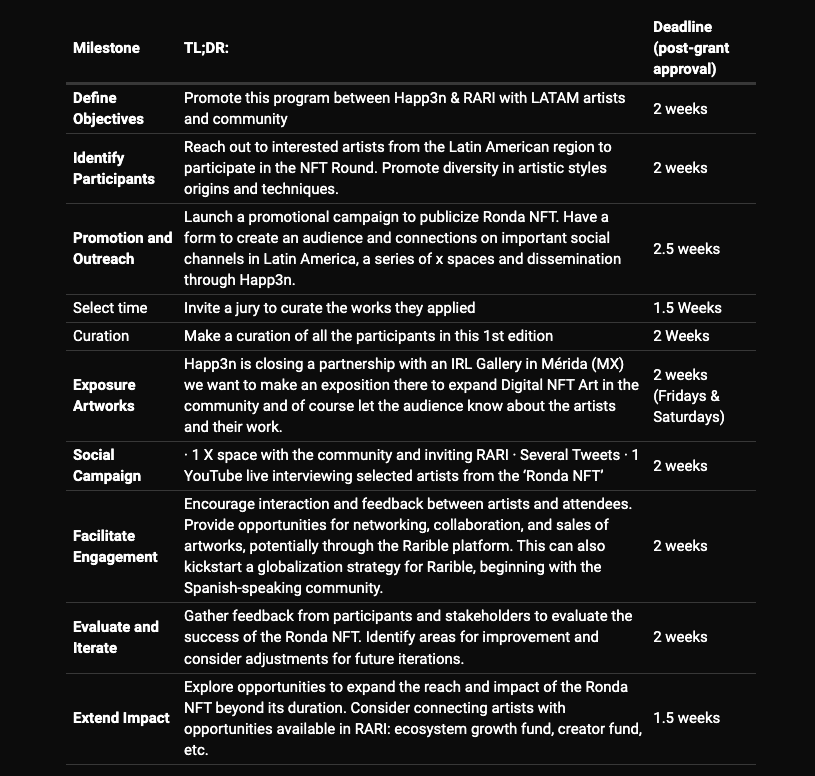
By implementing these steps, we can establish RARIBLE as a leading destination for artists in Latin America, unlocking new opportunities for cultural exchange, economic empowerment, and creative expression.
We'd also like to emphasize that to fully leverage the potential impact of this campaign, we would greatly appreciate RARI DAO's support in amplifying some of our content and campaigns, either through the grants program or as a DAO initiative.
# 🎬 Timeline
about 3 or 3.5 months
# 🧬 History
Latin America stands out in art for its vast cultural wealth, ranging from pre-Columbian civilizations to contemporary currents, reflecting a unique mix of indigenous, European, African and Asian influences. This cultural diversity translates into a wide range of styles and themes in the region's artwork, providing an enriching and distinctive experience.
Digital platforms like Rarible offer Latin American artists the opportunity to expand their global reach, connecting with a broader audience and participating in an international market. This democratization of access to art, facilitated by technology and social networks, provides new possibilities for the marketing and distribution of digital works, allowing Latin America to contribute significantly to the global artistic landscape in the 21st century.
# **🧙🏻 Overall Cost**
### Explanation of Budget Categories
**✨ Management:** Allocated evenly across three months for planning and coordination efforts between 3 workers
**🍄 Advertising & Graphics:** Consistently funded to maintain continuous promotional activities and design work
**🌈 Art Awards:** Disbursed in the third month to reward top-selling artists.
**🧶 Team Bonuses:** Higher in the third month due to additional compensation of $150 each for the two art curators. This is to reward their efforts and ensure their continued support and participation in the project and ecosystem.
**⛑️ Contingency:** Set aside evenly for unforeseen expenses throughout the project.
### Final Budget & Art Prize Award
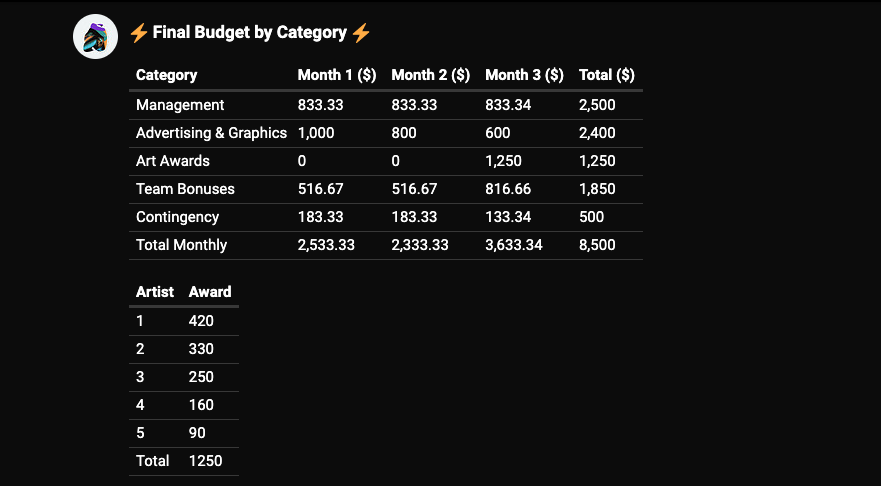
> **Total Budget $8.5K**
### 🚀 Regarding the changes that have been proposed in the community calls and comments into RARI forum Foundation, I bring you the final proposal.
StableLab was initially supportive of this proposal as we felt it would be a good experiment to test out the new working group model. However, now that there are discussions about a governance focused working group we would rather support that proposal for a wg experiment. We feel tokenomics are an extremely hard topic for a DAO to tackle and a working group focused on this may not yield valuable results. A more direct impact can be made to the RARI ecosystem if our first working group focuses on governance and strengthening the power of the DAO.
# RRC-29: A Clearer Grants Committee Mandate
# Abstract
This proposal aims to define a more transparent structure for the [Grants Committee](https://forum.rari.foundation/t/follow-up-to-rrc-12-rari-foundation-grants-committee-selection/1742) and ultimately for the Ecosystem Growth Fund.
# Motivation
Taking into account what could be called an initial GC pilot which we are about to wrap up, the need to define comprehensive strategies and focus areas with grantees is required. There is also the need to communicate clearer GC responsibilities, compensation, and better community involvement in GC activities.
More specifically, this will better help us drive development and usage, cultivating enthusiastic users and talented builders that will help shape the future of the Rarible protocol and chain, fostering a sustainable creator economy.
# Rationale
GC needs a set of guiding principles to steer us forward. The first grant sprint helped us define and set up good structures early on but also opened our eyes to areas where we could do things better both internally and externally.
# Key Terms
GC: Grants Committee
RFP: Request for Proposal
# Specification
The current structure focuses on having two community members and two Foundation member on the committee. One member acts as the grant’s lead responsible for coordination; the other committee members assume evaluator roles, overseeing the grant application evaluation process and supporting grantees, helping them meet and exceed their milestones.
In the initial set-up of the GC, responsibilities were not spelled out, and no real KPI was set to be tracked as a deliverable for the working group. However, after sprint one of the Ecosystem Fund, we are outlining some responsibilities and suggesting some KPIs so the community can easily track the progress of the GC.
## GC Responsibilities
* The Committee will self-determine how they reach consensus on grant applications from the intake form as well as the recommendations from the GC Lead.
* The GC will operate transparently by communicating progress during governance calls and sharing information and feedback in public forums.
* Work in iterations (quarterly) - which will allow us to be flexible in funds usage
* Define minimum and maximum allocation for grantees. This tells what kind of program we’ll be running. i.e small and fast grants, or midsize grants that can span over six months
* The GC will also publish a report on their process, learnings, and outcomes at the end of each cycle (three months).
* Creation of RFPs and marketing content to communicate updates and opportunities to the builders.
* Communicate the information regarding approval/rejection of proposals to the RARI DAO community regularly.
* Discuss program improvements within the team during scheduled meetings.
* Each member of the GC will transparently share Conflict of Interest disclosure with the community whenever necessary.
* Publish the qualified projects for every cycle along with our rationale for supporting them on Forum.
* Continue iterating on grant process.
* If something is not clearly outlined here, the GC has decision-making authority over its operations and may decide to make exceptions for proposers at their discretion.
## GC KPIs
* Number of Applications Received: Total number of grant applications received. This should include both accepted and rejected applications and a brief note explaining the decision.
* Grant Distribution Timeline: Measure the time taken to review, approve, and distribute grants, ensuring a timely turnaround time of no longer than 10 days from application to resolution
* Grant Amount Disbursed: Monitor the total value of grants distributed to successful applicants including distribution across projects, and budget utilization rate.
* User Metrics: Measure the increase in the number of users or active participants in the protocol as a result of funded projects.
## MoS
* Successful review of grantee proposals
* Report submitted to the community at the end of every grant pilot
## Multisig Policies
* Assuming the same four member squad in control of the Ecosystem Grants Fund, the multi-sig will be structured as 3 out of 4.
* multisig address: 0x8099b56FC797731f03dA9074a65bBb5Adf16b09F
# Budget
Of the GC members, two are from the Foundation, and two are from the RARI DAO community. Foundation members either part-time or full-time get compensated from the yearly operations budget. However, the two community members are not compensated.
I am proposing we compensate these two community members in $RARI that gets unlocked at the end of each cycle. More specifically, I suggest 12k $RARI for each member gets locked through Hedgey around the time the operational budget goes live in December then at the start of next year 2025, and going forward, 3k $RARI is unlocked for each member at the end of every cycle (quarterly).
Concerning the current situation where we are already nearing the end of a cycle and with the two community members ([@Jaf](https://forum.rari.foundation/u/jaf) and [@WinVerse](https://forum.rari.foundation/u/winverse)) having already worked for six months, I propose 3k $RARI each for their contributions thus far, and a six-month lockup of 12k $RARI for the remainder of the year. 6k $RARI will get unlocked at the end of the next cycle and if one more cycle is done before the end of the year, the remaining 6k is unlocked. All unused funds will be sent back to the treasury.
There is no separate compensation as multisig signers.
# RRC-26 Tokenomics Working Group Proposal (Corrected Version)
# Abstract
This proposal aims to establish a Tokenomics Working Group (TokWG) within the RARI DAO for a period of three months. The ‘TokWG’ will operate for three months, with the primary goal of researching & proposing the first draft of tokenomics strategies to enhance the economic sustainability and growth of the RARI DAO ecosystem
# Motivation
Effective tokenomics is critical for the long-term success and sustainability of any crypto product. With the rapid growth of the crypto space as well as the DAO, it is imperative to revisit and refine our tokenomics model to ensure it aligns with the community’s goals and fosters sustainable growth. Establishing a dedicated TokWG will provide the necessary focus and expertise to develop innovative and effective tokenomics solutions.
# Rationale
Forming a TokWG will enable a concentrated effort on improving RARI’s tokenomics. By leveraging the collective expertise within our community and external advisors, we can create well-researched and tailored tokenomics strategies. This focused approach increases the likelihood of developing successful solutions that drive value for our ecosystem.
# Key Terms
Tokenomics: The economic model governing the creation, distribution, and value of tokens within an ecosystem
# Specification
### Goals
* Conduct comprehensive research on current tokenomics models & identify best practices.
* Create a draft proposal for a possible set of tokenomics solutions tailored to the RARI ecosystem.
* Provide detailed documentation on the recommended solutions
* Gather community feedback on the proposed solutions to refine & improve them
### Timeline
Month 1: Group formation and initial research
Month 2: Identification of potential tokenomics models, development & gathering solutions
Month 3: Finalisation of first draft of the recommendations, clear documentation & presentation to the DAO.
### KPIs
\#number of researched solution
\#biweekly WG updates
### MoS
* Draft proposal with clear documentation & actionable recommendations
### Multi-sig policies
* Assuming a 5 member squad, the multi-sig will be structured as 3 out of 5
* 10% of the compensation will be sent at the start of the project
* 40% of the compensation will be sent upon delivery of the first draft of the tokenomics solutions
* All remaining compensation will be sent upon submission of recommendation
* Multi-sig address 0xC805b3Cd0686c9F6d406b1BF9ae64fA28FF7E88e
### Roles & responsibilities of each member
**Project Lead/Steward:** [@jengajojo](https://forum.rari.foundation/u/jengajojo)
Oversees the group, coordinates tasks, and ensures milestones are met.
**Research Analysts:** [@Jaf](https://forum.rari.foundation/u/jaf) + [@Sixty](https://forum.rari.foundation/u/sixty)
Conduct in-depth research on tokenomics models and trends.
**Foundation representative:** [@addie](https://forum.rari.foundation/u/addie)
Works with the RARI foundation to coordinate efforts and resources
**Scribe:** [@coffee-crusher](https://forum.rari.foundation/u/coffee-crusher)
Prepares detailed documentation of the recommended solutions.
# Budget
| **Role** | **Quantity** | **Compensation (RARI)** |
| ------------------------- | ------------ | ----------------------- |
| Steward | 1 | 3000 |
| Research Analyst | 2 | 6000 |
| Foundation representative | 1 | 0 |
| Scribe | 1 | 3000 |
| Buffer | | 1000 |
| **Total Ask** | | **13000** |
# RRC-28 Implementing a RARI Protocol Fee
## Abstract
This proposal suggests altering the Rarible protocol’s fee structure to create a protocol fee of 0.5%. The revenue generated from this fee would all go to the RARI DAO treasury. This will enhance the DAO’s financial resources and create more alignment between users and the DAO.
## Motivation
Implementing a fee structure that directs fee revenue will help bolster the sustainability of the RARI DAO. It will also create more autonomy for the RARI DAO as the DAO will not have to rely on external capital and will instead have more resources available to fund DAO initiatives. This will help with the progressive decentrilization of the DAO and make the DAO stronger for the future.
## Rationale
The proposal aligns with RARI DAO’s mission of broadening the NFT use case horizon by creating a creator-centric and fully decentralized robust ecosystem. By channeling revenue to the DAO treasury, it enhances the financial stability and resilience of the protocol, enabling further development, community initiatives, and long-term sustainability. This helps to address the Long term sustainability of the DAO, which is one of the three core values of the RARI DAO.
## Specifications
Since the protocol’s contracts are fully controlled by the DAO, the on-chain Tally proposal can automatically update the fee structure using Tally’s executable code feature.
The proposed fee would be 0.5% (0.25% seller fee + 0.25% buyer fee). All 100% of the Protocol Fees will be sent to the RARI DAO treasury to help bolster the autonomy and long-term sustainability of the RARI DAO.
## Steps to Implement
* DAO discusses appropriate fee structures.
* Tally proposal is created with executable code to update fee structure and direct revenue to the DAO automatically
* Implement new order version with enabled protocol fees
## Timeline
* 1 week for the DAO to decide on fee structure and provide opinions on the proposal
* 1 week for Tally vote
* Time for the protocol team to implement new order version with enabled protocol fees
* Upon the passing of the Tally vote, the contracts will automatically be upgraded to reflect the new fees and direct said fees to the DAO treasury
## Overall Cost
There is no cost associated with this proposal.
While StableLab is skeptical of the direct benefits that will be seen from this proposal, we support encouraging community involvement in the DAO. We think this will serve as a good experiment to see if the community can handle responsibilities like this or if the DAO needs to rethink the working group model.
# RRC-26 Tokenomics Working Group Proposal
# Abstract
This proposal aims to establish a Tokenomics Working Group (TokWG) within the RARI DAO for a period of three months. The ‘TokWG’ will operate for three months, with the primary goal of researching & proposing the first draft of tokenomics strategies to enhance the economic sustainability and growth of the RARI DAO ecosystem
# Motivation
Effective tokenomics is critical for the long-term success and sustainability of any crypto product. With the rapid growth of the crypto space as well as the DAO, it is imperative to revisit and refine our tokenomics model to ensure it aligns with the community’s goals and fosters sustainable growth. Establishing a dedicated TokWG will provide the necessary focus and expertise to develop innovative and effective tokenomics solutions.
# Rationale
Forming a TokWG will enable a concentrated effort on improving RARI’s tokenomics. By leveraging the collective expertise within our community and external advisors, we can create well-researched and tailored tokenomics strategies. This focused approach increases the likelihood of developing successful solutions that drive value for our ecosystem.
# Key Terms
Tokenomics: The economic model governing the creation, distribution, and value of tokens within an ecosystem
# Specification
### Goals
* Conduct comprehensive research on current tokenomics models & identify best practices.
* Create a draft proposal for a possible set of tokenomics solutions tailored to the RARI ecosystem.
* Provide detailed documentation on the recommended solutions
* Gather community feedback on the proposed solutions to refine & improve them
### Timeline
Month 1: Group formation and initial research
Month 2: Identification of potential tokenomics models, development & gathering solutions
Month 3: Finalisation of first draft of the recommendations, clear documentation & presentation to the DAO.
### KPIs
\#number of researched solution
\#biweekly WG updates
### MoS
* Draft proposal with clear documentation & actionable recommendations
### Multi-sig policies
* Assuming a 5 member squad, the multi-sig will be structured as 3 out of 5
* 10% of the compensation will be sent at the start of the project
* 40% of the compensation will be sent upon delivery of the first draft of the tokenomics solutions
* All remaining compensation will be sent upon submission of recommendation
* Multi-sig address 0xC805b3Cd0686c9F6d406b1BF9ae64fA28FF7E88e
### Roles & responsibilities of each member
**Project Lead/Steward:** [@jengajojo](https://forum.rari.foundation/u/jengajojo)
Oversees the group, coordinates tasks, and ensures milestones are met.
**Research Analysts:** [@Jaf](https://forum.rari.foundation/u/jaf) + [@Sixty](https://forum.rari.foundation/u/sixty)
Conduct in-depth research on tokenomics models and trends.
**Foundation representative:** [@addie](https://forum.rari.foundation/u/addie)
Works with the RARI foundation to coordinate efforts and resources
**Scribe:** [@coffee-crusher](https://forum.rari.foundation/u/coffee-crusher)
Prepares detailed documentation of the recommended solutions.
# Budget
| **Role** | **Quantitiy** | **Compensation (RARI)** |
| :------------------------ | :-----------: | ----------------------: |
| Steward | 1 | 3000 |
| Research Analyst | 2 | 6000 |
| Foundation representative | 1 | 0 |
| Scribe | 1 | 3000 |
| Buffer | | 1000 |
| **Total ask** | | **13000** |
# Uniswap Delegate Reward- 3 Months Cycle 1
**Summary**
This proposal outlines the Uniswap Delegate Reward Initiative, a compensation program designed to improve participation quality and dedication among Uniswap delegates. The initiative was developed by several members of the Uniswap Delegate Reward Working Group, which conducted extensive research and produced findings supporting the implementation of such a program.
**Background**
In late February 2024, StableLab proposed the [Uniswap Delegate Reward Initiative](https://gov.uniswap.org/t/rfc-uniswap-delegate-reward/22909). After the GovSwap event in Denver, further research to plan and implement the Delegate Reward Initiative was highlighted, leading to the formation of the Uniswap Delegate Reward Working Group, composed of 8 members from different organizations. After extensive research for more than a month, the Working Group produced several findings, which can be found [here](https://gov.uniswap.org/t/findings-from-uniswap-delegate-reward-working-group/23702).
The details of the findings were slightly different. However, this conclusion summarized the findings quite nicely:
*“There was a general consensus across most categories that a compensation program for delegates could improve participation quality and dedication. However, the enthusiasm varied, with those deeply involved in governance showing the strongest support.”*
The Uniswap Delegate Reward Working Group explored several frameworks for implementing rewards, including a Committee structure that allows several non-delegates to get rewarded for helping to contribute to various scopes. However, some non-delegates in the Working Group preferred the Delegate-only model while other non-delegates in the Group suggested other alternatives.
Therefore, we believe that the delegate-focused structure can be launched, but other members can also propose structures that focus on different aspects, ultimately leaving the decision up to governance.
**Proposal Details**
**Qualified Applicants for the First Cycle**
There were 14 delegates who qualified for the application and applied for the first cycle. After examining both Voting Participation, Proposal Authorship, and Other Governance Participation, top 12 delegates were chosen. The details can be found [here ](https://docs.google.com/spreadsheets/d/1WXf8Z2AnLIyKGNKYjKKsfb-c-d1hmCLAX-5rYAbiHDk/edit?usp=sharing).
**Delegate Reward Eligibility**
The qualified Delegates need to fulfill the following to be eligible for up to $6,000 USD worth of $UNI reward per month.
**Requirements**
1\. Maintain 80% onchain and offchain voting participation for the past 3 months. Achieving this will provide $3,000 USD worth of $UNI
**Additional (only available if the above Requirement of Voting Participation is fulfilled)**
2\. Write rationale for the voting on their delegate profile. Achieving this will provide an additional $3,000 USD worth of $UNI
**Budget**
We are requesting 216,000 \[ 6000 \*3 \* 12] USD worth of UNI for the Uniswap Delegate Reward Initiative, plus an additional 64,000 USD (40 hours \* 8 members \* 200 USD per hour) worth of UNI as a retroactive reward for the Uniswap Delegate Reward Working Group. The Working Group members will be required to share their hours. 
The total amount of 280,000 USD worth of UNI, 27,000 UNI at the time of the writing, once approved, will be sent to the Accountability Committee, which will be responsible for the monthly distribution of rewards to eligible delegates and retroactive reward for the Working Group members. In the unlikely scenario that the budget is depleted before the end of the 3-month cycle, Cycle 1 will end early. 
After considerable thought, we voted in support of the DeFi Education Fund as we already gave options for different amounts for the Uniswap community, and a large number of them voted to provide the original amount. In addition, we believe that if DEF doesn't keep their promise and doesn't share their updates to the community, @GFXlabs will help to pressure them to act accountable.
=s# Mobilizing the Uniswap Treasury
![]()**Authors:** [<u>Abdullah</u>](https://twitter.com/abdullahbumar) (Arana Digital) & [<u>Doo</u>](https://twitter.com/DooWanNam) (StableLab)
### Summary:
* The Uniswap DAO's treasury, containing assets worth nearly ~$6B, predominantly in $UNI tokens, faces challenges due to its single-asset composition and the lack of a plan for productive utilization.
* To address the treasury's volatility and underutilization, we propose forming the Uniswap Treasury Working Group (UTWG) to explore treasury management strategies aimed at achieving sustainability and growth for the DAO. The UTWG will examine various treasury plans for Uniswap DAO based on 8 weeks of research and interviews with various entities and individuals familiar with treasury management and adjacent subject matters.
* The UTWG will be composed of four members. StableLab and Arana Digital are a part of working group zero (WG0). They have been helping administer and organize this proposal for the past couple of weeks. The other two members, Karpatkey and Franklin DAO, [<u>have been elected via a Snapshot vote</u>](https://snapshot.org/#/uniswapgovernance.eth/proposal/0x7584aabd34944953f37008d4a6209e4efee8f1a066a5051fbba37910dae80b49). The elected members, along with WG0, will be responsible for helping conduct research and aiding in proposing the final deliverables to the DAO.
* A deliverable will correspondingly be released on the forum where we present at least two viable treasury management options for the DAO to begin pursuing. Both of these options will be presented as their individual RFC/RFP, ideally allowing various treasury managers to present their products and services to the DAO. The UTWG will help facilitate this process.
* We hope that a simultaneous discussion around, say, DUNA, or other legal frameworks, takes place. It seems unlikely that the DAO will be able to conduct treasury management if it doesn’t open itself up to adopting a legal architecture. Our hope is that while the Foundation and potentially another working group sort out the legal side, we are able to make some strides on treasury management research. Upon adoption of a legal entity, we can then hit the ground running by actually implementing the conclusions derived from the UTWG’s research.
![]()**Treating the Uniswap Treasury as an Endowment**
“Treasury” is a broad term that typically mirrors the nature of its underlying protocol. Some treasuries quite literally reflect a protocol’s balance sheet, where the holdings are used to cover capital expenditures, and income is either paid out as a dividend to token holders or used to further grow the protocol. Other treasuries are integral in managing risk, with Aave and Compound being prime examples. Then, some treasuries, like that of Uniswap, are structured more similarly to an endowment, where the DAO must manage a large pool of capital to further the sustenance of the protocol in the long-term.
The concept of an endowment refers to a collective pool of assets held by a nonprofit institution. These assets are employed to support an institution perpetually, with a clear directive of aligning with the desires of the contributing donor(s). In Uniswap’s case, the DAO was established upon the creation of the $UNI token–and 43% of the total supply was endowed to the DAO.
![]()The goal of the DAO is to support Uniswap’s growth and development in a manner that aligns with the collective vision of the token holders and their entrusted cohort of delegates. These objectives can be achieved by funding development projects, liquidity incentives, community grants, and other programs that contribute to the ecosystem's growth and resilience. ***However, such pursuits cannot be facilitated without robust treasury management.***
### The Native Token Problem
The Uniswap treasury is often touted as one of the largest sums of capital at the disposal of a DAO. As of today, Uniswap’s treasury boasts nearly ~$6B of assets, larger than any other DeFi protocol. That number, however, is highly inflated due to the composition of the treasury. Nearly 100% of the treasury is solely composed of one asset: the native $UNI token. Hence, the value of the treasury, in dollar terms, should be massively discounted.
Imagine if a traditional endowment was allotted billions of dollars in a singular, volatile asset, with a directive of using that treasury to sustain its core business–preposterous, right? That’s exactly the position where Uniswap is. What’s more is that there’s no current plan to mobilize this treasury in a productive manner. There lies a large amount of dormant capital simply sitting in the treasury without any explicit plan to be utilized. From our perspective, there needs to be an initiative to spur this dormant capital into action, even if it means doing so little by little. ***The goal of this proposal is to create a committee to begin researching ways by which we can put this treasury into effect.***
### What Are We Optimizing For?
**This proposal optimizes for two variables:**
1. ***Sustainability:*** the DAO should be a self-sustaining entity, able to cover its future costs in perpetuity. ******
2. ***Growth:*** the DAO should utilize its capital to grow its principal $UNI allotment in terms of dollars, thereby further propelling the adoption of Uniswap and delivering value to relevant stakeholders.
Sustainability is the bare minimum. It acts as a floor. Unless the $UNI price continues to increase forever, the DAO, whenever it reaches into its treasury reserves, is reducing its runway. Hence, the first objective in any treasury management initiative should be to diversify out of the native token and into a more stable asset, like a basket of stablecoins. One could go as far as stating that any $UNI held in the treasury should actually be written down to zero. This mindset, where [<u>treasury $UNI is effectively treated as an unissued share,</u>](https://uncommoncore.co/a-new-mental-model-for-defi-treasuries/) should spur us towards diversification.
Since crypto is prone to fat-tail events, the DAO should establish a more robust cushion in case the market crashes. In 2021, the Uni treasury value ran to nearly $19B, and it quickly fell into a limbo zone between $1.5B - $2B for nearly 1.5 years between Q2 2022 and Q1 2024. No endowment should be this volatile. We should be in a position where if the DAO needs to fund certain initiatives, there are reserves to draw from without causing significant impairment to the token price. For instance, when the Foundation needs to be funded again, it should ideally be the case that a large portion of those requested funds are given in the form of stablecoins for instant liquidity.
Beyond mere diversification, the DAO needs to pursue growth. Currently there are no programs in place for the treasury to increase its net asset value beyond $UNI appreciation. This is where the treasury can be used to generate revenue, either from operating or non-operating activities. Let’s break this concept down–distinguishing between the operating and non-operating income for the DAO is important for defining the source of treasury growth.
**Operating Income:** Operating income would pertain to any income generated from the primary business activities of the protocol, which, in Uniswap’s case, is fees from swaps. Currently, the DAO does not collect any income from fees and likely won’t in the future under the Uniswap Foundation’s [<u>recently proposed fee architecture</u>](https://gov.uniswap.org/t/temperature-check-activate-uniswap-protocol-governance/22936). ***The Uniswap DAO will therefore not be sustainable in the long-run by relying on income from operations–fees generated will most likely be paid out to token holders in full, leaving the DAO with near zero income. To that end, we must rely on non-operating activities to ensure the sustainability of the Uni DAO.***
**Non-Operating Income:** All income not generated from fees falls into this category. If the Uniswap DAO does not plan on attaining revenue from operations, then it must utilize its current treasury to collect income via alternative methods–likely through yield-bearing strategies and investments. Reliance on non-operating income further establishes why the Uni treasury mirrors the setup of an endowment, where the long-term sustainability of the protocol is built on indirect investments detached from the protocol’s core operations. ***These methods are to be further explored, and the present proposal aims to pioneer such exploration.***
### Working Group Details
Based on the above reasoning, the UTWG will conduct 8 weeks worth of research into the types of treasury management initiatives that the DAO may reasonably pursue in the short-to-medium term. The group will note on the experience of treasury management practices of other DAOs, adopting practices that have historically worked well and conforming them to Uniswap’s current situation, along with the presentation of new models that we believe are potentially more effective. Considering treasury management has been a key aspect of many prominent DAOs like Maker and Aave to Lido and Gnosis, we believe that there are many case studies and frameworks that can be explored to ensure initial experiments will return positive results.
The UTWG will also try to collaborate with those working on various legal developments including the recent [<u>Wyoming Decentralized Unincorporated Nonprofit Association (DUNA) Act</u>](https://a16zcrypto.com/posts/article/duna-for-daos/). This process may fall outside of the jurisdiction of the treasury committee and may require outsourcing entirely to another party. It’s vital that this treasury research is analyzed in the context of potential legal structures, and we won’t move forward with implementing our research unless there are proper legal frameworks in place. The Uniswap DAO has yet to formalize its opinions on how to set up legal entities, so this caveat may delay the implementation of the proposed treasury initiatives. The UTWG’s research may conclude that a legal working group should work in concert with the treasury group to effectively bring this program to fruition.
It’s also important to emphasize that the deliverables of the UTWG will aim to highlight potential treasury management options rather than pinpointing specific service providers. If the committee comes to the conclusion that an RFP process is the ideal manner by which treasury managers should be appointed, for example, then one of the UTWG deliverables will be a call to action for various service providers. After ample discussion in the forum, the most promising service providers will qualify for a vote of confidence from the DAO. We will communicate with the Uniswap Accountability Committee to determine how monitoring of this program will proceed in the long run. Depending on a handful of factors, like how much time it’ll operationally take to implement treasury management, it may be best to have the Committee act as the liaison between the treasury managers and the DAO–or out of the UTWG’s research, it may pose more beneficial to sustain this working group long term. The UTWG will also have to communicate with the DAO after the 8-week period to flesh out any further details regarding the proposal, hence there will likely also be an extensive feedback period. The exact structure and timeline regarding the operations beyond the 8-week period are to be determined, and we will keep the DAO posted regarding updates around this process.
Note that it’s too early in the research process to conclude the exact operations of the treasury initiatives–the above paragraph simply outlines a potential order of operations, which is subject to change based on our research. ***Our*** ***goal is to simply present the DAO with an assortment of options, backed by interviews and research.***
**The Uniswap Treasury Working Group Members**
The UTWG will be composed of four members. StableLab and Arana Digital are a part of working group zero (WG0). They have been helping administer and organize this proposal for the past couple of weeks. The other two members, Karpatkey and Franklin DAO, have been elected via a Snapshot vote. The elected members, along with WG0, will be responsible for helping conduct research and aiding in proposing the final deliverables to the DAO.
***StableLab***
* StableLab is a governance firm focused on professional delegation, DAO framework design, and product development. StableLab works with various projects, from the ones just starting their journey to decentralization to the most prominent DeFi protocols. They are the leading professional delegate team with a track record across major DeFi protocols, including MakerDAO, Optimism, Aave, 1inch, Balancer, and more.
***Arana Digital***
* AD is a professional governance group. The team is deeply steeped in the crypto space and has multiple years of participation in protocol governance. With delegation history for DEXs, money markets, L2s, liquid staking protocols, and stablecoins. AD brings a diversity of experience to DAOs–its members have consulted for companies like Immutable and dYdX, worked at crypto investment and trading firms, set up various validator nodes, and run educational events for university students.
***Franklin DAO***
* Franklin DAO has been an active member of Uniswap’s DAO since we first became delegates ~2 years ago. They pride themselves on having strong working relationships with key members/delegates of the DAO, and contributing in a way that promotes the sustainability and growth of Uniswap. Their team has a variety of experience in directly managing risk + incentives via market parameterization and ML modeling (Ion Protocol). They’ve also worked at notable venture funds like Portal, Galaxy, and Big Brain.
***Karpatkey***
* Karpatkey has been an active delegate in the Uniswap Protocol since August 2023, with a 93% participation across all voting actions. In addition to our Uniswap DAO contributions, Karpatkey has historically deployed a combined $62.91M worth of LP positions in both Uniswap V2 and V3. They have a team of DeFi engineers, treasury managers and analysts who regularly lead DeFi incentive programs and actively manage treasury assets for various protocols. They serve in treasury roles for AAVE, Balancer, CoW Protol, ENS, Gnosis DAO and Lido.
**Budget**
The UTWG asks for a budget of 6,000 $UNI. The hourly rate will be the same as the Accountability Committee at $200 per hour. This onchain requests to send the mentioned UNI amount to the Accountability Committee multisig (0x3B59C6d0034490093460787566dc5D6cE17F2f9C). At the end of each month, each of the 4 UTWG members will submit a receipt of worked hours, and the Committee will correspondingly pay the members’ wallets. Retroactive compensation will be distributed to WG0 based on their input hours by the start of the program (i.e. once the onchain vote passes).
### Next Steps
This program will take effect starting the week of May 20th and will conclude during the week of July 15th–at which point the UTWG will present its research publicly to the DAO. The conclusions from the research will determine the timing of a potential RFP process/implementation of the stated treasury management initiatives. The exact structure and timeline regarding the operations beyond the 8-week period are to be determined, and we will keep the DAO posted regarding updates around this process.
# RRC-19 Rari Chain Sequencer Revenue Split
# Abstract
The proposal aims to create a plan for what to do with the RARI Chain sequencer revenue that is now being generated. The proposed revenue share is a 50/50 split between the Rari DAO and the Rari Foundation. The DAO’s share would go towards the DAO treasury (35%) and a new sub-treasury called the “Creator Fund” (15%). The foundation’s Share would go towards operational and maintenance costs (30%) and towards repaying the Arbitrum Grant (20%).
# Motivation
With the new Rari Chain now generating sequencer fees the Rari Community needs to decide where these funds should go. Implementing this revenue-sharing model ensures a fair distribution of resources between the RARI DAO and the Foundation, fostering sustainability and growth for both entities. By allocating funds to a creator fund, we support creator innovation within the community, while bolstering the main treasury ensures financial stability for future DAO endeavors. Allocating a portion of the Foundation’s share to pay off the Arbitrum grant will help fulfill the Foundation’s agreement agreement with Arbitrum and allocating funds towards maintenance and operations ensures the continued smooth functioning of the chain.
# Rationale
This proposal aligns with the RARI DAO community’s mission to foster a decentralized and sustainable ecosystem for digital art and collectibles. By sharing revenue between the DAO and the Foundation, we ensure that both entities have the necessary resources to support the growth and development of the RARI ecosystem. The allocation of funds to a creative fund reflects our commitment to nurturing creativity and innovation within the community while directing resources to the main treasury strengthens the financial foundation of the DAO.
# Key Terms (optional)
* RARI Foundation: A Cayman Islands legal entity that represents the DAO IRL. It allows the RARI DAO to have a formal representation, enter into contractual relationships, and utilize the other benefits and protections of a legal entity.
* Creator Fund: A new treasury that would be created and used to fund creators and their initiatives within the RARI community.
* Main Treasury: The primary repository of funds controlled by the RARI DAO for supporting various initiatives and projects.
* Sequencer Fee Revenue: Rewards collected in ETH generated from transactions on the RARI Chain
# Specifications
The RARI DAO and RARI Foundation would split the Sequencer Revenue 50/50 with the funds more specifically being broken down into the following categories.
## DAO’s Share - 50%
### 15% to a Creator Fund
RRC-19 proposes creating a new sub-treasury called the Creator Fund. This treasury would be funded using 15% of all sequencer revenue generated. This treasury will be reserved to fund creative projects and initiatives.
Having a new treasury explicitly for creative initiatives will encourage creatives in the NFT space to join the DAO and create proposals to fund interesting creative projects. This will help attract new members to the DAO and help foster innovative ideas in the Rari Ecosystem.
### 35% to the Treasury:
35% of the Sequencer Fees would go towards the RARI DAO Treasury. This will help sustain the DAO by funding DAO initiatives as well as ensuring the DAO has the funding to continue with operation costs for the foreseeable future.
## Foundation’s Share - 50%
### 30% for maintenance and operations costs:
This portion of sequencer revenue would be used by the RARI foundation to operate, maintain, and improve the RARI Chain. This helps to ensure the Chain remains operational and can continue to return sequencer fees for the RARI Ecosystem.
### 20% for paying off the Arbitrum Grant:
RARI received a grant from the Arbitrum Foundation to build the RARI Chain using Artribrum Orbit. This grant needs to be paid back by the RARI Foundation. Using 20% of sequencer fees to repay this grant will allow us to fulfill the agreement with Arbitrum without requiring the use of treasury funds.
# Steps to Implement
* Create a new Creator Fund Treasury Address and give the DAO the power to control these funds.
* The foundation will inform the third party that operates the sequencer to send the rewards to the appropriate addresses.
# Timeline
Once the proposal is passed, the revenue split can be enacted for the next monthly sequencer payment.
# Overall Cost
There is no cost associated with this proposal
# RRC-17: Distribute remainder of Incentives Reward Program budget
Authors: [@Jaf](https://forum.rari.foundation/u/jaf)
Reviewers: [@JanaBe](https://forum.rari.foundation/u/janabe) , [@addie](https://forum.rari.foundation/u/addie) , [@WinVerse](https://forum.rari.foundation/u/winverse) , [@Matt\_StableLab](https://forum.rari.foundation/u/matt_stablelab) , [@jarisjames](https://forum.rari.foundation/u/jarisjames)
## Abstract:
This draft proposal aims to distribute the remaining budget of the Incentives Rewards Program in a proportional manner among those who delegated during the program. This will encourage program participants to feel incentivized to participate in future programs.
## Motivation:
After concluding the program and observing promising results in the primary objective of boosting veRARI delegation and encouraging delegates to actively seek delegation, it is in the Rari DAO’s best interest to ensure participants remain motivated for future programs. Distributing the unallocated surplus of rewards proportionally aims to sustain this level of community engagement.
## Rationale:
Upon finalizing the program and receiving participants feedback, it became apparent that some members of the community had interpreted the rewards differently than intended. To address this, we propose distributing the remainder of the reward budget proportionally to those who delegated during the program.
After the program is concluded, the following results are obtained.
* 81,974.08 locked $RARI during the program
* 45,008.91 veRARI delegated during the program
* 5,661.05 $RARI Rewards distributed throughout the program
Initially, as outlined in [RRC-13](https://forum.rari.foundation/t/rrc-13-delegation-incentives-program/1774), 30,000 $RARI were designated as rewards for delegators, leaving a balance of 24,338.95 $RARI for distribution.
Allocating the remaining 24,338.95 $RARI in this proportional manner is beneficial to make delegators genuinely feel incentivized and aligned with their initial expectations when they delegated.
## Key Terms
Delegate - Someone who votes/participates in governance on behalf of themselves or their delegators.
Delegator - Someone who owns $RARI but does not actively participate in governance. Instead, they entrust their tokens to a delegate. This way, their tokens are still actively being used in governance.
$RARI - Rarible’s ecosystem native token, tradable on major exchanges. When locked, it is turned into veRARI tokens, which can be used in RARI Foundation’s governance.
veRARI: veRARI, or vote-escrowed $RARI, is a token you receive in exchange for locking $RARI (which is done automatically when you claim your reward). This token lets you participate in the governance of the Rarible Protocol and RARI Foundation by voting on proposals submitted to the DAO and grants you RARI Prime status.
## Specifications:
Rewards will be made available for all delegations carried out during the program (Nov 21st - Dec 15 2023) to claim following the pre-established program parameters: rewards automatically locked when claimed and following a 6 months lock + 3 months linear unlock.
## Steps to Implement:
The solution is ready to implement upon proposal passing.
# RRC-18 Raise Proposal Quorum
Authors: [@Matt\_StableLab](https://forum.rari.foundation/u/matt_stablelab)
## Abstract
This proposal aims to Increase the quorum from 10% of the total supply of veRARI to 15% of the total supply of veRARI.
## Motivation
Recently the amount of veRARI has dramatically increased thanks to the [delegate launchpad](https://forum.rari.foundation/t/rrc-9-rari-dao-delegate-launchpad-program/1563) programs and the [delegation incentives program](https://forum.rari.foundation/t/rrc-13-delegation-incentives-program/1774). This has increased the number of votes cast on RARI proposals.
While this is a good sign as it shows Rari governance is growing and becoming more active, it also can put the DAO in danger if the quorum is too low. A low quorum can allow malicious proposals to pass through governance using very few votes.
After the recent delegation campaigns, [4 delegates](https://www.tally.xyz/gov/rari-foundation/delegates) can now single-handedly reach quorum with their votes. It is important to raise the quorum to require many voices in the DAO to be heard before a proposal is valid. This will help protect the DAO and the protocol.
## Rationale
As the Rarible Protocol continues to be [transferred to the control of the DAO](https://forum.rari.foundation/t/rrc-14-continuation-of-rarible-protocol-transfer-to-community/1811) the DAO must have safety measures in place to protect the protocol.
Currently, the quorum of about 10,000 veRARI is not sufficient to protect the protocol. A higher quorum ensures more votes need to be cast before a proposal is legitimate. Requiring more voters to vote will help limit the possibility of a malicious vote passing.
15% of the total supply of veRARI is a more appropriate quorum for the new state of the DAO. This increase will serve to protect the DAO as we gain more responsibility over the protocol. Additionally, raising the quorum will serve to accommodate the recent increase in participation we have seen and will continue to see as the DAO grows.
## Key Terms
**Quorum**: the minimum number of votes that must be cast on any proposal to make the results of that proposal valid.
## Steps to Implement
To implement this proposal the DAO will change the quorum from 10% of the total supply of veRARI to 15% of the total supply of veRARI.
## Timeline
This proposal would follow the normal governance timeline with the quorum being changed after a successful Tally vote.
## Overall Cost
There is no cost associated with this proposal
See our full rationale on the forum: https://forum.rari.foundation/t/rrc-15-pre-vote-discussion-on-glambase-integration-with-rari-chain/1815/8?u=matt_stablelab
# Creator Economy Working Group Proposal
**Authors**: [@Crown](https://forum.rari.foundation/u/crown), [@jarisjames](https://forum.rari.foundation/u/jarisjames), [@Wednesday](https://forum.rari.foundation/u/wednesday), [@Melasin.eth](https://forum.rari.foundation/u/melasin.eth)
**Abstract**
This proposal outlines a strategic collaboration between the Rari Foundation and OSPN - formerly known as DAOlationships, a community that creates content as a public good. We’re focusing on enhancing community engagement through a decentralized creator economy. The initiative involves launching a hybrid roundtable podcast and Twitter space titled “Beyond PFPs,” utilizing Huddle01 for video format and the Rari Foundation Twitter for live community interaction. This approach aims to explore the diverse applications of Rarible’s open source NFT protocol in an engaging, multimedia format, highlighting real-world NFT use cases.
**Motivation**
While NFTs are often seen primarily as digital collectibles or profile pictures, their potential reaches far into various sectors. Our podcast will introduce a range of innovative applications, such as tokenizing real estate deeds on the blockchain as one of many examples. We aim to engage with projects across different industries, suggesting creative ways to use Rarible’s open source NFT protocol. Topics could include digital identity verification, enhancing supply chain transparency, or creating unique digital experiences in art and entertainment. These discussions are designed to broaden the understanding of NFTs, showcasing their versatility and potential impact in numerous fields.
We aim to elevate community engagement and promote Rarible’s open source NFT protocol through innovative content delivery. The “Beyond PFPs” podcast will also serve as a business development tool to inspire guests to create real-world NFT use cases, advancing the space through the Rarible protocol.
**Rationale**
This collaboration aligns with the Rari Foundation’s values, introducing a novel approach to content creation in the Web3 space. It offers an opportunity to showcase real-world applications of NFTs, encouraging guests to develop NFT projects using the Rarible Protocol. This strategy aims to enhance community knowledge while fostering practical innovation in the NFT space.
**Key Terms**
OSPN - Open Source Peoples Network, formerly known as DAOlationships: A Decentralized Creator Economy focused on producing content as a public good.
“Beyond PFPs” Podcast: A multimedia exploration of NFT use cases beyond profile pictures, hosted on various platforms, such as YouTube, Twitter Spaces, Spotify, [Pods 2](https://pods.media/) (web3 alternative to Spotify).
**Specifications**
The podcast will utilize web3 and traditional media platforms, offering a rich, interactive experience. Key elements include:
* Podcast Content Strategy: Development of a comprehensive plan for episode themes, guest interviews, and a publication schedule, focusing on diverse perspectives related to the Rarible Protocol and real-world NFT applications.
* Hybrid Podcast/Twitter Space: Hosting the podcast in a video format on Huddle01, combined with live Twitter Spaces for real-time community engagement.
* YouTube, Spotify, and Pods Integration: Will create a YouTube account for video uploads, a dedicated Spotify account, and utilizing [Pods 2](https://pods.media/) for audio content, ensuring accessibility across various media channels.
* Sponsorship and Revenue Sharing: Actively seeking sponsors for the podcast, so we can become self sustainable, and continue to create content for the Rari Foundation after the duration of this campaign.
* Quality Assurance in Production: Adhering to high production standards for both audio and video content, with regular review sessions for continuous improvement.
* Promotion Strategy: Coordinated promotion across social media, crypto communities, and other relevant channels, leveraging organic sharing and the networks of both Rarible and DAOlationships.
**Steps to Implement**
* Set up necessary channels on platforms like YouTube, Spotify, and Pods.
* Co-create a podcast content plan aligned with the Rari Foundation’s values and focusing on real-world NFT applications.
* Execute podcast production in both video and audio formats.
* Co-promote and share podcast episodes across various channels.
**Timeline**
Start Date: Begin Research/Scheduling in December, and begin producing content in January.
Milestones:
* Create all necessary channels: YouTube, Spotifiy, Pods
* Create the branding for “Beyond PFPs”
* Create the Schedule for the 1st month of the Podcast (4 Episodes)
* Book guests for one episode per week, 4 episodes per month
* Create a Graphic promoting each episode. 1 per week
* Release at least 2 tweets per week from the Rari Foundation & DAOlationships twitter account
* Host 4 episodes per month, 1 per week
* Edit 4 episodes per month, 1 per week
* Upload 1 episode to YouTube, & Spotify per week, 4 per month
Completion Date: 3 Months.
**Overall Cost**
The total cost for this partnership is estimated at 6,000 RARI, covering content creation, social media management, research, video editing, graphic design, operations, and bounties for social listening to assist in landing notable guests.
To ensure accountability and alignment with project milestones, we propose utilizing the grant framework of Hedgey Finance, a free open-source tool for time-locked token distribution. This approach will allocate locked RARI tokens, which can be revoked by the DAO if necessary. Additionally, a condition will be coded into the grant agreement to unlock portions of the RARI tokens as specific milestones are achieved. This method ensures that the funds are used efficiently and in accordance with the progress of the project, providing a transparent and secure way to manage the grant.