# Nouns Treasury: Keep USDC Liquid, Earn Yield While It Waits
**TL;DR**
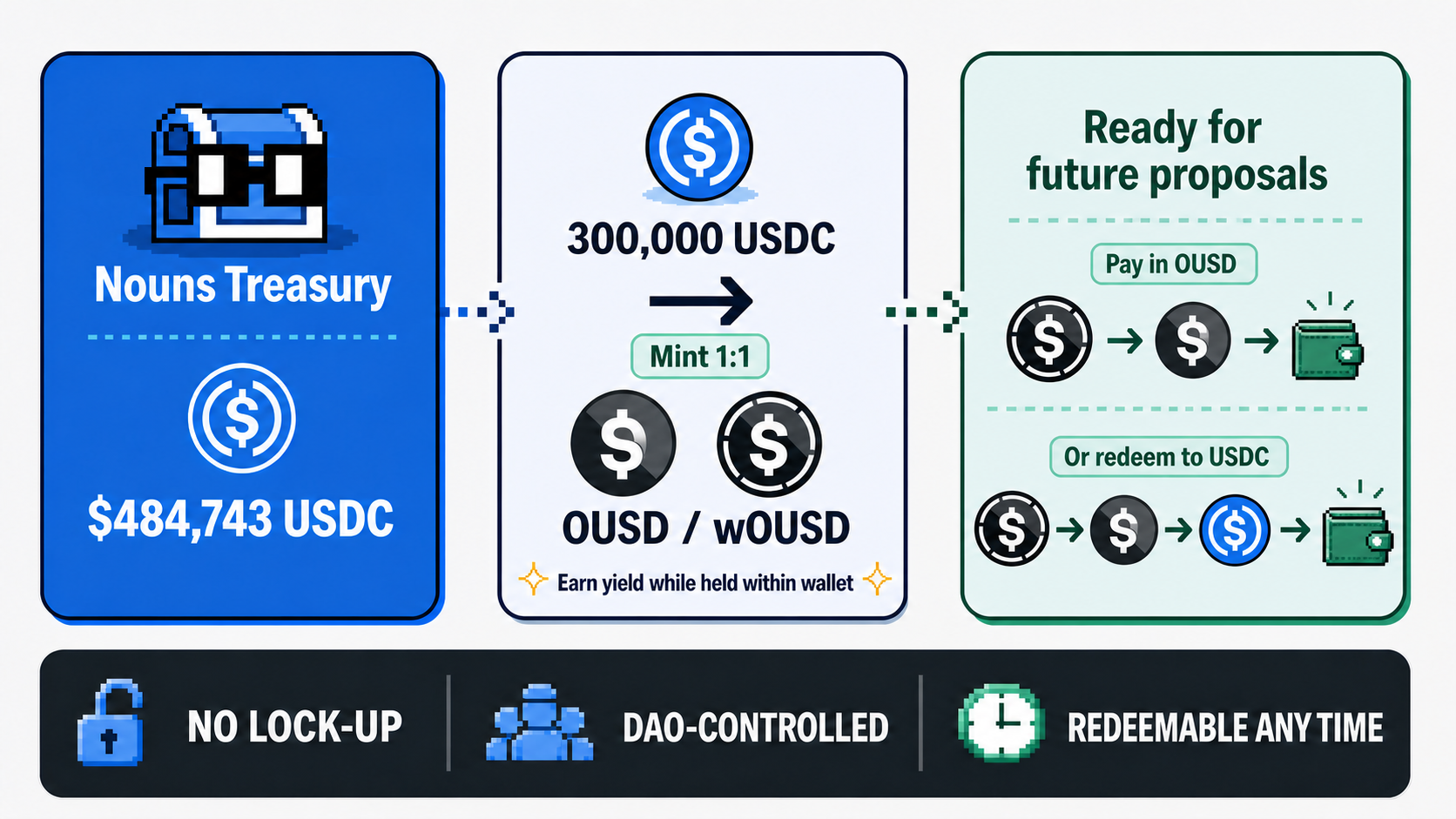
Nouns has 484,743 USDC sitting idle.
This proposal moves 300,000 USDC into OUSD so the USDC can earn a yield while waiting to be used for other proposals, while still remaining fully accessible to the DAO. It also wraps it into the non-rebasing wOUSD to simplify treasury accounting.
OUSD is a fully liquid stablecoin - converting USDC to OUSD does not lock up any funds, so there is no opportunity risk of funding other proposals with these tokens by converting some USDC to OUSD.
- **No funds are locked.**
- **No funds are spent or given to a third party.**
- **The DAO can convert OUSD → USDC at any time.**
- **wOUSD and OUSD are fully liquid.**
- **184,743 USDC remains in native USDC immediately after execution.**
- If a future proposal needs more USDC, the DAO can redeem any or all of this position first. This proposal does not prevent, delay, or compete with future spending proposals.
At the current estimated yield of \~5.15% APY, 300,000 USDC would generate roughly **$1,287/month** (\~$15,450/year), while the DAO keeps fully control and liquidity.
*This proposal was modeled after* recent staking proposals *that the DAO ratified.*
## Scope and rationale
This is a limited treasury-mechanics change, not a grant or a change to Nouns’ auction or governance rules. In this proposal the DAO is allocating 300,000 USDC (4.4% of the treasury) to a DAO-controlled yield-bearing stablecoin. Its purpose is not to make treasury management the DAO’s product, it is to let a portion of idle stablecoin reserves contribute variable yield toward future Nouns funding while 184,743 USDC remains natively available. This proposal authorizes only this capped position. Any increase beyond 300,000 USDC, or any future use of the position, would require a separate DAO proposal.
## What this proposal does
Think of this as moving part of the DAO’s idle cash from a checking account into a yield-bearing version of the same cash. Like converting the DAO's ETH into stETH !
## Why do this?
Idle USDC earns nothing. This proposal lets the DAO earn yield on a portion of that balance without sacrificing the ability to fund future ideas.
The expected yield can help fund: future proposals, operating costs, purchases of additional ETH, direct donations to charity, or simply increase the DAO’s USDC balance over time.
Most importantly: **if a better use of OUSD funds appears tomorrow, Nouns is free to use the funds tomorrow - because OUSD is fully liquid.**
## Why wOUSD instead of OUSD?
OUSD earns yield automatically via rebase (think of it like a dividend directly to your wallet). It distributes yield in the same way stETH has distributed yield to the Nouns DAO over the last several years before it was converted into wstETH. wOUSD is simply the wrapped, non-rebasing form of OUSD.
It earns the same underlying yield, but the value accrues in the token’s exchange rate rather than by increasing the number of tokens held. That format is generally simpler for treasury accounting and avoids daily rebasing activity.
Wrapping does **not** create a lock-up. It is reversible at any time.
## Wait...how does OUSD earn yield?
OUSD puts deposited USDC to work in onchain strategies instead of leaving it idle.
In simple terms: borrowers and liquidity markets pay fees or interest to use the capital. Those earnings flow back to the OUSD vault, increasing the value held by OUSD and wOUSD holders.
OUSD's current strategies include:
- Lending USDC through Morpho on Ethereum mainnet, Base, and Hyperliquid.
- Deploying USDC to a Curve AMO (automated market-operations strategy).
- Automatically claiming MORPHO, CRV, and CVX rewards and converting them into more stablecoins.
OUSD holders receive this yield automatically. wOUSD receives the same yield, but it appears in the growing wOUSD-to-OUSD exchange rate instead of as a growing token balance.
Yield rates change with market conditions, but are paid out daily without interruption.
## Risks
This is not risk-free. The relevant risks are smart-contract and stablecoin risk:
- OUSD relies on smart contracts and external yield strategies.
- OUSD is backed by USDC, so it shares USDC-related risks.
- Yield rates can change and are not guaranteed.
Origin has operated OUSD since 2020, has undergone 12+ [audits](https://docs.originprotocol.com/security-and-risk/audits) ([some](https://reports.yaudit.dev/2025-11-origin) by the same auditing firm than Nouns [used](https://reports.yaudit.dev/2022-10-NounsDAO-Token-Buyer)), maintains a bug bounty [program](https://docs.originprotocol.com/security-and-risk/bug-bounties), and uses established DeFi venues for its strategies. More detail and links can be included for anyone who wants to evaluate the technical risk.
## Transactions
There are 4 transactions involved: approve, mint, approve, and deposit
- [USDC](https://etherscan.io/address/0xA0b86991c6218b36c1d19d4a2e9eb0ce3606eb48) ‘approve’
- approves the usage of the USDC from the Nouns DAO treasury
- USDC uses 6 decimal places, so 300000000000 = 300k USDC
- [OUSD vault](https://etherscan.io/address/0xe75d77b1865ae93c7eaa3040b038d7aa7bc02f70) ‘mint’
- mints OUSD using USDC at a 1:1 rate
- [OUSD](https://etherscan.io/address/0x2a8e1e676ec238d8a992307b495b45b3feaa5e86) ‘approve’
- approves the usage of the OUSD from the Nouns DAO treasury
- OUSD uses 18 decimal places, so 300000000000000000000000 = 300k OUSD
- [wOUSD](https://etherscan.io/address/0xd2af830e8cbdfed6cc11bab697bb25496ed6fa62) ‘deposit’
- wraps OUSD into non-rebasing wOUSD for accounting simplification
# Nouns Treasury: Keep USDC Liquid, Earn Yield While It Waits

**TL;DR**
Nouns has 484,743 USDC sitting idle.
This proposal moves 300,000 USDC into OUSD so the USDC can earn a yield while waiting to be used for other proposals, while still remaining fully accessible to the DAO. It also wraps it into the non-rebasing wOUSD to simplify treasury accounting.
OUSD is a fully liquid stablecoin - converting USDC to OUSD does not lock up any funds, so there is no opportunity risk of funding other proposals with these tokens by converting some USDC to OUSD.
- **No funds are locked.**
- **No funds are spent or given to a third party.**
- **The DAO can convert OUSD → USDC at any time.**
- **wOUSD and OUSD are fully liquid.**
- **184,743 USDC remains in native USDC immediately after execution.**
- If a future proposal needs more USDC, the DAO can redeem any or all of this position first. This proposal does not prevent, delay, or compete with future spending proposals.
At the current estimated yield of \~5.15% APY, 300,000 USDC would generate roughly **$1,287/month** (\~$15,450/year), while the DAO keeps fully control and liquidity.
*This proposal was modeled after* recent staking proposals *that the DAO ratified.*
## Scope and rationale
This is a limited treasury-mechanics change, not a grant or a change to Nouns’ auction or governance rules. In this proposal the DAO is allocating 300,000 USDC (4.4% of the treasury) to a DAO-controlled yield-bearing stablecoin. Its purpose is not to make treasury management the DAO’s product, it is to let a portion of idle stablecoin reserves contribute variable yield toward future Nouns funding while 184,743 USDC remains natively available. This proposal authorizes only this capped position. Any increase beyond 300,000 USDC, or any future use of the position, would require a separate DAO proposal.
## What this proposal does
Think of this as moving part of the DAO’s idle cash from a checking account into a yield-bearing version of the same cash. Like converting the DAO's ETH into stETH !
## Why do this?
Idle USDC earns nothing. This proposal lets the DAO earn yield on a portion of that balance without sacrificing the ability to fund future ideas.
The expected yield can help fund: future proposals, operating costs, purchases of additional ETH, direct donations to charity, or simply increase the DAO’s USDC balance over time.
Most importantly: **if a better use of OUSD funds appears tomorrow, Nouns is free to use the funds tomorrow - because OUSD is fully liquid.**
## Why wOUSD instead of OUSD?
OUSD earns yield automatically via rebase (think of it like a dividend directly to your wallet). It distributes yield in the same way stETH has distributed yield to the Nouns DAO over the last several years before it was converted into wstETH. wOUSD is simply the wrapped, non-rebasing form of OUSD.
It earns the same underlying yield, but the value accrues in the token’s exchange rate rather than by increasing the number of tokens held. That format is generally simpler for treasury accounting and avoids daily rebasing activity.
Wrapping does **not** create a lock-up. It is reversible at any time.
## Wait...how does OUSD earn yield?
OUSD puts deposited USDC to work in onchain strategies instead of leaving it idle.
In simple terms: borrowers and liquidity markets pay fees or interest to use the capital. Those earnings flow back to the OUSD vault, increasing the value held by OUSD and wOUSD holders.
OUSD's current strategies include:
- Lending USDC through Morpho on Ethereum mainnet, Base, and Hyperliquid.
- Deploying USDC to a Curve AMO (automated market-operations strategy).
- Automatically claiming MORPHO, CRV, and CVX rewards and converting them into more stablecoins.
OUSD holders receive this yield automatically. wOUSD receives the same yield, but it appears in the growing wOUSD-to-OUSD exchange rate instead of as a growing token balance.
Yield rates change with market conditions, but are paid out daily without interruption.
## Risks
This is not risk-free. The relevant risks are smart-contract and stablecoin risk:
- OUSD relies on smart contracts and external yield strategies.
- OUSD is backed by USDC, so it shares USDC-related risks.
- Yield rates can change and are not guaranteed.
Origin has operated OUSD since 2020, has undergone 12+ [audits](https://docs.originprotocol.com/security-and-risk/audits) ([some](https://reports.yaudit.dev/2025-11-origin) by the same auditing firm than Nouns [used](https://reports.yaudit.dev/2022-10-NounsDAO-Token-Buyer)), maintains a bug bounty [program](https://docs.originprotocol.com/security-and-risk/bug-bounties), and uses established DeFi venues for its strategies. More detail and links can be included for anyone who wants to evaluate the technical risk.
## Transactions
There are 4 transactions involved: approve, mint, approve, and deposit
- [USDC](https://etherscan.io/address/0xA0b86991c6218b36c1d19d4a2e9eb0ce3606eb48) ‘approve’
- approves the usage of the USDC from the Nouns DAO treasury
- USDC uses 6 decimal places, so 300000000000 = 300k USDC
- [OUSD vault](https://etherscan.io/address/0xe75d77b1865ae93c7eaa3040b038d7aa7bc02f70) ‘mint’
- mints OUSD using USDC at a 1:1 rate
- [OUSD](https://etherscan.io/address/0x2a8e1e676ec238d8a992307b495b45b3feaa5e86) ‘approve’
- approves the usage of the OUSD from the Nouns DAO treasury
- OUSD uses 18 decimal places, so 300000000000000000000000 = 300k OUSD
- [wOUSD](https://etherscan.io/address/0xd2af830e8cbdfed6cc11bab697bb25496ed6fa62) ‘deposit’
- wraps OUSD into non-rebasing wOUSD for accounting simplification nouns-treasury:-keep-usdc-liquid,-earn-yield-while-it-waits-1
# Nouns Treasury: Keep USDC Liquid, Earn Yield While It Waits
##

**TL;DR**
Nouns has 484,743 USDC sitting idle.
This proposal moves 300,000 USDC into OUSD so the USDC can earn a yield while waiting to be used for other proposals, while still remaining fully accessible to the DAO. It also wraps it into the non-rebasing wOUSD to simplify treasury accounting..
OUSD is a fully liquid stablecoin - converting USDC to OUSD does not lock up any funds, so there is no opportunity risk of funding other proposals with these tokens by converting some USDC to OUSD.
- **No funds are locked.**
- **No funds are spent or given to a third party.**
- **The DAO can convert OUSD → USDC at any time.**
- **wOUSD and OUSD are fully liquid.**
- **184,743 USDC remains in native USDC immediately after execution.**
- If a future proposal needs more USDC, the DAO can redeem any or all of this position first. This proposal does not prevent, delay, or compete with future spending proposals.
At the current estimated yield of \~5.15% APY, 300,000 USDC would generate roughly **$1,287/month** (\~$15,450/year), while the DAO keeps fully control and liquidity.
*This proposal was modeled after* recent staking proposals *that the DAO ratified.*
##
## Scope and rationale
This is a limited treasury-mechanics change, not a grant or a change to Nouns’ auction or governance rules.
In this proposal the DAO is allocating 300,000 USDC (4.4% of the total treasury) to a DAO-controlled yield-bearing stablecoin position. Its purpose is not to make treasury management the DAO’s product, it is to let a portion of idle stablecoin reserves contribute variable yield toward future Nouns funding while 184,743 USDC remains natively available.
This proposal authorizes only this capped position. Any increase beyond 300,000 USDC, or any future use of the position, would require a separate DAO proposal.
## What this proposal does
Think of this as moving part of the DAO’s idle cash from a checking account into a yield-bearing version of the same cash. Like converting the DAO's ETH into stETH !
## Why do this?
Idle USDC earns nothing. This proposal lets the DAO earn yield on a portion of that balance without sacrificing the ability to fund future ideas.
The expected yield can help fund: future proposals, operating costs, purchases of additional ETH, direct donations to charity, or simply increase the DAO’s USDC balance over time.
Most importantly: **if a better use of OUSD funds appears tomorrow, Nouns is free to use the funds tomorrow - because OUSD is fully liquid.**
## Why wOUSD instead of OUSD?
OUSD earns yield automatically via rebase (think of it like a dividend directly to your wallet). It distributes yield in the same way stETH has distributed yield to the Nouns DAO over the last several years before it was converted into wstETH. wOUSD is simply the wrapped, non-rebasing form of OUSD.
It earns the same underlying yield, but the value accrues in the token’s exchange rate rather than by increasing the number of tokens held. That format is generally simpler for treasury accounting and avoids daily rebasing activity.
Wrapping does **not** create a lock-up. It is reversible at any time.
## Wait...how does OUSD earn yield?
OUSD puts deposited USDC to work in onchain strategies instead of leaving it idle.
In simple terms: borrowers and liquidity markets pay fees or interest to use the capital. Those earnings flow back to the OUSD vault, increasing the value held by OUSD and wOUSD holders.
OUSD's current strategies include:
- Lending USDC through Morpho on Ethereum mainnet, Base, and Hyperliquid.
- Deploying USDC to a Curve AMO (automated market-operations strategy).
- Automatically claiming MORPHO, CRV, and CVX rewards and converting them into more stablecoins.
OUSD holders receive this yield automatically. wOUSD receives the same yield, but it appears in the growing wOUSD-to-OUSD exchange rate instead of as a growing token balance.
Yield rates change with market conditions, but are paid out daily without interruption.
## Risks
This is not risk-free. The relevant risks are smart-contract and stablecoin risk:
- OUSD relies on smart contracts and external yield strategies.
- OUSD is backed by USDC, so it shares USDC-related risks.
- Yield rates can change and are not guaranteed.
Origin has operated OUSD since 2020, has undergone 12+ [audits](https://docs.originprotocol.com/security-and-risk/audits) ([some](https://reports.yaudit.dev/2025-11-origin) by the same auditing firm than Nouns [used](https://reports.yaudit.dev/2022-10-NounsDAO-Token-Buyer)), maintains a bug bounty [program](https://docs.originprotocol.com/security-and-risk/bug-bounties), and uses established DeFi venues for its strategies. More detail and links can be included for anyone who wants to evaluate the technical risk.
## Transactions
There are 4 transactions involved: approve, mint, approve, and deposit
- [USDC](https://etherscan.io/address/0xA0b86991c6218b36c1d19d4a2e9eb0ce3606eb48) ‘approve’
- approves the usage of the USDC from the Nouns DAO treasury
- USDC uses 6 decimal places, so 300000000000 = 300k USDC
- [OUSD vault](https://etherscan.io/address/0xe75d77b1865ae93c7eaa3040b038d7aa7bc02f70) ‘mint’
- mints OUSD using USDC at a 1:1 rate
- [OUSD](https://etherscan.io/address/0x2a8e1e676ec238d8a992307b495b45b3feaa5e86) ‘approve’
- approves the usage of the OUSD from the Nouns DAO treasury
- OUSD uses 18 decimal places, so 300000000000000000000000 = 300k OUSD
- [wOUSD](https://etherscan.io/address/0xd2af830e8cbdfed6cc11bab697bb25496ed6fa62) ‘deposit’
- wraps OUSD into DUNA compliant wOUSD nouns-treasury:-keep-usdc-liquid,-earn-yield-while-it-waits-update-2
# Nouns Treasury: Keep USDC Liquid, Earn Yield While It Waits
##

**TL;DR**
Nouns has 484,743 USDC sitting idle.
This proposal moves 300,000 USDC into OUSD so the USDC can earn a yield while waiting to be used for other proposals, while still remaining fully accessible to the DAO. It also wraps it to remain compliant with the DUNA.
OUSD is a fully liquid stablecoin - converting USDC to OUSD does not lock up any funds, so there is no opportunity risk of funding other proposals with these tokens by converting some USDC to OUSD.
- **No funds are locked.**
- **No funds are spent or given to a third party.**
- **The DAO can convert OUSD → USDC at any time.**
- **wOUSD and OUSD are fully liquid.**
- **184,743 USDC remains in native USDC immediately after execution.**
- If a future proposal needs more USDC, the DAO can redeem any or all of this position first. This proposal does not prevent, delay, or compete with future spending proposals.
At the current estimated yield of \~5.15% APY, 300,000 USDC would generate roughly **$1,287/month** (\~$15,450/year), while the DAO keeps fully control and liquidity.
*This proposal was modeled after* recent staking proposals *that the DAO ratified.*
## What this proposal does
Think of this as moving part of the DAO’s idle cash from a checking account into a yield-bearing version of the same cash. Like converting the DAO's ETH into stETH !
## Why do this?
Idle USDC earns nothing. This proposal lets the DAO earn yield on a portion of that balance without sacrificing the ability to fund future ideas.
The expected yield can help fund: future proposals, operating costs, purchases of additional ETH, direct donations to charity, or simply increase the DAO’s USDC balance over time.
Most importantly: **if a better use of OUSD funds appears tomorrow, Nouns is free to use the funds tomorrow - because OUSD is fully liquid.**
## Why wOUSD instead of OUSD?
OUSD earns yield automatically via rebase (think of it like a dividend directly to your wallet). It distributes yield in the same way stETH has distributed yield to the Nouns DAO over the last several years before it was converted into wstETH. wOUSD is simply the wrapped, non-rebasing form of OUSD.
It earns the same underlying yield, but the value accrues in the token’s exchange rate rather than by increasing the number of tokens held. That format is generally simpler for treasury accounting and avoids daily rebasing activity.
Wrapping does **not** create a lock-up. It is reversible at any time.
## Wait...how does OUSD earn yield?
OUSD puts deposited USDC to work in onchain strategies instead of leaving it idle.
In simple terms: borrowers and liquidity markets pay fees or interest to use the capital. Those earnings flow back to the OUSD vault, increasing the value held by OUSD and wOUSD holders.
OUSD's current strategies include:
- Lending USDC through Morpho on Ethereum mainnet, Base, and Hyperliquid.
- Deploying USDC to a Curve AMO (automated market-operations strategy).
- Automatically claiming MORPHO, CRV, and CVX rewards and converting them into more stablecoins.
OUSD holders receive this yield automatically. wOUSD receives the same yield, but it appears in the growing wOUSD-to-OUSD exchange rate instead of as a growing token balance.
Yield rates change with market conditions, but are paid out daily without interruption.
## Risks
This is not risk-free. The relevant risks are smart-contract and stablecoin risk:
- OUSD relies on smart contracts and external yield strategies.
- OUSD is backed by USDC, so it shares USDC-related risks.
- Yield rates can change and are not guaranteed.
Origin has operated OUSD since 2020, has undergone 12+ [audits](https://docs.originprotocol.com/security-and-risk/audits) ([some](https://reports.yaudit.dev/2025-11-origin) by the same auditing firm than Nouns [used](https://reports.yaudit.dev/2022-10-NounsDAO-Token-Buyer)), maintains a bug bounty [program](https://docs.originprotocol.com/security-and-risk/bug-bounties), and uses established DeFi venues for its strategies. More detail and links can be included for anyone who wants to evaluate the technical risk.
## Transactions
There are 4 transactions involved: approve, mint, approve, and deposit
- [USDC](https://etherscan.io/address/0xE75D77B1865Ae93c7eaa3040B038D7aA7BC02F70) ‘approve’
- approves the usage of the USDC from the Nouns DAO treasury
- USDC uses 6 decimal places, so 300000000000 = 300k USDC
- [OUSD vault](https://etherscan.io/address/0xe75d77b1865ae93c7eaa3040b038d7aa7bc02f70) ‘mint’
- mints OUSD using USDC at a 1:1 rate
- [OUSD](https://etherscan.io/address/0x2a8e1e676ec238d8a992307b495b45b3feaa5e86) ‘approve’
- approves the usage of the OUSD from the Nouns DAO treasury
- OUSD uses 18 decimal places, so 300000000000000000000000 = 300k OUSD
- [wOUSD](https://etherscan.io/address/0xd2af830e8cbdfed6cc11bab697bb25496ed6fa62) ‘deposit’
- wraps OUSD into DUNA compliant wOUSD nouns-treasury:-keep-usdc-liquid,-earn-yield-while-it-waits-update-1
# Nouns Treasury: Keep USDC Liquid, Earn Yield While It Waits
##

**TL;DR**
Nouns has 484,743 USDC sitting idle.
This proposal moves 300,000 USDC into OUSD so the USDC can earn a yield while waiting to be used for other proposals, while still remaining fully accessible to the DAO. It also wraps it into wOSUD to simplify treasury accounting.
OUSD is a fully liquid stablecoin - converting USDC to OUSD does not lock up any funds, so there is no opportunity risk of funding other proposals with these tokens by converting some USDC to OUSD.
- **No funds are locked.**
- **No funds are spent or given to a third party.**
- **The DAO can convert OUSD → USDC at any time.**
- **wOUSD and OUSD are fully liquid.**
- **184,743 USDC remains in native USDC immediately after execution.**
- If a future proposal needs more USDC, the DAO can redeem any or all of this position first. This proposal does not prevent, delay, or compete with future spending proposals.
At the current estimated yield of \~5.15% APY, 300,000 USDC would generate roughly **$1,287/month** (\~$15,450/year), while the DAO keeps fully control and liquidity.
*This proposal was modeled after* recent staking proposals *that the DAO ratified.*
## Scope and rationale
This is a limited treasury-mechanics change, not a grant or a change to Nouns’ auction or governance rules.
The DAO would allocate 300,000 USDC (4.4% of the total treasury) to a DAO-controlled yield-bearing stablecoin position. Its purpose is not to make treasury management the DAO’s product, but to let a portion of idle stablecoin reserves contribute variable yield toward future Nouns funding while 184,743 USDC remains natively available.
This proposal authorizes only this capped position. Any increase beyond 300,000 USDC, or any future use of the position, would require a separate DAO proposal.
## What this proposal does
Think of this as moving part of the DAO’s idle cash from a checking account into a yield-bearing version of the same cash. Like converting the DAO's ETH into stETH !
## Why do this?
Idle USDC earns nothing. This proposal lets the DAO earn yield on a portion of that balance without sacrificing the ability to fund future ideas.
The expected yield can help fund: future proposals, operating costs, purchases of additional ETH, direct donations to charity, or simply increase the DAO’s USDC balance over time.
Most importantly: **if a better use of OUSD funds appears tomorrow, Nouns is free to use the funds tomorrow - because OUSD is fully liquid.**
## Why wOUSD instead of OUSD?
OUSD earns yield automatically via rebase (think of it like a dividend directly to your wallet). It distributes yield in the same way stETH has distributed yield to the Nouns DAO over the last several years before it was converted into wstETH. wOUSD is simply the wrapped, non-rebasing form of OUSD.
It earns the same underlying yield, but the value accrues in the token’s exchange rate rather than by increasing the number of tokens held. That format is generally simpler for treasury accounting and avoids daily rebasing activity.
Wrapping does **not** create a lock-up. It is reversible at any time.
## Wait...how does OUSD earn yield?
OUSD puts deposited USDC to work in onchain strategies instead of leaving it idle.
In simple terms: borrowers and liquidity markets pay fees or interest to use the capital. Those earnings flow back to the OUSD vault, increasing the value held by OUSD and wOUSD holders.
OUSD's current strategies include:
- Lending USDC through Morpho on Ethereum mainnet, Base, and Hyperliquid.
- Deploying USDC to a Curve AMO (automated market-operations strategy).
- Automatically claiming MORPHO, CRV, and CVX rewards and converting them into more stablecoins.
OUSD holders receive this yield automatically. wOUSD receives the same yield, but it appears in the growing wOUSD-to-OUSD exchange rate instead of as a growing token balance.
Yield rates change with market conditions, but are paid out daily without interruption.
## Risks
This is not risk-free. The relevant risks are smart-contract and stablecoin risk:
- OUSD relies on smart contracts and external yield strategies.
- OUSD is backed by USDC, so it shares USDC-related risks.
- Yield rates can change and are not guaranteed.
Origin has operated OUSD since 2020, has undergone 12+ [audits](https://docs.originprotocol.com/security-and-risk/audits) ([some](https://reports.yaudit.dev/2025-11-origin) by the same auditing firm than Nouns [used](https://reports.yaudit.dev/2022-10-NounsDAO-Token-Buyer)), maintains a bug bounty [program](https://docs.originprotocol.com/security-and-risk/bug-bounties), and uses established DeFi venues for its strategies. More detail and links can be included for anyone who wants to evaluate the technical risk.
## Transactions
There are 4 transactions involved: approve, mint, approve, and deposit
- [USDC](https://etherscan.io/address/0xA0b86991c6218b36c1d19d4a2e9eb0ce3606eb48) ‘approve’
- approves the usage of the USDC from the Nouns DAO treasury
- USDC uses 6 decimal places, so 300000000000 = 300k USDC
- [OUSD vault](https://etherscan.io/address/0xe75d77b1865ae93c7eaa3040b038d7aa7bc02f70) ‘mint’
- mints OUSD using USDC at a 1:1 rate
- [OUSD](https://etherscan.io/address/0x2a8e1e676ec238d8a992307b495b45b3feaa5e86) ‘approve’
- approves the usage of the OUSD from the Nouns DAO treasury
- OUSD uses 18 decimal places, so 300000000000000000000000 = 300k OUSD
- [wOUSD](https://etherscan.io/address/0xd2af830e8cbdfed6cc11bab697bb25496ed6fa62) ‘deposit’
- wraps OUSD into DUNA compliant wOUSD nouns-treasury:-keep-usdc-liquid,-earn-yield-while-it-waits-update
# Nouns Treasury: Keep USDC Liquid, Earn Yield While It Waits
##

**TL;DR**
Nouns has 484,743 USDC sitting idle.
This proposal moves 300,000 USDC into OUSD so the USDC can earn a yield while waiting to be used for other proposals, while still remaining fully accessible to the DAO. It also wraps it to remain compliant with the DUNA.
OUSD is a fully liquid stablecoin - converting USDC to OUSD does not lock up any funds, so there is no opportunity risk of funding other proposals with these tokens by converting some USDC to OUSD.
- **No funds are locked.**
- **No funds are spent or given to a third party.**
- **The DAO can convert OUSD → USDC at any time.**
- **wOUSD and OUSD are fully liquid.**
- **184,743 USDC remains in native USDC immediately after execution.**
- If a future proposal needs more USDC, the DAO can redeem any or all of this position first. This proposal does not prevent, delay, or compete with future spending proposals.
At the current estimated yield of \~5.15% APY, 300,000 USDC would generate roughly **$1,287/month** (\~$15,450/year), while the DAO keeps fully control and liquidity.
*This proposal was modeled after* recent staking proposals *that the DAO ratified.*
## What this proposal does
Think of this as moving part of the DAO’s idle cash from a checking account into a yield-bearing version of the same cash. Like converting the DAO's ETH into stETH !
## Why do this?
Idle USDC earns nothing. This proposal lets the DAO earn yield on a portion of that balance without sacrificing the ability to fund future ideas.
The expected yield can help fund: future proposals, operating costs, purchases of additional ETH, direct donations to charity, or simply increase the DAO’s USDC balance over time.
Most importantly: **if a better use of OUSD funds appears tomorrow, Nouns is free to use the funds tomorrow - because OUSD is fully liquid.**
## Why wOUSD instead of OUSD?
OUSD earns yield automatically via rebase (think of it like a dividend directly to your wallet). It distributes yield in the same way stETH has distributed yield to the Nouns DAO over the last several years before it was converted into wstETH. wOUSD is simply the wrapped, non-rebasing form of OUSD.
It earns the same underlying yield, but the value accrues in the token’s exchange rate rather than by increasing the number of tokens held. That format is generally simpler for treasury accounting and avoids daily rebasing activity.
Wrapping does **not** create a lock-up. It is reversible at any time.
## Wait...how does OUSD earn yield?
OUSD puts deposited USDC to work in onchain strategies instead of leaving it idle.
In simple terms: borrowers and liquidity markets pay fees or interest to use the capital. Those earnings flow back to the OUSD vault, increasing the value held by OUSD and wOUSD holders.
OUSD's current strategies include:
- Lending USDC through Morpho on Ethereum mainnet, Base, and Hyperliquid.
- Deploying USDC to a Curve AMO (automated market-operations strategy).
- Automatically claiming MORPHO, CRV, and CVX rewards and converting them into more stablecoins.
OUSD holders receive this yield automatically. wOUSD receives the same yield, but it appears in the growing wOUSD-to-OUSD exchange rate instead of as a growing token balance.
Yield rates change with market conditions, but are paid out daily without interruption.
## Risks
This is not risk-free. The relevant risks are smart-contract and stablecoin risk:
- OUSD relies on smart contracts and external yield strategies.
- OUSD is backed by USDC, so it shares USDC-related risks.
- Yield rates can change and are not guaranteed.
Origin has operated OUSD since 2020, has undergone 12+ [audits](https://docs.originprotocol.com/security-and-risk/audits) ([some](https://reports.yaudit.dev/2025-11-origin) by the same auditing firm than Nouns [used](https://reports.yaudit.dev/2022-10-NounsDAO-Token-Buyer)), maintains a bug bounty [program](https://docs.originprotocol.com/security-and-risk/bug-bounties), and uses established DeFi venues for its strategies. More detail and links can be included for anyone who wants to evaluate the technical risk.
## Transactions
There are 4 transactions involved: approve, mint, approve, and deposit
- [USDC](https://etherscan.io/address/0xE75D77B1865Ae93c7eaa3040B038D7aA7BC02F70) ‘approve’
- approves the usage of the USDC from the Nouns DAO treasury
- USDC uses 6 decimal places, so 300000000000 = 300k USDC
- [OUSD vault](https://etherscan.io/address/0xe75d77b1865ae93c7eaa3040b038d7aa7bc02f70) ‘mint’
- mints OUSD using USDC at a 1:1 rate
- [OUSD](https://etherscan.io/address/0x2a8e1e676ec238d8a992307b495b45b3feaa5e86) ‘approve’
- approves the usage of the OUSD from the Nouns DAO treasury
- OUSD uses 18 decimal places, so 300000000000000000000000 = 300k OUSD
- [wOUSD](https://etherscan.io/address/0xd2af830e8cbdfed6cc11bab697bb25496ed6fa62) ‘deposit’
- wraps OUSD into DUNA compliant wOUSD
# Nouns Treasury: Keep USDC Liquid, Earn Yield While It Waits
##

**TL;DR**
Nouns has 484,743 USDC sitting idle.
This proposal moves 300,000 USDC into OUSD so the USDC can earn a yield while waiting to be used for other proposals, while still remaining fully accessible to the DAO. It also wraps it to remain compliant with the DUNA.
OUSD is a fully liquid stablecoin - converting USDC to OUSD does not lock up any funds, so there is no opportunity risk of funding other proposals with these tokens by converting some USDC to OUSD.
- **No funds are locked.**
- **No funds are spent or given to a third party.**
- **The DAO can convert OUSD → USDC at any time.**
- **wOUSD and OUSD are fully liquid.**
- **184,743 USDC remains in native USDC immediately after execution.**
- If a future proposal needs more USDC, the DAO can redeem any or all of this position first. This proposal does not prevent, delay, or compete with future spending proposals.
At the current estimated yield of \~5.15% APY, 300,000 USDC would generate roughly **$1,287/month** (\~$15,450/year), while the DAO keeps fully control and liquidity.
*This proposal was modeled after* recent staking proposals *that the DAO ratified.*
## What this proposal does
Think of this as moving part of the DAO’s idle cash from a checking account into a yield-bearing version of the same cash. Like converting the DAO's ETH into stETH !
## Why do this?
Idle USDC earns nothing. This proposal lets the DAO earn yield on a portion of that balance without sacrificing the ability to fund future ideas.
The expected yield can help fund: future proposals, operating costs, purchases of additional ETH, direct donations to charity, or simply increase the DAO’s USDC balance over time.
Most importantly: **if a better use of OUSD funds appears tomorrow, Nouns is free to use the funds tomorrow - because OUSD is fully liquid.**
## Why wOUSD instead of OUSD?
OUSD earns yield automatically via rebase (think of it like a dividend directly to your wallet). It distributes yield in the same way stETH has distributed yield to the Nouns DAO over the last several years before it was converted into wstETH. wOUSD is simply the wrapped, non-rebasing form of OUSD.
It earns the same underlying yield, but the value accrues in the token’s exchange rate rather than by increasing the number of tokens held. That format is generally simpler for treasury accounting and avoids daily rebasing activity.
Wrapping does **not** create a lock-up. It is reversible at any time.
## Wait...how does OUSD earn yield?
OUSD puts deposited USDC to work in onchain strategies instead of leaving it idle.
In simple terms: borrowers and liquidity markets pay fees or interest to use the capital. Those earnings flow back to the OUSD vault, increasing the value held by OUSD and wOUSD holders.
OUSD's current strategies include:
- Lending USDC through Morpho on Ethereum mainnet, Base, and Hyperliquid.
- Deploying USDC to a Curve AMO (automated market-operations strategy).
- Automatically claiming MORPHO, CRV, and CVX rewards and converting them into more stablecoins.
OUSD holders receive this yield automatically. wOUSD receives the same yield, but it appears in the growing wOUSD-to-OUSD exchange rate instead of as a growing token balance.
Yield rates change with market conditions, but are paid out daily without interruption.
## Risks
This is not risk-free. The relevant risks are smart-contract and stablecoin risk:
- OUSD relies on smart contracts and external yield strategies.
- OUSD is backed by USDC, so it shares USDC-related risks.
- Yield rates can change and are not guaranteed.
Origin has operated OUSD since 2020, has undergone 12+ [audits](https://docs.originprotocol.com/security-and-risk/audits) ([some](https://reports.yaudit.dev/2025-11-origin) by the same auditing firm than Nouns [used](https://reports.yaudit.dev/2022-10-NounsDAO-Token-Buyer)), maintains a bug bounty [program](https://docs.originprotocol.com/security-and-risk/bug-bounties), and uses established DeFi venues for its strategies. More detail and links can be included for anyone who wants to evaluate the technical risk.
## Transactions
There are 4 transactions involved: approve, mint, approve, and deposit
- [USDC](https://etherscan.io/address/0xE75D77B1865Ae93c7eaa3040B038D7aA7BC02F70) ‘approve’
- approves the usage of the USDC from the Nouns DAO treasury
- USDC uses 6 decimal places, so 300000000000 = 300k USDC
- [OUSD vault](https://etherscan.io/address/0xe75d77b1865ae93c7eaa3040b038d7aa7bc02f70) ‘mint’
- mints OUSD using USDC at a 1:1 rate
- [OUSD](https://etherscan.io/address/0x2a8e1e676ec238d8a992307b495b45b3feaa5e86) ‘approve’
- approves the usage of the OUSD from the Nouns DAO treasury
- OUSD uses 18 decimal places, so 300000000000000000000000 = 300k OUSD
- [wOUSD](https://etherscan.io/address/0xd2af830e8cbdfed6cc11bab697bb25496ed6fa62) ‘deposit’
- wraps OUSD into DUNA compliant wOUSD nouns-treasury:-keep-usdc-liquid,-earn-yield-while-it-waitsadded 2 links - Fun fact, Origin's 2025 audit and 2026 audit were completed by the same auditing firm that completed the NounsDAO Token Buyer audit in 2022
# Nouns Treasury: Keep USDC Liquid, Earn Yield While It Waits
##

**TL;DR**
Nouns has 484,743 USDC sitting idle.
This proposal moves 300,000 USDC into OUSD so the USDC can earn a yield while waiting to be used for other proposals, while still remaining fully accessible to the DAO. It also wraps it to remain compliant with the DUNA.
OUSD is a fully liquid stablecoin - converting USDC to OUSD does not lock up any funds, so there is no opportunity risk of funding other proposals with these tokens by converting some USDC to OUSD.
- **No funds are locked.**
- **No funds are spent or given to a third party.**
- **The DAO can convert OUSD → USDC at any time.**
- **wOUSD and OUSD are fully liquid.**
- **184,743 USDC remains in native USDC immediately after execution.**
- If a future proposal needs more USDC, the DAO can redeem any or all of this position first. This proposal does not prevent, delay, or compete with future spending proposals.
At the current estimated yield of \~5.15% APY, 300,000 USDC would generate roughly **$1,287/month** (\~$15,450/year), while the DAO keeps fully control and liquidity.
*This proposal was modeled after* recent staking proposals *that the DAO ratified.*
## What this proposal does
Think of this as moving part of the DAO’s idle cash from a checking account into a yield-bearing version of the same cash. Like converting the DAO's ETH into stETH !
## Why do this?
Idle USDC earns nothing. This proposal lets the DAO earn yield on a portion of that balance without sacrificing the ability to fund future ideas.
The expected yield can help fund: future proposals, operating costs, purchases of additional ETH, direct donations to charity, or simply increase the DAO’s USDC balance over time.
Most importantly: **if a better use of OUSD funds appears tomorrow, Nouns is free to use the funds tomorrow - because OUSD is fully liquid.**
## Why wOUSD instead of OUSD?
OUSD earns yield automatically via rebase (think of it like a dividend directly to your wallet). It distributes yield in the same way stETH has distributed yield to the Nouns DAO over the last several years before it was converted into wstETH. wOUSD is simply the wrapped, non-rebasing form of OUSD.
It earns the same underlying yield, but the value accrues in the token’s exchange rate rather than by increasing the number of tokens held. That format is generally simpler for treasury accounting and avoids daily rebasing activity.
Wrapping does **not** create a lock-up. It is reversible at any time.
## Wait...how does OUSD earn yield?
OUSD puts deposited USDC to work in onchain strategies instead of leaving it idle.
In simple terms: borrowers and liquidity markets pay fees or interest to use the capital. Those earnings flow back to the OUSD vault, increasing the value held by OUSD and wOUSD holders.
OUSD's current strategies include:
- Lending USDC through Morpho on Ethereum mainnet, Base, and Hyperliquid.
- Deploying USDC to a Curve AMO (automated market-operations strategy).
- Automatically claiming MORPHO, CRV, and CVX rewards and converting them into more stablecoins.
OUSD holders receive this yield automatically. wOUSD receives the same yield, but it appears in the growing wOUSD-to-OUSD exchange rate instead of as a growing token balance.
Yield rates change with market conditions, but are paid out daily without interruption.
## Risks
This is not risk-free. The relevant risks are smart-contract and stablecoin risk:
- OUSD relies on smart contracts and external yield strategies.
- OUSD is backed by USDC, so it shares USDC-related risks.
- Yield rates can change and are not guaranteed.
Origin has operated OUSD since 2020, has undergone 12+ [audits](https://docs.originprotocol.com/security-and-risk/audits), maintains a bug bounty [program](https://docs.originprotocol.com/security-and-risk/bug-bounties), and uses established DeFi venues for its strategies. More detail and links can be included for anyone who wants to evaluate the technical risk.
## Transactions
There are 4 transactions involved: approve, mint, approve, and deposit
- [USDC](https://etherscan.io/address/0xE75D77B1865Ae93c7eaa3040B038D7aA7BC02F70) ‘approve’
- approves the usage of the USDC from the Nouns DAO treasury
- USDC uses 6 decimal places, so 300000000000 = 300k USDC
- [OUSD vault](https://etherscan.io/address/0xe75d77b1865ae93c7eaa3040b038d7aa7bc02f70) ‘mint’
- mints OUSD using USDC at a 1:1 rate
- [OUSD](https://etherscan.io/address/0x2a8e1e676ec238d8a992307b495b45b3feaa5e86) ‘approve’
- approves the usage of the OUSD from the Nouns DAO treasury
- OUSD uses 18 decimal places, so 300000000000000000000000 = 300k OUSD
- [wOUSD](https://etherscan.io/address/0xd2af830e8cbdfed6cc11bab697bb25496ed6fa62) ‘deposit’
- wraps OUSD into DUNA compliant wOUSD nouns-treasury:-keep-usdc-liquid,-earn-yield-while-it-waits
# Nouns Treasury: Keep USDC Liquid, Earn Yield While It Waits
##

**TL;DR**
Nouns has 484,743 USDC sitting idle.
This proposal moves 300,000 USDC into OUSD so the USDC can earn a yield while waiting to be used for other proposals, while still remaining fully accessible to the DAO. It also wraps it to remain compliant with the DUNA.
OUSD is a fully liquid stablecoin - converting USDC to OUSD does not lock up any funds, so there is no opportunity risk of funding other proposals with these tokens by converting some USDC to OUSD.
- **No funds are locked.**
- **No funds are spent or given to a third party.**
- **The DAO can convert OUSD → USDC at any time.**
- **wOUSD and OUSD are fully liquid.**
- **184,743 USDC remains in native USDC immediately after execution.**
- If a future proposal needs more USDC, the DAO can redeem any or all of this position first. This proposal does not prevent, delay, or compete with future spending proposals.
At the current estimated yield of \~5.15% APY, 300,000 USDC would generate roughly **$1,287/month** (\~$15,450/year), while the DAO keeps control and liquidity.
*This proposal was modeled after* [936](https://nouns.wtf/vote/936) and [991](https://nouns.wtf/vote/991) *that the DAO ratified.*
## What this proposal does
Think of this as moving part of the DAO’s idle cash from a checking account into a yield-bearing version of the same cash. Like converting the DAO's ETH into stETH !
## Why do this?
Idle USDC earns nothing. This proposal lets the DAO earn yield on a portion of that balance without sacrificing the ability to fund future ideas.
The expected yield can help fund: future proposals, operating costs, purchases of additional ETH, or simply increase the DAO’s USDC balance over time.
Most importantly: **if a better use of OUSD funds appears tomorrow, Nouns is free to use the funds tomorrow - because OUSD is fully liquid.**
## Why wOUSD instead of OUSD?
OUSD earns yield automatically via rebase (think of it like a dividend directly to your wallet). It distributes yield in the same way stETH has distributed yield to the Nouns DAO over the last several years before it was converted into wstETH. wOUSD is simply the wrapped, non-rebasing form of OUSD.
It earns the same underlying yield, but the value accrues in the token’s exchange rate rather than by increasing the number of tokens held. That format is generally simpler for treasury accounting and avoids daily rebasing activity.
Wrapping does **not** create a lock-up. It is reversible at any time.
## Wait...how does OUSD earn yield?
OUSD puts deposited USDC to work in onchain strategies instead of leaving it idle.
In simple terms: borrowers and liquidity markets pay fees or interest to use the capital. Those earnings flow back to the OUSD vault, increasing the value held by OUSD and wOUSD holders.
OUSD's current strategies include:
- Lending USDC through Morpho on Ethereum mainnet, Base, and Hyperliquid.
- Deploying USDC to a Curve AMO (automated market-operations strategy).
- Automatically claiming MORPHO, CRV, and CVX rewards and converting them into more stablecoins.
OUSD holders receive this yield automatically. wOUSD receives the same yield, but it appears in the growing wOUSD-to-OUSD exchange rate instead of as a growing token balance.
Yield rates change with market conditions, but are paid out daily without interruption.
## Risks
This is not risk-free. The relevant risks are smart-contract and stablecoin risk:
- OUSD relies on smart contracts and external yield strategies.
- OUSD is backed by USDC, so it shares USDC-related risks.
- Yield rates can change and are not guaranteed.
Origin has operated OUSD since 2020, has undergone 12+ [audits](https://docs.originprotocol.com/security-and-risk/audits), maintains a bug bounty [program](https://docs.originprotocol.com/security-and-risk/bug-bounties), and uses established DeFi venues for its strategies. More detail and links can be included for anyone who wants to evaluate the technical risk.
## Transactions
There are 4 transactions involved: approve, mint, approve, and deposit
- [USDC](https://etherscan.io/address/0xE75D77B1865Ae93c7eaa3040B038D7aA7BC02F70) ‘approve’
- approves the usage of the USDC from the Nouns DAO treasury
- USDC uses 6 decimal places, so 300000000000 = 300k USDC
- [OUSD vault](https://etherscan.io/address/0xe75d77b1865ae93c7eaa3040b038d7aa7bc02f70) ‘mint’
- mints OUSD using USDC at a 1:1 rate
- [OUSD](https://etherscan.io/address/0x2a8e1e676ec238d8a992307b495b45b3feaa5e86) ‘approve’
- approves the usage of the OUSD from the Nouns DAO treasury
- OUSD uses 18 decimal places, so 300000000000000000000000 = 300k OUSD
- [wOUSD](https://etherscan.io/address/0xd2af830e8cbdfed6cc11bab697bb25496ed6fa62) ‘deposit’
- wraps OUSD into DUNA compliant wOUSD nouns-treasury:-keep-usdc-liquid,-earn-yield-while-it-waits
# Nouns Treasury: Keep USDC Liquid, Earn Yield While It Waits
##

**TL;DR**
Nouns has 484,743 USDC sitting idle.
This proposal moves 300,000 USDC into OUSD so the USDC can earn a yield while waiting to be used for other proposals, while still remaining fully accessible to the DAO. It also wraps it to remain compliant with the DUNA.
OUSD is a fully liquid stablecoin - converting USDC to OUSD does not lock up any funds, so there is no opportunity risk of funding other proposals with these tokens by converting some USDC to OUSD.
- **No funds are locked.**
- **No funds are spent or given to a third party.**
- **The DAO can convert OUSD → USDC at any time.**
- **wOUSD and OUSD are fully liquid.**
- **184,743 USDC remains in native USDC immediately after execution.**
- If a future proposal needs more USDC, the DAO can redeem any or all of this position first. This proposal does not prevent, delay, or compete with future spending proposals.
At the current estimated yield of \~5.15% APY, 300,000 USDC would generate roughly **$1,287/month** (\~$15,450/year), while the DAO keeps control and liquidity.
*This proposal was modeled after* [936](https://nouns.wtf/vote/936) and [991](https://nouns.wtf/vote/991) *that the DAO ratified.*
## What this proposal does
Think of this as moving part of the DAO’s idle cash from a checking account into a yield-bearing version of the same cash.
The DAO swaps:
> 300,000 USDC → OUSD → wOUSD
The DAO still controls the tokens in its own treasury. There is no manager, counterparty custody, fixed term, withdrawal request, or lock-up period. The OUSD can be spent in the same way as USDC is spent.
If Nouns later passes a proposal that needs USDC, the DAO can simply reverse the process:
> wOUSD → OUSD → USDC
Unwrapping takes the treasury back to USDC. A position of OUSD is not a commitment of funds to a project, grant, or multi-month budget. It is simply a way to extend the DAO's runway without giving up control or usage of the funds.
## Treasury after execution
| Asset | Amount | Availability |
| ---------------------------- | ----------------------------- | -------------------------------------------------------------------------------------- |
| Native USDC | 184,743 USDC | Immediately available |
| wOUSD | 300,000 USDC worth at deposit | Can be unwrapped back to OUSD, or redeemed back to USDC at any time, or spent as wOUSD |
| Total treasury USDC exposure | 484,743 USDC | Remains under DAO control |
## Why do this?
Idle USDC earns nothing. This proposal lets the DAO earn yield on a portion of that balance without sacrificing the ability to fund future ideas.
The expected yield can help fund: future proposals, operating costs, purchases of additional ETH, or simply increase the DAO’s USDC balance over time.
Most importantly: **if a better use of OUSD funds appears tomorrow, Nouns is free to use the funds tomorrow - because OUSD is fully liquid.**
## Why wOUSD instead of OUSD?
OUSD earns yield automatically via rebase (think of it like a dividend directly to your wallet). wOUSD is simply the wrapped, non-rebasing form of OUSD.
It earns the same underlying yield, but the value accrues in the token’s exchange rate rather than by increasing the number of tokens held. That format is generally simpler for treasury accounting and avoids daily rebasing activity.
Wrapping does **not** create a lock-up. It is reversible at any time.
## Wait...how does OUSD earn yield?
OUSD puts deposited USDC to work in onchain strategies instead of leaving it idle.
In simple terms: borrowers and liquidity markets pay fees or interest to use the capital. Those earnings flow back to the OUSD vault, increasing the value held by OUSD and wOUSD holders.
OUSD's current strategies include:
- Lending USDC through Morpho on Ethereum mainnet, Base, and Hyperliquid.
- Deploying USDC to a Curve AMO (automated market-operations strategy).
- Automatically claiming MORPHO, CRV, and CVX rewards and converting them into more stablecoins.
OUSD holders receive this yield automatically. wOUSD receives the same yield, but it appears in the growing wOUSD-to-OUSD exchange rate instead of as a growing token balance.
Yield rates change with market conditions, but are paid out daily without interruption.
## Risks
This is not risk-free. The relevant risks are smart-contract and stablecoin risk:
- OUSD relies on smart contracts and external yield strategies.
- OUSD is backed by USDC, so it shares USDC-related risks.
- Yield rates can change and are not guaranteed.
Origin has operated OUSD since 2020, has undergone 12+ [audits](https://docs.originprotocol.com/security-and-risk/audits), maintains a bug bounty [program](https://docs.originprotocol.com/security-and-risk/bug-bounties), and uses established DeFi venues for its strategies. More detail and links can be included for anyone who wants to evaluate the technical risk.
## Transactions
There are 4 transactions involved: approve, mint, approve, and deposit
- [USDC](https://etherscan.io/address/0xE75D77B1865Ae93c7eaa3040B038D7aA7BC02F70) ‘approve’
- approves the usage of the USDC from the Nouns DAO treasury
- USDC uses 6 decimal places, so 300000000000 = 300k USDC
- [OUSD vault](https://etherscan.io/address/0xe75d77b1865ae93c7eaa3040b038d7aa7bc02f70) ‘mint’
- mints OUSD using USDC at a 1:1 rate
- [OUSD](https://etherscan.io/address/0x2a8e1e676ec238d8a992307b495b45b3feaa5e86) ‘approve’
- approves the usage of the OUSD from the Nouns DAO treasury
- OUSD uses 18 decimal places, so 300000000000000000000000 = 300k OUSD
- [wOUSD](https://etherscan.io/address/0xd2af830e8cbdfed6cc11bab697bb25496ed6fa62) ‘deposit’
- wraps OUSD into DUNA compliant wOUSD nouns-treasury:-keep-usdc-liquid,-earn-yield-while-it-waits
Updated version of this proposal here: https://www.nouns.camp/candidates/nouns-treasury%3A-keep-usdc-liquid%2C-earn-yield-while-it-waits-cc4fd6e348009710404641a01b29f15703b90aed
# Nouns Treasury: Keep USDC Liquid, Earn Yield While It Waits
##

**TL;DR**
Nouns has 484,743 USDC sitting idle.
This proposal moves 300,000 USDC into OUSD so the USDC can earn a yield while waiting to be used for other proposals, while still remaining fully accessible to the DAO. It also wraps it to remain compliant with the DUNA.
OUSD is a fully liquid stablecoin - converting USDC to OUSD does not lock up any funds, so there is no opportunity risk of funding other proposals with these tokens by converting some USDC to OUSD.
- **No funds are locked.**
- **No funds are spent or given to a third party.**
- **The DAO can convert OUSD → USDC at any time.**
- **wOUSD and OUSD are fully liquid.**
- **184,743 USDC remains in native USDC immediately after execution.**
- If a future proposal needs more USDC, the DAO can redeem any or all of this position first. This proposal does not prevent, delay, or compete with future spending proposals.
At the current estimated yield of \~5.15% APY, 300,000 USDC would generate roughly **$1,287/month** (\~$15,450/year), while the DAO keeps control and liquidity.
*This is almost 3x the amount Nouns is generating on the ETH* currently *staked through wstETH, mETH, and rETH. This proposal was modeled after* [936](https://nouns.wtf/vote/936) and [991](https://nouns.wtf/vote/991) *that the DAO ratified.*
## What this proposal does
Think of this as moving part of the DAO’s idle cash from a checking account into a yield-bearing version of the same cash.
The DAO swaps:
> 300,000 USDC → OUSD → wOUSD
The DAO still controls the tokens in its own treasury. There is no manager, counterparty custody, fixed term, withdrawal request, or lock-up period. The OUSD can be spent in the same way as USDC is spent.
If Nouns later passes a proposal that needs USDC, the DAO can simply reverse the process:
> wOUSD → OUSD → USDC
Unwrapping takes the treasury back to USDC. A position of OUSD is not a commitment of funds to a project, grant, or multi-month budget. It is simply a way to extend the DAO's runway without giving up control or usage of the funds.
## Treasury after execution
| Asset | Amount | Availability |
| ---------------------------- | ----------------------------- | -------------------------------------------------------------------------------------- |
| Native USDC | 184,743 USDC | Immediately available |
| wOUSD | 300,000 USDC worth at deposit | Can be unwrapped back to OUSD, or redeemed back to USDC at any time, or spent as wOUSD |
| Total treasury USDC exposure | 484,743 USDC | Remains under DAO control |
## Why do this?
Idle USDC earns nothing. This proposal lets the DAO earn yield on a portion of that balance without sacrificing the ability to fund future ideas.
The expected yield can help fund: future proposals, operating costs, purchases of additional ETH, or simply increase the DAO’s USDC balance over time.
Most importantly: **if a better use of OUSD funds appears tomorrow, Nouns is free to use the funds tomorrow - because OUSD is fully liquid.**
## Why wOUSD instead of OUSD?
OUSD earns yield automatically. wOUSD is simply the wrapped, non-rebasing form of OUSD.
It earns the same underlying yield, but the value accrues in the token’s exchange rate rather than by increasing the number of tokens held. That format is generally simpler for treasury accounting and avoids daily rebasing activity.
Wrapping does **not** create a lock-up. It is reversible at any time.
## Wait...how does OUSD earn yield?
OUSD puts deposited USDC to work in onchain strategies instead of leaving it idle.
In simple terms: borrowers and liquidity markets pay fees or interest to use the capital. Those earnings flow back to the OUSD vault, increasing the value held by OUSD and wOUSD holders.
OUSD's current strategies include:
- Lending USDC through Morpho on Ethereum mainnet, Base, and Hyperliquid.
- Deploying USDC to a Curve AMO (automated market-operations strategy).
- Automatically claiming MORPHO, CRV, and CVX rewards and converting them into more stablecoins.
OUSD holders receive this yield automatically. wOUSD receives the same yield, but it appears in the growing wOUSD-to-OUSD exchange rate instead of as a growing token balance.
Yield rates change with market conditions, but are paid out daily without interruption.
## Risks
This is not risk-free. The relevant risks are smart-contract and stablecoin risk:
- OUSD relies on smart contracts and external yield strategies.
- OUSD is backed by USDC, so it shares USDC-related risks.
- Yield rates can change and are not guaranteed.
Origin has operated OUSD since 2020, has undergone 12+ [audits](https://docs.originprotocol.com/security-and-risk/audits), maintains a bug bounty [program](https://docs.originprotocol.com/security-and-risk/bug-bounties), and uses established DeFi venues for its strategies. More detail and links can be included for anyone who wants to evaluate the technical risk.
## Transactions
There are 4 transactions involved: approve, mint, approve, and deposit
- [USDC](https://etherscan.io/address/0xE75D77B1865Ae93c7eaa3040B038D7aA7BC02F70) ‘approve’
- approves the usage of the USDC from the Nouns DAO treasury
- USDC uses 6 decimal places, so 300000000000 = 300k USDC
- [OUSD vault](https://etherscan.io/address/0xe75d77b1865ae93c7eaa3040b038d7aa7bc02f70) ‘mint’
- mints OUSD using USDC at a 1:1 rate
- [OUSD](https://etherscan.io/address/0x2a8e1e676ec238d8a992307b495b45b3feaa5e86) ‘approve’
- approves the usage of the OUSD from the Nouns DAO treasury
- OUSD uses 18 decimal places, so 300000000000000000000000 = 300k OUSD
- [wOUSD](https://etherscan.io/address/0xd2af830e8cbdfed6cc11bab697bb25496ed6fa62) ‘deposit’
- wraps OUSD into DUNA compliant wOUSD nouns-treasury:-keep-usdc-liquid,-earn-yield-while-it-waits
# Nouns Treasury: Keep USDC Liquid, Earn Yield While It Waits
##

**TL;DR**
Nouns has 484,743 USDC sitting idle.
This proposal moves 300,000 USDC into OUSD so the USDC can earn a yield while waiting to be used for other proposals, while still remaining fully accessible to the DAO. It also wraps it to remain compliant with the DUNA.
OUSD is a fully liquid stablecoin - converting USDC to OUSD does not lock up any funds, so there is no opportunity risk of funding other proposals with these tokens by converting some USDC to OUSD.
- **No funds are locked.**
- **No funds are spent or given to a third party.**
- **The DAO can convert OUSD → USDC at any time.**
- **wOUSD and OUSD are fully liquid.**
- **184,743 USDC remains in native USDC immediately after execution.**
- If a future proposal needs more USDC, the DAO can redeem any or all of this position first. This proposal does not prevent, delay, or compete with future spending proposals.
At the current estimated yield of \~5.15% APY, 300,000 USDC would generate roughly **$1,287/month** (\~$15,450/year), while the DAO keeps control and liquidity.
*That is almost 3x the amount Nouns is generating on the ETH* currently *staked through wstETH, mETH, and rETH.*
## What this proposal does
Think of this as moving part of the DAO’s idle cash from a checking account into a yield-bearing version of the same cash.
The DAO swaps:
> 300,000 USDC → OUSD → wOUSD
The DAO still controls the tokens in its own treasury. There is no manager, counterparty custody, fixed term, withdrawal request, or lock-up period. The OUSD can be spent in the same way as USDC is spent.
If Nouns later passes a proposal that needs USDC, the DAO can simply reverse the process:
> wOUSD → OUSD → USDC
Unwrapping takes the treasury back to USDC. A position of OUSD is not a commitment of funds to a project, grant, or multi-month budget. It is simply a way to extend the DAO's runway without giving up control or usage of the funds.
## Treasury after execution
| Asset | Amount | Availability |
| ---------------------------- | ----------------------------- | -------------------------------------------------------------------------------------- |
| Native USDC | 184,743 USDC | Immediately available |
| wOUSD | 300,000 USDC worth at deposit | Can be unwrapped back to OUSD, or redeemed back to USDC at any time, or spent as wOUSD |
| Total treasury USDC exposure | 484,743 USDC | Remains under DAO control |
## Why do this?
Idle USDC earns nothing. This proposal lets the DAO earn yield on a portion of that balance without sacrificing the ability to fund future ideas.
The expected yield can help fund: future proposals, operating costs, purchases of additional ETH, or simply increase the DAO’s USDC balance over time.
Most importantly: **if a better use of OUSD funds appears tomorrow, Nouns is free to use the funds tomorrow - because OUSD is fully liquid.**
## Why wOUSD instead of OUSD?
OUSD earns yield automatically. wOUSD is simply the wrapped, non-rebasing form of OUSD.
It earns the same underlying yield, but the value accrues in the token’s exchange rate rather than by increasing the number of tokens held. That format is generally simpler for treasury accounting and avoids daily rebasing activity.
Wrapping does **not** create a lock-up. It is reversible at any time.
## Wait...how does OUSD earn yield?
OUSD puts deposited USDC to work in onchain strategies instead of leaving it idle.
In simple terms: borrowers and liquidity markets pay fees or interest to use the capital. Those earnings flow back to the OUSD vault, increasing the value held by OUSD and wOUSD holders.
OUSD's current strategies include:
- Lending USDC through Morpho on Ethereum mainnet, Base, and Hyperliquid.
- Deploying USDC to a Curve AMO (automated market-operations strategy).
- Automatically claiming MORPHO, CRV, and CVX rewards and converting them into more stablecoins.
OUSD holders receive this yield automatically. wOUSD receives the same yield, but it appears in the growing wOUSD-to-OUSD exchange rate instead of as a growing token balance.
Yield rates change with market conditions, but are paid out daily without interruption.
## Risks
This is not risk-free. The relevant risks are smart-contract and stablecoin risk:
- OUSD relies on smart contracts and external yield strategies.
- OUSD is backed by USDC, so it shares USDC-related risks.
- Yield rates can change and are not guaranteed.
Origin has operated OUSD since 2020, has undergone 12+ [audits](https://docs.originprotocol.com/security-and-risk/audits), maintains a bug bounty [program](https://docs.originprotocol.com/security-and-risk/bug-bounties), and uses established DeFi venues for its strategies. More detail and links can be included for anyone who wants to evaluate the technical risk.
## Transactions
There are 4 transactions involved: approve, mint, approve, and deposit
- [USDC](https://etherscan.io/address/0xE75D77B1865Ae93c7eaa3040B038D7aA7BC02F70) ‘approve’
- approves the usage of the USDC from the Nouns DAO treasury
- USDC uses 6 decimal places, so 300000000000 = 300k USDC
- [OUSD vault](https://etherscan.io/address/0xe75d77b1865ae93c7eaa3040b038d7aa7bc02f70) ‘mint’
- mints OUSD using USDC at a 1:1 rate
- [OUSD](https://etherscan.io/address/0x2a8e1e676ec238d8a992307b495b45b3feaa5e86) ‘approve’
- approves the usage of the OUSD from the Nouns DAO treasury
- OUSD uses 18 decimal places, so 300000000000000000000000 = 300k OUSD
- [wOUSD](https://etherscan.io/address/0xd2af830e8cbdfed6cc11bab697bb25496ed6fa62) ‘deposit’
- wraps OUSD into DUNA compliant wOUSD nouns-treasury:-keep-usdc-liquid,-earn-yield-while-it-waits
@0xF6e7...6aA9
This proposal was modeled after Treasury Management prop 936 (https://nouns.wtf/vote/936), where idle treasury funds were staked into stETH and wrapped into wstETH
> TL;DR: This proposal deploys 300,000 USDC of treasury funds into an external yield vault, which is a treasury-mechanics change that defaults AGAINST under Article II.
>
> Moving idle treasury USDC into OUSD/wOUSD to earn yield is a change to how the treasury holds and deploys its assets — treasury mechanics under Article II.1, which defaults AGAINST absent extraordinary and explicit justification. The 'treasury management' framing is exactly the kind of euphemism II.3 says does not change the structural classification, and exposing treasury funds to external smart-contract and depeg risk walls value into a financial product rather than proliferating Nouns culture (V.1). Because this is structural, it can never be auto-ratified and requires human review (II.2).
>
> [ suggestions ]
> - Reframe and justify as a treasury-mechanics change with explicit risk analysis and an exit plan, understanding it still requires human review.
> - Tie any yield generated to concrete mission spending so the deliverable proliferates Nouns rather than merely accumulating.
>
> more @ nounsvote.com
# Nouns Treasury Management - USDC
###
**TL;DR**
This proposal deploys a portion of the DAO’s idle USDC into productive staking while maintaining meaningful liquidity for future proposals. Specifically, the DAO currently holds 484,743 USDC in its treasury. Under this proposal, 300,000 USDC will be staked via Origin Protocol’s Origin Dollar (OUSD) for yield generation.
After receiving OUSD, the position will be wrapped into wOUSD, a non rebasing version of OUSD that eliminates unnecessary taxable events triggered by daily yield distributions. Following this transaction, the DAO will retain approximately 184,743 in native USDC form to preserve flexibility for future proposals.
Passing of this proposal will generate approximately $1,375 per month ($16,500 per year) that can be used to offset or cover the cost of other future proposals and operational expenses. The wOUSD can be unwrapped and redeemed for the underlying USDC at all times.
## Specifications
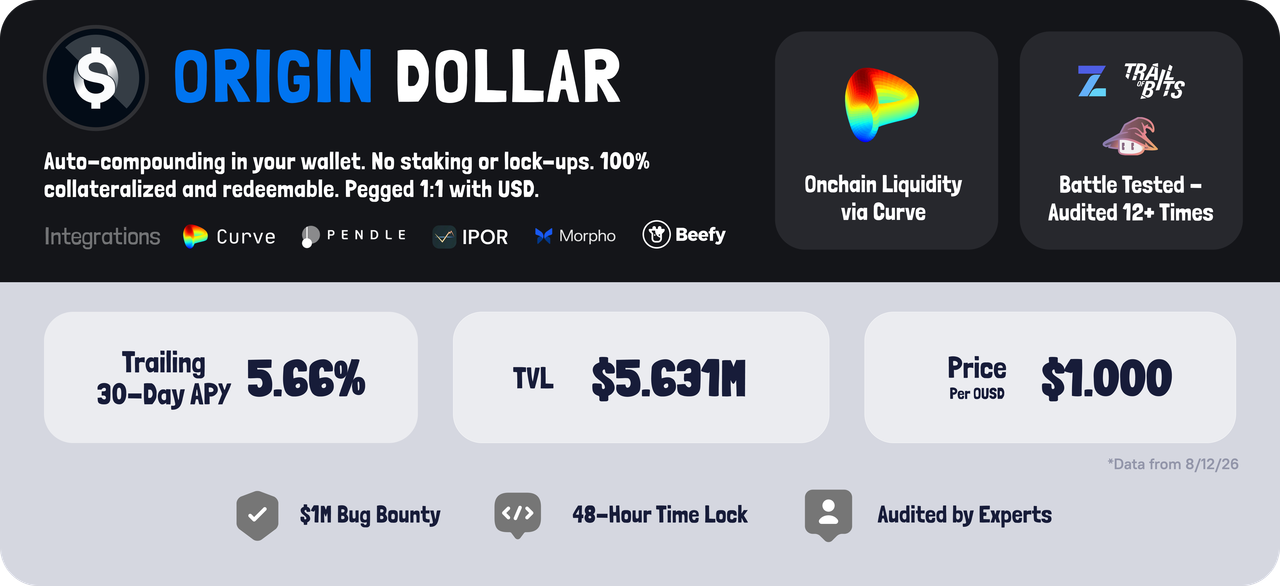
Launched in 2020 by Origin Protocol, [OUSD](https://www.originprotocol.com/ousd) is an ERC20 stablecoin that generates yield while sitting in your wallet or multi-sig. Backed 1:1 by USDC, holders can go in and out of OUSD as they please. Yield is paid out daily and automatically (sometimes multiple times per day) though a positive rebase in the form of additional OUSD, proportional to the amount of OUSD held. OUSD yield, currently \~5.5% APY, comes from a combination of:
1. Deploying USDC collateral to a Curve AMO
2. Lending USDC collateral to Morpho on ETH mainnet, Base, and Hyperliquid
3. Reward tokens (MORPHO, CRV, and CVX) are automatically claimed and converted to stablecoin
4. OUSD sitting in non-upgradable contracts does not rebase, instead the interest generated from those tokens is provided to those that can rebase
Current and historical OUSD yields can be seen via the OUSD[ analytics page](https://analytics.originprotocol.com/oeth/) at all times.[ Proof of Yield](https://analytics.originprotocol.com/ousd/poy/) tracks every OUSD yield event as the yield is distributed.
There is no set emission schedule for OUSD - similar to stETH, OUSD is minted on demand when users deposit their stablecoin into the protocol, and burned on demand when users redeem OUSD for the collateral USDC. OUSD is completely non-custodial, there are no lock-ups, terms, or conditions. Any web3 wallet can support OUSD and its rebasing function, including hardware wallets and multi-sigs. There is no need to ever again give up the keys to a 3rd party platform, such as Celsius, Blockfi, or FTX, to earn yield on stablecoin.
A visual representation of OUSD’s design appears as follows:

Similar to wstETH, there is a corresponding tokenized vault version of OUSD, which is wOUSD. wOUSD is a ERC-4626 tokenized vault designed to accrue yield in price rather than in quantity. When you wrap OUSD, you get back a fixed number of wOUSD tokens. This number will not go up - you will have the same number of wOUSD tokens tomorrow as you have today. However, the number of OUSD tokens that you can unwrap to will go up over time, as wOUSD earns yield at the same rate as standard OUSD. The wOUSD to OUSD exchange rate can be read from the wOUSD contract (function number 16), or via the OUSD dapp.
Current exchange rate as of 8/12/26: 1 wOUSD = 1.30141137 OUSD
**Risk Mitigation**
There are three risks when using OUSD, and Origin is making sure to reduce each risk as much as possible:
*Smart contract risk of the yield strategies* - Origin is only using platforms for yield generation that have a proven track record, have been audited, have billions in TVL, maintain a bug bounty program, and provide over-collateralized loans. Over-collateralization in itself, combined with liquidations, provides a reasonable level of security for lenders.
*Stablecoin risk* - Origin has chosen USDC, one of the largest stablecoins to ever exist, to back OUSD, and it has stood the test of time and maintained its peg quite well through multiple bull and bear cycles. It has also demonstrated significant growth in circulating supply, so the Origin team is confident that USDC will maintain its peg and that OUSD will remain stable. OUSD also uses a Chainlink oracle for pricing data for USDC to ensure accurate pricing at all times. If USDC falls below its $1 peg, [OIP-4 disables minting](https://github.com/OriginProtocol/origin-dollar/issues/1000) of additional OUSD tokens using the de-pegged asset.
*Smart contract risk of OUSD* - Origin is taking every step possible to be proactive and lessen the chance of losing funds. Security reviews of OUSD are prioritized over new feature development, with regular audits being done, and multiple engineers are required to review each code change with a detailed checklist. A 48-hour timelock goes into effect before protocol upgrades are launched, and deep dives into the exploits of other protocols are constantly being done to make sure the same exploits don’t exist on Origin contracts. Security is extremely important to the Origin team. 12+ audits have been done on the OUSD codebase since 2020, all of which can be seen on [Audits - OUSD.](https://docs.originprotocol.com/security-and-risk/audits) Origin also holds a top three spot on the [Immunefi leaderboard](https://immunefi.com/bug-bounty/?sort=medianResponseTime%3Aasc) for average response time for bug bounty submissions, and maintains a $1m bug bounty.
**Contracts being called**
- [USDC](https://etherscan.io/token/0xA0b86991c6218b36c1d19d4a2e9eb0ce3606eb48) ‘approve’ (approves the usage of the USDC from the wallet)
- [OUSD vault](https://etherscan.io/address/0xe75d77b1865ae93c7eaa3040b038d7aa7bc02f70#code) ‘mint’ (receives OUSD using USDC at a 1:1 rate)
- [OUSD](https://etherscan.io/token/0x2A8e1E676Ec238d8A992307B495b45B3fEAa5e86) ‘approve’ (approves the usage of the OUSD from the wallet)
- [wOUSD](https://etherscan.io/token/0xD2af830E8CBdFed6CC11Bab697bB25496ed6FA62) ‘deposit’ (wraps OUSD into wOUSD)
# Nouns Treasury Management - USDC

###
**TL;DR**
This proposal deploys a portion of the DAO’s idle USDC into productive staking while maintaining meaningful liquidity for future proposals. Specifically, the DAO currently holds 484,743 USDC in its treasury. Under this proposal, 300,000 USDC will be staked via Origin Protocol’s Origin Dollar (OUSD) for yield generation.
After receiving OUSD, the position will be wrapped into wOUSD, a non rebasing version of OUSD that eliminates unnecessary taxable events triggered by daily yield distributions. Following this transaction, the DAO will retain approximately 184,743 in native USDC form to preserve flexibility for future proposals.
Passing of this proposal will generate approximately $1,375 per month ($16,500 per year) that can be used to offset or cover the cost of other future proposals and operational expenses. The wOUSD can be unwrapped and redeemed for the underlying USDC at all times.

## Specifications
Launched in 2020 by Origin Protocol, [OUSD](https://www.originprotocol.com/ousd) is an ERC20 stablecoin that generates yield while sitting in your wallet or multi-sig. Backed 1:1 by USDC, holders can go in and out of OUSD as they please. Yield is paid out daily and automatically (sometimes multiple times per day) though a positive rebase in the form of additional OUSD, proportional to the amount of OUSD held. OUSD yield, currently \~5.5% APY, comes from a combination of:
1. Deploying USDC collateral to a Curve AMO
2. Lending USDC collateral to Morpho on ETH mainnet, Base, and Hyperliquid
3. Reward tokens (MORPHO, CRV, and CVX) are automatically claimed and converted to stablecoin
4. OUSD sitting in non-upgradable contracts does not rebase, instead the interest generated from those tokens is provided to those that can rebase
Current and historical OUSD yields can be seen via the OUSD[ analytics page](https://analytics.originprotocol.com/oeth/) at all times.[ Proof of Yield](https://analytics.originprotocol.com/ousd/poy/) tracks every OUSD yield event as the yield is distributed.
There is no set emission schedule for OUSD - similar to stETH, OUSD is minted on demand when users deposit their stablecoin into the protocol, and burned on demand when users redeem OUSD for the collateral USDC. OUSD is completely non-custodial, there are no lock-ups, terms, or conditions. Any web3 wallet can support OUSD and its rebasing function, including hardware wallets and multi-sigs. There is no need to ever again give up the keys to a 3rd party platform, such as Celsius, Blockfi, or FTX, to earn yield on stablecoin.
A visual representation of OUSD’s design appears as follows:

Similar to wstETH, there is a corresponding tokenized vault version of OUSD, which is wOUSD. wOUSD is a ERC-4626 tokenized vault designed to accrue yield in price rather than in quantity. When you wrap OUSD, you get back a fixed number of wOUSD tokens. This number will not go up - you will have the same number of wOUSD tokens tomorrow as you have today. However, the number of OUSD tokens that you can unwrap to will go up over time, as wOUSD earns yield at the same rate as standard OUSD. The wOUSD to OUSD exchange rate can be read from the wOUSD contract (function number 16), or via the OUSD dapp.
Current exchange rate as of 8/12/26: 1 wOUSD = 1.30141137 OUSD
**Risk Mitigation**
There are three risks when using OUSD, and Origin is making sure to reduce each risk as much as possible:
*Smart contract risk of the yield strategies* - Origin is only using platforms for yield generation that have a proven track record, have been audited, have billions in TVL, maintain a bug bounty program, and provide over-collateralized loans. Over-collateralization in itself, combined with liquidations, provides a reasonable level of security for lenders.
*Stablecoin risk* - Origin has chosen USDC, one of the largest stablecoins to ever exist, to back OUSD, and it has stood the test of time and maintained its peg quite well through multiple bull and bear cycles. It has also demonstrated significant growth in circulating supply, so the Origin team is confident that USDC will maintain its peg and that OUSD will remain stable. OUSD also uses a Chainlink oracle for pricing data for USDC to ensure accurate pricing at all times. If USDC falls below its $1 peg, [OIP-4 disables minting](https://github.com/OriginProtocol/origin-dollar/issues/1000) of additional OUSD tokens using the de-pegged asset.
*Smart contract risk of OUSD* - Origin is taking every step possible to be proactive and lessen the chance of losing funds. Security reviews of OUSD are prioritized over new feature development, with regular audits being done, and multiple engineers are required to review each code change with a detailed checklist. A 48-hour timelock goes into effect before protocol upgrades are launched, and deep dives into the exploits of other protocols are constantly being done to make sure the same exploits don’t exist on Origin contracts. Security is extremely important to the Origin team. 12+ audits have been done on the OUSD codebase since 2020, all of which can be seen on [Audits - OUSD.](https://docs.originprotocol.com/security-and-risk/audits) Origin also holds a top three spot on the [Immunefi leaderboard](https://immunefi.com/bug-bounty/?sort=medianResponseTime%3Aasc) for average response time for bug bounty submissions, and maintains a $1m bug bounty.
**Contracts being called**
- [USDC](https://etherscan.io/token/0xA0b86991c6218b36c1d19d4a2e9eb0ce3606eb48) ‘approve’ (approves the usage of the USDC from the wallet)
- [OUSD vault](https://etherscan.io/address/0xe75d77b1865ae93c7eaa3040b038d7aa7bc02f70#code) ‘mint’ (receives OUSD using USDC at a 1:1 rate)
- [OUSD](https://etherscan.io/token/0x2A8e1E676Ec238d8A992307B495b45B3fEAa5e86) ‘approve’ (approves the usage of the OUSD from the wallet)
- [wOUSD](https://etherscan.io/token/0xD2af830E8CBdFed6CC11Bab697bB25496ed6FA62) ‘deposit’ (wraps OUSD into wOUSD) nouns-treasury-management---usdc
# Stacking Treasury Yield With OETH 3.0 - step 1/2
Gm Nouners! Peter here with an updated version of my [previous](https://www.nouns.game/vote/816) OETH proposal to stack Nouns treasury yield though OETH
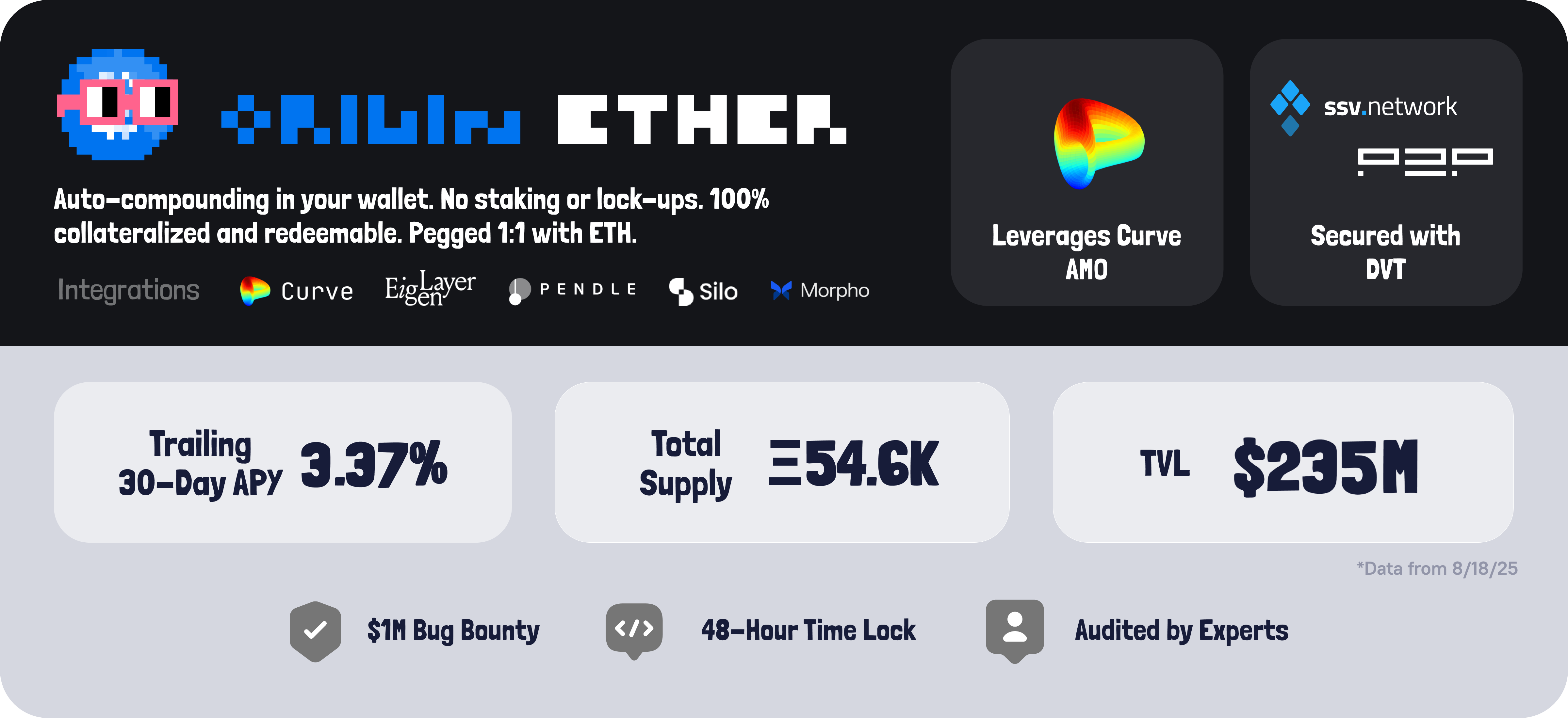
# Summary:
This is the first step in a two-part proposal to convert 1000 ETH of Nouns treasury assets into Origin Ether (OETH) to both increase yield and diversify across multiple LSTs.
- **Why now?** Nouns recently signaled interest in expanding staking beyond stETH (Proposal 810 & 818). Current OETH yield is 3.37% APY, higher than stETH (2.80%) and rETH (2.58%).
- **Impact**: At 1000 ETH, this means roughly +7 ETH/year (\~$30k) of additional yield compared to stETH, while reducing reliance on any single LST provider. A delegation to Nouns is also included in this proposal, giving Nouns governance rights in the Origin DAO
- **Proposal Roadmap**:
- **Step 1** (this proposal): unwrap 826 wstETH to ETH
- **Step 2** (follow up proposal): deposit into OETH, secure governance rights with xOGN, and bring Nouns to Origin’s community of thousands of ETH users
*TL;DR: More yield, more diversity, longer runway, and a direct say in OETH governance.*
# Abstract:
I am Peter from the Origin Protocol core team. This is a proposal to increase the yield of the Nouns treasury ETH/LST and increase LST diversity by utilizing Origin Ether (OETH). This proposal was inspired by the Mantle proposal to [unstake](https://nouns.wtf/vote/810) ETH from stETH to be used within other LSTs for increased treasury diversification.
# Motivation:
Origin submitted a 1 ETH proposal to Nouns back in 2023 to test out safely earning the DAO’s ETH a yield through using OETH. However, this proposal did not pass, largely due to poor timing and disagreements with the Nouns fork.
The proposal to Nouns was later followed up with a 1 ETH [proposal](https://lilnouns.wtf/vote/165) to test staking OETH within the Lil Nouns treasury. After several months a supplementary [proposal](https://lilnouns.wtf/vote/203/description) was passed to stake a larger amount of ETH into OETH, where the Lil Nouns treasury has been safely [earning](https://etherscan.io/address/0xd5f279ff9EB21c6D40C8f345a66f2751C4eeA1fB#asset-tokens) a yield ever since. OETH performance reports were shared with the DAO after [30](https://blush-rapid-impala-153.mypinata.cloud/ipfs/bafkreihopcixhvpcyvrhpsl5i3ya4ii6ckqw5vlhf2e4xeut7aywnspv3m), [60](https://blush-rapid-impala-153.mypinata.cloud/ipfs/bafybeigwtvuuyawbejkjb2njjlbcvy44rkc24gcajscjjjnaquig3phrim), [90](https://blush-rapid-impala-153.mypinata.cloud/ipfs/bafybeihg5oisg5e6srs35ffy3b3r4kjpqfvlgikiyqm2jvsmgn7yibgcyq), and [180](https://blush-rapid-impala-153.mypinata.cloud/ipfs/bafybeifsh7jybq26h76vxktioarhd4py7s7aabwhvwivqorbetfrjxvvfi) days to give the DAO full transparency of OETH’s performance alone and versus Lido’s stETH, RocketPool's rETH, and Frax’s frxETH. We believe OETH has now been used within Lil Nouns long enough to warrant another attempt at a proposal for Nouns to safely use OETH for both yield generation and treasury diversification.
As mentioned in proposal 810 & 818, it is clear that the Nouns community is once again interested in earning yield on the treasury and extending the project runway. Proposal 810 & 818 signal that the community would prefer to continue earning yield with LSTs other than stETH, rather than eliminating risk completely and converting LSTs entirely back to ETH to be untouched. This proposal was not meant to replace the mETH proposal from Mantle, but rather to compliment it, and further increase diversity between LSTs within the Nouns treasury.
# Specification:
There have been several changes from the last version of this proposal, developed from discussions within the Nouns community:
1. The amount of ETH in the proposal was increased from 300 to 1000. By having 1k OETH in the treasury, the treasury will be split 1/3 each between Lido, Mantle, and Origin LSTs, and will lead to a greater yield generation and diversification within Nouns. To achieve 1k OETH, Nouns will unwrap 826 wstETH as the first function in the proposal.
2. Origin will provide the Nouns DAO a delegation of xOGN, so that Nouns can participate directly within the Origin Protocol DAO. The delegated amount will start at the level equal to most current UGP delegates, or about 100k xOGN. The [proposal](https://snapshot.box/#/s:origingov.eth/proposal/0x6b3f06e99442aafb31533d12ac8d174d95566de4b78406161e7d2387be93a94e) to provide non-university organizations a governance delegation passed last week - with this delegation Nouns will have a say in each Origin Protocol governance vote, and will have enough voting power to submit new proposals on Origin's [snapshot](https://snapshot.box/#/s:origingov.eth) as well as on-chain proposals on Origin's [dapp](https://app.originprotocol.com/#/ogn/governance) (something that is not possible on the Mantle [snapshot](https://snapshot.box/#/s:bitdao.eth/create/gt1mu) if not whitelisted). OGN governance can directly update/improve OETH, as the OETH protocol is fully controlled by OGN (whereas the mETH protocol is controlled by [COOK](https://docs.mantle.xyz/meth/governance/tokenomics), which is a different governance token than the token Mantle delegated to Nouns)
3. Origin will co-market Nouns to Origin's user base and community of thousands of ETH holders, users, and participants to ensure that the Nouns brand is in front of as wide an audience as possible.
4. At least one Origin Protocol representative will continue attending Nouns DAO/subDAO calls and/or events as we have been the last 2 years and will continue to be a direct line for any questions regarding OETH staking or the other Origin Protocol [products](https://app.originprotocol.com/). The Origin Protocol representative can also be used as a resource for insight in the greater ETH staking world.
## Proposal actions
This proposal has 3 function calls:
1. unwrap the wstETH into stETH
2. approve the Lido exit queue contract
3. request a redemption (withdrawal) from Lido for its underlying ETH at a 1:1 rate
Step 2/2 of this proposal will feature 4 function calls:
1. Claim the ETH from Lido
2. Using the claimed ETH, Mint OETH at a 1:1 rate through Origin's Zapper
3. Wrap the OETH into wOETH to avoid unnecessary daily income‑tax liability for the DUNA
4. Opt-in the Nouns wallet for yield
## OETH Overview
[Origin Ether](https://www.originprotocol.com/oeth) was launched in May 2023 and is an ETH-pegged ERC20 that generates yield while sitting in your wallet. Similar to stETH, OETH yield is paid out daily and automatically (sometimes multiple times per day) through a positive rebase in the form of additional OETH, proportional to the amount of OETH held. OETH is a full-fledged LST with an extremely tight peg (1:1 redemptions to ETH thru Origin’s [ARM](https://docs.originprotocol.com/protocol/arm)) and high yields thanks to DVT direct staking. OETH earns its yield from 3 core components:
- Beacon chain staking through [SSV/P2p](https://grafana.originprotocol.com/public-dashboards/68227b64cc33446886b16a0c024361ea)
- The [Curve AMO](https://docs.originprotocol.com/yield-bearing-tokens/core-concepts/amo)
- Those [opted-out](https://docs.originprotocol.com/yield-bearing-tokens/core-concepts/rebasing-and-smart-contracts) from receiving the yield - any users LPing in a DEX pool are giving up their OETH yield (in exchange for trading fees & emissions) to those opted-in, leading to a boost in yield
OETH can be wrapped into a DUNA-compliant wOETH to change how the yield is received. wOETH is a ERC-4626 tokenized vault designed to accrue yield in price rather than in quantity. When you wrap OETH, you get back a fixed number of wOETH tokens. This number will not go up - you will have the same number of wOETH tokens tomorrow as you have today. However, the number of OETH tokens that you can unwrap to will go up over time, as wOETH earns yield at the same rate as standard OETH. The wOETH to OETH exchange rate can be read from the contract (0xDcEe70654261AF21C44c093C300eD3Bb97b78192, function number 16), or via the OETH dapp.
OETH’s meticulous design provides increased yields while protecting against centralization and slashing events. Current and historical OETH yields can be seen via the OETH [analytics page](https://analytics.originprotocol.com/oeth/) at all times. [Proof of Yield](https://analytics.originprotocol.com/oeth/poy/) tracks every OETH yield event as the yield is distributed.
## Security Risk Mitigation
OETH has been operational for over 2 years with a TVL of 54,000+ ETH ($235m+), zero exploits or security incidents to date and has demonstrated a strong commitment to smart contract security as shown by our past audits and active ImmuneFi [bug bounty](https://docs.originprotocol.com/security-and-risk/bug-bounties) with a max bounty of $1,000,000 for critical findings. Origin has a continuous auditing agreement with OpenZeppelin and yAudit to review 100% of the OETH and OUSD smart contract changes. All audits can be found [here](https://docs.originprotocol.com/security-and-risk/audits).
External OETH risk assessments:
- [Prisma Risk](https://www.llamarisk.com/research/collateral-risk-woeth-addendum1) - Asset Risk Assessment Addendum: Origin Ether (OETH)
- [LlamaRisk full collateral risk assessment](https://governance.aave.com/t/arfc-add-support-for-wrapped-oeth-woeth-to-aave-v3/19285/2) supporting the onboarding of OETH to the Aave V3 instance
- [Chaos Labs collateral risk assessment](https://governance.aave.com/t/arfc-add-support-for-wrapped-oeth-woeth-to-aave-v3/19285/3) supporting the onboarding of OETH to the Aave V3 instance
Many members of the Origin team, including both founders, are holding a significant portion of their personal wealth in OETH. Origin Protocol’s corporate treasury is also holding millions of dollars in OETH. We have skin in the game and are willing to put our own money at risk with the code we have written.
There are no lockups with this proposal, Nouns can move in and out of OETH and wOETH as the Nouncil, core team, DAO, and community desires. OETH remains completely liquid at all times and can be spent in the same way as its backing collateral, if unexpected expenses were to arise.
unstake-1,000-steth@0x0495...7673
new version is live as a candidate: https://www.nouns.camp/candidates/stacking-treasury-yield-with-oeth-3.0---step-1%2F2-cc4fd6e348009710404641a01b29f15703b90aed
>
>
> https://www.nouns.game/vote/816 Have you got the new version of this proposal?
>
# Stacking Treasury Yield With OETH 3.0 - step 1/2
Gm Nouners! Peter here with an updated version of my [previous](https://www.nouns.game/vote/816) OETH proposal to stack Nouns treasury yield though OETH

# Summary:
This is the first step in a two-part proposal to convert 1000 ETH of Nouns treasury assets into Origin Ether (OETH) to both increase yield and diversify across multiple LSTs.
- **Why now?** Nouns recently signaled interest in expanding staking beyond stETH (Proposal 810 & 818). Current OETH yield is 3.37% APY, higher than stETH (2.80%) and rETH (2.58%).
- **Impact**: At 1000 ETH, this means roughly +7 ETH/year (\~$30k) of additional yield compared to stETH, while reducing reliance on any single LST provider. A delegation to Nouns is also included in this proposal, giving Nouns governance rights in the Origin DAO
- **Proposal Roadmap**:
- **Step 1** (this proposal): unwrap 826 wstETH to ETH
- **Step 2** (follow up proposal): deposit into OETH, secure governance rights with xOGN, and bring Nouns to Origin’s community of thousands of ETH users
*TL;DR: More yield, more diversity, longer runway, and a direct say in OETH governance.*
# Abstract:
I am Peter from the Origin Protocol core team. This is a proposal to increase the yield of the Nouns treasury ETH/LST and increase LST diversity by utilizing Origin Ether (OETH). This proposal was inspired by the Mantle proposal to [unstake](https://nouns.wtf/vote/810) ETH from stETH to be used within other LSTs for increased treasury diversification.
# Motivation:
Origin submitted a 1 ETH proposal to Nouns back in 2023 to test out safely earning the DAO’s ETH a yield through using OETH. However, this proposal did not pass, largely due to poor timing and disagreements with the Nouns fork.
The proposal to Nouns was later followed up with a 1 ETH [proposal](https://lilnouns.wtf/vote/165) to test staking OETH within the Lil Nouns treasury. After several months a supplementary [proposal](https://lilnouns.wtf/vote/203/description) was passed to stake a larger amount of ETH into OETH, where the Lil Nouns treasury has been safely [earning](https://etherscan.io/address/0xd5f279ff9EB21c6D40C8f345a66f2751C4eeA1fB#asset-tokens) a yield ever since. OETH performance reports were shared with the DAO after [30](https://blush-rapid-impala-153.mypinata.cloud/ipfs/bafkreihopcixhvpcyvrhpsl5i3ya4ii6ckqw5vlhf2e4xeut7aywnspv3m), [60](https://blush-rapid-impala-153.mypinata.cloud/ipfs/bafybeigwtvuuyawbejkjb2njjlbcvy44rkc24gcajscjjjnaquig3phrim), [90](https://blush-rapid-impala-153.mypinata.cloud/ipfs/bafybeihg5oisg5e6srs35ffy3b3r4kjpqfvlgikiyqm2jvsmgn7yibgcyq), and [180](https://blush-rapid-impala-153.mypinata.cloud/ipfs/bafybeifsh7jybq26h76vxktioarhd4py7s7aabwhvwivqorbetfrjxvvfi) days to give the DAO full transparency of OETH’s performance alone and versus Lido’s stETH, RocketPool's rETH, and Frax’s frxETH. We believe OETH has now been used within Lil Nouns long enough to warrant another attempt at a proposal for Nouns to safely use OETH for both yield generation and treasury diversification.
As mentioned in proposal 810 & 818, it is clear that the Nouns community is once again interested in earning yield on the treasury and extending the project runway. Proposal 810 & 818 signal that the community would prefer to continue earning yield with LSTs other than stETH, rather than eliminating risk completely and converting LSTs entirely back to ETH to be untouched. This proposal was not meant to replace the mETH proposal from Mantle, but rather to compliment it, and further increase diversity between LSTs within the Nouns treasury.
# Specification:
There have been several changes from the last version of this proposal, developed from discussions within the Nouns community:
1. The amount of ETH in the proposal was increased from 300 to 1000. By having 1k OETH in the treasury, the treasury will be split 1/3 each between Lido, Mantle, and Origin LSTs, and will lead to a greater yield generation and diversification within Nouns. To achieve 1k OETH, Nouns will unwrap 826 wstETH as the first function in the proposal.
2. Origin will provide the Nouns DAO a delegation of xOGN, so that Nouns can participate directly within the Origin Protocol DAO. The delegated amount will start at the level equal to most current UGP delegates, or about 100k xOGN. The [proposal](https://snapshot.box/#/s:origingov.eth/proposal/0x6b3f06e99442aafb31533d12ac8d174d95566de4b78406161e7d2387be93a94e) to provide non-university organizations a governance delegation passed last week - with this delegation Nouns will have a say in each Origin Protocol governance vote, and will have enough voting power to submit new proposals on Origin's [snapshot](https://snapshot.box/#/s:origingov.eth) as well as on-chain proposals on Origin's [dapp](https://app.originprotocol.com/#/ogn/governance) (something that is not possible on the Mantle [snapshot](https://snapshot.box/#/s:bitdao.eth/create/gt1mu) if not whitelisted). OGN governance can directly update/improve OETH, as the OETH protocol is fully controlled by OGN (whereas the mETH protocol is controlled by [COOK](https://docs.mantle.xyz/meth/governance/tokenomics), which is a different governance token than the token Mantle delegated to Nouns)
3. Origin will co-market Nouns to Origin's user base and community of thousands of ETH holders, users, and participants to ensure that the Nouns brand is in front of as wide an audience as possible.
4. At least one Origin Protocol representative will continue attending Nouns DAO/subDAO calls and/or events as we have been the last 2 years and will continue to be a direct line for any questions regarding OETH staking or the other Origin Protocol [products](https://app.originprotocol.com/). The Origin Protocol representative can also be used as a resource for insight in the greater ETH staking world.
## Proposal actions
This proposal has 3 function calls:
1. unwrap the wstETH into stETH
2. approve the Lido exit queue contract
3. request a redemption (withdrawal) from Lido for its underlying ETH at a 1:1 rate
Step 2/2 of this proposal will feature 4 function calls:
1. Claim the ETH from Lido
2. Using the claimed ETH, Mint OETH at a 1:1 rate through Origin's Zapper
3. Wrap the OETH into wOETH to avoid unnecessary daily income‑tax liability for the DUNA
4. Opt-in the Nouns wallet for yield
## OETH Overview
[Origin Ether](https://www.originprotocol.com/oeth) was launched in May 2023 and is an ETH-pegged ERC20 that generates yield while sitting in your wallet. Similar to stETH, OETH yield is paid out daily and automatically (sometimes multiple times per day) through a positive rebase in the form of additional OETH, proportional to the amount of OETH held. OETH is a full-fledged LST with an extremely tight peg (1:1 redemptions to ETH thru Origin’s [ARM](https://docs.originprotocol.com/protocol/arm)) and high yields thanks to DVT direct staking. OETH earns its yield from 3 core components:
- Beacon chain staking through [SSV/P2p](https://grafana.originprotocol.com/public-dashboards/68227b64cc33446886b16a0c024361ea)
- The [Curve AMO](https://docs.originprotocol.com/yield-bearing-tokens/core-concepts/amo)
- Those [opted-out](https://docs.originprotocol.com/yield-bearing-tokens/core-concepts/rebasing-and-smart-contracts) from receiving the yield - any users LPing in a DEX pool are giving up their OETH yield (in exchange for trading fees & emissions) to those opted-in, leading to a boost in yield
OETH can be wrapped into a DUNA-compliant wOETH to change how the yield is received. wOETH is a ERC-4626 tokenized vault designed to accrue yield in price rather than in quantity. When you wrap OETH, you get back a fixed number of wOETH tokens. This number will not go up - you will have the same number of wOETH tokens tomorrow as you have today. However, the number of OETH tokens that you can unwrap to will go up over time, as wOETH earns yield at the same rate as standard OETH. The wOETH to OETH exchange rate can be read from the contract (0xDcEe70654261AF21C44c093C300eD3Bb97b78192, function number 16), or via the OETH dapp.
OETH’s meticulous design provides increased yields while protecting against centralization and slashing events. Current and historical OETH yields can be seen via the OETH [analytics page](https://analytics.originprotocol.com/oeth/) at all times. [Proof of Yield](https://analytics.originprotocol.com/oeth/poy/) tracks every OETH yield event as the yield is distributed.
## Security Risk Mitigation
OETH has been operational for over 2 years with a TVL of 54,000+ ETH ($235m+), zero exploits or security incidents to date and has demonstrated a strong commitment to smart contract security as shown by our past audits and active ImmuneFi [bug bounty](https://docs.originprotocol.com/security-and-risk/bug-bounties) with a max bounty of $1,000,000 for critical findings. Origin has a continuous auditing agreement with OpenZeppelin and yAudit to review 100% of the OETH and OUSD smart contract changes. All audits can be found [here](https://docs.originprotocol.com/security-and-risk/audits).
External OETH risk assessments:
- [Prisma Risk](https://www.llamarisk.com/research/collateral-risk-woeth-addendum1) - Asset Risk Assessment Addendum: Origin Ether (OETH)
- [LlamaRisk full collateral risk assessment](https://governance.aave.com/t/arfc-add-support-for-wrapped-oeth-woeth-to-aave-v3/19285/2) supporting the onboarding of OETH to the Aave V3 instance
- [Chaos Labs collateral risk assessment](https://governance.aave.com/t/arfc-add-support-for-wrapped-oeth-woeth-to-aave-v3/19285/3) supporting the onboarding of OETH to the Aave V3 instance
Many members of the Origin team, including both founders, are holding a significant portion of their personal wealth in OETH. Origin Protocol’s corporate treasury is also holding millions of dollars in OETH. We have skin in the game and are willing to put our own money at risk with the code we have written.
There are no lockups with this proposal, Nouns can move in and out of OETH and wOETH as the Nouncil, core team, DAO, and community desires. OETH remains completely liquid at all times and can be spent in the same way as its backing collateral, if unexpected expenses were to arise. stacking-treasury-yield-with-oeth-3.0---step-1/2
unstake-1,000-steth@0x0495...7673
The new version is being written right now and should be ready this week
>
>
> https://www.nouns.game/vote/816 Have you got the new version of this proposal?
>
unstake-1,000-steth@0xC7CC...7d87
The new version of 816 will come after unstaking the 1k ETH from Lido. There wont be available ETH otherwise
>
>
> https://www.nouns.game/vote/816 Have you got the new version of this proposal?
>
# Unstake 1,000 stETH
Let’s unstake another 1k of our current stETH to increase treasury diversification options.
With the OETH [topic](https://www.nouns.camp/topics/pre-proposal-discussion%3A-stacking-treasury-yield-with-oeth-3.0-cc4fd6e348009710404641a01b29f15703b90aed) suggesting a few options, 1k ETH would provide the most diversity, while also increasing the yield Nouns is generating for the treasury.
There are different options for unstaking from stETH back to ETH, but the traditional unstake-and-claim approach leads to the least amount of slippage for Nouns.
Here is the first proposal in a multi-part proposal. This prop will be followed up with a proposal to claim the ETH from Lido.
Due to a large number of stETH users rushing to unstake their stETH (likely because of [this](https://x.com/0xdoge_bull/status/1947833084138951000)) the current unstaking time is now 21 days
unstake-1,000-stethadded Lido exit context
# Unstake 1,000 stETH
Let’s unstake another 1k of our current stETH to increase treasury diversification options.
With the OETH [topic](https://www.nouns.camp/topics/pre-proposal-discussion%3A-stacking-treasury-yield-with-oeth-3.0-cc4fd6e348009710404641a01b29f15703b90aed) suggesting a few options, 1k ETH would provide the most diversity, while also increasing the yield Nouns is generating for the treasury.
There are different options for unstaking from stETH back to ETH, but the traditional unstake-and-claim approach leads to the least amount of slippage for Nouns.
Here is the first proposal in a multi-part proposal. This prop will be followed up with a proposal to claim the ETH from Lido. unstake-1,000-steth
# Collateral Basket Change Proposal: Adding Wrapped OETH (wOETH) to the dgnETH Collateral Basket
[https://forum.reserve.org/t/rfc-collateral-basket-change-proposal-adding-wrapped-oeth-woeth-to-the-dgneth-collateral-basket/1196](https://forum.reserve.org/t/rfc-collateral-basket-change-proposal-adding-wrapped-oeth-woeth-to-the-dgneth-collateral-basket/1196)
Origin Ether (OETH) was launched in May 2023 and is an ERC20 that generates yield while sitting in your wallet. Similar to stETH, OETH yield is paid out daily and automatically (sometimes multiple times per day) through a positive rebase in the form of additional OETH, proportional to the amount of OETH held. OETH is a full-fledged LST with an extremely tight peg (1:1 redemptions to ETH thru Origin’s ARM) and high yields thanks to DVT direct staking through SSV/P2p and a Curve AMO.
wOETH is a ERC-4626 tokenized vault designed to accrue yield in price rather than in quantity. When you wrap OETH, you get back a fixed number of wOETH tokens. This number will not go up - you will have the same number of wOETH tokens tomorrow as you have today. However, the number of OETH tokens that you can unwrap to will go up over time, as wOETH earns yield at the same rate as standard OETH. The wOETH to OETH exchange rate can be read from the contract (0xDcEe70654261AF21C44c093C300eD3Bb97b78192 , function number 16), or via the OETH dapp.
# Pre-Proposal Discussion: Stacking Treasury Yield With OETH 3.0
This is a discussion topic for the next OETH proposal to go up on chain, after these two failed to pass in Nouns:
1 ETH Test: Stacking Treasury Yield With Origin Ether (1 ETH>OETH)- [https://nouns.wtf/vote/388](https://nouns.wtf/vote/388) Stacking Treasury Yield With OETH 2.0 (300 ETH>OETH) - [https://nouns.wtf/vote/816](https://nouns.wtf/vote/816)
and these two successfully passed in Lil Nouns:
1 ETH Experiment: Generating Diversified Yields with OETH (1 ETH>OETH) - [https://lilnouns.wtf/vote/165](https://lilnouns.wtf/vote/165) The coveted staking prop (50 ETH>OETH)- [https://lilnouns.wtf/vote/203](https://lilnouns.wtf/vote/203)
If we were put the OETH proposal back up, which amount should we go with? The very first prop suggested starting with 1 ETH to test Nouns can safely earn yield with OETH, but that test is no longer necessary within Nouns as OETH has been well tested within Lil Nouns for more than a year. The latest failed proposal was for 300 ETH, but that number was chosen due to the amount of available ETH within the Nouns [treasury](https://etherscan.io/address/0xb1a32FC9F9D8b2cf86C068Cae13108809547ef71#asset-tokens) at the time of posting on-chain. Depending on the number agreed upon, we may need to put additional stETH through the redeem queue to have enough available ETH for this proposal, but that was not an issue as seen from props [810](https://nouns.wtf/vote/810) and [815](https://nouns.wtf/vote/815). The feedback I received was that the ETH amount should be higher, so I am starting the discussion with these options:
- 350 ETH - an option slightly larger than last time, maybe for those convinced the test within Lil's was not enough
- 420 ETH - an option for the meme value
- 1000 ETH - an option for maximum yield generation and diversification within Nouns, and for those who thought 300 ETH wasn't enough to make a difference
- XXXX ETH - another number not listed above that has significance to the DAO
On the next iteration of the OETH prop I will also include a delegation of xOGN to Nouns. I believe Origin's university governance program ([UGP](https://docs.originprotocol.com/ogn/university-governance-program)) could be expanded to provide DAOs, projects, clubs, and other non-university organizations a delegation of governance power. It would require a governance vote within the Origin Protocol DAO to get the expansion program set up, but I have already [started that process](https://governance.originprotocol.com/t/nugp-an-expansion-of-origins-governance-program/168), and would be happy to support it through Origin's governance cycle. The amount of xOGN delegated will be decided on by Origin Protocol's DAO.pre-proposal-discussion:-stacking-treasury-yield-with-oeth-3.0
@0x54eE...68Ba
Hey, you can cross-reference the two transactions with the contracts on the OETH registry here: https://docs.originprotocol.com/registry/contracts/oeth-registry
The first transaction calls 'deposit' on the Zapper, the second calls 'opt-in' on OETH itself
>
>
> Do we have someone on our end that can audit these huge staking proposal transactions?
>
> Not assuming bad intent, just want to make sure we don’t make a 300 ETH mistake.
>
> If the transactions are obvious to everyone else and I’m missing something, nevermind.
>
Hey vote.0xdusk.eth, that is certainly a possibility. Providing DAO's some governance power could be a program similar to what we did with the university governance program (UGP). It would probably require a governance vote to get a DAO delegation program set up, but I'd be happy to write, submit, and support that prop. Here's some more info on the UGP: https://docs.originprotocol.com/ogn/university-governance-program
# Collateral basket change proposal to address liquidity bottlenecks
[https://forum.reserve.org/t/rfc-collateral-basket-change-proposal-to-address-liquidity-bottlenecks/1175/9](https://forum.reserve.org/t/rfc-collateral-basket-change-proposal-to-address-liquidity-bottlenecks/1175/9)
This proposal outlines a strategic update to the ETHplus collateral basket aimed at optimizing liquidity and minimizing slippage during large-scale minting and redemption events. As ETHplus has experienced significant growth—404% year-over-year in ETH-denominated TVL—the protocol now supports larger institutional LPs whose activities demand more robust liquidity infrastructure. The proposed changes rebalance the basket to improve the performance of redemption curves while maintaining a high level of diversification and increasing the overall yield profile. The proposal also introduces OETH as a new collateral asset, supported by third-party audits and risk assessments. This optimization enhances ETHplus scalability and positions it for continued sustainable growth.
# Stacking Treasury Yield With OETH 2.0
## Stacking Treasury Yield With OETH 2.0
Relevant Proposals:
On Nouns:
[https://nouns.wtf/vote/18](https://nouns.wtf/vote/18) - Stake 1 eth in Lido
[https://nouns.wtf/vote/22](https://nouns.wtf/vote/22) - Stake 10% of treasury in Lido
[https://nouns.wtf/vote/30](https://nouns.wtf/vote/30) - Stake additional 10% of treasury in Lido
[https://nouns.wtf/vote/52](https://nouns.wtf/vote/52) - Increase Treasury stETH Position to ~20%
[https://nouns.wtf/vote/217](https://nouns.wtf/vote/217) - Stake additional 5k ETH in Lido
[https://nouns.wtf/vote/227](https://nouns.wtf/vote/227) - Stake additional 5k ETH in Lido
[https://nouns.wtf/vote/313](https://nouns.wtf/vote/313) - stETH peg protection
[https://nouns.wtf/vote/810](https://nouns.wtf/vote/810) - Unstake 1k stETH (to be used for treasury diversification)
On Lil Nouns:
[https://lilnouns.wtf/vote/165](https://lilnouns.wtf/vote/165) - 1 ETH Experiment: Generating Diversified Yields with OETH
[https://lilnouns.wtf/vote/203](https://lilnouns.wtf/vote/203) - The coveted staking prop
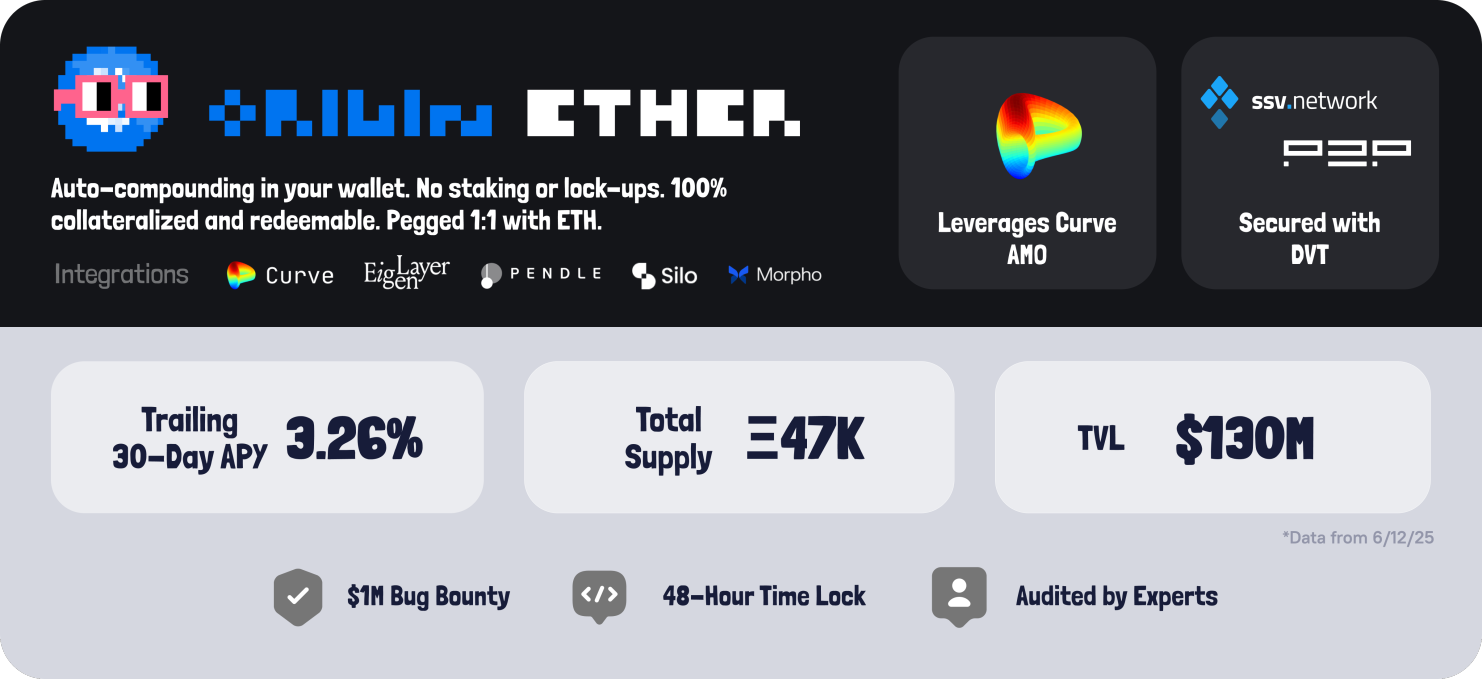
**Summary**:
This is a proposal to convert 300 ETH into Origin Ether ([OETH](https://www.oeth.com/)) to both increase yield and increase LST diversity for the Nouns treasury.
This proposal will include two transactions: the first to convert ETH into OETH, and the second to opt-in the Nouns wallet for yield generation.
**Abstract**:
I am Peter from the Origin Protocol core team. This is a proposal to both increase the yield of the Nouns treasury ETH/LST, and increase LST diversity, by utilizing Origin Ether (OETH). This proposal was inspired by the proposal to [unstake](https://nouns.wtf/vote/810) ETH from stETH to be used within other LSTs for increased treasury diversification.
**Motivation**:
Origin submitted a 1 ETH [proposal](https://nouns.wtf/vote/388) to Nouns back in 2023 to test out safely earning the DAO’s ETH a yield through using OETH. However, this proposal did not pass, largely due to poor timing and disagreements with the fork.
The proposal to Nouns was later followed up with a 1 ETH [proposal](https://lilnouns.wtf/vote/165) to test staking OETH within the Lil Nouns treasury. After several months a supplementary [proposal](https://lilnouns.wtf/vote/203/description) was passed to stake a larger amount of ETH into OETH, where the Lil Nouns treasury has been safely [earning](https://etherscan.io/address/0xd5f279ff9EB21c6D40C8f345a66f2751C4eeA1fB#asset-tokens) a yield ever since. OETH performance reports were shared with the DAO after [30](https://ipfs.io/ipfs/bafkreihopcixhvpcyvrhpsl5i3ya4ii6ckqw5vlhf2e4xeut7aywnspv3m), [60](https://blush-rapid-impala-153.mypinata.cloud/ipfs/bafybeigwtvuuyawbejkjb2njjlbcvy44rkc24gcajscjjjnaquig3phrim), [90](https://blush-rapid-impala-153.mypinata.cloud/ipfs/bafybeihg5oisg5e6srs35ffy3b3r4kjpqfvlgikiyqm2jvsmgn7yibgcyq), and [180](https://blush-rapid-impala-153.mypinata.cloud/ipfs/bafybeifsh7jybq26h76vxktioarhd4py7s7aabwhvwivqorbetfrjxvvfi) days to give the DAO full transparency of OETH’s performance alone and versus Lido’s stETH, RocketPool rETH, and Frax’s frxETH. We believe OETH has now been used within Lil Nouns long enough to warrant another attempt at a proposal for Nouns to safely use OETH for both yield generation and treasury diversification.
As mentioned from proposals 18, 22, 30, 52, 217, 227, and now 810, it is clear that the Nouns community is once again interested in earning yield on the treasury and extending the project runway. Proposal 810 signals that the community would prefer to continue earning yield with LSTs other than stETH, rather than eliminating risk completely and converting LSTs entirely back to ETH to be untouched.
OETH yield is currently at 3.26% APY, whereas frxETH is down to 3.07%, stETH is down to 2.82%, and rETH is down to 2.58%. We are proposing to begin with 300 OETH, and can submit an additional proposal in the future to increase the amount as the community and DAO sees fit. This proposal was not meant to replace the mETH proposal from Mantle, but rather to compliment it, and further increase diversity between LSTs within the Nouns treasury.
## OETH Overview
[Origin Ether](https://www.oeth.com/) was launched in May 2023 and is an ETH-pegged ERC20 that generates yield while sitting in your wallet. Similar to stETH, OETH yield is paid out daily and automatically (sometimes multiple times per day) through a positive rebase in the form of additional OETH, proportional to the amount of OETH held. OETH is a full-fledged LST with an extremely tight peg (1:1 redemptions to ETH thru Origin’s [ARM](https://docs.originprotocol.com/protocol/arm) and high yields thanks to DVT direct staking. OETH earns its yield from 3 core components:
- Beacon chain staking through [SSV/P2p](https://grafana.originprotocol.com/public-dashboards/68227b64cc33446886b16a0c024361ea)
- The [Curve AMO](https://docs.originprotocol.com/introduction/core-concepts/amo)
- Those [opted-out](https://docs.originprotocol.com/introduction/core-concepts/rebasing-and-smart-contracts) from receiving the yield - any users LPing in a dex pool are giving up their OETH yield (in exchange for trading fees & emissions) to those opted-in, leading to a boost in yield
OETH’s meticulous design provides increased yields while protecting against centralization and slashing events. Current and historical OETH yields can be seen via the OETH [analytics page](https://analytics.originprotocol.com/oeth/) at all times. [Proof of Yield](https://analytics.originprotocol.com/oeth/poy) tracks every OETH yield event as the yield is distributed.
Obtaining OETH is seamless, Nouns can convert from ETH into OETH via any of the following methods:
* Minting via the OETH [Zapper](https://docs.originprotocol.com/protocol/oeth/zapper) - (transaction #1 of this proposal)
* Minting on [OETH.com](https://app.oeth.com/)
* Swapping on [Curve](https://curve.fi/#/ethereum/pools/factory-v2-298/deposit)
* Swapping on [Uniswap](https://app.uniswap.org/#/swap?inputCurrency=0x856c4efb76c1d1ae02e20ceb03a2a6a08b0b8dc3&outputCurrency=ETH)
**Security Risk Mitigation**
OETH has been operational for over 2 years with a TVL of 47,000+ ETH ($130m+), zero exploits or security incidents to date and has demonstrated a strong commitment to smart contract security as shown by our past audits and active ImmuneFi [bug bounty](https://docs.originprotocol.com/security-and-risk/bug-bounties) with a max bounty of $1,000,000 for critical findings. Origin has a continuous auditing agreement with OpenZeppelin and yAudit to review 100% of the OETH and OUSD smart contract changes. All audits can be found [here](https://docs.originprotocol.com/security-and-risk/audits).
External OETH risk assessments:
* [Prisma Risk](https://www.llamarisk.com/research/collateral-risk-woeth-addendum1) - Asset Risk Assessment Addendum: Origin Ether (OETH)
* [LlamaRisk full collateral risk assessment](https://governance.aave.com/t/arfc-add-support-for-wrapped-oeth-woeth-to-aave-v3/19285/2) supporting the onboarding of OETH to the Aave V3 instance
* [Chaos Labs collateral risk assessment](https://governance.aave.com/t/arfc-add-support-for-wrapped-oeth-woeth-to-aave-v3/19285/3) supporting the onboarding of OETH to the Aave V3 instance
**Disclosure**
Peter is a core member of Origin Protocol and is joined by the fully doxxed [Origin team](https://www.originprotocol.com/community) and community, which includes hundreds of thousands of members and open-source contributors. Many members of the Origin team, including both founders, are holding a significant portion of their personal wealth in OETH. Origin Protocol’s corporate treasury is also holding millions of dollars in OETH. We have skin in the game and are willing to put our own money at risk with the code we have written.
There are no lockups with this proposal, Nouns can move in and out of OETH as the Nouncil, core team, DAO, and community desires. OETH remains completely liquid at all times, and can be spent in the same way as its backing collateral, if unexpected expenses were to arise.
# Stacking Treasury Yield With OETH 2.0
## Stacking Treasury Yield With OETH 2.0

Relevant Proposals:
On Nouns:
[https://nouns.wtf/vote/18](https://nouns.wtf/vote/18) - Stake 1 eth in Lido
[https://nouns.wtf/vote/22](https://nouns.wtf/vote/22) - Stake 10% of treasury in Lido
[https://nouns.wtf/vote/30](https://nouns.wtf/vote/30) - Stake additional 10% of treasury in Lido
[https://nouns.wtf/vote/52](https://nouns.wtf/vote/52) - Increase Treasury stETH Position to ~20%
[https://nouns.wtf/vote/217](https://nouns.wtf/vote/217) - Stake additional 5k ETH in Lido
[https://nouns.wtf/vote/227](https://nouns.wtf/vote/227) - Stake additional 5k ETH in Lido
[https://nouns.wtf/vote/313](https://nouns.wtf/vote/313) - stETH peg protection
[https://nouns.wtf/vote/810](https://nouns.wtf/vote/810) - Unstake 1k stETH (to be used for treasury diversification)
On Lil Nouns:
[https://lilnouns.wtf/vote/165](https://lilnouns.wtf/vote/165) - 1 ETH Experiment: Generating Diversified Yields with OETH
[https://lilnouns.wtf/vote/203](https://lilnouns.wtf/vote/203) - The coveted staking prop

**Summary**:
This is a proposal to convert 300 ETH into Origin Ether ([OETH](https://www.oeth.com/)) to both increase yield and increase LST diversity for the Nouns treasury.
This proposal will include two transactions: the first to convert ETH into OETH, and the second to opt-in the Nouns wallet for yield generation.
**Abstract**:
I am Peter from the Origin Protocol core team. This is a proposal to both increase the yield of the Nouns treasury ETH/LST, and increase LST diversity, by utilizing Origin Ether (OETH). This proposal was inspired by the proposal to [unstake](https://nouns.wtf/vote/810) ETH from stETH to be used within other LSTs for increased treasury diversification.
**Motivation**:
Origin submitted a 1 ETH [proposal](https://nouns.wtf/vote/388) to Nouns back in 2023 to test out safely earning the DAO’s ETH a yield through using OETH. However, this proposal did not pass, largely due to poor timing and disagreements with the fork.
The proposal to Nouns was later followed up with a 1 ETH [proposal](https://lilnouns.wtf/vote/165) to test staking OETH within the Lil Nouns treasury. After several months a supplementary [proposal](https://lilnouns.wtf/vote/203/description) was passed to stake a larger amount of ETH into OETH, where the Lil Nouns treasury has been safely [earning](https://etherscan.io/address/0xd5f279ff9EB21c6D40C8f345a66f2751C4eeA1fB#asset-tokens) a yield ever since. OETH performance reports were shared with the DAO after [30](https://ipfs.io/ipfs/bafkreihopcixhvpcyvrhpsl5i3ya4ii6ckqw5vlhf2e4xeut7aywnspv3m), [60](https://blush-rapid-impala-153.mypinata.cloud/ipfs/bafybeigwtvuuyawbejkjb2njjlbcvy44rkc24gcajscjjjnaquig3phrim), [90](https://blush-rapid-impala-153.mypinata.cloud/ipfs/bafybeihg5oisg5e6srs35ffy3b3r4kjpqfvlgikiyqm2jvsmgn7yibgcyq), and [180](https://blush-rapid-impala-153.mypinata.cloud/ipfs/bafybeifsh7jybq26h76vxktioarhd4py7s7aabwhvwivqorbetfrjxvvfi) days to give the DAO full transparency of OETH’s performance alone and versus Lido’s stETH, RocketPool rETH, and Frax’s frxETH. We believe OETH has now been used within Lil Nouns long enough to warrant another attempt at a proposal for Nouns to safely use OETH for both yield generation and treasury diversification.
As mentioned from proposals 18, 22, 30, 52, 217, 227, and now 810, it is clear that the Nouns community is once again interested in earning yield on the treasury and extending the project runway. Proposal 810 signals that the community would prefer to continue earning yield with LSTs other than stETH, rather than eliminating risk completely and converting LSTs entirely back to ETH to be untouched.
OETH yield is currently at 3.26% APY, whereas frxETH is down to 3.07%, stETH is down to 2.82%, and rETH is down to 2.58%. We are proposing to begin with 300 OETH, and can submit an additional proposal in the future to increase the amount as the community and DAO sees fit. This proposal was not meant to replace the mETH proposal from Mantle, but rather to compliment it, and further increase diversity between LSTs within the Nouns treasury.
## OETH Overview
[Origin Ether](https://www.oeth.com/) was launched in May 2023 and is an ETH-pegged ERC20 that generates yield while sitting in your wallet. Similar to stETH, OETH yield is paid out daily and automatically (sometimes multiple times per day) through a positive rebase in the form of additional OETH, proportional to the amount of OETH held. OETH is a full-fledged LST with an extremely tight peg (1:1 redemptions to ETH thru Origin’s [ARM](https://docs.originprotocol.com/protocol/arm) and high yields thanks to DVT direct staking. OETH earns its yield from 3 core components:
- Beacon chain staking through [SSV/P2p](https://grafana.originprotocol.com/public-dashboards/68227b64cc33446886b16a0c024361ea)
- The [Curve AMO](https://docs.originprotocol.com/introduction/core-concepts/amo)
- Those [opted-out](https://docs.originprotocol.com/introduction/core-concepts/rebasing-and-smart-contracts) from receiving the yield - any users LPing in a dex pool are giving up their OETH yield (in exchange for trading fees & emissions) to those opted-in, leading to a boost in yield
OETH’s meticulous design provides increased yields while protecting against centralization and slashing events. Current and historical OETH yields can be seen via the OETH [analytics page](https://analytics.originprotocol.com/oeth/) at all times. [Proof of Yield](https://analytics.originprotocol.com/oeth/poy) tracks every OETH yield event as the yield is distributed.
Obtaining OETH is seamless, Nouns can convert from ETH into OETH via any of the following methods:
* Minting via the OETH [Zapper](https://docs.originprotocol.com/protocol/oeth/zapper) - (transaction #1 of this proposal)
* Minting on [OETH.com](https://app.oeth.com/)
* Swapping on [Curve](https://curve.fi/#/ethereum/pools/factory-v2-298/deposit)
* Swapping on [Uniswap](https://app.uniswap.org/#/swap?inputCurrency=0x856c4efb76c1d1ae02e20ceb03a2a6a08b0b8dc3&outputCurrency=ETH)
**Security Risk Mitigation**
OETH has been operational for over 2 years with a TVL of 47,000+ ETH ($130m+), zero exploits or security incidents to date and has demonstrated a strong commitment to smart contract security as shown by our past audits and active ImmuneFi [bug bounty](https://docs.originprotocol.com/security-and-risk/bug-bounties) with a max bounty of $1,000,000 for critical findings. Origin has a continuous auditing agreement with OpenZeppelin and yAudit to review 100% of the OETH and OUSD smart contract changes. All audits can be found [here](https://docs.originprotocol.com/security-and-risk/audits).
External OETH risk assessments:
* [Prisma Risk](https://www.llamarisk.com/research/collateral-risk-woeth-addendum1) - Asset Risk Assessment Addendum: Origin Ether (OETH)
* [LlamaRisk full collateral risk assessment](https://governance.aave.com/t/arfc-add-support-for-wrapped-oeth-woeth-to-aave-v3/19285/2) supporting the onboarding of OETH to the Aave V3 instance
* [Chaos Labs collateral risk assessment](https://governance.aave.com/t/arfc-add-support-for-wrapped-oeth-woeth-to-aave-v3/19285/3) supporting the onboarding of OETH to the Aave V3 instance
**Disclosure**
Peter is a core member of Origin Protocol and is joined by the fully doxxed [Origin team](https://www.originprotocol.com/community) and community, which includes hundreds of thousands of members and open-source contributors. Many members of the Origin team, including both founders, are holding a significant portion of their personal wealth in OETH. Origin Protocol’s corporate treasury is also holding millions of dollars in OETH. We have skin in the game and are willing to put our own money at risk with the code we have written.
There are no lockups with this proposal, Nouns can move in and out of OETH as the Nouncil, core team, DAO, and community desires. OETH remains completely liquid at all times, and can be spent in the same way as its backing collateral, if unexpected expenses were to arise.stacking-treasury-yield-with-oeth-20
Peter here, dropping a few important points while there are still a few hours left in the vote:
- OETH is not just backed by ETH but is also designed to be pegged to ETH 1:1 - it can be spent at any time just like ETH can
- The yield strategies used to generate OETH yield are only utilizing battle-tested protocols that have handled billions of dollars in liquidity
- The strategies are not complex, they are fully viewable on-chain at all times
- OETH (≠) Celsius, Blockfi, FTX, or any other failed platform over the past few years. It is purely Defi
- Audits, audits, audits
- 10+ audits have been done on the OETH codebase, and more are being done right now with OpenZeppelin on retainer. View the audits here- https://bit.ly/OETHaudits
- The OETH codebase is 95% of the OUSD codebase, which has been live since January 2020 with no issues
- No energy is required from Nouns to hold OETH, or manage an OETH position - OETH is designed to be passive
- It would require only half as much ETH as stETH to earn the same amount of yield. Imagine if 5,417 ETH were returned to the treasury to be spent on Nounish things
# 1 ETH Test: Stacking Treasury Yield With Origin Ether

**TL;DR**:
I am Peter from the Origin Protocol core team. This is a proposal for a (very) low-risk test to earn yield for the Nouns treasury by utilizing Origin Ether ([OETH](https://oeth.com/)). Converting 1 ETH into 1 OETH (they are 1:1) for 30 days would act as a case study to test that Nouns can safely earn high risk-adjusted yields for the treasury by utilizing OETH.
Origin Protocol is an OG team that launched in 2017. We launched OETH about 4 months ago, with the goal of making it possible for retail users to earn the same kind of yields that institutional traders earn, without needing millions of dollars and a full-fledged trading team. OETH deploys collateral to blue-chip protocols, distributing the yield back to holders daily via positive rebase. Current OETH yield is 8.01% APY on ETH, or about 2x that of the largest LSTs.
We have seen much larger test case props to Nouns ([Prop 320 for example](https://nouns.wtf/vote/320)); in our opinion this is much too large of an amount to test a new technology with, which is why we are proposing to begin with a 1 OETH test, and can submit an additional proposal in the future for an increased amount as the Nouns community becomes more familiar with OETH.
This proposal will include two transactions: the first to convert 1 ETH into 1 OETH, and the second to opt the Nouns wallet in for yield generation.
A more detailed overview on the proposal and on how OETH works can be found below.

## Stacking Treasury Yield With OETH
Previous Relevant Proposals:
18 - [Stake 1 eth in Lido](https://nouns.wtf/vote/18)
22 - [Stake 10% of treasury in Lido](https://nouns.wtf/vote/22)
30 - [Stake additional 10% of treasury in Lido](https://nouns.wtf/vote/30)
52 - [Increase Treasury stETH Position to ~20%](https://nouns.wtf/vote/52)
217 - [Stake additional 5000 ETH in Lido](https://nouns.wtf/vote/217)
227 - [Stake additional 5000 ETH in Lido](https://nouns.wtf/vote/227)
313 - [stETH peg protection](https://nouns.wtf/vote/313)
320 - [Treasury Diversification](https://nouns.wtf/vote/320)
**Summary**:
This is a proposal to convert 1 ETH into 1 Origin Ether ([OETH](https://www.coingecko.com/en/coins/origin-ether)) to test OETH yield generation for the Nouns treasury.
**Abstract**:
This is a low-risk test to increase the yield of the Nouns treasury ETH/stETH from 0-4% to 8-10% utilizing Origin Ether (OETH). Converting 1 ETH into 1 OETH for 30 days would form a similar hypothesis as proposal 18 - in this case, that Nouns can safely stack yields utilizing OETH.
**Motivation**:
From proposals 18, 22, 30, 52, 217, and 227, it is clear that the Nouns DAO was interested in earning yield on the treasury and extending the project runway. Proposal 313 signals that the community would prefer to continue earning yield with stETH, instead of eliminating risk completely and converting entirely back to ETH. Proposal 320 signals that other mainnet LSTs can be useful for treasury diversification.
The OETH TVL has been trending upwards at a rate of about $1m per day since launch and has been crushing it in comparison to direct competitors with the yield we are generating. OETH yield is currently at 8.01% APY, whereas icETH APY is down to 2.94% and Cian stETH strategy is down to 4.02% despite taking leverage.
We are proposing to begin with 1 OETH, and can submit an additional proposal in the future to increase the amount as the community becomes more familiar with OETH. OETH provides significantly increased yields while also protecting against centralization and slashing events.
## OETH Overview
Origin Ether was launched in May 2023 and is an ERC20 LST aggregator that generates blue chip yield while sitting in your wallet. OETH is backed 1:1 by stETH, rETH, frxETH, ETH, and WETH at all times; holders can go in and out of OETH as they please. Similar to stETH, OETH yield is paid out daily and automatically (sometimes multiple times per day) through a positive rebase in the form of additional OETH, proportional to the amount of OETH held.
OETH yield, currently ~8.00% APY, comes from a combination of:
1. Deploying ETH/WETH on Curve, Convex, and Morpho
2. LST validator rewards
3. A 50bip exit fee is charged to those who choose to exit OETH via the [dapp](https://app.oeth.com/) (completely avoidable if using a DEX), this fee goes back to OETH holders
4. OETH sitting in non-upgradable smart contracts does not rebase, instead the interest generated from those tokens is provided to those that can rebase
These 4 yield generating functions combined enable OETH to generate higher yields than holding or farming any single LST manually. The current collateral allocation and yield strategies can be seen on-chain at all times via the [OETH analytics page](https://www.oeth.com/analytics). Future OETH collateral and yield strategies are governed by [OGV stakers](https://governance.ousd.com/stake).
Obtaining OETH is seamless, anyone can convert from ETH, stETH, rETH, or frxETH into OETH via any of the following methods:
- Minting on [OETH.com](https://app.oeth.com/)
- Swapping on [Curve](https://curve.fi/#/ethereum/pools/factory-v2-298/deposit)
- Swapping on [Uniswap](https://app.uniswap.org/#/swap?inputCurrency=0x856c4efb76c1d1ae02e20ceb03a2a6a08b0b8dc3&outputCurrency=ETH)
- Swapping on [Maverick](https://app.mav.xyz/pool?chain=1&tokenA=0x856c4efb76c1d1ae02e20ceb03a2a6a08b0b8dc3&tokenB=0xc02aaa39b223fe8d0a0e5c4f27ead9083c756cc2&fee=0.0004&width=0.001)
- Swapping on [Sushiswap](https://app.sushi.com/swap?inputCurrency=ETH&outputCurrency=0x856c4Efb76C1D1AE02e20CEB03A2A6a08b0b8dC3&chainId=1)
For this proposal, Nouns will be using [The Zapper](https://docs.oeth.com/core-concepts/the-zapper) to convert the 1 ETH into 1 OETH. A second transaction will also be included to ensure the Nouns wallet is [opted-in for yield generation](https://docs.oeth.com/core-concepts/elastic-supply/rebasing-and-smart-contracts).
**Benefits of Using OETH**
There are a few reasons for why Nouns would choose to use OETH over of attempting to use the same yield strategies:
- The yield will always be higher with OETH than if you were to use any of the same yield strategies, since not all OETH is opted-in for yield, and because of the exit fee. At the moment 23,731 OETH is collecting yield and 21,280 is not, so Nouns would receive this boost in yield from the OETH opted-out. With the exit fee Nouns would get paid each time there's an exit - occasionally this puts the combined yield into the 100s!
- The Curve/Convex strategy would be very difficult (if not impossible) to replicate without having a Curve pool with a gauge + millions in TVL - Nouns would essentially need its own token and voting power and would be competing for yield with the other large flywheel token holders.
- If Nouns were to do the same strategies, someone would need to manage the position. The OETH protocol would be that manager, with collateral reallocated among the whitelisted yield strategies each week.
- The OETH protocol chases not just the highest yields but also the safest. During the weekend of March 10 when USDC and DAI depegged, it took the OUSD strategists/Origin engineers about 4 minutes to notice the depeg, and 16 minutes to start the process of moving the funds to a safer strategy. $0 were lost!
- The OETH protocol covers all gas costs for moving funds between yield strategies, which is happening weekly but eventually will happen daily. With the price of gas on Ethereum, this could get costly for Nouns if Nouns were to follow the same reallocation schedule.
- The cost for security - Origin has OpenZeppelin on retainer! Every new OETH contract is audited before going live. OETH security is prioritized over new feature development. The same level of security would cost Nouns millions of dollars in audit and development costs.
- Top-notch development team - OETH shares 95% of the same code as OUSD, which has been live on mainnet for more than 3 years - longer than the Nouns DAO! The battle-tested code that has seen almost $400m combined has been and continues to be developed by a team of 10 full-time engineers. This level of talent required to maintain the smart contracts would be extremely expensive for Nouns, if Nouns were to try and replicate the OETH strategies.
## Usage of Funds Generated
Since launch, OETH has earned a yield of about 2x that of stETH yield. With the extra yield generated for the Nouns treasury, there are several avenues for using the additional funds:
- Subsidizing public goods spend - Nouns traditionally spends ~800 ETH per month on public goods
- Subsidizing Nouns marketing - this would offset the cost for future Nouns movies, paid promotions, conference expenses, swag, and Noggles
- Subsidizing Nouns infrastructure and auction expenses
- Subsidizing cost for collaboration with other projects - Pudgy Penguins is just the beginning!
- Funding large team efforts for less - it would take 50% of the stETH yield to fund another Nounish or Agora sized team effort
- Extended DAO runway - Nouns would extend the project runway twice as long
**Community Cases for Increased Yield**
I also don't think getting to our eth position to 100% staked eth limits our spending in any way… the ~500 ETH additional yield we'll get from staking the 10k ETH is not nothing. It's being able to fund another ~$1M / year sized team. That's like being able to fund another nounish or agora sized team effort, which is meaningful! - *Noun40*
I think the DAO should maintain around ~6mo of operating spend as ETH… diversify into other staking providers to reduce concentration risk. Overall in agreement with staking more ETH to increase runway. - *cfeng.eth*
The income generated from holding stETH also amounts to ~500 ETH / yr, which is more than 2 weeks of auctions. - *noun12.eth*
stETH is a better way of holding eth - *fugazi.eth*
I believe there is already too much of the treasury being staked in Lido. I am not interested in staking more, and if I were, I would want to use some other protocol that isn't Lido since we already have a lot in Lido. - *onnnnnnnion.eth*
## Potential Risks and Mitigation
There are six possible risks when using OETH, and Origin is making sure to reduce each risk as much as possible:
*New token risk* - Given OETH is a relatively new token, some may be worried that OETH is prone to new attack surfaces. While this may be true for other new tokens, OETH was built reusing 95% of the OUSD code, of which 10+ audits have been done since 2020. Not that long ago, [OUSD reached a market cap of $300m](https://defillama.com/protocol/origin-dollar) without breaking, and without diminishing the APY it was capable of generating. Origin continues to work on OUSD, despite the lower market cap.
*Counterparty risk* - OETH is governed by OGV stakeholders around the world. Everything from yield generation to fee collection and distribution is managed by a set of smart contracts on the Ethereum blockchain. These contracts are upgradeable with a timelock and are controlled by hundreds of governance token holders. While the initial contracts and yield-earning strategies were developed by the Origin team, anyone can shape the future of OETH by creating or voting on proposals, submitting new strategies, or contributing code improvements. We intend for all important decisions to be made through community governance and limited powers to be delegated to trusted contributors who are more actively involved in the day-to-day management of the protocol.
*Smart contract risk of the yield strategies* - Origin is only using platforms for yield generation that have a proven track record, have been audited, have billions in TVL, maintain a bug bounty program, and provide over-collateralized loans. Over-collateralization in itself, combined with liquidations, provides a reasonable level of security for lenders.
*Collateral risk* - Origin has chosen 3 of the largest LSTs to ever exist to back OETH, and they have maintained their peg quite well since launch. They have also demonstrated significant growth in circulating supply, so the Origin team is confident that the 3 LSTs will maintain their peg and that OETH will remain stable to ETH. To ensure accurate pricing at all times, OETH is using Chainlink oracles for pricing data for rETH and stETH, and a dual oracle for frxETH that combines two sources: the Curve frxETH/ETH EMA oracle and the Uniswap frxETH/FRAX TWAP oracle. In situations where any OETH collateral falls below peg, [OIP-4 disables minting](https://github.com/OriginProtocol/origin-dollar/issues/1000) of additional OETH tokens using the de-pegged asset.
*Slashing risk* - Since OETH is collateralized by multiple LSTs at the same time, OETH is protected from slashing from any individual collateral LST. If there is a small slash, the OETH yield will simply decrease, as income will likely exceed the size of the slash. During a major slashing event, both the slashed LST and OETH will experience a drop in value relative to ETH, but OETH should not fall as low and for as long as the slashed LST, as the remaining un-slashed OETH LSTs will soften the blow. There will never be a negative OETH rebase.
*Smart contract risk of OETH* - Origin is taking every step possible to be proactive and lessen the chance of losing funds. Security reviews are prioritized over new feature development, with regular audits being done, and multiple engineers are required to review each code change with a detailed checklist. There are timelocks before protocol upgrades are launched, and deep dives into the exploits of other protocols are constantly being done to make sure the same exploits don’t exist on Origin contracts. Security is extremely important to the Origin team. OETH was built reusing 95% of the OUSD code, of which 10+ audits have been done since 2020. All audits can be seen on [Audits - OETH](https://docs.oeth.com/security-and-risks/audits) , and OpenZeppelin is now on retainer. On-chain insurance protocol InsurAce awarded OETH and OUSD the [highest possible security rating of AAA](https://app.insurace.io/coverage/buycovers), of which only 3 other projects on the InsurAce platform have received. Optional OETH cover is currently available for both OETH and OUSD on InsurAce. Origin Defi also maintains a $1m bug bounty through [Immunefi](https://immunefi.com/explore/), with a resolution time of 7 hours.
External OETH analysis:
[Llama Risk](https://cryptorisks.substack.com/p/asset-risk-assessment-origin-ether) - Asset Risk Assessment: Origin Ether (OETH)
[Auxo](https://mirror.xyz/auxo.eth/1NXxHhJmj44EfHmvA5pEH7mpSLtg-CbYRqmuEkaTRRk) - OETH - Protocol Analysis
OETH in the news:
[Coindesk](https://www.coindesk.com/tech/2023/05/16/origin-protocol-enters-competitive-ether-yield-market-with-oeth-offering/) - Origin Protocol Enters Competitive Ether Yield Market With OETH Offering
[TokenInsight](https://tokeninsight.com/en/news/origin-protocol-launches-yield-aggregating-eth-derivative-called-oeth) - Origin Protocol Launches Yield Aggregating $ETH Derivative Called $OETH
[Blockster](https://blockster.com/maximize-eth-staking-yields-with-oeth-a-yield-bearing-ether-pegged-token-by-origin-protocol) - Maximize ETH Staking Yields with OETH: A Yield-Bearing, Ether-Pegged Token by Origin Protocol
**Closing Thoughts**
Peter is a core member of [Origin Protocol](https://originprotocol.com/) and is joined by the fully doxxed Origin team and community, which includes hundreds of thousands of members and open-source contributors. Many members of the Origin team, including both founders, are holding a significant portion of their personal wealth in OETH. Origin Protocol’s corporate treasury is also holding millions of dollars in OETH. We have skin in the game and are willing to put our own money at risk with the code we have written.
There are no lockups with this proposal, Nouns can move in and out of OETH as the Nouncil, core team, DAO, and community desires. OETH remains completely liquid at all times, and can be spent in the same way as its backing collateral, if unexpected expenses were to arise.
# 1 ETH Test: Stacking Treasury Yield With Origin Ether

**TL;DR**:
I am Peter from the Origin Protocol core team. This is a proposal for a (very) low-risk test to earn yield for the Nouns treasury by utilizing Origin Ether ([OETH](https://oeth.com/)). Converting 1 ETH into 1 OETH (they are 1:1) for 30 days would act as a case study to test that Nouns can safely earn high risk-adjusted yields for the treasury by utilizing OETH.
Origin Protocol is an OG team that launched in 2017. We launched OETH about 4 months ago, with the goal of making it possible for retail users to earn the same kind of yields that institutional traders earn, without needing millions of dollars and a full-fledged trading team. OETH deploys collateral to blue-chip protocols, distributing the yield back to holders daily via positive rebase. Current OETH yield is 8.01% APY on ETH, or about 2x that of the largest LSTs.
We have seen much larger test case props to Nouns ([Prop 320 for example](https://nouns.wtf/vote/320)); in our opinion this is much too large of an amount to test a new technology with, which is why we are proposing to begin with a 1 OETH test, and can submit an additional proposal in the future for an increased amount as the Nouns community becomes more familiar with OETH.
This proposal will include two transactions: the first to convert 1 ETH into 1 OETH, and the second to opt the Nouns wallet in for yield generation.
A more detailed overview on the proposal and on how OETH works can be found below.

## Stacking Treasury Yield With OETH
Previous Relevant Proposals:
18 - [Stake 1 eth in Lido](https://nouns.wtf/vote/18)
22 - [Stake 10% of treasury in Lido](https://nouns.wtf/vote/22)
30 - [Stake additional 10% of treasury in Lido](https://nouns.wtf/vote/30)
52 - [Increase Treasury stETH Position to ~20%](https://nouns.wtf/vote/52)
217 - [Stake additional 5000 ETH in Lido](https://nouns.wtf/vote/217)
227 - [Stake additional 5000 ETH in Lido](https://nouns.wtf/vote/227)
313 - [stETH peg protection](https://nouns.wtf/vote/313)
320 - [Treasury Diversification](https://nouns.wtf/vote/320)
**Summary**:
This is a proposal to convert 1 ETH into 1 Origin Ether ([OETH](https://www.coingecko.com/en/coins/origin-ether)) to test OETH yield generation for the Nouns treasury.
**Abstract**:
This is a low-risk test to increase the yield of the Nouns treasury ETH/stETH from 0-4% to 8-10% utilizing Origin Ether (OETH). Converting 1 ETH into 1 OETH for 30 days would form a similar hypothesis as proposal 18 - in this case, that Nouns can safely stack yields utilizing OETH.
**Motivation**:
From proposals 18, 22, 30, 52, 217, and 227, it is clear that the Nouns DAO was interested in earning yield on the treasury and extending the project runway. Proposal 313 signals that the community would prefer to continue earning yield with stETH, instead of eliminating risk completely and converting entirely back to ETH. Proposal 320 signals that other mainnet LSTs can be useful for treasury diversification.
The OETH TVL has been trending upwards at a rate of about $1m per day since launch and has been crushing it in comparison to direct competitors with the yield we are generating. OETH yield is currently at 8.01% APY, whereas icETH APY is down to 2.94% and Cian stETH strategy is down to 4.02% despite taking leverage.
We are proposing to begin with 1 OETH, and can submit an additional proposal in the future to increase the amount as the community becomes more familiar with OETH. OETH provides significantly increased yields while also protecting against centralization and slashing events.
## OETH Overview
Origin Ether was launched in May 2023 and is an ERC20 LST aggregator that generates blue chip yield while sitting in your wallet. OETH is backed 1:1 by stETH, rETH, frxETH, ETH, and WETH at all times; holders can go in and out of OETH as they please. Similar to stETH, OETH yield is paid out daily and automatically (sometimes multiple times per day) through a positive rebase in the form of additional OETH, proportional to the amount of OETH held.
OETH yield, currently ~8.00% APY, comes from a combination of:
1. Deploying ETH/WETH on Curve, Convex, and Morpho
2. LST validator rewards
3. A 50bip exit fee is charged to those who choose to exit OETH via the [dapp](https://app.oeth.com/) (completely avoidable if using a DEX), this fee goes back to OETH holders
4. OETH sitting in non-upgradable smart contracts does not rebase, instead the interest generated from those tokens is provided to those that can rebase
These 4 yield generating functions combined enable OETH to generate higher yields than holding or farming any single LST manually. The current collateral allocation and yield strategies can be seen on-chain at all times via the [OETH analytics page](https://www.oeth.com/analytics). Future OETH collateral and yield strategies are governed by [OGV stakers](https://governance.ousd.com/stake).
Obtaining OETH is seamless, anyone can convert from ETH, stETH, rETH, or frxETH into OETH via any of the following methods:
- Minting on [OETH.com](https://app.oeth.com/)
- Swapping on [Curve](https://curve.fi/#/ethereum/pools/factory-v2-298/deposit)
- Swapping on [Uniswap](https://app.uniswap.org/#/swap?inputCurrency=0x856c4efb76c1d1ae02e20ceb03a2a6a08b0b8dc3&outputCurrency=ETH)
- Swapping on [Maverick](https://app.mav.xyz/pool?chain=1&tokenA=0x856c4efb76c1d1ae02e20ceb03a2a6a08b0b8dc3&tokenB=0xc02aaa39b223fe8d0a0e5c4f27ead9083c756cc2&fee=0.0004&width=0.001)
- Swapping on [Sushiswap](https://app.sushi.com/swap?inputCurrency=ETH&outputCurrency=0x856c4Efb76C1D1AE02e20CEB03A2A6a08b0b8dC3&chainId=1)
For this proposal, Nouns will be using [The Zapper](https://docs.oeth.com/core-concepts/the-zapper) to convert the 1 ETH into 1 OETH. A second transaction will also be included to ensure the Nouns wallet is [opted-in for yield generation](https://docs.oeth.com/core-concepts/elastic-supply/rebasing-and-smart-contracts).
**Benefits of Using OETH**
There are a few reasons for why Nouns would choose to use OETH over of attempting to use the same yield strategies:
- The yield will always be higher with OETH than if you were to use any of the same yield strategies, since not all OETH is opted-in for yield, and because of the exit fee. At the moment 23,731 OETH is collecting yield and 21,280 is not, so Nouns would receive this boost in yield from the OETH opted-out. With the exit fee Nouns would get paid each time there's an exit - occasionally this puts the combined yield into the 100s!
- The Curve/Convex strategy would be very difficult (if not impossible) to replicate without having a Curve pool with a gauge + millions in TVL - Nouns would essentially need its own token and voting power and would be competing for yield with the other large flywheel token holders.
- If Nouns were to do the same strategies, someone would need to manage the position. The OETH protocol would be that manager, with collateral reallocated among the whitelisted yield strategies each week.
- The OETH protocol chases not just the highest yields but also the safest. During the weekend of March 10 when USDC and DAI depegged, it took the OUSD strategists/Origin engineers about 4 minutes to notice the depeg, and 16 minutes to start the process of moving the funds to a safer strategy. $0 were lost!
- The OETH protocol covers all gas costs for moving funds between yield strategies, which is happening weekly but eventually will happen daily. With the price of gas on Ethereum, this could get costly for Nouns if Nouns were to follow the same reallocation schedule.
- The cost for security - Origin has OpenZeppelin on retainer! Every new OETH contract is audited before going live. OETH security is prioritized over new feature development. The same level of security would cost Nouns millions of dollars in audit and development costs.
- Top-notch development team - OETH shares 95% of the same code as OUSD, which has been live on mainnet for more than 3 years - longer than the Nouns DAO! The battle-tested code that has seen almost $400m combined has been and continues to be developed by a team of 10 full-time engineers. This level of talent required to maintain the smart contracts would be extremely expensive for Nouns, if Nouns were to try and replicate the OETH strategies.
## Usage of Funds Generated
Since launch, OETH has earned a yield of about 2x that of stETH yield. With the extra yield generated for the Nouns treasury, there are several avenues for using the additional funds:
- Subsidizing public goods spend - Nouns traditionally spends ~800 ETH per month on public goods
- Subsidizing Nouns marketing - this would offset the cost for future Nouns movies, paid promotions, conference expenses, swag, and Noggles
- Subsidizing Nouns infrastructure and auction expenses
- Subsidizing cost for collaboration with other projects - Pudgy Penguins is just the beginning!
- Funding large team efforts for less - it would take 50% of the stETH yield to fund another Nounish or Agora sized team effort
- Extended DAO runway - Nouns would extend the project runway twice as long
**Community Cases for Increased Yield**
I also don't think getting to our eth position to 100% staked eth limits our spending in any way… the ~500 ETH additional yield we'll get from staking the 10k ETH is not nothing. It's being able to fund another ~$1M / year sized team. That's like being able to fund another nounish or agora sized team effort, which is meaningful! - *Noun40*
I think the DAO should maintain around ~6mo of operating spend as ETH… diversify into other staking providers to reduce concentration risk. Overall in agreement with staking more ETH to increase runway. - *cfeng.eth*
The income generated from holding stETH also amounts to ~500 ETH / yr, which is more than 2 weeks of auctions. - *noun12.eth*
stETH is a better way of holding eth - *fugazi.eth*
I believe there is already too much of the treasury being staked in Lido. I am not interested in staking more, and if I were, I would want to use some other protocol that isn't Lido since we already have a lot in Lido. - *onnnnnnnion.eth*
## Potential Risks and Mitigation
There are six possible risks when using OETH, and Origin is making sure to reduce each risk as much as possible:
*New token risk* - Given OETH is a relatively new token, some may be worried that OETH is prone to new attack surfaces. While this may be true for other new tokens, OETH was built reusing 95% of the OUSD code, of which 10+ audits have been done since 2020. Not that long ago, [OUSD reached a market cap of $300m](https://defillama.com/protocol/origin-dollar) without breaking, and without diminishing the APY it was capable of generating. Origin continues to work on OUSD, despite the lower market cap.
*Counterparty risk* - OETH is governed by OGV stakeholders around the world. Everything from yield generation to fee collection and distribution is managed by a set of smart contracts on the Ethereum blockchain. These contracts are upgradeable with a timelock and are controlled by hundreds of governance token holders. While the initial contracts and yield-earning strategies were developed by the Origin team, anyone can shape the future of OETH by creating or voting on proposals, submitting new strategies, or contributing code improvements. We intend for all important decisions to be made through community governance and limited powers to be delegated to trusted contributors who are more actively involved in the day-to-day management of the protocol.
*Smart contract risk of the yield strategies* - Origin is only using platforms for yield generation that have a proven track record, have been audited, have billions in TVL, maintain a bug bounty program, and provide over-collateralized loans. Over-collateralization in itself, combined with liquidations, provides a reasonable level of security for lenders.
*Collateral risk* - Origin has chosen 3 of the largest LSTs to ever exist to back OETH, and they have maintained their peg quite well since launch. They have also demonstrated significant growth in circulating supply, so the Origin team is confident that the 3 LSTs will maintain their peg and that OETH will remain stable to ETH. To ensure accurate pricing at all times, OETH is using Chainlink oracles for pricing data for rETH and stETH, and a dual oracle for frxETH that combines two sources: the Curve frxETH/ETH EMA oracle and the Uniswap frxETH/FRAX TWAP oracle. In situations where any OETH collateral falls below peg, [OIP-4 disables minting](https://github.com/OriginProtocol/origin-dollar/issues/1000) of additional OETH tokens using the de-pegged asset.
*Slashing risk* - Since OETH is collateralized by multiple LSTs at the same time, OETH is protected from slashing from any individual collateral LST. If there is a small slash, the OETH yield will simply decrease, as income will likely exceed the size of the slash. During a major slashing event, both the slashed LST and OETH will experience a drop in value relative to ETH, but OETH should not fall as low and for as long as the slashed LST, as the remaining un-slashed OETH LSTs will soften the blow. There will never be a negative OETH rebase.
*Smart contract risk of OETH* - Origin is taking every step possible to be proactive and lessen the chance of losing funds. Security reviews are prioritized over new feature development, with regular audits being done, and multiple engineers are required to review each code change with a detailed checklist. There are timelocks before protocol upgrades are launched, and deep dives into the exploits of other protocols are constantly being done to make sure the same exploits don’t exist on Origin contracts. Security is extremely important to the Origin team. OETH was built reusing 95% of the OUSD code, of which 10+ audits have been done since 2020. All audits can be seen on [Audits - OETH](https://docs.oeth.com/security-and-risks/audits) , and OpenZeppelin is now on retainer. On-chain insurance protocol InsurAce awarded OETH and OUSD the [highest possible security rating of AAA](https://app.insurace.io/coverage/buycovers), of which only 3 other projects on the InsurAce platform have received. Optional OETH cover is currently available for both OETH and OUSD on InsurAce. Origin Defi also maintains a $1m bug bounty through [Immunefi](https://immunefi.com/explore/), with a resolution time of 7 hours.
External OETH analysis:
[Llama Risk](https://cryptorisks.substack.com/p/asset-risk-assessment-origin-ether) - Asset Risk Assessment: Origin Ether (OETH)
[Auxo](https://mirror.xyz/auxo.eth/1NXxHhJmj44EfHmvA5pEH7mpSLtg-CbYRqmuEkaTRRk) - OETH - Protocol Analysis
OETH in the news:
[Coindesk](https://www.coindesk.com/tech/2023/05/16/origin-protocol-enters-competitive-ether-yield-market-with-oeth-offering/) - Origin Protocol Enters Competitive Ether Yield Market With OETH Offering
[TokenInsight](https://tokeninsight.com/en/news/origin-protocol-launches-yield-aggregating-eth-derivative-called-oeth) - Origin Protocol Launches Yield Aggregating $ETH Derivative Called $OETH
[Blockster](https://blockster.com/maximize-eth-staking-yields-with-oeth-a-yield-bearing-ether-pegged-token-by-origin-protocol) - Maximize ETH Staking Yields with OETH: A Yield-Bearing, Ether-Pegged Token by Origin Protocol
**Closing Thoughts**
Peter is a core member of [Origin Protocol](https://originprotocol.com/) and is joined by the fully doxxed Origin team and community, which includes hundreds of thousands of members and open-source contributors. Many members of the Origin team, including both founders, are holding a significant portion of their personal wealth in OETH. Origin Protocol’s corporate treasury is also holding millions of dollars in OETH. We have skin in the game and are willing to put our own money at risk with the code we have written.
There are no lockups with this proposal, Nouns can move in and out of OETH as the Nouncil, core team, DAO, and community desires. OETH remains completely liquid at all times, and can be spent in the same way as its backing collateral, if unexpected expenses were to arise.
1-eth-test-stacking-treasury-yield-with-origin-ether