lil-noun-<>-b<>rder/ess-builders'-op@0x50f1...Fc4a
Thanks for raising this it’s a fair concern and I appreciate you calling it out.
During the Public Nouns proposal process, we were encouraged to seek additional funding sources, as the scope of the Builder’s OP extended beyond the initial 3 ETH. The 3 ETH from Public Nouns was intentionally structured as seed support, not full program funding.
Since then, we’ve already begun execution. In partnership with BizMarket, we’ve built the first operational layer of the program and have started a 2-week Builder Sprint, which represents the final phase of the original Public Nouns proposal. As of now, delivery on that proposal is approximately 80% complete, with the Builder’s OP concluding by February 8th.
The ask from Lil Nouns is not speculative or pre-execution it’s to extend and scale a program that is already live. By the time this proposal is voted on, we’ll be able to share concrete results, including participation, products built, and early traction.
I’ve included links to the live registration and recent updates here for transparency:
https://x.com/BorderlessDev/status/2010988944620498952?s=20
Happy to share more details or metrics as the sprint progresses.
>
>
> This prop is asking for 10 ETH which to be honest gives me pause for a new concept especially since this project just got 3ETH from public goods, I’d suggest to reduce the ask or wait to re-propose until you have results with the @publicnouns funds they got 📖
>
# Lil Noun <> B<>rder/ess Builders' OP
## Objectives
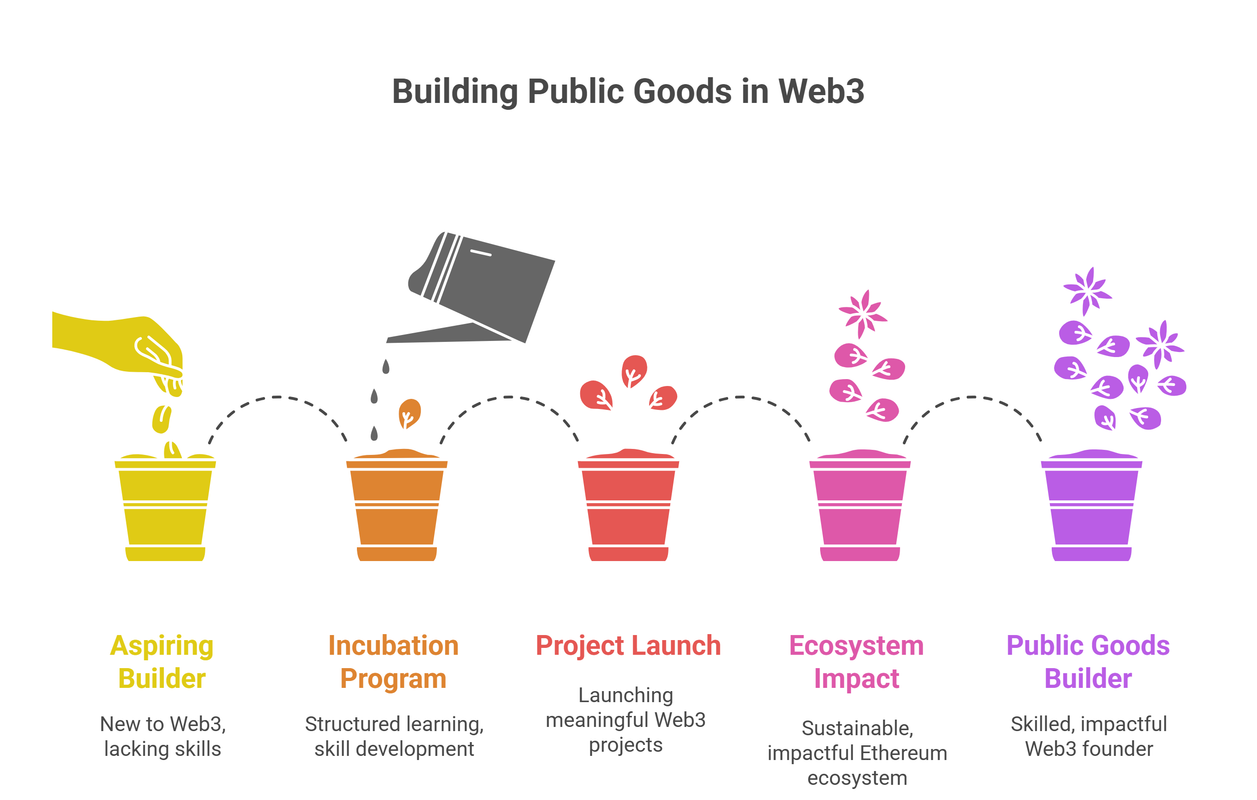
The objective of the B<>rder/ess Builders OP is to convert early-stage experimentation into long-term, compounding public goods value for the Lil Nouns ecosystem.
Specifically, the program aims to:
[](https://postimg.cc/4YLMJWBz)
1. Grow a pipeline of first-time builders and student founders producing open, usable public goods.
2. Reduce early-stage failure caused by a lack of product, business, and coordination skills.
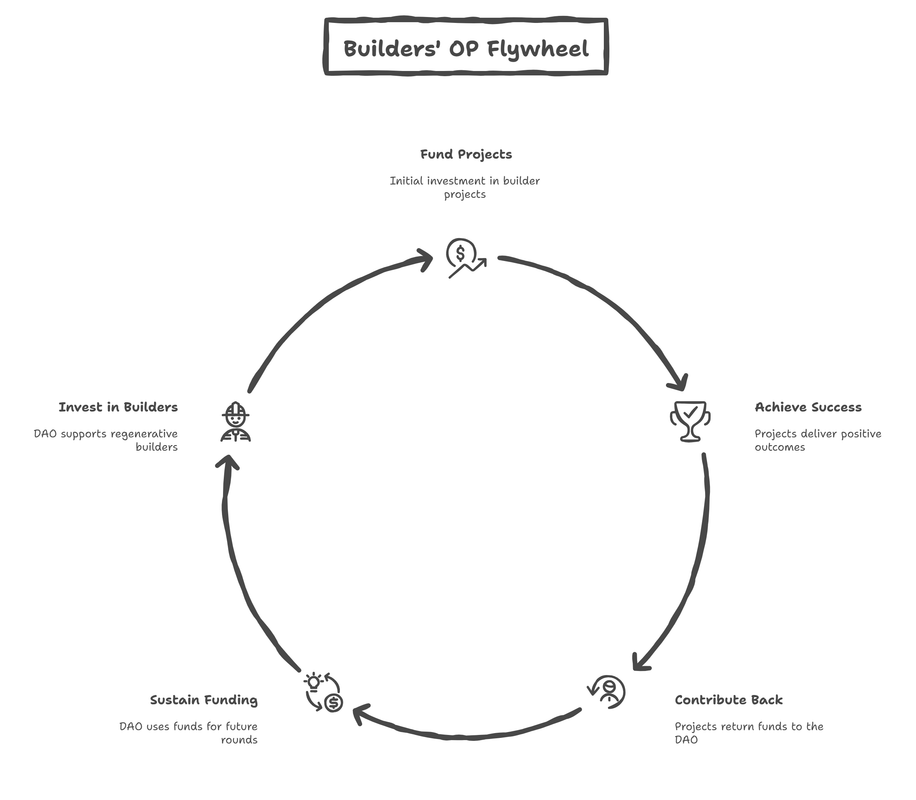
3. Create a feedback loop where successful projects replenish the Lil Nouns treasury through;
4. Revenue-sharing agreements.
5. Buybacks or deposits to the Lil Nouns treasury
6. Contributions following large grants, investments, or protocol partnerships.
**How This Serves Lil Nouns**
[](https://postimg.cc/R64NLjqv)
1. Extends Lil Nouns’ mission beyond grants into productive capital formation.
2. Converts funded experimentation into durable ecosystem assets.
3. Positions Lil Nouns as an early supporter of builders who later succeed, creating alignment and loyalty.
4. Diversifies treasury growth toward builder-generated value.
[](https://postimg.cc/Z0vJXdYs)
## Platforms & Rationale
**Primary Platforms**
1. Ethereum & Ethereum-aligned L2s (e.g. Base, Scroll, Celo)
2. Selected for Ethereum equivalence, low-cost experimentation, and strong developer tooling.
**Supporting Tooling**
1. Karma GAP — for milestone tracking, impact reporting, and grant accountability
2. Scaffold-ETH / Foundry / Remix — proven onboarding tools for early builders
3. AI-assisted dev platforms (v0, Bolt, etc.) — reduce build time and lower skill barriers
**Rationale** These platforms:
- Lower technical friction for first-time builders
- Are composable with the existing Ethereum public goods infrastructure
- Allow Lil Nouns-funded outputs (code, playbooks, reports) to remain non-rivalrous and reusable
**Diligence**
-- Prior hands-on deployments through Vibecoding Sprint
-- Multiple cohorts run across Ethereum-aligned ecosystems since 2022
-- Demonstrated builder retention, project completion, and user onboarding
**Example Scenario**
[](https://postimg.cc/VS6YsmSg)
If 10 early builders graduate from the Builders’ OP and just 3–4 of them turn into revenue-generating products or receive large ecosystem grants:
- And *hypothetically,* each contributes a small 2–5% return from revenues, raises, or grants.
- Collectively, this could generate recurring inflows to the DAO treasury, a model of Revenue-Generating Projects funding public goods.
## Risks
1. **Technical Risks**
Smart contract bugs or incomplete MVPs
**Mitigation:**
- Use of testnets, audited templates, and Scaffold-ETH
- Emphasis on MVPs and user testing rather than production-scale DeFi
**2. Market / Adoption Risks**
Projects may fail to reach users or sustain traction
**Mitigation:**
- Adoption targets (100–1,000 users) baked into the program
- Marketing sprints and user onboarding moments
- Early kill-or-pivot decisions via lean experimentation
**3. Execution Risks**
First-time builders lack experience
**Mitigation:**
- Structured support teams (technical, marketing, business)
- Reduced cohort size per cycle
- Proven delivery track record across multiple programs
**4. Treasury Risk**
Not all projects will succeed
**Mitigation:**
- Portfolio approach: many small experiments
- Returns expected from a minority of high-performing projects, not all
## Returns
Returns are asymmetric and long-term, driven by builder success.
**Expected Outcomes**
- Majority of projects: learning, open-source outputs, ecosystem value
- Minority of projects (10–30%): revenue-generating or grant-winning
**Return Mechanisms**
- Percentage of revenue from successful projects
- Percentage of large grants or investments received
- Buybacks or treasury deposits agreed upfront
**Assumptions**
Based on prior cohorts:
- 11 projects shipped in one sprint
- Multiple teams continue building post-program
- Even 1–2 successful projects per year can justify the program cost and create compounding upside.
## Monitoring & Access
**Operations**
- Program operated by the B<>rder/ess core team
- Support teams embedded per cohort
**Tracking & Reporting**
- Builder milestones tracked via Karma GAP
- Metrics include:
---- Projects shipped
---- Users onboarded
---- Retention after 6 months
---- Revenue or grant outcomes
---- Public reports published after each cohort
**Controls**
- Milestone-based disbursement of prizes
- Adoption-linked rewards
- Transparency via open reports and on-chain metrics where possible
- Lil Nouns retains visibility into:
---- Outputs
---- Outcomes
---- Treasury contributions tied to funded builders
## Exit Criteria
**For Individual Projects**
- Projects exit the program when they:
- Reach adoption targets
- Secure external funding or grants
- Transition into independent operations
**For Lil Nouns Capital**
- Positions are adjusted or concluded when:
---- A project fails to achieve traction after defined iterations
---- A project becomes self-sustaining and begins contributing back
---- Agreements are fulfilled (revenue share, buyback, treasury deposit)
**Reporting**
- Exit outcomes documented in cohort reports
- Successes and failures shared transparently to inform future DAO decisions
**FEEDBACK LOOP**
[](https://postimg.cc/jnsqVsxS)
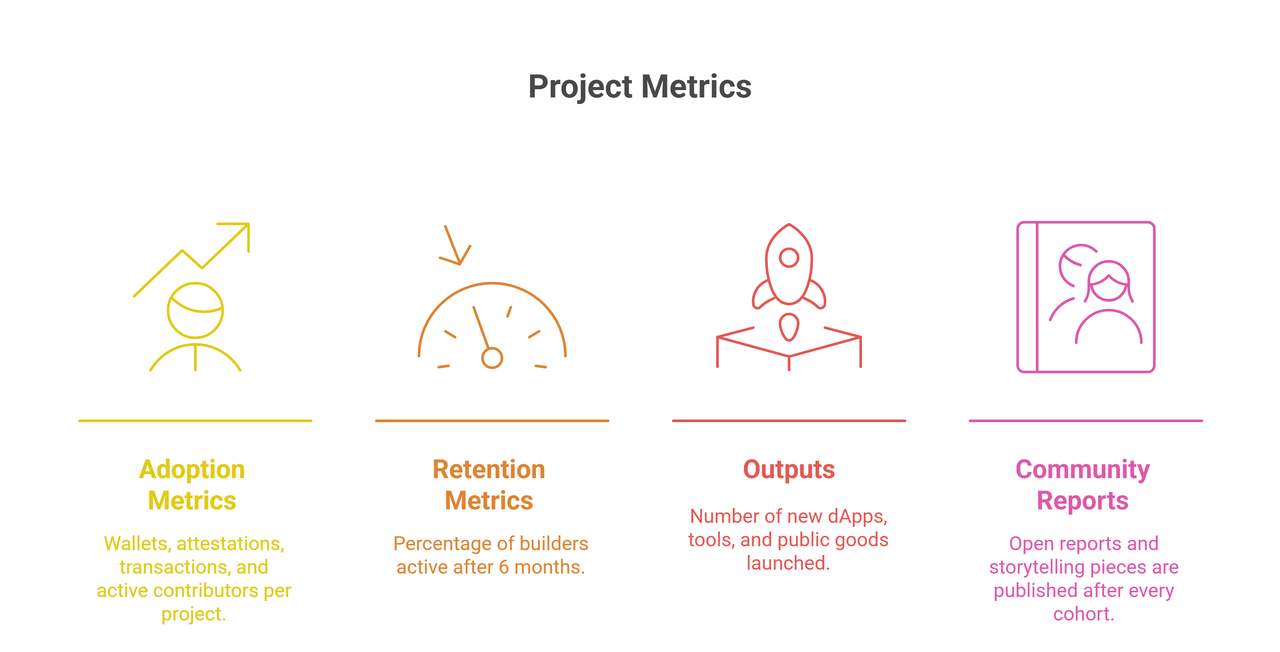
*Adoption Metrics:* Wallets, attestations, transactions, and active contributors per project. *Retention Metrics:* % of builders active after 6 months. *Outputs:* Number of new dApps, tools, and public goods launched. *Community Reports:* Open reports and storytelling pieces are published after every cohort for transparency and replication.
**BUDGET AND ALLOCATION STRUCTURE**
[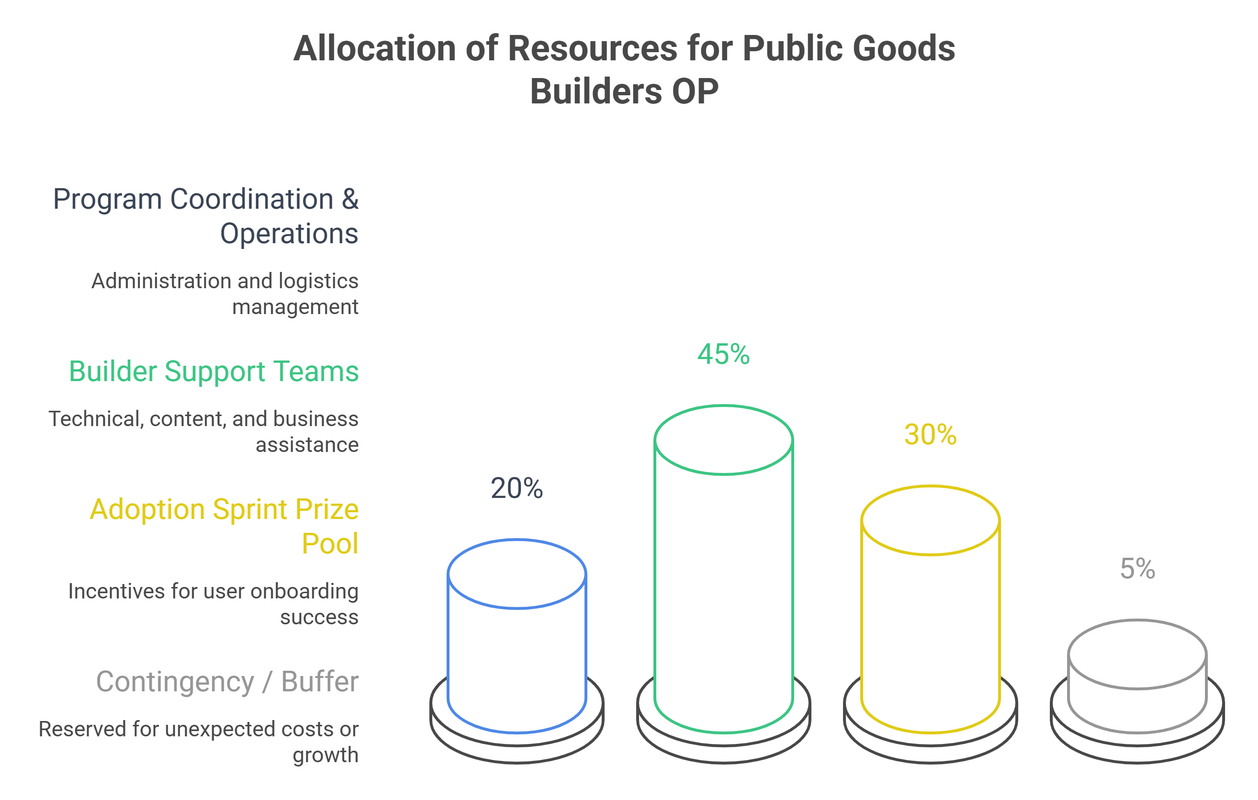](https://postimg.cc/14FrXv5G)
**Program Coordination & Operations – 20%** This encompasses administration, program management, mentor coordination, and logistics for bimonthly cohorts, ensuring the smooth operation of the program and maintaining reporting accountability.
**Builder Support Teams – 45%** *Technical Support (15%):* Product design, smart contracts, front-end dev, and data analytics. *Content & Marketing (15%):* Branding, storytelling, community building, and growth campaigns. *Business Development (15%):* Product-market fit guidance, partnerships, fundraising strategies, community nd team building, monitoring and evaluation.
**Adoption Sprint Prize Pool – 30%**
- Incentives for builders who successfully onboard 100–1,000 users.
- Structured as milestone-based disbursements tied to verifiable adoption metrics.
**Contingency / Buffer – 5%** Reserved for unexpected costs or scaling opportunities during the OP.
*Budget Summary:*
- Coordination & Ops – 20%
- Builder Support Teams – 45%
- Prize Pool – 30%
- Contingency – 5%
**EXTRA DETAILS - FULL PROPOSAL AND EXECUTION STRATEGY HERE**
[https://docs.google.com/document/d/1wzJeDws_fuuBzmfEY3gNqgsaB7KGBNRITcrQALwAvvk/edit?usp=sharing](https://docs.google.com/document/d/1wzJeDws_fuuBzmfEY3gNqgsaB7KGBNRITcrQALwAvvk/edit?usp=sharing)
Hello everyone, I'm KarlaGod ([https://x.com/_karlagod)](https://x.com/_karlagod), Lead Partner at B<>rder/ess ([https://x.com/borderlessdev)](https://x.com/borderlessdev), and we’re excited to share the Public Goods Builders OP, a structured incubation program designed to turn first-time builders into successful founders while creating sustainable value for public goods ecosystems like Lil Nouns and Public Nouns.
**Our core thesis is simple:** If we help early builders launch real products, the projects that succeed can contribute revenue back to the DAOs that funded their early development.
This creates a regenerative loop where DAOs aren’t only spending on experiments, but helping launch products that can replenish the treasury over time.
We recently had this program supported by Public Nouns with 3ETH, and we start our Pilot this January. We’re now exploring additional funding from Lil Nouns so the impact canscale, and we can continue in Q1 2026 with more founders, more public goods projects, more on-chain adoption, and a clear pathway for successful teams to return value back to public goods DAOs.
I’ve attached a link to our doc in the "Proposal Idea Notion" and also the doc itself, which goes into full detail on the program structure, expected impact, KPIs, and reporting flow, the sustainability model and overall impact and growth.
Would love for you to read through it and share feedback or questions. Your input will help us shape this into something that truly strengthens the Lil Nouns ecosystem and the wider public goods landscape.
Thanks for taking a look, excited to build this with LilNouns' support 😊
*Please feel free to comment on the doc, it's public for all, and all comments are welcome.*\*
Proposal Idea Notion: [https://al409.notion.site/B-RDER-ESS-LIL-NOUNS-A-PUBLIC-GOODS-BUILDERS-OP-69475e35a4b440b0924f2b19de1f5e18?source=copy_link](https://al409.notion.site/B-RDER-ESS-LIL-NOUNS-A-PUBLIC-GOODS-BUILDERS-OP-69475e35a4b440b0924f2b19de1f5e18?source=copy_link)lil-noun-<>-b<>rder/ess-builders'-op
# Lil Noun <> B<>rder/ess Builders' OP
## Objectives
The objective of the B<>rder/ess Builders OP is to convert early-stage experimentation into long-term, compounding public goods value for the Lil Nouns ecosystem.
Specifically, the program aims to:
1. Grow a pipeline of first-time builders and student founders producing open, usable public goods.
2. Reduce early-stage failure caused by a lack of product, business, and coordination skills.
3. Create a feedback loop where successful projects replenish the Lil Nouns treasury through;
4. Revenue-sharing agreements.
5. Buybacks or deposits to the Lil Nouns treasury
6. Contributions following large grants, investments, or protocol partnerships.
**How This Serves Lil Nouns**
1. Extends Lil Nouns’ mission beyond grants into productive capital formation.
2. Converts funded experimentation into durable ecosystem assets.
3. Positions Lil Nouns as an early supporter of builders who later succeed, creating alignment and loyalty.
4. Diversifies treasury growth toward builder-generated value.
## Platforms & Rationale
**Primary Platforms**
1. Ethereum & Ethereum-aligned L2s (e.g. Base, Scroll, Celo)
2. Selected for Ethereum equivalence, low-cost experimentation, and strong developer tooling.
**Supporting Tooling**
1. Karma GAP — for milestone tracking, impact reporting, and grant accountability
2. Scaffold-ETH / Foundry / Remix — proven onboarding tools for early builders
3. AI-assisted dev platforms (v0, Bolt, etc.) — reduce build time and lower skill barriers
**Rationale** These platforms:
- Lower technical friction for first-time builders
- Are composable with the existing Ethereum public goods infrastructure
- Allow Lil Nouns-funded outputs (code, playbooks, reports) to remain non-rivalrous and reusable
**Diligence**
-- Prior hands-on deployments through Vibecoding Sprint
-- Multiple cohorts run across Ethereum-aligned ecosystems since 2022
-- Demonstrated builder retention, project completion, and user onboarding
## Risks
1. **Technical Risks**
Smart contract bugs or incomplete MVPs
**Mitigation:**
- Use of testnets, audited templates, and Scaffold-ETH
- Emphasis on MVPs and user testing rather than production-scale DeFi
**2. Market / Adoption Risks**
Projects may fail to reach users or sustain traction
**Mitigation:**
- Adoption targets (100–1,000 users) baked into the program
- Marketing sprints and user onboarding moments
- Early kill-or-pivot decisions via lean experimentation
**3. Execution Risks**
First-time builders lack experience
**Mitigation:**
- Structured support teams (technical, marketing, business)
- Reduced cohort size per cycle
- Proven delivery track record across multiple programs
**4. Treasury Risk**
Not all projects will succeed
**Mitigation:**
- Portfolio approach: many small experiments
- Returns expected from a minority of high-performing projects, not all
## Returns
Returns are asymmetric and long-term, driven by builder success.
**Expected Outcomes**
- Majority of projects: learning, open-source outputs, ecosystem value
- Minority of projects (10–30%): revenue-generating or grant-winning
**Return Mechanisms**
- Percentage of revenue from successful projects
- Percentage of large grants or investments received
- Buybacks or treasury deposits agreed upfront
**Assumptions**
Based on prior cohorts:
- 11 projects shipped in one sprint
- Multiple teams continue building post-program
- Even 1–2 successful projects per year can justify the program cost and create compounding upside.
## Monitoring & Access
**Operations**
- Program operated by the B<>rder/ess core team
- Support teams embedded per cohort
**Tracking & Reporting**
- Builder milestones tracked via Karma GAP
- Metrics include:
---- Projects shipped
---- Users onboarded
---- Retention after 6 months
---- Revenue or grant outcomes
---- Public reports published after each cohort
**Controls**
- Milestone-based disbursement of prizes
- Adoption-linked rewards
- Transparency via open reports and on-chain metrics where possible
- Lil Nouns retains visibility into:
---- Outputs
---- Outcomes
---- Treasury contributions tied to funded builders
## Exit Criteria
**For Individual Projects**
- Projects exit the program when they:
- Reach adoption targets
- Secure external funding or grants
- Transition into independent operations
**For Lil Nouns Capital**
- Positions are adjusted or concluded when:
---- A project fails to achieve traction after defined iterations
---- A project becomes self-sustaining and begins contributing back
---- Agreements are fulfilled (revenue share, buyback, treasury deposit)
**Reporting**
- Exit outcomes documented in cohort reports
- Successes and failures shared transparently to inform future DAO decisions
**EXTRA DETAILS - FULL PROPOSAL AND EXECUTION STRATEGY HERE**
[https://docs.google.com/document/d/1wzJeDws_fuuBzmfEY3gNqgsaB7KGBNRITcrQALwAvvk/edit?usp=sharing](https://docs.google.com/document/d/1wzJeDws_fuuBzmfEY3gNqgsaB7KGBNRITcrQALwAvvk/edit?usp=sharing)
Hello everyone, I'm KarlaGod ([https://x.com/_karlagod)](https://x.com/_karlagod), Lead Partner at B<>rder/ess ([https://x.com/borderlessdev)](https://x.com/borderlessdev), and we’re excited to share the Public Goods Builders OP, a structured incubation program designed to turn first-time builders into successful founders while creating sustainable value for public goods ecosystems like Lil Nouns and Public Nouns.
**Our core thesis is simple:** If we help early builders launch real products, the projects that succeed can contribute revenue back to the DAOs that funded their early development.
This creates a regenerative loop where DAOs aren’t only spending on experiments, but helping launch products that can replenish the treasury over time.
We recently had this program supported by Public Nouns with 3ETH, and we start our Pilot this January. We’re now exploring additional funding from Lil Nouns so the impact canscale, and we can continue in Q1 2026 with more founders, more public goods projects, more on-chain adoption, and a clear pathway for successful teams to return value back to public goods DAOs.
I’ve attached a link to our doc in the "Proposal Idea Notion" and also the doc itself, which goes into full detail on the program structure, expected impact, KPIs, and reporting flow, the sustainability model and overall impact and growth.
Would love for you to read through it and share feedback or questions. Your input will help us shape this into something that truly strengthens the Lil Nouns ecosystem and the wider public goods landscape.
Thanks for taking a look, excited to build this with LilNouns' support 😊
*Please feel free to comment on the doc, it's public for all, and all comments are welcome.*\*
Proposal Idea Notion: [https://al409.notion.site/B-RDER-ESS-LIL-NOUNS-A-PUBLIC-GOODS-BUILDERS-OP-69475e35a4b440b0924f2b19de1f5e18?source=copy_link](https://al409.notion.site/B-RDER-ESS-LIL-NOUNS-A-PUBLIC-GOODS-BUILDERS-OP-69475e35a4b440b0924f2b19de1f5e18?source=copy_link)lil-noun-<>-b<>rder/ess-builders'-op
# Replenishing Public Nouns Treasury through the B<>rder/ess Builders' OP
[](https://postimg.cc/Pp6wC8vx)
**INTRODUCTION**
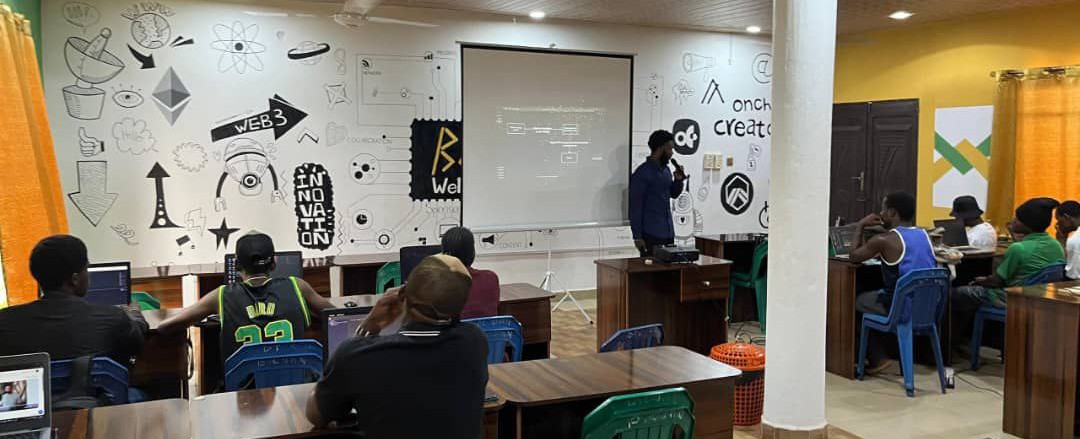
B<>rder/ess is a Public Good building the next generation of Web3 talent from today's universities. We raise the next generation of:
- Builders and Founders
- Developers
- Web3 Creatives and Story Tellers
- Web3 Contributors to Public Goods who build value, products, and communities to promote the sustainability of Ethereum in our local communities.
We build **web3 physical hubs**, **web3 campus tech clubs**, and **learning tools** that help students become Ethereum builders through builder development and real-world projects.
**Since 2022, we've:**
- Established Physical Web3 hubs at Nigerian universities for learning and innovation, one in the [University of Nigeria and another in Port-Harcourt, Rivers State](https://borderlessbuild.dev/clubs-and-hubs)
- Created [14+ campus tech clubs](https://borderlessbuild.dev/clubs-and-hubs) for peer developer growth.
- [Run 20+ Cipher Sessions and hackathons, onboarding](https://mirror.xyz/karlagod.eth/nVxg3z3Uk3N756UFdfydoyj21NCPBaZWpaHRuT9QTQI) 300+ developers into Web3 ecosystems like Lisk OPstack, Arbitrum, Base, Celo, and Filecoin.
- Reached 8,000+ students through educational programs.
- Raised funding for [50+ university projects with $33K during GG23](https://gov.gitcoin.co/t/web3-for-universities-community-round-full-round-report/20351) for web3 For Universities initiatives.
- Launched tools like ByteOnchain.xyz using attestations for Web3 education and credentials.
We treat builder growth as a public good, whether it’s a **Developer**, **Entrepreneur**, **Creator**, or **Contributor**: all our resources are freely accessible, forkable, and improvable, multiplying builder value across Ethereum.
**Relevant Links To Our Updated Impact Reports**
[2024](https://mirror.xyz/karlagod.eth/-CTCNFmRvWXFNJ_SRb3XudTPUc6rV1Cf1cwzY1PlH-k)
[1st Half of 2025](https://giveth.io/project/brderess-builders?tab=updates#:~:text=B%3C%3ERDER/ESS%20IMPACT%20REPORTS%20JANUARY%20%2D%20MAY%202025)
**PROJECT DESCRIPTION - THE PUBLIC GOODS BUILDERS OP**
[](https://postimg.cc/Z0vJXdYs)
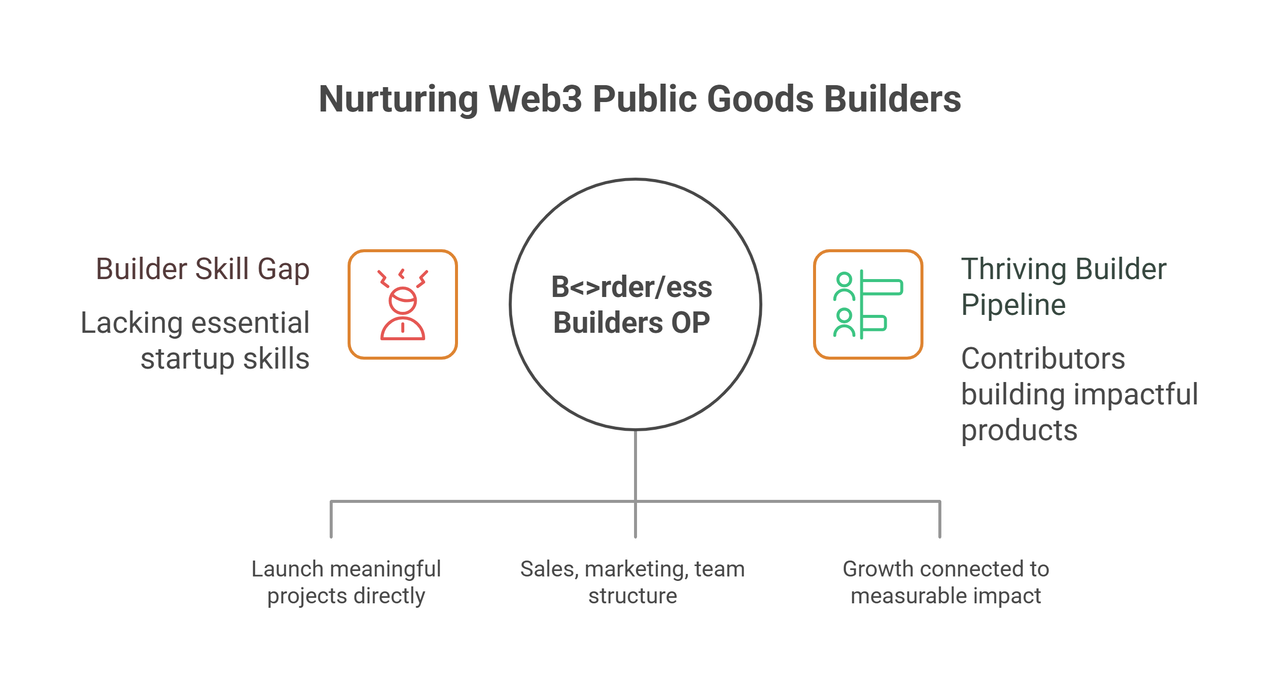
Most ecosystems offer incubation programs for startups, but there's no dedicated framework for Public Goods or first-time builders entering Ethereum.
Many early founders struggle not from weak ideas, but from lacking essential skills in sales, marketing, team structure, financial management, and other areas, including resilience.
For Ethereum to scale sustainably, the ecosystem must nurture its young builder pipeline, helping contributors move from learning to building, and from concepts to products with real adoption.
The Public Goods Builders OP addresses this need by providing a structured pathway for new founders to launch meaningful projects and directly connect their growth to measurable ecosystem impact.
**About the Public Goods Builders OP**
[](https://postimg.cc/4YLMJWBz)
The Public Goods Builders OP is a bi-monthly incubation program designed for first-time founders, student entrepreneurs, and indie developers who want to take their ideas on-chain and build value as entrepreneurs.
Since traditional incubators focus on seasoned founders, this program is the first incubation model for Public Goods, equipping new builders with the technical, marketing, and business support they need to succeed.
**Each cohort helps projects across four key areas:**
- *Public Goods:* Open, community-driven solutions that strengthen Ethereum.
- *Profit-Sustaining Products:* Ventures with sustainable business models.
- *Impact-Based Innovations:* Social, economic, or environmental solutions.
- *Regenerative Projects:* Initiatives that replenish and create lasting positive cycles.
Our goal is to help builders go from **Concept → MVP → Product-Market Fit → Go-To-Market with 100–1,000 active users per project**, and the program will leverage the resources that the Physical B<>rder/ess web3 Hubs provide.
**The Target Audience**
1. First-time builders: individuals launching their very first on-chain project.
2. Student builders: university and early-career talents experimenting with public goods and Web3 entrepreneurship.
3. Emerging developers: technical contributors transitioning from coding to full product-building for the first time.
**PUBLIC NOUNS TREASURY REPLENISHMENT STRATEGY**
[](https://postimg.cc/R64NLjqv)
The Builders’ OP not only funds early builders but also creates a regenerative cycle in which successful projects contribute back to the Public Nouns DAO, sustaining future funding rounds and experiments.
*It would have some housekeeping, like:*
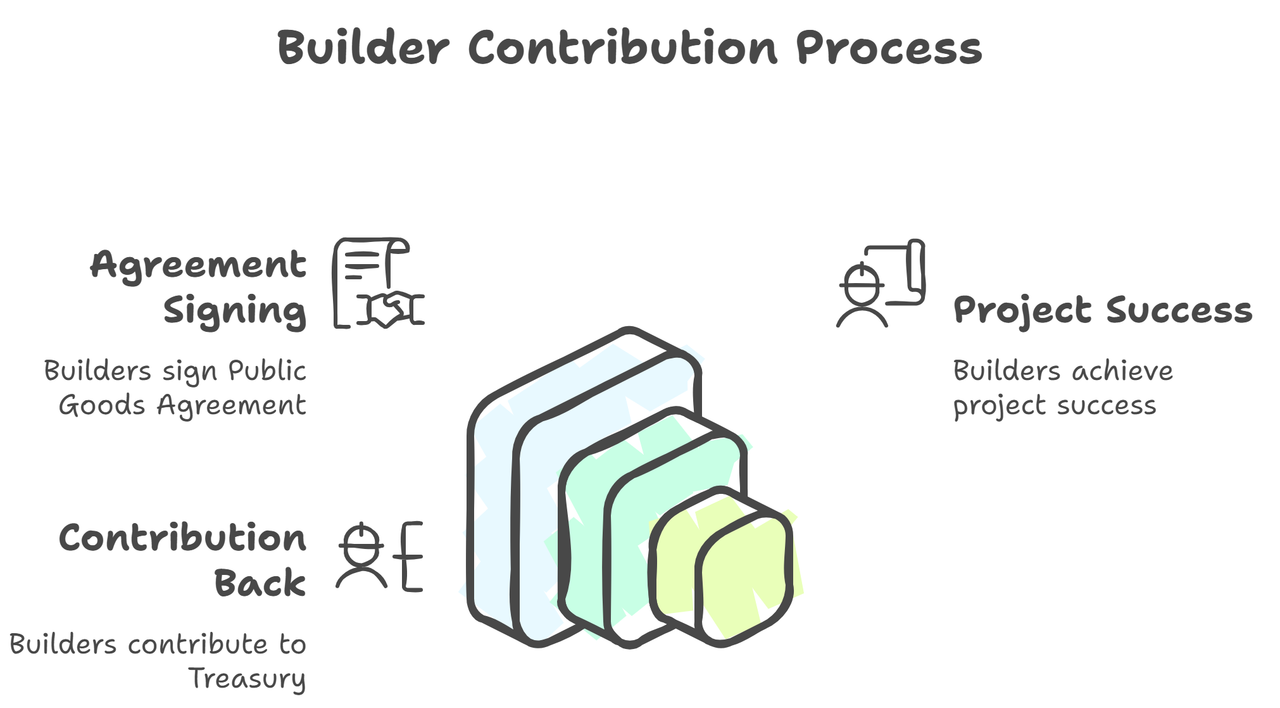
**Builder Agreements** - selected builders would commit to contribute a small percentage of their revenues, token allocations, or grant inflows back to the Public Nouns Treasury as they grow and succeed.
**Revenue Sharing** - as a builder’s project becomes profitable and secures external funding, builders will donate a small percentage of the revenue or capital raised to pNoun treasury. This creates a sustainable loop; the DAO becomes both a catalyst and a stakeholder in future success stories.
**Buyback & Treasury Growth** - Projects may choose to buy back pNouns NFTs or deposit directly into the DAO treasury as a sign of alignment and appreciation.
**Measured Transparency** - Using on-chain tracking and attestations, the Builders’ OP can transparently display returns from successful projects.
**Long-Term Impact** - Over multiple cohorts, Public Nouns would have developed a portfolio of graduated builders and a pipeline of sustainable contributors who amplify treasury value through revenue-generating projects and measurable financial inflows.
**Example Scenario**
[](https://postimg.cc/VS6YsmSg)
If 10 early builders graduate from the Builders’ OP and just 3–4 of them turn into revenue-generating products or receive large ecosystem grants:
- And *hypothetically,* each contributes a small 2–5% return from revenues, raises, or grants.
- Collectively, this could generate recurring inflows to the DAO treasury, a model of Revenue-Generating Projects funding public goods.
**THE PUBLIC GOOD’S BUILDERS' OP PROCESS**
[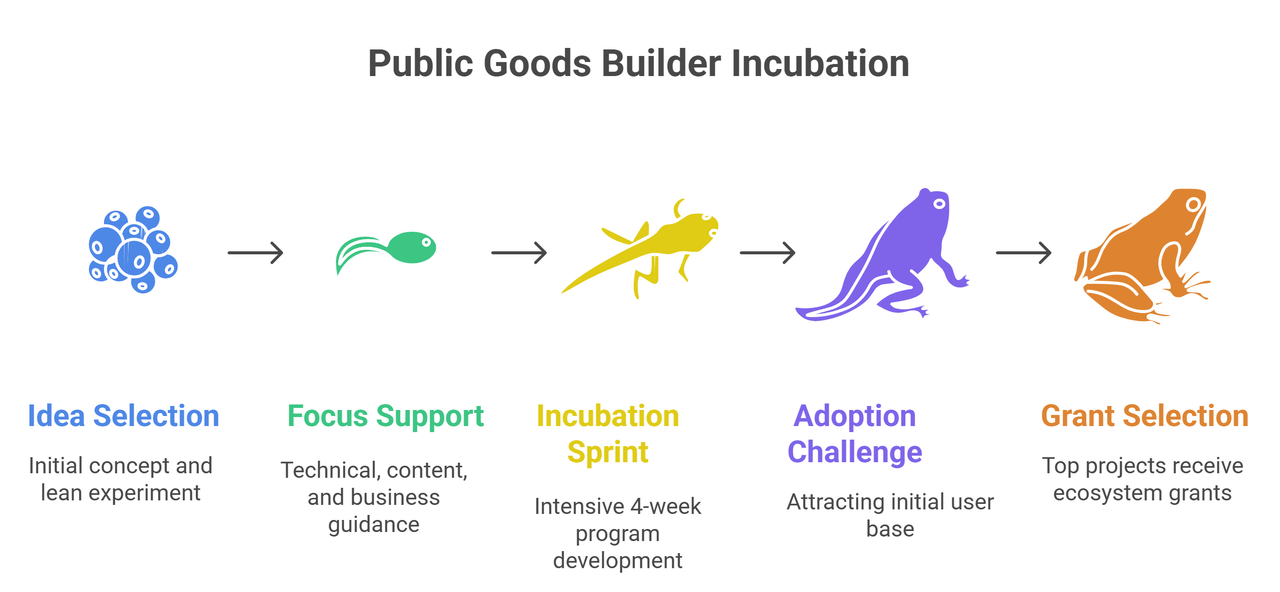](https://postimg.cc/4YkvpVnR)
**Stage 1: Support Team Formation**
We've created a dedicated support team focused on three critical areas of builder success for any product being developed in 2025:
*Technical Support –* Covering the full product lifecycle, including product design, smart contract development, front-end engineering, and data analytics.
*Content & Marketing –* Providing storytelling, branding, community engagement, and growth marketing to help projects reach and retain their audiences.
*Business Development –* Guiding founders on product-market fit, partnerships, fundraising strategies, and long-term sustainability.
**Stage 2: Builder onboarding and Idea Selection**
Entrepreneurs and developers apply with their public goods, impact-driven, profit-sustaining, or regenerative ideas. Selected builders are accepted into the program and taken through an idea validation process.
Using a lean experimentation approach, ideas are tested and validated through customer interviews, market research, and data-driven questioning. Final selections are made based on the evidence gathered, ensuring only the most viable and impactful ideas move forward.
This de-risks projects at the earliest stage, we not only save founders from pursuing unsustainable directions but also give funders confidence that resources are being channelled into solutions with the highest chance of real-world adoption and long-term impact.
***(2 weeks) The Lean Experiment Approach:*** At the idea stage, every builder is guided to test assumptions quickly and cheaply before building, following four key steps:
*Identify Assumptions -* Builders list the riskiest assumptions behind their idea, like this impact tool is needed, or users will pay for this function, or there’s nothing like this yet in web3
*Design Experiments -* For each assumption, builders design a small, fast experiment to validate the idea or ask questions.
*Collect Data -* Run the experiments with potential users through customer interviews, surveys, early demos, or pilot campaigns to gather evidence.
*Decide:* Pivot, Persevere, or Drop - If the data validates it, then build; if not, then pivot.
**Stage 3: Incubation Sprint**
The incubation sprint comprises a 3-week session where builders are taken through sessions on;
- Product
- Impact Design
- Web3 Business Structure and Leadership
- Marketing and Building in Public
- Finance management and structure for startups
- Grants writing & Co-ordination for sustainability
Key Focus for the sprint is;
1. Build, test, and deploy on-chain MVPs.
2. Design Co-ordination and operations for sustainability
3. Develop a go-to-market strategy.
4. Align on adoption targets.
**Stage 4: Marketing Sprint and Evaluation**
The marketing sprint is a 3-week adoption challenge designed to help Builders activate 100–1,000 real users during the sprint. Adoption is tracked through wallets, attestations, transactions, or active dApp usage, allowing projects to move beyond MVP and achieve real-world traction.
*After the Sprint;*
Founders present their projects to the community and evaluators. Success is measured by:
- Product readiness (on-chain deployment).
- Adoption metrics achieved.
- Sustainability and impact potential.
**Final Stage: Rewards & Continuity**
Prizes awarded to projects that meet or exceed adoption milestones, and high-performing teams are fast-tracked into:
*Partnership opportunities.*
- Hand-holding through applying to Public Goods Funding rounds (Gitcoin, Giveth, Octant, and other ecosystem grants).
- Handholding through builder programs like Buildathons, Ethereum Fellowship, Incubase, and more.
- Content / Marketing boost for 1 month.
**BUDGET AND ALLOCATION STRUCTURE**
[](https://postimg.cc/14FrXv5G)
**Program Coordination & Operations – 20%**
This encompasses administration, program management, mentor coordination, and logistics for bimonthly cohorts, ensuring the smooth operation of the program and maintaining reporting accountability.
**Builder Support Teams – 45%**
*Technical Support (15%):* Product design, smart contracts, front-end dev, and data analytics.
*Content & Marketing (15%):* Branding, storytelling, community building, and growth campaigns.
*Business Development (15%):* Product-market fit guidance, partnerships, fundraising strategies, community nd team building, monitoring and evaluation.
**Adoption Sprint Prize Pool – 30%**
- Incentives for builders who successfully onboard 100–1,000 users.
- Structured as milestone-based disbursements tied to verifiable adoption metrics.
**Contingency / Buffer – 5%**
Reserved for unexpected costs or scaling opportunities during the OP.
*Budget Summary:*
- Coordination & Ops – 20%
- Builder Support Teams – 45%
- Prize Pool – 30%
- Contingency – 5%
**EXPECTED OUTCOMES and IMPACT**
[](https://postimg.cc/G4TY2QRb)
**Outcomes and KPIs**
We have 3 main expected outcomes and the following KPI’s for the Public Goods Builders OP;
*1. Experimentation:* Increased Public Goods experimentation and sustainability.
*2. Builders:* Steady flow of first-time builders growing into productive founders
*3. Users:* Tangible user growth tied to funded projects (wallets, attestations, deployed dApps, contributors).
*Key Performance Indicators (KPIs)*
*Builder Pipeline:* No of founders/developers incubated per cohort.
*Retention:* % of builders still active after 6 months.
*Adoption:* Average No of users per project (target: 100–1,000+).
*Outputs:* No of new tools, dApps, products launched.
*Public Goods Impact:* No of projects aligning with non-rivalrous and open-source principles.
*Ecosystem Growth:* On-chain attestations, wallet activity, community contributors engaged.
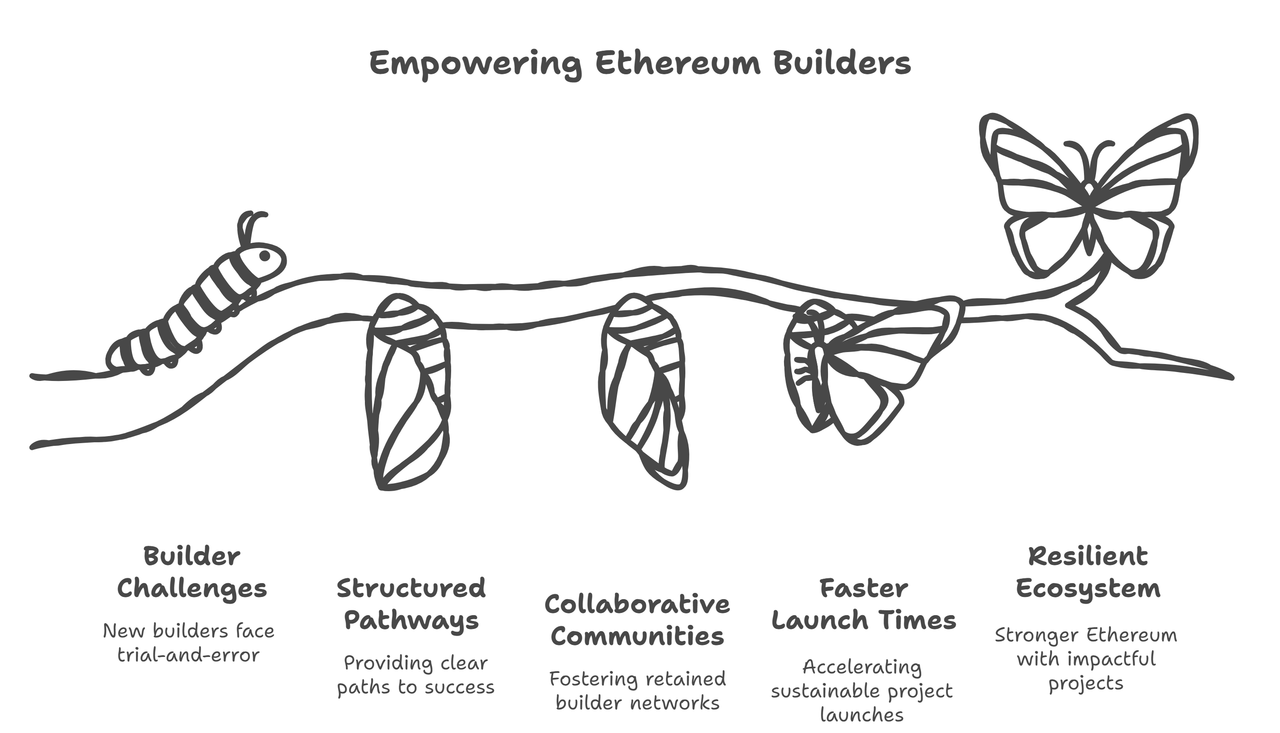
**Impact**
I. Greater resilience for the Ethereum ecosystem through retained, collaborative builder communities in 2025.
II. Reduced reliance on trial-and-error, equipping new builders with structured pathways to success.
III. Faster time-to-launch for sustainable and impactful projects.
**HOW DOES THIS INITIATIVE SUPPORT PUBLIC GOODS?**
[](https://postimg.cc/rdmSTkpt)
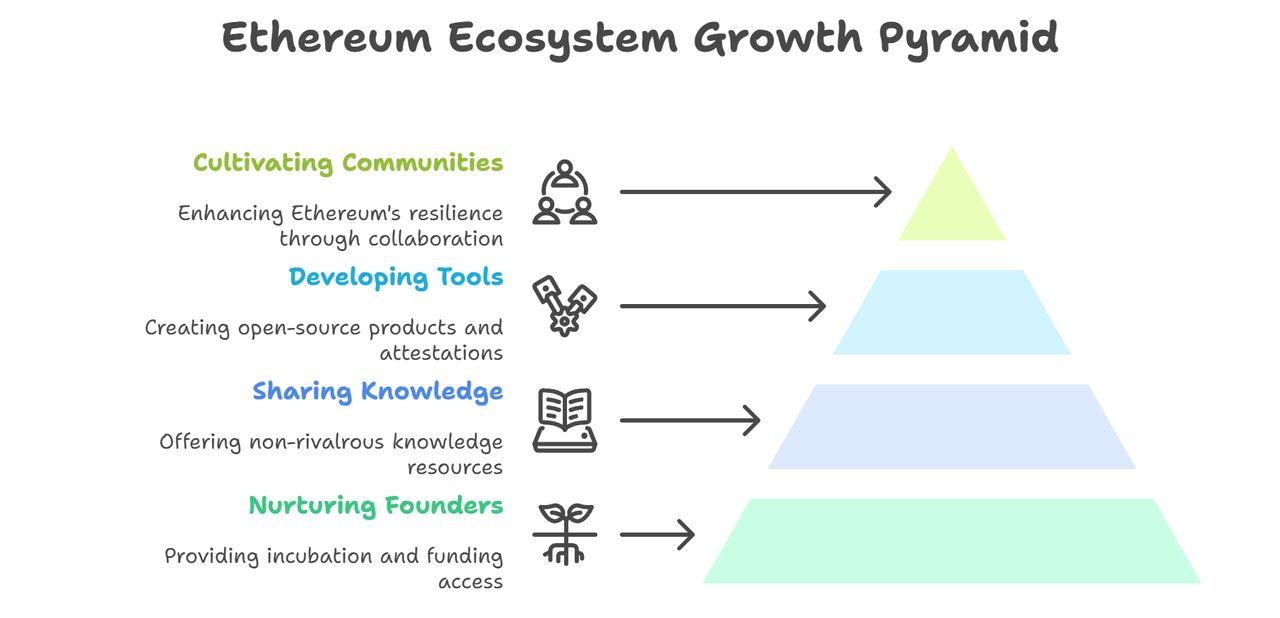
Public Goods Builders OP strengthens Ethereum's public goods ecosystem by:
Nurturing first-time founders who otherwise lack access to incubation and funding and reducing builder development growth from trial by error to “first-take”, “first-success”, failure is good, but time wasting is worse.
**If it takes two failures to learn, then it shouldn’t have to take ten failures.** What we’re trying to do is reduce the number of failures and mistakes to accelerate builder growth and build the sustainability of builders in the next generation for Ethereum.
1. Sharing non-rivalrous knowledge covering sales, coordination, resilience, and financial management that builders apply across multiple projects.
2. Developing open-source products, attestations, and tools that benefit the broader ecosystem.
3. Cultivating collaborative builder communities that enhance Ethereum's resilience.
This program ensures public goods aren't only funded but also actively incubated into practical, usable products.
WHY DOES IT NEED FUNDING RIGHT NOW?
Ethereum is at a stage in 2025 where:
- The builder pipeline is thin; most incubators focus on seasoned founders, leaving first-time builders underserved.
- Without structured guidance, many young founders waste resources through trial-and-error and ultimately abandon their projects.
- Public goods face a market gap: promising ideas fail during execution due to inadequate support systems.
[Read my Sense Making Report on Builder Development as Ethereum’s biggest problems](https://gov.gitcoin.co/t/gitcoin-sensemaking-report-builder-development-as-ethereum-s-most-meaningful-problem/21677)
Funding this now, ensures the next generation of builders enters the ecosystem with proper structure, mentorship, and adoption-driven goals, preventing this gap from widening further.
HOW IS IT NON-RIVALROUS?
The knowledge, resources, and support structures shared in the Public Goods Builders OP can be used by one builder without reducing access for another.
Every cohort creates learning materials, case studies, and open tools that remain freely available for future builders and ecosystems.
HOW IS IT NON-EXCLUDABLE?
Participation in the program and its outputs are not limited to one group knowledge, skills, and tools are shared openly with the Ethereum ecosystem.
Whether or not a builder was in the program, they can still access reports, tools, playbooks, and open-source code that come from it.
**5 REASONS TO VOTE YES FOR THIS PROPOSAL**
*1. First-time Builder Focus:* It’s the only incubation program targeting new founders and student builders.
*2. Replenishes the Public Nouns DAO in the long run:* Creates a direct connection between successful products in the Builders' Op and Eth Deposits or pNoun sales for the treasury.
*3. Proven Track Record:* B<>rder/ess has already built physical web3 hubs, launched byteonchain.xyz, trained 300+ devs, and raised/funded 50+ student projects in Gitcoin rounds.
*4. Adoption-driven Model:* Success is tied to 100–1,000 real users, ensuring measurable impact.
*5. Alignment with Public Nouns:* Supports experimentation, advocacy, and funding of public goods in practice.
**FEEDBACK LOOP**
[](https://postimg.cc/jnsqVsxS)
*Adoption Metrics:* Wallets, attestations, transactions, and active contributors per project.
*Retention Metrics:* % of builders active after 6 months.
*Outputs:* Number of new dApps, tools, and public goods launched.
*Community Reports:* Open reports and storytelling pieces are published after every cohort for transparency and replication.
**GRANT RATIONALE (PUBLIC NOUNS MANIFESTO ALIGNMENT)**
The mission of Public Nouns DAO is to support public goods through:
*Experimentation:* Public Goods Builders OP is an experiment in creating the first incubation program for public goods builders, not just startups.
*Advocacy:* We’re showcasing the stories of first-time founders, students, and impact-driven projects, raising awareness of why public goods matter and how new builders can contribute.
*Funding:* Direct support enables founders to test, build, and deploy public goods projects with measurable adoption goals, ensuring funding turns into results.
By funding this program, Public Nouns helps create a replicable model for public goods incubation, scaling Ethereum’s capacity to onboard, support, and retain its next generation of builders.
**Thank You**
**KarlaGod**
nouns-x-octant-collab@0xf84a...b5A8
I think this makes a lot of sense, both common and uncommon. I'm jumping in to the space to take the listen.
> Let's go! good to see you here!!
# B<>RDER/ESS <> PUBLIC NOUNS: A PUBLIC GOODS BUILDERS OP
[](https://postimg.cc/Pp6wC8vx)
**INTRODUCTION**
B<>rder/ess is a Public Good building the next generation of Web3 talent from today's universities. We raise the next generation of:
- Builders and Founders
- Smart Contract Developers
- On-chain analysts
- Cybersecurity experts
- Product Designers
- Web3 Creatives and Story Tellers
- Web3 Contributors
who build value, products, and communities to promote the sustainability of Ethereum in our local communities.
We build **web3 physical hubs**, **web3 campus tech clubs**, and **learning tools** that help students become Ethereum builders through builder development and real-world projects.
**Since 2022, we've:**
- Established Physical Web3 hubs at Nigerian universities for learning and innovation, one in the [University of Nigeria and another in Port-Harcourt, Rivers State](https://borderlessbuild.dev/clubs-and-hubs)
- Created [14+ campus tech clubs](https://borderlessbuild.dev/clubs-and-hubs) for peer developer growth.
- [Run 20+ Cipher Sessions and hackathons, onboarding](https://mirror.xyz/karlagod.eth/nVxg3z3Uk3N756UFdfydoyj21NCPBaZWpaHRuT9QTQI) 300+ developers into Web3 ecosystems like Lisk OPstack, Arbitrum, Base, Celo, and Filecoin.
- Reached 8,000+ students through educational programs.
- Raised funding for [50+ university projects with $33K during GG23](https://gov.gitcoin.co/t/web3-for-universities-community-round-full-round-report/20351) for web3 For Universities initiatives.
- Launched tools like ByteOnchain.xyz using attestations for Web3 education and credentials.
We treat builder growth as a public good, whether it’s a **Developer**, **Entrepreneur**, **Creator**, or **Contributor**: all our resources are freely accessible, forkable, and improvable, multiplying builder value across Ethereum.
**Relevant Links To Our Updated Impact Reports**
[2024](https://mirror.xyz/karlagod.eth/-CTCNFmRvWXFNJ_SRb3XudTPUc6rV1Cf1cwzY1PlH-k)
[1st Half of 2025](https://giveth.io/project/brderess-builders?tab=updates#:~:text=B%3C%3ERDER/ESS%20IMPACT%20REPORTS%20JANUARY%20%2D%20MAY%202025)
**PROJECT DESCRIPTION - THE PUBLIC GOODS BUILDERS OP**
[](https://postimg.cc/Z0vJXdYs)
Most ecosystems offer incubation programs for startups, but there's no dedicated framework for Public Goods or first-time builders entering Ethereum.
Many early founders struggle not from weak ideas, but from lacking essential skills in sales, marketing, team structure, financial management, and other areas, including resilience.
For Ethereum to scale sustainably, the ecosystem must nurture its young builder pipeline, helping contributors move from learning to building, and from concepts to products with real adoption.
The Public Goods Builders OP addresses this need by providing a structured pathway for new founders to launch meaningful projects and directly connect their growth to measurable ecosystem impact.
**About the Public Goods Builders OP**
[](https://postimg.cc/4YLMJWBz)
The Public Goods Builders OP is a bi-monthly incubation program designed for first-time founders, student entrepreneurs, and indie developers who want to take their ideas on-chain and build value as entrepreneurs.
Since traditional incubators focus on seasoned founders, this program is the first incubation model for Public Goods, equipping new builders with the technical, marketing, and business support they need to succeed.
**Each cohort helps projects across four key areas:**
- *Public Goods:* Open, community-driven solutions that strengthen Ethereum.
- *Profit-Sustaining Products:* Ventures with sustainable business models.
- *Impact-Based Innovations:* Social, economic, or environmental solutions.
- *Regenerative Projects:* Initiatives that replenish and create lasting positive cycles.
Our goal is to help builders go from **Concept → MVP → Product-Market Fit → Go-To-Market with 100–1,000 active users per project**, and the program will leverage the resources that the Physical B<>rder/ess web3 Hubs provide.
**The Target Audience**
1. First-time builders: individuals launching their very first on-chain project.
2. Student builders: university and early-career talents experimenting with public goods and Web3 entrepreneurship.
3. Emerging developers: technical contributors transitioning from coding to full product-building for the first time.
**THE PUBLIC GOOD’S BUILDERS' OP PROCESS**
[](https://postimg.cc/4YkvpVnR)
**Stage 1: Support Team Formation**
We've created a dedicated support team focused on three critical areas of builder success for any product being developed in 2025:
*Technical Support –* Covering the full product lifecycle, including product design, smart contract development, front-end engineering, and data analytics.
*Content & Marketing –* Providing storytelling, branding, community engagement, and growth marketing to help projects reach and retain their audiences.
*Business Development –* Guiding founders on product-market fit, partnerships, fundraising strategies, and long-term sustainability.
**Stage 2: Builder onboarding and Idea Selection**
Entrepreneurs and developers apply with their public goods, impact-driven, profit-sustaining, or regenerative ideas. Selected builders are accepted into the program and taken through an idea validation process.
Using a lean experimentation approach, ideas are tested and validated through customer interviews, market research, and data-driven questioning. Final selections are made based on the evidence gathered, ensuring only the most viable and impactful ideas move forward.
This de-risks projects at the earliest stage, we not only save founders from pursuing unsustainable directions but also give funders confidence that resources are being channelled into solutions with the highest chance of real-world adoption and long-term impact.
***(2 weeks) The Lean Experiment Approach:*** At the idea stage, every builder is guided to test assumptions quickly and cheaply before building, following four key steps:
*Identify Assumptions -* Builders list the riskiest assumptions behind their idea, like this impact tool is needed, or users will pay for this function, or there’s nothing like this yet in web3
*Design Experiments -* For each assumption, builders design a small, fast experiment to validate the idea or ask questions.
*Collect Data -* Run the experiments with potential users through customer interviews, surveys, early demos, or pilot campaigns to gather evidence.
*Decide:* Pivot, Persevere, or Drop - If the data validates it, then build; if not, then pivot.
**Stage 3: Incubation Sprint**
The incubation sprint comprises a 3-week session where builders are taken through sessions on;
- Product
- Impact Design
- Web3 Business Structure and Leadership
- Marketing and Building in Public
- Finance management and structure for startups
- Grants writing & Co-ordination for sustainability
Key Focus for the sprint is;
1. Build, test, and deploy on-chain MVPs.
2. Design Co-ordination and operations for sustainability
3. Develop a go-to-market strategy.
4. Align on adoption targets.
**Stage 4: Marketing Sprint and Evaluation**
The marketing sprint is a 3-week adoption challenge designed to help Builders activate 100–1,000 real users during the sprint. Adoption is tracked through wallets, attestations, transactions, or active dApp usage, allowing projects to move beyond MVP and achieve real-world traction.
*After the Sprint;*
Founders present their projects to the community and evaluators. Success is measured by:
- Product readiness (on-chain deployment).
- Adoption metrics achieved.
- Sustainability and impact potential.
**Final Stage: Rewards & Continuity**
Prizes awarded to projects that meet or exceed adoption milestones, and high-performing teams are fast-tracked into:
*Partnership opportunities.*
- Hand-holding through applying to Public Goods Funding rounds (Gitcoin, Giveth, Octant, and other ecosystem grants).
- Handholding through builder programs like Buildathons, Ethereum Fellowship, Incubase, and more.
- Content / Marketing boost for 1 month.
**BUDGET AND ALLOCATION STRUCTURE**
[](https://postimg.cc/14FrXv5G)
**Program Coordination & Operations – 20%**
This encompasses administration, program management, mentor coordination, and logistics for bimonthly cohorts, ensuring the smooth operation of the program and maintaining reporting accountability.
**Builder Support Teams – 45%**
*Technical Support (15%):* Product design, smart contracts, front-end dev, and data analytics.
*Content & Marketing (15%):* Branding, storytelling, community building, and growth campaigns.
*Business Development (15%):* Product-market fit guidance, partnerships, fundraising strategies, community nd team building, monitoring and evaluation.
**Adoption Sprint Prize Pool – 30%**
- Incentives for builders who successfully onboard 100–1,000 users.
- Structured as milestone-based disbursements tied to verifiable adoption metrics.
**Contingency / Buffer – 5%**
Reserved for unexpected costs or scaling opportunities during the OP.
*Budget Summary:*
- Coordination & Ops – 20%
- Builder Support Teams – 45%
- Prize Pool – 30%
- Contingency – 5%
**EXPECTED OUTCOMES and IMPACT**
[](https://postimg.cc/G4TY2QRb)
**Outcomes and KPIs**
We have 3 main expected outcomes and the following KPI’s for the Public Goods Builders OP;
*1. Experimentation:* Increased Public Goods experimentation and sustainability.
*2. Builders:* Steady flow of first-time builders growing into productive founders
*3. Users:* Tangible user growth tied to funded projects (wallets, attestations, deployed dApps, contributors).
*Key Performance Indicators (KPIs)*
*Builder Pipeline:* No of founders/developers incubated per cohort.
*Retention:* % of builders still active after 6 months.
*Adoption:* Average No of users per project (target: 100–1,000+).
*Outputs:* No of new tools, dApps, products launched.
*Public Goods Impact:* No of projects aligning with non-rivalrous and open-source principles.
*Ecosystem Growth:* On-chain attestations, wallet activity, community contributors engaged.
**Impact**
I. Greater resilience for the Ethereum ecosystem through retained, collaborative builder communities in 2025.
II. Reduced reliance on trial-and-error, equipping new builders with structured pathways to success.
III. Faster time-to-launch for sustainable and impactful projects.
**HOW DOES THIS INITIATIVE SUPPORT PUBLIC GOODS?**
[](https://postimg.cc/rdmSTkpt)
Public Goods Builders OP strengthens Ethereum's public goods ecosystem by:
Nurturing first-time founders who otherwise lack access to incubation and funding and reducing builder development growth from trial by error to “first-take”, “first-success”, failure is good, but time wasting is worse.
**If it takes two failures to learn, then it shouldn’t have to take ten failures.** What we’re trying to do is reduce the number of failures and mistakes to accelerate builder growth and build the sustainability of builders in the next generation for Ethereum.
1. Sharing non-rivalrous knowledge covering sales, coordination, resilience, and financial management that builders apply across multiple projects.
2. Developing open-source products, attestations, and tools that benefit the broader ecosystem.
3. Cultivating collaborative builder communities that enhance Ethereum's resilience.
This program ensures public goods aren't only funded but also actively incubated into practical, usable products.
WHY DOES IT NEED FUNDING RIGHT NOW?
Ethereum is at a stage in 2025 where:
- The builder pipeline is thin; most incubators focus on seasoned founders, leaving first-time builders underserved.
- Without structured guidance, many young founders waste resources through trial-and-error and ultimately abandon their projects.
- Public goods face a market gap: promising ideas fail during execution due to inadequate support systems.
[Read my Sense Making Report on Builder Development as Ethereum’s biggest problems](https://gov.gitcoin.co/t/gitcoin-sensemaking-report-builder-development-as-ethereum-s-most-meaningful-problem/21677)
Funding this now, ensures the next generation of builders enters the ecosystem with proper structure, mentorship, and adoption-driven goals, preventing this gap from widening further.
HOW IS IT NON-RIVALROUS?
The knowledge, resources, and support structures shared in the Public Goods Builders OP can be used by one builder without reducing access for another.
Every cohort creates learning materials, case studies, and open tools that remain freely available for future builders and ecosystems.
HOW IS IT NON-EXCLUDABLE?
Participation in the program and its outputs are not limited to one group knowledge, skills, and tools are shared openly with the Ethereum ecosystem.
Whether or not a builder was in the program, they can still access reports, tools, playbooks, and open-source code that come from it.
**5 REASONS TO VOTE YES FOR THIS PROPOSAL**
*1. First-time Builder Focus:* It’s the only incubation program targeting new founders and student builders.
*2. Public Goods Pipeline:* Directly incubates Ethereum-aligned public goods projects.
*3. Proven Track Record:* B<>rder/ess has already built physical web3 hubs, launched byteonchain.xyz, trained 300+ devs, and raised/funded 50+ student projects in Gitcoin rounds.
*4. Adoption-driven Model:* Success is tied to 100–1,000 real users, ensuring measurable impact.
*5. Alignment with Public Nouns:* Supports experimentation, advocacy, and funding of public goods in practice.
**FEEDBACK LOOP**
[](https://postimg.cc/jnsqVsxS)
*Adoption Metrics:* Wallets, attestations, transactions, and active contributors per project.
*Retention Metrics:* % of builders active after 6 months.
*Outputs:* Number of new dApps, tools, and public goods launched.
*Community Reports:* Open reports and storytelling pieces are published after every cohort for transparency and replication.
**GRANT RATIONALE (PUBLIC NOUNS MANIFESTO ALIGNMENT)**
The mission of Public Nouns DAO is to support public goods through:
*Experimentation:* Public Goods Builders OP is an experiment in creating the first incubation program for public goods builders, not just startups.
*Advocacy:* We’re showcasing the stories of first-time founders, students, and impact-driven projects, raising awareness of why public goods matter and how new builders can contribute.
*Funding:* Direct support enables founders to test, build, and deploy public goods projects with measurable adoption goals, ensuring funding turns into results.
By funding this program, Public Nouns helps create a replicable model for public goods incubation, scaling Ethereum’s capacity to onboard, support, and retain its next generation of builders.
**FUNDING REQUEST**
3 Eth
**WALLET ADDRESS**
0x9DCbA70B2dfe5807e2A847E065EBb666791F8b8A
karlagod.eth
# Public Nouns <> Byte Onchain Public Goods Event & Concert
INTRODUCTION
What is B<>rder/ess?
B<>rder/ess is a public good that raises the next generation of web3 builders from today's universities.
The B<>rder/ess Goal
Our goal is to raise the next generation of onchain;
a. Protocol builders
b. Smart Contract Developers
c. On-chain analysts
d. Cyber Security experts
e. Product Designers, and UX creatives
who'd build Web3 products that can foster adoption.
The B<>rder/ess PoW
We achieve our goal through our (Proof of Work) PoWs;
- Building physical web3 hubs on Campuses
- Organising quarterly Cipher Sessions
- Hosting web3 events
- Providing Crypto Education and Finance training in our communities
- Offering mentorship in different digital skill-set
- Establishing Campus Tech Clubs and
- Launching web3 projects.
PROPOSAL GOAL
B<>rder/ess is proposing to have a Public Goods concert during the Byte Onchain Conference to onboard 200 Creators & Artists into the web3 and Public Goods space.
BYTE ONCHAIN PUBLIC GOODS CONCERT DELIVERABLES
The Byte Onchain Concert is a Public Goods Concert with the aim to Onboard Creatives and individuals to web3 and “Edutain” them about Public Goods in web3.
CONCERT ONBOARDING ACTIVITIES
1. Onboard 200 Artists, Fans & Creators: Through interactive and engaging activities, we aim to bring 200 artists and creators onchain, introducing them to the Ecosystem and help them understand its potential for supporting public goods.
2. Live NFT Creation: Artists can create and mint their first NFTs during the event.
3. Public Goods Showcase: Highlighting existing web3 projects that support public goods, with opportunities for attendees to interact and contribute.
4. Incentivized Onchain Tasks: Artists and creators can complete simple onchain tasks, such as creating a wallet or interacting with a dApp, to earn rewards and gain attestations.
5. Create a small QF round to pick songs to be performed and artist to perform.
Provide Attestation booths, banners with qr codes at Byte Onchain to help newbies get started with wallet use and simple attestation tasks.
6. Perform web3-themed music.
VALUE FOR PUBLIC NOUNS
1. 2 Nouns Dao Themed Workshops during the Byte Onchain conference
2. A workshop on https://docs.publicnouns.wtf/ and Public Nouns Dao Governance process highlighting opportunities for community and builders and highlighting projects building in the Nouns ecosystem.
3. A workshop for developers and builders on using Public Nouns SDK
4. 1 Public Nouns Booth Space
We’d drive traffic to Public Nouns booth space to get builders and participants to join the Public Nouns community.
The booth space will also drive traffic online as we’d get visitors to take a picture, tag Publicnouns on Farcaster and X.
5. 1 Public Nouns Dao Themed Panel Session on Public Goods
During this session, we’d drive the conversation around what public goods are and how Public Nouns Dao has funded various public goods projects.
6. We’d advise on how new projects can be active in the Public Nouns Dao community.
7. 1 Public Nouns Song and 1 video shoot
We’ll shoot a video for it, and also perform it during the Public Goods concert.
CONTENT AND MEDIA ACTIVITIES
- 2 Podcast features on Public Nouns in our Byte Onchain Podcast.
- Brand placement, before, during and after Byte Onchain event.
- Open verse challenge and Content Contest with the Public Nouns Song for Twitter, and Tiktok activities, where winners are picked via votes on nouns.wtf
VERIFICATION OF ACTIVITIES
We'll verify that these activities took place through;
- Videos - The entire event will be streamed on our YouTube
- On-chain attestations at the Nouns Booth from participants
- Twitter follows on the Public Nouns account and discord invites.
FUNDING REQUEST
2.5 ETH
WALLET ADDRESS
ENS: karlagod.eth
Address: 0x9DCbA70B2dfe5807e2A847E065EBb666791F8b8A
KarlaGod
B<>rder/ess Developer’s Programme